July 9, 2026
European rare earth supply chains face unprecedented vulnerability as Chinese entities control over 95% of heavy rare earth processing capacity. The Leading Edge Materials Norra Kärr project emerges as one of Sweden's most strategically positioned assets during this critical period. Furthermore, recent Chinese export restrictions have exposed systematic weaknesses in European industrial supply networks, creating price spikes exceeding 300% during disruption periods.
Against this backdrop of supply vulnerability, the European Union faces an accelerating crisis in heavy rare earth access. Critical minerals energy security concerns have intensified as European policymakers confront the gap between strategic recognition and operational reality. However, Swedish mining jurisdiction provides regulatory clarity that positions domestic projects favorably within emerging policy frameworks.
What Makes Norra Kärr Europe's Most Strategic Heavy Rare Earth Asset?
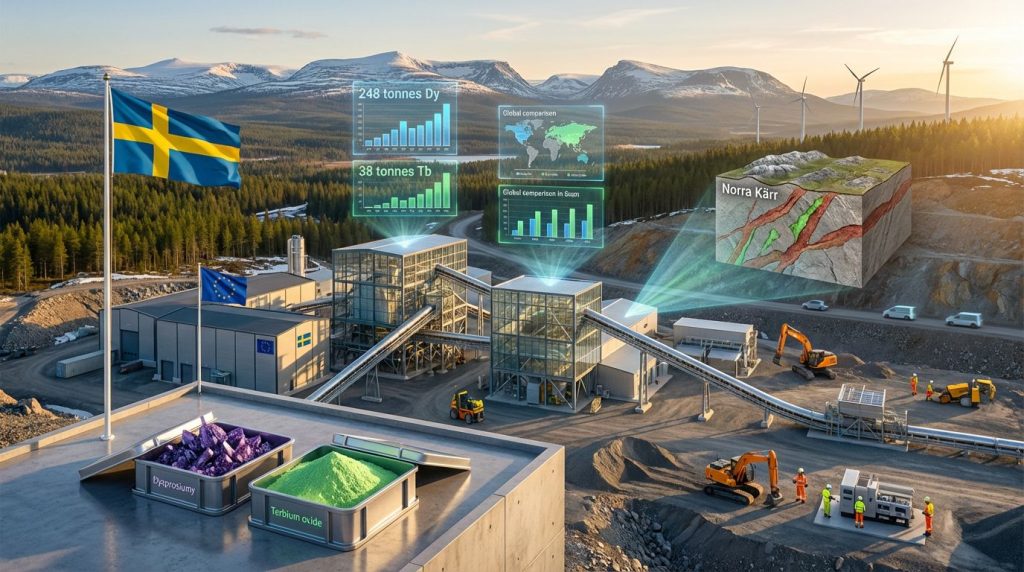
The Leading Edge Materials Norra Kärr project in Sweden represents one of Europe's few advanced-stage heavy rare earth developments capable of meaningful supply contribution. Located approximately 300 kilometres southwest of Stockholm, the deposit contains substantial reserves of dysprosium and terbium within eudialyte minerals. Consequently, this positions the project as a potential cornerstone of European supply security strategy.
Quantifying Production Scale Against Global Benchmarks
The production profile of the Leading Edge Materials Norra Kärr project demonstrates scale comparable to established global operations. Technical assessments indicate annual dysprosium production capacity of 248 tonnes and terbium oxide output of 38 tonnes. For instance, these figures position the Swedish asset at strategically significant levels within global heavy rare earth supply.
Global Heavy REE Operations Comparison:
| Project | Dysprosium (tonnes/year) | Terbium Oxide (tonnes/year) | Development Stage |
|---|---|---|---|
| Norra Kärr | 248 | 38 | Prefeasibility |
| Lynas Malaysian Expansion | 250 | 50 | Production |
| Mountain Pass (MP Materials) | ~180 | ~25 | Production |
| Mount Weld (Lynas) | ~220 | ~35 | Production |
This scale comparison reveals Norra Kärr's position within the top tier of global heavy rare earth projects. The Swedish asset's production profile approaches levels achieved by Lynas Rare Earths' recent Malaysian expansion, demonstrating the strategic significance of European domestic capacity development.
The project benefits from 16 years of accumulated technical data spanning multiple feasibility cycles. Furthermore, this historical database encompasses geological understanding, mineral processing test work, and market assessment studies conducted since 2009. This extensive foundation provides substantial knowledge that reduces technical risk compared to greenfield exploration projects.
Resource Classification and Technical Maturity Assessment
Leading Edge Materials possesses 28,000 metres of drill core available for optimisation studies. In addition, this represents one of the most comprehensive technical databases for European rare earth projects. This extensive drilling programme provides detailed geological understanding across the deposit, enabling refined mineral processing approaches and resource classification upgrades.
The company is advancing resource classification from inferred to measured and indicated categories. However, this represents a critical milestone for project financing and strategic partnership development. Previous technical work achieved probable reserve classification specifically for rare earth components, though comprehensive resource upgrades require completion of current optimisation programmes.
Technical Maturity Advantages:
• Extensive drilling database: 28,000 metres of core providing detailed geological characterisation
• Historical feasibility studies: Multiple study iterations since 2009 establishing processing pathways
• Mineral processing optimisation: Current test work focused on eudialyte concentrate production
• Dual revenue streams: REE concentrate plus nepheline syenite industrial mineral by-products
• Resource upgrade pathway: Transition from inferred to indicated/measured classifications
The eudialyte mineral extraction process represents the primary technical focus. Furthermore, optimisation programmes target high-grade concentrate production suitable for third-party processing arrangements. This approach allows project development without requiring integrated downstream infrastructure, reducing capital intensity whilst maintaining strategic value.
When big ASX news breaks, our subscribers know first
How Does European Supply Security Drive Investment Rationale?
European industrial policy increasingly recognises heavy rare earth supply vulnerability as both an economic and national security imperative. The concentration of global processing capacity within Chinese entities creates systematic risk that traditional market mechanisms cannot adequately address. Consequently, this necessitates strategic intervention comparable to defence or energy infrastructure investments.
Quantifying Market Vulnerability Metrics
Chinese export restrictions implemented during 2024-2025 demonstrated the acute vulnerability of European supply chains. Industry analysis indicates dysprosium price volatility ranging between 300-400% during supply disruption periods. For instance, European permanent magnet manufacturers experienced production constraints and strategic inventory depletion during these periods.
"European defence manufacturers require reliable heavy rare earth access for equipment production, yet source 95% of materials from jurisdictions whose geopolitical alignment cannot be assumed indefinitely."
European Supply Dependency Analysis:
• Permanent magnet manufacturing: 95% dependent on Chinese dysprosium and terbium sources
• Defence sector exposure: Critical applications including missile guidance systems and radar components
• Wind turbine production: High-temperature magnet requirements necessitate heavy rare earth additives
• Electric vehicle motors: Coercivity enhancement through dysprosium additions for operational efficiency
The technical relationship between dysprosium availability and permanent magnet performance creates inflexible demand characteristics. Dysprosium additions to neodymium-iron-boron magnets increase coercivity and high-temperature performance. These represent critical specifications for electric vehicle motors and wind turbine generators that cannot be readily substituted through alternative materials.
Industry leaders have publicly characterised the situation as reaching crisis levels. Comprehensive rare earth reserves analysis reveals that supply disruptions create cascading effects throughout European manufacturing networks. However, Vacuumschmelze, a major European permanent magnet manufacturer, has emphasised the urgency of supply diversification through policy forums.
Policy Framework Evolution and Support Mechanisms
European policymakers are developing intervention mechanisms modelled on successful precedents established in other jurisdictions. The United States Department of Defense partnership with MP Materials provides a framework combining price floor arrangements. Furthermore, this includes capital contributions and strategic offtake agreements that European institutions are evaluating for applicability.
The government intervention precedent demonstrates institutional mechanisms available for strategic project support. However, implementation remains in development phases as independent expert assessments evaluate projects against strategic criteria including scale, technical maturity, and jurisdictional risk profiles.
Critical Raw Materials Act Strategic Project Pathways:
• Strategic project designation: EU framework providing preferential access to financing facilities
• Price support mechanism development: Floor prices and contract-for-difference models under discussion
• Regulatory pathway acceleration: Streamlined permitting for projects meeting strategic criteria
• Public-private partnership frameworks: Government capital participation reducing project risk
Sweden's government has articulated positioning as a European mining leader, creating favourable policy conditions for critical mineral developments. This political commitment translates recognition of supply vulnerability into concrete support for domestic projects. In particular, this benefits projects approaching production readiness during crisis periods.
What Are the Key Technical and Economic Development Milestones?
The Leading Edge Materials Norra Kärr project advancement centres on completing prefeasibility study work and securing mining lease approval. These represent two critical milestones expected to catalyse strategic partnership development and government support programme access.
2026 Prefeasibility Study Completion Timeline
Leading Edge Materials is executing a comprehensive prefeasibility study targeting completion in first half 2026. This timeline represents a pivotal development phase encompassing mineral processing optimisation, resource classification upgrades, and economic modelling refinements. Furthermore, these studies incorporate current market conditions into project evaluation frameworks.
Critical Path Analysis:
| Milestone | Target Completion | Dependencies | Strategic Impact |
|---|---|---|---|
| Mineral processing optimisation | Q2 2026 | Eudialyte test work completion | Processing route validation |
| Resource upgrade completion | Q1 2026 | Drilling programme analysis | Financing and partnership eligibility |
| Mining lease approval | Near-term | Swedish regulatory process | Project development authorisation |
| Market assessment completion | Q1 2026 | Independent consultant reports | Economic modelling inputs |
| Partnership framework establishment | H1 2026 | PFS completion milestone | Strategic collaboration agreements |
The prefeasibility study leverages extensive historical technical work whilst incorporating optimised processing approaches. However, this comprehensive analysis will establish updated project economics incorporating both rare earth concentrate sales and nepheline syenite by-product revenue contributions.
Technical work programmes focus on producing high-grade eudialyte concentrates suitable for third-party processing arrangements. This approach enables economic modelling without requiring integrated downstream infrastructure. Consequently, this reduces capital requirements whilst maintaining strategic value proposition for European supply security.
Mine-Gate Economics vs. Integrated Processing Models
Leading Edge Materials is pursuing a capital-efficient development strategy focused on extraction and primary processing. This approach allows economic validation without integrated downstream requirements, providing flexibility for partnership arrangements whilst establishing fundamental project economics.
The economic modelling framework positions the project to sell concentrates to third-party processors. Furthermore, this establishes mine-gate pricing that provides economic visibility without vertical integration capital intensity. This phased development acknowledges capital market constraints whilst maintaining optionality for future downstream expansion.
Economic Development Framework:
• Extraction-focused development: Lower capital intensity enabling faster project advancement
• Third-party processing partnerships: Revenue realisation without downstream infrastructure investment
• Nepheline syenite revenue contribution: Industrial mineral by-products enhancing project economics
• Phased expansion optionality: Future vertical integration capability maintaining strategic flexibility
Nepheline syenite industrial mineral markets provide additional revenue streams beyond rare earth components. European applications in ceramics, glass, and coating industries offer established market access. For instance, companies like Sibelco in Norway provide operational benchmarks for market assessment and pricing validation.
How Does Norra Kärr Compare to Alternative European Critical Minerals Projects?
The European critical minerals landscape features limited advanced-stage heavy rare earth projects capable of meaningful supply contribution. Most competing developments remain in early exploration phases or face significant technical and regulatory challenges. Consequently, this positions the Leading Edge Materials Norra Kärr project as a standout asset within the regional supply security framework.
Competitive Positioning Within EU Strategic Asset Portfolio
Assessment of European strategic metals projects reveals significant advantages for Norra Kärr in terms of technical maturity, resource scale, and jurisdictional positioning. Whilst several projects exist across Europe, few demonstrate comparable production scale potential or advanced development status.
European Heavy REE Project Comparison:
| Project | Location | Development Stage | Resource Scale | Jurisdictional Risk | Timeline to Production |
|---|---|---|---|---|---|
| Leading Edge Materials Norra Kärr | Sweden | Prefeasibility | 248t Dy, 38t Tb | Low | 3-4 years |
| Kvanefjeld (Energy Transition Minerals) | Greenland | Feasibility | Higher scale | Medium-High | Uncertain |
| Tanbreez (Tanbreez Mining) | Greenland | Exploration | Substantial | Medium-High | 5+ years |
| Strange Lake (Torngat Metals) | Canada-Labrador | Early Development | Significant | Low | 5+ years |
Sweden's established mining jurisdiction provides regulatory clarity and political stability that contrast favourably with some competing locations. The country's technical mining capability, combined with government commitment to critical mineral development, creates supportive conditions for project advancement.
The 16-year technical database distinguishes Norra Kärr from earlier-stage projects requiring extensive exploration and feasibility work. This historical foundation reduces technical risk and enables focused optimisation rather than fundamental resource definition. Furthermore, this accelerates development timelines relative to competing assets.
Investment Risk-Return Profile Analysis
The Leading Edge Materials Norra Kärr project presents a differentiated risk-return profile within European critical minerals investment opportunities. Technical risk mitigation through extensive historical data combines with favourable jurisdictional conditions. In addition, strategic timing during European supply crisis periods enhances investment attractiveness.
Risk Mitigation Factors:
• Technical risk reduction: 16-year database and 28,000 metres drill core providing comprehensive foundation
• Regulatory pathway clarity: Swedish mining framework with established permitting processes
• Market timing advantages: European supply crisis creating favourable policy environment
• Strategic partnership potential: Downstream manufacturer engagement reducing market risk
Capital requirements for mine-gate focused development remain substantially lower than integrated processing alternatives. This improves project returns whilst reducing financing complexity. Consequently, this approach enables project advancement within typical junior mining company capital constraints whilst maintaining strategic value.
What Partnership and Financing Strategies Support Development?
Leading Edge Materials is engaging multiple pathways for project financing and strategic collaboration. The company leverages European supply security concerns to attract both government support and downstream industry partnerships. Furthermore, the convergence of policy support mechanisms and commercial supply security requirements creates favourable conditions for project financing arrangements.
Downstream Manufacturer Engagement Framework
European permanent magnet manufacturers face increasing pressure to secure alternative supply sources as Chinese export restrictions demonstrate systematic vulnerability. Leading Edge Materials has identified companies like Vacuumschmelze that have publicly emphasised supply security requirements. This creates alignment between producer and consumer strategic objectives.
Strategic partnership discussions focus on collaborative arrangements that benefit both mineral development and downstream processing security. These frameworks could include offtake agreements, technology transfer arrangements, and potentially equity participation in project development.
Partnership Value Propositions:
• Supply security guarantee: European domestic source reducing geopolitical supply risk
• Price stability mechanisms: Long-term contracts providing protection against manipulation
• Technical collaboration: Joint optimisation of processing routes and product specifications
• Strategic positioning: Partnership alignment with EU Critical Raw Materials Act objectives
The Leading Edge Materials Norra Kärr project development timeline positions strategic partnerships to coincide with prefeasibility study completion. Furthermore, this allows technical validation to inform collaboration terms and investment structures.
Government Support and Strategic Investment Pathways
European Union policy mechanisms increasingly support strategic critical mineral projects through multiple intervention frameworks. The critical raw materials supply initiatives provide institutional pathways for government financing participation. However, national governments are developing complementary support programmes simultaneously.
Price support mechanisms under discussion include floor pricing arrangements and contracts-for-difference modelled on US Department of Defense interventions for MP Materials. These mechanisms acknowledge that market manipulation by dominant suppliers creates investment risks requiring government intervention beyond standard commercial financing.
Government Support Mechanisms:
• EU Critical Raw Materials Act funding: Strategic project designation providing financing access
• Swedish national interest project benefits: Accelerated permitting and government backing
• Multi-exchange listing structure: Toronto, Stockholm, NYSE, Frankfurt providing capital market access
• Policy timing alignment: Supply crisis creating political urgency for domestic production support
Why Is Timing Critical for Norra Kärr's Development Success?
The convergence of supply crisis intensification, policy mechanism development, and competitor project delays creates a strategic opportunity window for advanced-stage European heavy rare earth developments. Projects achieving production readiness within the next 3-4 years benefit from unprecedented government support and downstream industry partnerships.
Market Cycle Convergence Analysis
Multiple market forces align to support European heavy rare earth project development during the 2025-2030 timeframe. Supply crisis recognition has translated into concrete policy development. Furthermore, downstream manufacturers actively seek alternative supply arrangements to reduce Chinese dependency.
Chinese export restrictions implemented throughout 2025 have exposed systematic vulnerabilities that cannot be resolved through strategic inventory management alone. European manufacturers require reliable long-term supply sources with geopolitical alignment. Consequently, this creates sustained demand for domestic production capacity.
Convergence Factors:
• Supply crisis intensification: Chinese restrictions creating permanent uncertainty rather than temporary disruptions
• Policy mechanism implementation: EU and national government support programmes entering operational phases
• Competitor delays: Technical and regulatory challenges affecting alternative European projects
• Industrial urgency: Defence and renewable energy sectors prioritising supply security over cost optimisation
Geopolitical Risk Escalation Factors
NATO alliance supply chain security requirements increasingly encompass critical mineral dependencies, elevating heavy rare earth supply diversification to defence policy priority. This strategic recognition creates institutional support for domestic production development beyond traditional commercial considerations.
The defence implications of heavy rare earth supply security extend beyond industrial applications into equipment and armaments production. European military systems increasingly incorporate advanced permanent magnet technologies requiring reliable dysprosium and terbium access from allied jurisdictions.
Industrial policy coordination across EU member states emphasises critical mineral security as fundamental to economic sovereignty and strategic autonomy objectives. This political commitment creates institutional momentum supporting projects that contribute meaningfully to supply diversification goals.
The next major ASX story will hit our subscribers first
What Are the Primary Investment Risks and Mitigation Strategies?
Investment in the Leading Edge Materials Norra Kärr project encompasses typical junior mining development risks alongside specific considerations related to rare earth market dynamics and European regulatory environments. Understanding these risk factors enables informed assessment of mitigation strategies and investment positioning.
Technical and Operational Risk Assessment
Eudialyte mineral processing represents the primary technical challenge, requiring optimisation of extraction routes to achieve commercial-grade concentrates suitable for third-party processing. Whilst historical test work provides substantial foundations, scaling optimisation to commercial levels requires continued technical validation.
Environmental permitting in Sweden involves comprehensive impact assessments and community engagement processes that could extend development timelines. However, Sweden's established mining jurisdiction provides regulatory clarity and technical capability that compare favourably with alternative European locations.
Risk Mitigation Approaches:
• Technical database leverage: 16-year historical foundation reducing exploration and processing uncertainty
• Capital discipline focus: Mine-gate economics avoiding integrated processing complexity
• Regulatory engagement: Active Swedish permitting process participation and community relations
• Partnership development: Downstream collaboration reducing market and processing risks
Market and Regulatory Risk Factors
Heavy rare earth price volatility represents ongoing market risk, though European supply security concerns create institutional support for price stabilisation mechanisms. Contract-for-difference arrangements under policy development could provide revenue protection against market manipulation.
Swedish mining policy stability generally supports project development, though political changes could affect government support mechanisms and permitting timelines. The broad political consensus supporting critical mineral development reduces but does not eliminate regulatory risk.
Market Risk Considerations:
• Price manipulation exposure: Chinese export control policies creating artificial volatility
• Competition from recycling: Technological advancement in heavy rare earth recovery from permanent magnets
• Alternative supply development: Competing projects potentially affecting market dynamics
• Policy dependency: Government support mechanism implementation timelines and sustainability
Frequently Asked Questions
How does Norra Kärr's production scale compare to established rare earth operations?
The Leading Edge Materials Norra Kärr project demonstrates production scale directly comparable to major global heavy rare earth expansions. With annual dysprosium capacity of 248 tonnes and terbium oxide output of 38 tonnes, the Swedish asset approaches scale achieved by Lynas Rare Earths' Malaysian expansion targeting 250 tonnes dysprosium and 50 tonnes terbium oxide.
This production profile positions Norra Kärr within the top tier of global heavy rare earth projects, representing meaningful supply contribution potential for European markets. The scale comparison demonstrates strategic significance beyond typical exploration projects. Furthermore, this indicates substantial reserves capable of sustained production at globally competitive levels.
What government support mechanisms are available for the project?
European Union Critical Raw Materials Act provides institutional frameworks for strategic project support, including preferential access to financing facilities and accelerated regulatory pathways. Whilst Norra Kärr was not included in initial strategic project designations, completion of prefeasibility studies and mining permits could position future applications favourably.
Price support mechanisms under active discussion include floor pricing and contract-for-difference arrangements modelled on US Department of Defense interventions for MP Materials. These mechanisms acknowledge systematic market manipulation requires government intervention beyond commercial financing to ensure supply security objectives.
Swedish government positioning as a European mining leader creates national-level support for critical mineral developments. In particular, this benefits projects approaching production readiness during supply crisis periods.
When could Norra Kärr realistically begin production?
Leading Edge Materials estimates a 3-4 year timeline from current development stage to production commencement, contingent on successful completion of prefeasibility studies and mining lease approval. This timeline assumes continued progress through technical optimisation, regulatory approvals, and project financing arrangements.
Critical milestones include prefeasibility study completion in first half 2026, mining lease decision expected in near-term, and strategic partnership agreements supporting project financing. Each milestone reduces development risk and positions the project for subsequent advancement phases.
Comparison with typical rare earth project development cycles indicates Norra Kärr's 3-4 year timeline represents accelerated advancement. This is enabled by extensive historical technical work and favourable jurisdictional conditions.
Disclaimer: This article contains forward-looking statements and projections that are subject to significant risks and uncertainties. Rare earth market conditions, government policy implementations, and project development timelines involve substantial uncertainties that could materially affect actual outcomes. Investment decisions should consider comprehensive risk factors and seek qualified professional advice.
Looking to Capitalise on Europe's Critical Rare Earth Supply Crisis?
Discovery Alert's proprietary Discovery IQ model delivers instant notifications on significant ASX mineral discoveries, including critical minerals opportunities that could benefit from the growing European supply security imperative. Visit Discovery Alert's dedicated discoveries page to explore historic examples of how major mineral discoveries have generated substantial returns for early investors, then begin your 30-day free trial today to position yourself ahead of the market.