July 22, 2026
When Supply Chains Fracture, Integrated Producers Reveal Their True Resilience
The aluminium industry has long operated on a deceptively simple premise: produce more, sell more, earn more. Volume growth, smelter utilisation rates, and capacity expansions dominated the strategic conversation for decades. Yet the events of mid-2026 exposed a more nuanced reality. When geopolitical disruption compresses supply faster than markets can adjust, the producers that win are not necessarily those with the largest output footprint, but those with the most intelligent mix of pricing exposure, feedstock flexibility, and downstream integration.
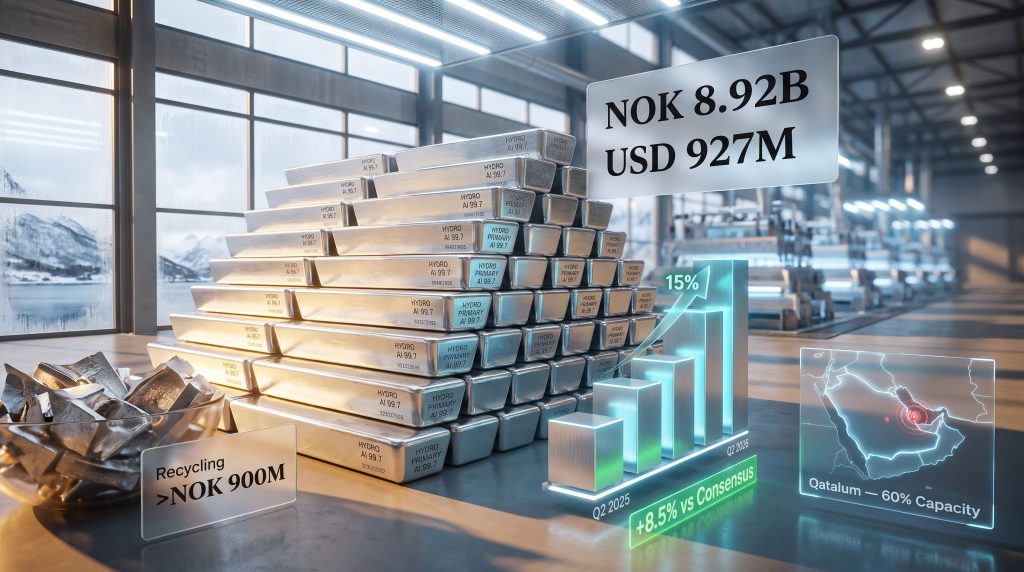
Norsk Hydro Q2 profit as higher aluminium prices offset Qatar hit is precisely the kind of earnings outcome that forces analysts to revisit their mental models. The Norwegian aluminium giant posted adjusted EBITDA of NOK 8.92 billion (approximately USD 927 million) for the April to June quarter, beating the analyst consensus of NOK 8.22 billion by roughly NOK 700 million, or approximately 8.5%. Year-on-year, that represents a 15% improvement in core operating earnings, achieved in a quarter where the company's own sales volumes contracted and one of its most significant joint ventures operated at a fraction of normal capacity.
Understanding how Hydro delivered that result, and what it signals about the structural dynamics of global aluminium markets, requires moving beyond the headline figure. Furthermore, contextualising this performance against broader alumina market pressures across the industry adds additional depth to the analysis.
When big ASX news breaks, our subscribers know first
The Four Forces That Defined Q2 2026 Performance
Rather than treating the earnings beat as a single event, it is more analytically useful to decompose the quarter into four competing forces that shaped the final outcome.
| Performance Driver | Direction | Relative Magnitude |
|---|---|---|
| Aluminium spot prices and regional premiums | Positive | High |
| Lower alumina input costs | Positive | Moderate |
| Qatalum joint venture output disruption | Negative | High |
| Norwegian crown appreciation and energy headwinds | Negative | Moderate |
The net result of these four forces was a significant earnings beat, but the composition matters as much as the quantum. The positive drivers were predominantly external and market-driven, while the negative drivers were a mix of geopolitical and operational. This asymmetry has important implications for how sustainable the current earnings level is once the supply disruption environment normalises.
The Aluminium Metal Segment: More Than Doubled Earnings on Lower Volumes
How Price Realisation Overwhelmed Volume Compression
The standout performer within Hydro's business architecture was its Aluminium Metal division, which reported adjusted EBITDA of NOK 6.42 billion for the quarter. To put that in perspective, the segment's earnings more than doubled compared to the prior corresponding period, a result that is particularly striking because it came alongside an 8% decline in sales volumes.
This price-volume paradox is one of the most instructive features of the Q2 2026 result. In a conventional commodity earnings cycle, volume contraction would be expected to compress segment earnings proportionally. The fact that a double-digit volume decline coincided with more than double the prior year's earnings illustrates the extraordinary magnitude of the price tailwind that characterised the quarter.
The drivers behind this margin expansion operated on two fronts simultaneously:
- Higher realised metal prices, reflecting the surge in London Metal Exchange benchmark aluminium to a four-year high reached in June 2026
- Strengthening physical delivery premiums in both European and North American markets, which amplified the benefit of higher benchmark prices for producers with customer exposure in those regions
- Lower alumina input costs, providing a secondary feedstock benefit that compounded the revenue-side gains
Partially offsetting these benefits were higher energy and carbon charges and the drag from a stronger Norwegian crown, which reduces the crown-equivalent value of US dollar-denominated metal sales when translated back into the reporting currency.
Why Aluminium Hit a Four-Year Price High in June 2026
Aluminium prices reaching a four-year high in June 2026 was not a random market event. Three converging supply-side forces drove the price surge in a way that was faster and sharper than most analyst models had anticipated. In addition, the broader aluminium tariffs impact across global trade further complicated pricing dynamics for producers operating across multiple regions.
-
Middle East smelter output reduction: Regional supply disruptions stemming from the ongoing Middle East crisis reduced available primary metal across global spot markets, tightening the balance between supply and demand in ways that LME prices reflected with unusual speed.
-
Physical premium expansion: Delivery premiums in Europe and North America strengthened as buyers competed for available metal, creating a compounding effect on top of the higher benchmark price.
-
Procurement acceleration by buyers: Market participants anticipating further supply disruptions moved to secure metal earlier than they otherwise would have, adding demand-side pressure to an already tightening supply environment.
"The price rally in mid-2026 was fundamentally a supply shock story, not a demand recovery story. That distinction carries significant implications for how long elevated prices can be sustained once Middle East smelter output begins normalising."
Qatalum: Quantifying the Joint Venture Drag and the Offtake Transition
A 66% Earnings Collapse at Hydro's Qatar Smelter
While the Aluminium Metal segment thrived on high prices, Hydro's Qatalum joint venture in Qatar told a very different story. The smelter operated at approximately 60% of nameplate capacity during Q2 2026, a direct consequence of the Middle East crisis that simultaneously drove aluminium prices higher.
The financial impact at the joint venture level was severe. Hydro's share of Qatalum's adjusted EBITDA fell to NOK 316 million in Q2 2026, compared with NOK 922 million in the same period a year earlier. That is a year-on-year decline of approximately 66%, representing a NOK 606 million earnings headwind absorbed at the group level.
| Period | Hydro's Share of Qatalum EBITDA | Year-on-Year Change |
|---|---|---|
| Q2 2025 | NOK 922 million | Baseline |
| Q2 2026 | NOK 316 million | -66% (approximately NOK 606 million decline) |
The Offtake Agreement Expiry: A Structural Shift in Metal Marketing
Compounding the capacity constraint was a significant structural change in the commercial relationship between Hydro and the Qatalum joint venture. During Q2 2026, Hydro's existing marketing and offtake agreement with Qatalum reached its contractual end. As a direct consequence, Hydro stopped purchasing metal from the facility during the quarter.
This is more than a footnote. The offtake arrangement had previously given Hydro access to competitively priced primary metal from a Gulf-based smelter, effectively serving as a feedstock supply channel as well as a profit-sharing vehicle. With that agreement no longer in place, Hydro has confirmed it is engaged in active discussions with its joint venture partner regarding future metal marketing and sales arrangements.
The medium-term commercial uncertainty this introduces is non-trivial. The terms under which Qatalum's metal will be routed to market going forward, and whether Hydro will retain any preferential access to that output, remain unresolved. Notably, how other top aluminium companies are managing similar joint venture and offtake structures provides a useful comparative lens for assessing Hydro's strategic options.
Scenario Modelling: The Upside if Qatalum Returns to Full Capacity
For investors assessing the group's earnings recovery potential, the Qatalum situation represents one of the clearest identifiable upside scenarios.
| Scenario | Hydro's Qatalum EBITDA Share | Implied Group Uplift vs Q2 2026 Actual |
|---|---|---|
| Q2 2025 baseline (full operation) | ~NOK 922 million | Reference point |
| Q2 2026 actual (approximately 60% capacity) | NOK 316 million | Not applicable |
| Full capacity restoration (hypothetical) | ~NOK 900-950 million | ~NOK 580-630 million uplift |
This hypothetical scenario assumes price and cost conditions broadly consistent with Q2 2026 actuals and is provided for illustrative purposes only. Actual outcomes will depend on a range of factors outside Hydro's operational control.
Recycling Operations: The Counterintuitive Beneficiary of Primary Supply Shock
Margins Above NOK 900 Million Despite Weak Underlying Demand
One of the less immediately obvious dynamics of the Q2 2026 result was the strong performance of Hydro's recycling segment. Recycling operations generated earnings above NOK 900 million during the quarter, a robust outcome achieved despite little improvement in the underlying end-market demand environment. According to Recycling Today, this segment has become an increasingly strategic pillar within Hydro's overall earnings architecture.
The mechanism that explains this apparent contradiction lies in how supply shocks propagate differently through primary and secondary aluminium markets. When primary smelter output tightens, LME prices and physical premiums rise. However, the cost of aluminium scrap, which is the principal feedstock for recycling operations, does not track primary metal prices with perfect correlation. The result is a widening spread between scrap input costs and recycled metal selling prices, which flows directly into recycler margins.
How the Recycling Margin Expansion Mechanism Works
- Primary aluminium supply contracts due to geopolitical or operational disruption
- LME benchmark prices and regional physical premiums rise in response
- Aluminium scrap prices increase, but typically with a lag and at a smaller magnitude than primary metal
- The spread between scrap procurement costs and recycled metal realisations widens
- Recycling operators with established scrap networks capture the expanded margin
"Hydro's recycling earnings strength in Q2 2026 is not simply a cyclical windfall. It reflects a structural advantage inherent in owning integrated recycling capacity within a market where primary aluminium supply is geographically concentrated and therefore exposed to regional disruption risk."
This structural insight has significant long-term implications. As global aluminium supply becomes more geographically polarised, with Middle East smelting capacity playing a larger role, integrated producers with substantial recycling infrastructure will enjoy a natural asymmetric hedge against primary supply disruptions.
Demand Outside China: The Cautionary Signal Beneath the Price Rally
Primary Consumption Ex-China Declined Year-on-Year
While the supply-side narrative of Q2 2026 was compelling, Hydro's own reporting contained a demand-side warning that deserves careful attention. The company noted that primary aluminium consumption outside China fell on a year-on-year basis during the quarter.
For analysts interpreting the aluminium price rally, this distinction is critical. A price surge driven by supply disruption and a price surge driven by demand growth have very different sustainability profiles.
| Demand Factor | Short-Term Outlook | Medium-Term Outlook |
|---|---|---|
| Ex-China primary aluminium demand | Soft, below prior year levels | Dependent on broader macro recovery |
| Chinese demand | Continues to dominate global consumption | Structural growth trajectory intact |
| Recycled aluminium substitution | Rising during primary supply disruptions | Could moderate primary price upside |
| New smelter capacity additions globally | Limited near-term additions | Potential overhang risk in 18-36 month horizon |
Supply-shock price premiums tend to compress faster than demand-driven price cycles. If Middle East smelter output begins recovering over the coming quarters, and ex-China demand remains subdued, the price environment that powered Norsk Hydro Q2 profit as higher aluminium prices offset Qatar hit may prove difficult to replicate.
The next major ASX story will hit our subscribers first
Energy Division: The Overlooked Earnings Drag
Hydropower Output and Regional Price Differentials Both Moved Against Hydro
The Energy division's Q2 2026 performance was the clearest weak point in Hydro's quarterly result, with earnings declining by more than 50% compared to the prior corresponding period. Two factors drove this deterioration simultaneously, and neither was easily foreseeable in analyst consensus models anchored to more normalised conditions.
- Lower hydropower generation volumes reflecting adverse hydrological conditions that reduced available water resources for electricity generation
- Unfavourable regional electricity price differentials that compressed the realised electricity price relative to prevailing benchmark references
This segment result illustrates a frequently underappreciated complexity in Hydro's business model. The company's ownership of Norwegian hydropower assets is widely understood as a strategic advantage, providing a natural hedge against energy cost inflation in its aluminium smelting operations. Consequently, under normal conditions, when hydropower output is strong, this integrated model compresses the energy cost line of the smelting business while generating independent earnings from electricity sales.
However, when hydrological conditions deteriorate and generation volumes fall, the hedge partially reverses. Hydro becomes more exposed to spot electricity market pricing, and the Energy division's independent earnings contribution declines. The Q2 2026 result is a useful reminder that vertical integration in energy-intensive manufacturing is not a one-way risk reducer. It redistributes risk rather than eliminating it, and the character of that redistribution changes with hydrological cycles.
What This Result Tells Investors About Integrated Aluminium Strategy
Five Structural Lessons From Hydro's Q2 2026 Earnings
Norsk Hydro Q2 profit as higher aluminium prices offset Qatar hit is instructive not just as a company-specific data point, but as a window into the evolving risk architecture of the global aluminium sector. Furthermore, parallels with approaches such as aluminium operations repowering and aluminium joint venture strategy pursued by peers underline that the broader industry is navigating similarly complex structural trade-offs.
-
Price realisation dominates volume in supply-constrained environments. An 8% volume decline mattered far less than the magnitude of price and premium appreciation. Integrated producers with strong commercial exposure to premium markets captured disproportionate benefit.
-
Geopolitical risk is now a structural aluminium market variable. The Middle East's growing share of global primary aluminium capacity means regional conflict can reshape global price dynamics rapidly and with little warning.
-
Recycling assets function as geopolitical hedges. The secondary aluminium margin expansion during primary supply disruptions demonstrates that integrated recycling capacity is not merely an environmental asset; it is a commercial buffer against supply chain fragility.
-
Joint venture complexity introduces earnings optionality and uncertainty. The Qatalum offtake expiry creates a period of commercial ambiguity that markets will need to monitor closely as renegotiations proceed.
-
Demand fundamentals outside China remain the critical swing variable. Until ex-China primary aluminium consumption recovers on a sustained basis, elevated prices remain vulnerable to normalisation as supply disruptions ease.
As GlobeNewswire's coverage of Hydro's Q2 2026 results highlighted, the quarter's performance was characterised by operational strength delivering solid results, even as individual business units faced markedly different conditions.
"Norsk Hydro Q2 profit as higher aluminium prices offset Qatar hit is most accurately read as a case study in how vertical integration, when combined with advantageous commodity price timing, can dramatically amplify earnings even when operational performance is mixed. The result demonstrates both the resilience of the integrated model and the limits of operational control when geopolitical forces dominate market dynamics."
Disclaimer: This article contains forward-looking analysis and hypothetical scenario modelling for illustrative purposes only. It does not constitute financial advice. Investors should conduct their own due diligence and seek professional advice before making investment decisions. All financial figures referenced are sourced from Reuters reporting on Norsk Hydro's Q2 2026 results as published on 22 July 2026.
For ongoing coverage of global aluminium market dynamics and integrated producer strategy, Mining Weekly at miningweekly.com provides comprehensive reporting on base metals and aluminium industry developments.
Want to Stay Ahead of the Next Major Aluminium or Base Metal Discovery?
Discovery Alert's proprietary Discovery IQ model scans ASX announcements in real time, instantly identifying significant mineral discoveries across more than 30 commodities — including aluminium and bauxite — and delivering actionable insights before the broader market reacts. Explore historic examples of exceptional discovery returns and begin your 14-day free trial to position yourself ahead of the next major market-moving event.