May 21, 2026
Strategic Shifts in North America's Copper Infrastructure
Global copper markets face mounting pressure from regulatory uncertainty at Horne Smelter across critical processing hubs, with implications extending far beyond individual facility operations. Industrial operators navigate increasingly complex environmental frameworks while maintaining supply chain stability for essential materials. These dynamics create investment paralysis scenarios where regulatory unpredictability outweighs traditional economic calculations, forcing strategic recalibrations across entire sectors.
The intersection of environmental policy evolution and industrial infrastructure modernisation generates compound challenges for copper processing operations. Legacy facilities encounter technical limitations when retrofitting to meet progressively stringent emission standards, while new regulatory frameworks often lack the predictability required for major capital commitments. This regulatory-industrial tension reshapes investment decision-making across North America's copper supply chains, particularly when considering copper investment strategies that account for evolving environmental compliance requirements.
When big ASX news breaks, our subscribers know first
What Makes the Horne Smelter Critical to North America's Copper Infrastructure?
Canada's Only Integrated Copper Processing Chain
The Horne Smelter and Canadian Copper Refinery complex in Rouyn-Noranda represents a unique strategic asset within North America's copper infrastructure. As Canada's only fully integrated copper smelting and refining operation, this facility combines primary smelting from concentrate with secondary refining capabilities at a single location, creating operational efficiencies unavailable elsewhere in the region.
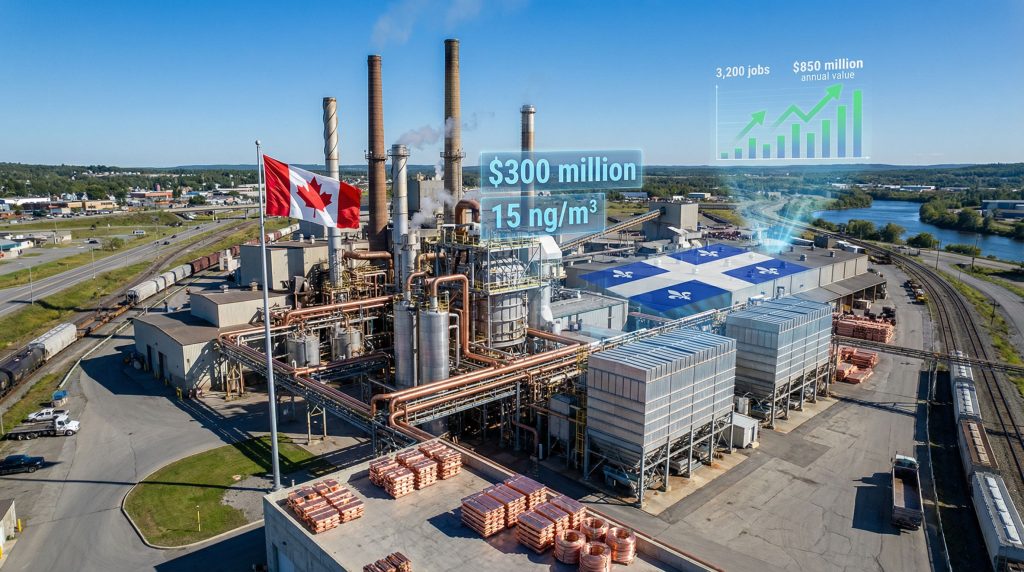
The economic footprint extends significantly beyond direct operations, supporting 3,200 direct and indirect jobs while generating approximately $850 million in annual added value to the regional economy. This scale of employment and economic impact underscores the facility's role as a critical economic anchor for the Rouyn-Noranda region and broader Quebec mining sector, particularly within the evolving mining industry evolution landscape.
The integration of smelting and refining processes creates several technical advantages:
• Direct quality control throughout the entire processing chain
• Reduced transportation and handling costs for intermediate products
• Optimised energy management across both smelting and refining operations
• Enhanced capacity to process diverse feedstock types, including recycled materials
Beyond copper production, the facility processes thousands of tonnes of recycled material annually, contributing to circular economy objectives while maintaining economic viability. This dual role as both primary processor and recycling hub differentiates the operation from traditional single-function facilities.
Geographic Positioning in Global Copper Markets
Quebec's position within the Great Lakes-St. Lawrence corridor provides strategic logistical advantages for copper processing operations. The Horne facility accepts copper concentrates from both Canadian mining operations and international sources, establishing its role as a continental processing hub rather than merely a regional operation.
The facility's geographic positioning enables:
• Access to established rail and water transportation networks
• Proximity to major North American copper end-markets
• Integration with mining operations across multiple Canadian provinces
• Efficient import capabilities for international concentrate supplies
This geographic advantage becomes particularly significant when considering the facility's status as the continent's only integrated copper processing chain. Furthermore, the location enables cost-effective concentrate sourcing from diverse suppliers while maintaining competitive transportation costs to major copper-consuming markets, contrasting favourably with US copper production logistics networks.
Why Are Arsenic Emission Standards Creating Investment Paralysis?
The 15 ng/m³ Target vs. Operational Reality
Regulatory authorities have established a 15 nanograms per cubic meter (ng/m³) arsenic emission target for the Horne Smelter, creating technical challenges for legacy smelting infrastructure designed to earlier environmental standards. Glencore's analysis indicates that achieving this target at the legal sampling station would result in concentrations below 7 ng/m³ over 98% of the urban area, demonstrating the stringency of the proposed standard.
The company has documented significant arsenic concentration reductions over the past two decades, indicating ongoing environmental improvement efforts. However, the transition to ultra-low emission levels requires substantial technological upgrades to existing systems, highlighting the central regulatory uncertainty at Horne Smelter.
Arsenic emission control in copper smelting involves complex technical considerations:
• Roasting Process Management: Controlling arsenic trioxide release from copper concentrates during high-temperature processing
• Capture System Efficiency: Upgrading electrostatic precipitators and baghouse filters to achieve enhanced performance levels
• Off-Gas Treatment: Implementing advanced gas cleaning technologies designed for ultra-low emission targets
• Continuous Monitoring: Installing sophisticated monitoring systems to ensure consistent compliance with stringent standards
Legacy infrastructure presents unique retrofitting challenges, as equipment originally designed for higher emission thresholds may require complete replacement rather than modification to achieve 15 ng/m³ performance levels.
Regulatory Framework Inconsistencies
The evolution of arsenic emission standards creates multi-tiered regulatory complexity that complicates long-term planning. Historical facility-specific limits of 100 ng/m³ contrast sharply with provincial standards of 3 ng/m³ and the currently negotiated target of 15 ng/m³, illustrating the challenge of aligning facility-specific realities with broader environmental policy objectives.
| Standard Type | Concentration Level | Application Context |
|---|---|---|
| Historical Facility-Specific | 100 ng/m³ | Previous permit framework |
| Provincial Standard | 3 ng/m³ | General environmental regulation |
| Negotiated Target | 15 ng/m³ | Current investment framework |
This regulatory framework inconsistency reflects tensions between:
• Technical Feasibility: Recognition that legacy infrastructure has inherent limitations
• Environmental Policy: Provincial standards applying uniform criteria across emission sources
• Economic Pragmatism: Intermediate targets balancing environmental improvement with investment viability
The Rouyn-Noranda City Council's December 2025 referral of permit amendments to provincial authorities exemplifies jurisdictional complexity, where municipal input can influence provincial environmental permitting processes. In addition, this exemplifies the complexities inherent in modern mining claims framework regulations across Canadian provinces, potentially extending decision timelines and creating additional uncertainty layers.
What Does Glencore's $300 Million Investment Proposal Really Mean?
Capital Allocation Strategy Under Uncertainty
Glencore's $300 million investment proposal represents a substantial capital commitment contingent on regulatory framework clarification. The company has explicitly stated that this investment cannot proceed without comprehensive regulatory assurance, translating the regulatory uncertainty at Horne Smelter into quantifiable investment paralysis, according to reports from Mining Weekly.
The investment conditions include four critical elements:
-
Permit Alignment: Ministerial permit modifications consistent with July 2025 amendment requests
-
Implementation Timeline: Realistic scheduling for emissions reduction plan execution
-
Regulatory Stability: Confirmed framework for future permit processes
-
Target Maintenance: Preservation of the 15 ng/m³ arsenic standard or alternative risk mitigation mechanisms
Vincent Plante, Executive Director of Glencore's North American Copper Division, emphasised that regulatory predictability represents an essential prerequisite given the investment scale and associated risks. This statement crystallises how regulatory uncertainty functions as a capital allocation barrier, preventing resource deployment even where operational necessity and environmental justification align.
Timeline Pressures and Decision Points
Glencore has indicated that structural decisions affecting both the Horne Smelter and Canadian Copper Refinery are expected before year-end 2025, creating a compressed timeline for regulatory resolution. The company requested an 18-month transition period to achieve the 15 ng/m³ target, indicating technical implementation requirements extending beyond immediate regulatory approval.
The interconnected nature of smelting and refining operations means that investment decisions cannot be made independently for each facility. Capital allocation must consider both operations simultaneously, amplifying the complexity of regulatory negotiations and their potential economic consequences.
The scale of investment and associated risks make regulatory predictability essential for proceeding with modernisation plans that could benefit both environmental performance and operational sustainability.
How Do Municipal Politics Complicate Industrial Environmental Policy?
Rouyn-Noranda City Council's Referral Decision
The municipal council's decision to refer permit amendment decisions to provincial authorities introduces additional complexity to environmental permitting processes. While respecting local governance structures, this referral mechanism can extend decision timelines and create uncertainty regarding approval pathways.
Local political dynamics reflect competing considerations:
• Community Health Concerns: Resident perspectives on arsenic emission levels and associated health risks
• Economic Dependency: Recognition of the facility's role as a major regional employer and economic contributor
• Environmental Responsibility: Municipal obligations to support environmental improvement initiatives
• Jurisdictional Clarity: Understanding of provincial vs. municipal authority in environmental permitting
Multi-Level Governance Challenges
The intersection of municipal input and provincial environmental authority creates coordination challenges that can affect industrial planning. While environmental permitting ultimately falls under provincial jurisdiction, municipal referrals can influence timing and potentially scope of regulatory decisions.
This multi-level governance structure requires:
• Clear Communication Channels: Coordination between municipal and provincial authorities
• Timeline Alignment: Municipal input processes that complement rather than delay provincial decision-making
• Stakeholder Engagement: Balanced consideration of community, environmental, and economic perspectives
• Precedent Management: Ensuring that municipal referral processes don't create unpredictable delays for future industrial permitting
What Are the Broader Implications for Canada's Mining Sector?
Regulatory Predictability as Investment Criteria
The regulatory uncertainty at Horne Smelter situation illustrates how regulatory uncertainty can override traditional economic investment criteria. For mining sector capital allocation, predictable environmental frameworks become as critical as ore grades, transportation costs, or market pricing in determining project viability.
Canadian mining competitiveness depends partly on regulatory certainty that enables long-term capital planning. When environmental standards evolve without clear transition pathways or timeline certainty, investment decisions may shift to jurisdictions offering more predictable frameworks, even if other economic factors favour Canadian operations. This trend contrasts with more stable investment environments such as Canada copper investment opportunities in other provinces.
Key regulatory predictability factors include:
• Standard Evolution Pathways: Clear processes for environmental standard updates with appropriate transition periods
• Consultation Mechanisms: Stakeholder engagement that balances environmental objectives with economic feasibility
• Implementation Timelines: Realistic scheduling that acknowledges technical and financial implementation requirements
• Grandfathering Provisions: Recognition of existing infrastructure capabilities and retrofit limitations
Supply Chain Vulnerability Assessment
The potential disruption of North America's only integrated copper smelting and refining operation creates supply chain vulnerabilities extending beyond immediate regional impacts. Alternative processing capacity analysis reveals limited substitute facilities with comparable integrated capabilities.
Supply chain implications include:
• Processing Capacity Gaps: Limited alternative facilities for both smelting and refining services
• Transportation Cost Increases: Higher logistics costs for accessing geographically distant processing facilities
• Service Level Disruptions: Potential delays and quality variations when utilising multiple non-integrated processors
• Strategic Material Security: Implications for Canadian critical minerals policy and supply chain resilience
The facility's role in processing both domestic concentrates and recycled materials means that closure impacts would affect multiple supply chain segments simultaneously, amplifying overall market disruption potential.
The next major ASX story will hit our subscribers first
Which Scenarios Could Emerge from Current Negotiations?
Scenario 1: Regulatory Alignment and Investment Proceeding
Under this scenario, provincial authorities approve permit modifications aligning with Glencore's July 2025 amendment requests, enabling the $300 million investment to proceed within the proposed 18-month implementation timeline.
Probability Assessment: Medium, contingent on provincial willingness to accept the 15 ng/m³ standard and provide regulatory certainty
Expected Outcomes:
• Environmental Performance: Achievement of 15 ng/m³ arsenic targets within 18 months
• Employment Stability: Maintenance of 3,200 direct and indirect jobs
• Economic Continuity: Sustained $850 million annual economic value generation
• Supply Chain Stability: Continued operation of North America's only integrated copper processing facility
Investment Timeline: 6-12 months for regulatory approval, followed by 18-month technical implementation
Scenario 2: Continued Uncertainty and Gradual Decline
This scenario involves prolonged permit negotiations without clear resolution, creating ongoing operational uncertainty that gradually undermines facility competitiveness and sustainability.
Probability Assessment: High, given current multi-level governance complexities and competing stakeholder interests
Implications:
• Deferred Maintenance: Delayed capital expenditures affecting long-term operational reliability
• Workforce Impacts: Potential employee retention challenges and reduced hiring for specialised positions
• Market Share Erosion: Customer relationship impacts as uncertainty affects service reliability perceptions
• Incremental Closure Risk: Gradual operational deterioration increasing eventual facility closure probability
Timeline Characteristics: 12-24 months of extended negotiations with periodic deadline extensions
Scenario 3: Facility Closure and Market Restructuring
Under this scenario, regulatory negotiations fail to achieve acceptable terms, leading to facility closure decisions and significant market restructuring, as highlighted in recent coverage by US News & World Report.
Probability Assessment: Low-Medium, increasing if regulatory uncertainty persists beyond 2025
Economic Impact:
• Regional Employment: Loss of 3,200 direct and indirect jobs in Rouyn-Noranda
• Economic Value: Elimination of $850 million annual regional economic contribution
• Supply Chain Restructuring: Major adjustments in North American copper processing patterns
• Alternative Development Potential: Possible new facility development in alternative Canadian locations with more predictable regulatory environments
Market Adjustment Timeline: 18-36 months for complete closure and supply chain reorganisation
| Scenario | Probability | Investment Impact | Employment Effect | Supply Chain Consequence |
|---|---|---|---|---|
| Regulatory Alignment | Medium | $300M+ proceeds | Stability maintained | Continued integration |
| Continued Uncertainty | High | Deferred/reduced | Gradual deterioration | Progressive disruption |
| Facility Closure | Low-Medium | Asset write-down | 3,200 jobs at risk | Significant restructuring |
How Should Investors and Industry Stakeholders Respond?
Risk Monitoring Framework
Stakeholders require systematic approaches to track regulatory resolution progress and assess evolving investment risks. Key indicators include regulatory timeline adherence, stakeholder negotiation progress, and technical implementation milestone achievement.
Critical Monitoring Metrics:
• Regulatory Decision Timelines: Provincial authority response schedules and milestone completion rates
• Technical Implementation Progress: Emission reduction technology deployment and performance verification
• Financial Performance Indicators: Operating margin impacts and capital expenditure deferrals
• Stakeholder Engagement Quality: Municipal, provincial, and community consultation effectiveness
Risk Assessment Framework:
-
Regulatory Risk: Probability of permit approval within acceptable timeframes and conditions
-
Technical Risk: Feasibility of achieving 15 ng/m³ targets within 18-month implementation periods
-
Financial Risk: Capital allocation impacts and return on investment projections under uncertainty
-
Market Risk: Supply chain disruption probabilities and alternative sourcing cost implications
Strategic Positioning for Market Changes
The regulatory uncertainty at Horne Smelter creates both risks and opportunities for broader industry participants. Companies with alternative processing capabilities may benefit from potential market disruptions, while copper consumers need contingency planning for supply chain modifications.
Opportunity Assessment:
• Alternative Processing Development: Potential for new integrated copper processing facility development in regulatory-friendly jurisdictions
• Technology Investment Priorities: Enhanced emission reduction technologies applicable across copper smelting operations
• Supply Chain Diversification: Development of alternative sourcing relationships and processing partnerships
• Regulatory Framework Development: Engagement in policy development processes that balance environmental objectives with industrial feasibility
Strategic Considerations:
The Horne Smelter situation demonstrates how regulatory uncertainty can create investment paralysis even where economic fundamentals support facility modernisation. Industry participants should prioritise regulatory engagement and framework development that provides sufficient certainty for long-term capital planning while achieving legitimate environmental improvement objectives.
Effective stakeholder engagement requires recognition that regulatory predictability serves both environmental and economic interests by enabling planned investments in emission reduction technologies rather than creating uncertainty that prevents such improvements.
Disclaimer: This analysis involves forward-looking assessments and regulatory predictions that are subject to change. Investment decisions should incorporate comprehensive due diligence and professional financial advice. Regulatory frameworks and policy decisions can evolve rapidly, affecting the validity of scenario assessments and probability estimates.
Looking to Capitalise on Copper Market Disruptions?
Discovery Alert's proprietary Discovery IQ model delivers real-time alerts on significant copper and mineral discoveries across the ASX, empowering subscribers to identify actionable opportunities ahead of broader market awareness of supply chain shifts and regulatory developments. Begin your 30-day free trial today at Discovery Alert to position yourself strategically as North American copper infrastructure undergoes these critical transformations.