
August 14, 2026
The Fundamental Forces Reshaping North American Energy Markets
The convergence of multiple supply streams has created unprecedented conditions in North American crude markets, fundamentally altering price formation mechanisms and trade flow patterns. The surging supply of US Gulf sour crude represents a structural shift in regional energy dynamics that affects everything from upstream investment decisions to refinery optimization strategies. Understanding these evolving market fundamentals requires examining the complex interplay between production growth, infrastructure constraints, and global demand patterns.
Supply abundance in energy markets typically triggers rebalancing mechanisms, but current conditions suggest traditional adjustment processes may be operating differently than historical precedent would indicate. The simultaneous expansion of multiple supply sources creates compound effects that challenge conventional market clearing mechanisms and force participants to adapt strategies across the entire value chain.
When big ASX news breaks, our subscribers know first
What's Driving the Unprecedented Surge in US Gulf Sour Crude Production?
Record-Breaking Gulf of Mexico Output Fundamentals
The surging supply of US Gulf sour crude stems primarily from coordinated deepwater project completions that have introduced substantial new production capacity within an accelerated timeframe. Four major offshore developments achieved operational status between July and December 2025, creating a concentrated supply influx that has fundamentally altered market dynamics.
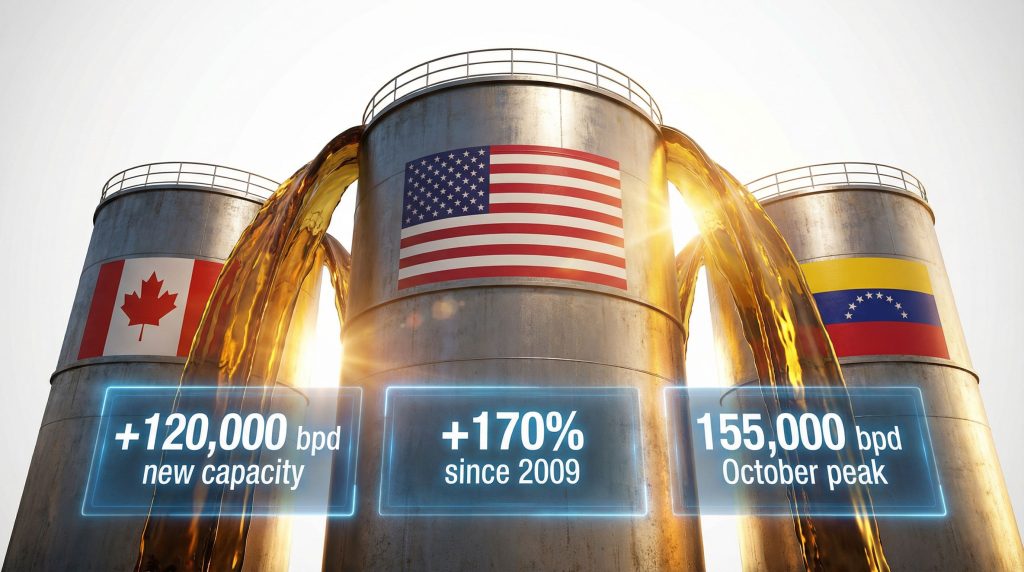
Shenandoah's production ramp exemplifies the scale of new capacity additions. The Beacon Offshore Energy floating production system, with 120,000 barrels per day nameplate capacity, began delivering oil through Genesis' SYNC pipeline system in July 2025. By October, the facility had reached its 100,000 barrel per day operational target, representing approximately 83% capacity utilisation within three months of startup. This production flows directly into the Cameron Highway Oil Pipeline System, which feeds the Southern Green Canyon crude stream.
BP's dual project contributions further amplified supply pressures through both expansion and new development. The Argos Southwest Extension added 20,000 barrels per day of oil equivalent to existing platform capacity, while the Atlantis Drill Center 1 expansion commenced operations two months ahead of schedule on December 11, 2025. The Atlantis expansion alone contributes approximately 15,000 barrels of oil equivalent daily to a platform with 200,000 barrel per day gross oil production capacity.
LLOG Exploration's Salamanca project represents the newest production stream, achieving first oil in the third quarter of 2025 with 50,000 barrel per day design capacity. Unlike other projects feeding into the Southern Green Canyon stream, Salamanca production flows into the medium sour Poseidon stream, diversifying the geographic impact of new supply additions.
| Project | Operator | Capacity (b/d) | Startup Date | Pipeline System |
|---|---|---|---|---|
| Shenandoah FPS | Beacon Offshore | 120,000 | July 2025 | SYNC → Chops → SGC |
| Argos Southwest | BP | 20,000 boe/d | Q3 2025 | Chops → SGC |
| Atlantis DC1 | BP | 15,000 boe/d | December 2025 | Chops |
| Salamanca | LLOG Exploration | 50,000 | Q3 2025 | Poseidon |
The US oil production trends reflect these significant capacity additions. US Energy Information Administration projects Gulf of Mexico deepwater production to average 1.95 million barrels daily in 2026, representing a 50,000 barrel per day increase from 2025 levels. This forecast reflects not only current project ramp-ups but also anticipated optimisation of existing facilities and potential additional capacity utilisation.
New Project Economics and Investment Flows
The clustering of major project completions within a six-month window demonstrates the convergence of several economic factors that supported sustained deepwater investment despite earlier market uncertainties. Floating production system technology has enabled operators to achieve faster deployment cycles compared to traditional fixed platform infrastructure, reducing time-to-production and improving project economics under volatile pricing conditions.
Capital deployment patterns suggest operators maintained confidence in long-term Gulf of Mexico fundamentals despite near-term oversupply risks. The decision to proceed with Atlantis Drill Center 1 ahead of schedule, completing two months early, indicates operator efficiency improvements and favourable project economics even under current pricing scenarios where Mars crude trades at a $4.18 per barrel discount to Brent.
Development timeline acceleration reflects technological advances in subsea infrastructure and drilling efficiency. The Salamanca project's progression from first oil to anticipated design capacity achievement by mid-2026 represents typical 6-9 month ramp periods that characterise modern Gulf deepwater projects, considerably faster than historical development cycles.
Technology-Enabled Production Efficiency Gains
Advanced floating production systems have fundamentally altered the economics of deepwater development by reducing infrastructure requirements and enabling more flexible field development strategies. The Shenandoah floating production system represents this technological evolution, allowing operators to maximise recovery from deepwater reservoirs without the capital intensity of fixed platform infrastructure.
Pipeline aggregation effects amplify individual project impacts through infrastructure consolidation. The concentration of Shenandoah, Argos Southwest, and Atlantis expansions all feeding into the Cameron Highway Oil Pipeline System creates compounding supply pressure at the Southern Green Canyon assessment point. This infrastructure consolidation means individual project ramp-ups aggregate within a single pricing mechanism, intensifying localised supply concentrations.
Production optimisation technologies enable operators to achieve higher capacity utilisation rates more rapidly than previous generation projects. The ability to reach 83% nameplate capacity within three months of startup, as demonstrated by Shenandoah, reflects advances in reservoir management, subsea systems, and production control technologies.
How Are Canadian Heavy Crude Imports Amplifying Supply Pressures?
Trans Mountain Pipeline System Impact Assessment
Canadian crude production growth presents a complex dynamic in North American supply pressures, with geographic arbitrage economics increasingly favouring Asia-Pacific destinations over traditional US markets. Canada energy challenges include balancing production growth with infrastructure constraints. Alberta crude and condensate production averaged 4.22 million barrels daily during the July-October 2025 period, representing 4% year-over-year growth that continues pushing against pipeline infrastructure constraints.
Trans Mountain Expansion operation has fundamentally altered Canadian export flow patterns since achieving full operational status in May 2024. The 890,000 barrel per day system capacity operated at 87% utilisation during the third quarter of 2025, accepting all crude nominations while Enbridge's Mainline to the US rejected 13% of nominations in January 2026 due to Alberta production surges during winter months.
The geographical distribution of TMX exports reveals the strategic redirection of Canadian heavy crude away from US markets. Approximately two-thirds of total TMX exports (roughly 590,000 barrels daily) flow to Asia-Pacific destinations, with the remainder directed to US west coast markets.
More specifically, heavy crude exports from Vancouver totalled 375,000 barrels daily year-to-date through November 2025, with over three-quarters destined for Asia-Pacific rather than US consumption.
US west coast heavy crude imports from Canada actually declined 25% compared to the second half of 2024, despite total Canadian heavy exports from Vancouver averaging 27% higher year-to-date. This divergence demonstrates that Canadian supply growth primarily serves international markets rather than amplifying US domestic supply pressures.
Alberta Oil Sands Production Surge Economics
Record production levels in Canadian oil sands reflect both operational improvements and favourable long-term economic fundamentals. 2026 production forecasts project Canadian crude and condensate output to rise 1.7% to a record 4.85 million barrels daily, representing 80,000 barrels per day above 2025 levels.
Seasonal production patterns create periodic pipeline bottlenecks that affect US-bound flows. The 13% rejection rate on Enbridge's Mainline in January 2026 reflects Alberta's typical winter production surge as additional wells come online in colder months. This seasonal pattern means Canadian crude "spillover" into US markets occurs primarily when pipeline access limitations force southbound redirection, rather than representing sustained supply pressure.
Production cost competitiveness enables sustained growth despite current heavy crude pricing challenges. Canadian heavy crude trades at significant discounts to benchmark crudes, yet production continues expanding, suggesting operators maintain positive economics even under current market conditions.
Market analysts note that Canadian producers prioritise international export opportunities when pipeline capacity permits, using US markets primarily as overflow destinations during infrastructure constraints.
Quality Premium Dynamics in Heavy Sour Markets
Heavy crude quality specifications create geographic demand variability that influences trade flow patterns. Canadian Cold Lake blend and conventional bitumen-derived streams require specific refinery configurations with advanced conversion capabilities, including coking and hydrocracking units. This technical requirement creates geographic clustering effects where refineries with appropriate conversion capacity can optimise heavy crude processing.
Chinese refinery investment in advanced cracking infrastructure has created stronger economic incentives for Canadian heavy crude exports to Asia-Pacific markets. Chinese refineries are installing increasingly sophisticated coking units to improve petrochemical yields, making heavy Canadian crude particularly attractive as the most competitively-priced, unsanctioned option for Chinese refiners.
US west coast refinery closures simultaneously reduce domestic demand for Canadian heavy crude. Phillips 66 closed its 139,000 barrel per day Los Angeles refinery, while Valero plans to shutter its 145,000 barrel per day Benicia refinery in April 2026. These facilities previously consumed 30,000 barrels daily of Cold Lake crude during January-June 2025, representing demand destruction that reduces Canadian heavy crude pressure on US markets.
What Does Venezuelan Crude Recovery Mean for Regional Supply Dynamics?
Sanctions Relief and Import Volume Restoration
Venezuelan crude imports to the US market have resumed meaningful volumes following Chevron's licence expansion in August 2025, adding another supply stream to already abundant North American crude availability. Venezuelan crude exports to the US reached 155,000 barrels daily in October, representing the highest monthly volume since March and demonstrating sustained production capability despite ongoing sanctions constraints.
Chevron operations under sanctions waivers provide the primary mechanism for Venezuelan crude re-entry to US markets. The company's operational licence enables consistent production and export flows, though volumes remain constrained relative to historical Venezuelan export capacity. October export levels of 155,000 barrels daily reflect both production optimisation and sanctions compliance protocols.
Supply consistency challenges persist despite improved export volumes. US pressure on Venezuelan operations continues creating operational uncertainty, with limited tanker traffic from Venezuelan ports following the December 10 seizure of a Venezuelan tanker. Furthermore, industry sources indicate only cargoes chartered by Chevron and a few other foreign majors working with state-owned PdV continue normal operations.
Geopolitical Risk Factors Affecting Supply Consistency
Market confidence in Venezuelan supply reliability remains constrained by ongoing geopolitical tensions and enforcement actions. The December 10 tanker seizure and subsequent US declaration of Venezuelan export blockage on December 16 demonstrate the continued volatility in Venezuelan crude availability despite technical production capability.
Quality considerations for Venezuelan heavy sour crude create both opportunities and constraints in current market conditions. Venezuelan Merey crude provides direct competition to Canadian heavy crude streams, particularly in Asia-Pacific markets where Chinese refineries seek competitively-priced heavy crude feedstock for advanced conversion units.
Long-term supply outlook for Venezuelan crude remains highly uncertain given political developments and potential policy changes. While current export levels provide meaningful supply additions to North American markets, the sustainability of these volumes depends on continued sanctions waiver renewals and operational stability.
Which Refinery Demand Patterns Are Responding to Abundant Supply?
US Gulf Coast Refinery Utilisation Trends
Refinery optimisation strategies are adapting to abundant sour crude availability through crude slate adjustments and margin optimisation. The surge in Southern Green Canyon spot trading activity to 300,000 barrels daily in December 2025 represents the largest monthly volume since assessment launch in 2006, indicating strong refinery interest in available sour crude supplies.
Argus Sour Crude Index composition reflects the structural shift in supply patterns. SGC's share of ASCI spot activity reached 26% for July-December 2025 trade months, marking the highest level since index launch in 2009. This increased share demonstrates how abundant new production is reshaping benchmark crude composition and pricing dynamics.
The US sour crude market shows significant pressure from oversupply conditions. Margin compression pressures affect complex refineries' ability to optimise heavy crude processing. Mars crude averaging an 80¢ per barrel discount to Domestic Sweet for January trade represents the widest spread since November 2024, while Southern Green Canyon's discount to WTI averaged almost $1.90 per barrel for January trading, the deepest since March 2023 deliveries.
Strategic Petroleum Reserve Purchasing Impact
Government crude purchases provide temporary demand support but face significant budget constraints. Recent SPR acquisitions of 900,000 barrels of sour crude for December-January delivery offered modest price support, but funding limitations restrict future government purchases to approximately 3 million barrels, representing only 1% of the 290 million barrels needed to refill the SPR to its 714 million barrel authorised capacity.
Budget constraints limit the Strategic Petroleum Reserve's ability to provide sustained demand support despite President Trump's stated goal to refill strategic stockpiles. Current funding levels indicate government purchases will provide only intermittent rather than systematic demand for surplus sour crude production.
How Are Global Trade Flows Adapting to US Supply Abundance?
Export Market Development and Competition
US crude export competitiveness faces challenges from abundant supply and transportation cost considerations. Higher freight rates combined with increased global availability of competitive crude grades limit US export opportunities, particularly for sour crude streams that compete directly with Middle Eastern and Latin American suppliers.
Regional market share dynamics reflect the complex interplay between domestic supply abundance and international demand patterns. While US Gulf sour crude production increases, the US imports of Venezuelan fuel oil demonstrate complex market flows. Iraqi crude seeking new outlets with Kirkuk crude making its way to US Gulf Coast destinations demonstrates how global supply chains adapt to changing availability and quality preferences.
Export demand challenges arise from increased availability of cheaper alternatives globally combined with elevated transportation costs. This combination constrains US crude export potential precisely when domestic supply abundance would typically drive increased export volumes.
Middle Eastern Crude Displacement Analysis
Traditional supplier market share faces pressure from North American supply abundance. Arab Heavy shipments declined 280,000 barrels daily to approximately 560,000 barrels daily in 2025, demonstrating how increased North American supply affects global trade patterns and supplier competitiveness.
Saudi Arabia's market strategy appears to prioritise domestic consumption over export market share preservation. Saudi Aramco keeping more heavy crude for domestic refining reduces international availability and creates opportunities for North American heavy crude suppliers in global markets.
However, the oil price rally analysis suggests broader market factors continue influencing global crude flows beyond just supply considerations.
The next major ASX story will hit our subscribers first
What Are the Price Formation Mechanisms Under Supply Pressure?
Benchmark Crude Relationship Analysis
Price discovery mechanisms are evolving under sustained supply pressure as Mars crude trades at a $4.18 per barrel discount to Brent compared to a 7¢ per barrel premium during the same period in 2024. This dramatic reversal in price relationships reflects the fundamental shift from supply scarcity to abundance in Gulf sour crude markets.
Southern Green Canyon pricing dynamics demonstrate how individual crude streams respond to concentrated supply pressure. The $1.90 per barrel discount to WTI for January trading represents the deepest discount since March 2023, indicating price formation mechanisms are adapting to structural supply changes rather than temporary market imbalances.
The OPEC price stagnation dynamics further complicate pricing relationships in global markets. Benchmark representation accuracy improves as supply abundance increases trading volumes and market participation. SGC's 26% share of ASCI spot activity enhances price discovery mechanisms by incorporating more representative trading volumes in benchmark calculations.
Volatility Patterns and Risk Management Considerations
Market liquidity improvements result from increased supply availability and expanded trading activity. December 2025 SGC spot volumes of 300,000 barrels daily represent substantial liquidity enhancement compared to typical trading patterns, providing market participants with improved hedging opportunities and price discovery mechanisms.
Risk management adaptation requires operators and refiners to adjust hedging strategies for extended periods of supply abundance. Traditional risk management approaches designed for supply-constrained markets may prove inadequate under sustained oversupply conditions.
Which Investment Implications Emerge from Sustained Oversupply?
Upstream Capital Allocation Efficiency
Project economics analysis must incorporate extended periods of suppressed price realisations when evaluating future Gulf of Mexico developments. Current discount levels of $4.18 per barrel to Brent challenge project economics for marginal developments and force operators to focus on lowest-cost, highest-return opportunities.
Development timing optimisation becomes critical when supply abundance persists. Atlantis Drill Center 1's ahead-of-schedule completion demonstrates how operators can improve project returns through execution efficiency, but also raises questions about optimal development pacing under current market conditions.
Portfolio management strategies require greater emphasis on capital discipline and project prioritisation. Sustained oversupply conditions favour projects with superior economics and operational flexibility over development programmes that depend on price recovery for economic viability.
Midstream Infrastructure Investment Requirements
Pipeline capacity utilisation patterns indicate infrastructure constraints may limit future production growth. While current TMX capacity operates at 87% utilisation, Enbridge Mainline rejection rates of 13% demonstrate how production growth can exceed existing infrastructure capacity.
Storage facility economics improve under oversupply conditions as contango market structures create storage arbitrage opportunities. Trans Mountain's planned drag-reducing agent implementation to add 85,000-90,000 barrels daily by 2027 represents infrastructure optimisation responding to sustained supply growth.
Transportation cost optimisation becomes increasingly important as supply abundance reduces price realisations. Westridge Marine Terminal dredging completion targeted for late 2026 will enable larger vessel loads, improving export economics for Canadian crude producers.
How Might Market Rebalancing Mechanisms Evolve?
Production Response Elasticity Analysis
Marginal production economics suggest supply response to sustained low prices may operate differently than historical patterns. Continued 4% year-over-year growth in Canadian production despite heavy crude discounts indicates production elasticity may be lower than conventional models suggest, particularly for oil sands operations with high fixed costs.
Operator financial flexibility varies significantly across production categories. Deepwater Gulf of Mexico projects with substantial sunk capital costs maintain production despite weak pricing, while marginal onshore production may respond more quickly to sustained price weakness.
Market clearing timeline remains uncertain given the sustained nature of current supply additions. 2026 production forecasts indicating continued growth suggest rebalancing mechanisms may require extended periods to achieve equilibrium. Furthermore, US-China trade tensions continue creating uncertainty in global demand patterns.
Demand Growth Scenarios and Supply Absorption
Refinery capacity changes will significantly influence demand absorption capabilities. US west coast refinery closures reduce domestic demand for heavy crude precisely when Canadian and Venezuelan supply increases, creating geographic mismatches between supply additions and demand centres.
Export market development potential depends on freight costs and international crude price competitiveness. Chinese heavy crude demand growth provides opportunities for North American suppliers, but transportation costs and competing suppliers limit market penetration potential.
Economic growth correlation with regional crude consumption affects long-term demand trajectories. Sustained supply growth of 1.7% annually requires corresponding demand expansion or export market development to achieve market balance.
What Are the Long-Term Strategic Implications?
North American Energy Independence Acceleration
Import dependency reduction continues accelerating as domestic supply growth outpaces consumption increases. Venezuelan crude imports of 155,000 barrels daily represent additional supply that reduces dependence on traditional Middle Eastern suppliers, though volumes remain modest relative to total consumption.
Regional supply chain resilience improves through supply source diversification and reduced transportation distances. Canadian production growth to 4.85 million barrels daily combined with Gulf of Mexico expansion to 1.95 million barrels daily creates supply redundancy that enhances energy security.
Geopolitical leverage shifts result from reduced import requirements and increased export potential. Abundant North American supply provides policy flexibility during international energy market disruptions and reduces vulnerability to supply chain interruptions.
Investment Climate Evolution for Energy Sector
Risk-return profiles are adjusting to reflect sustained supply abundance rather than historical scarcity premiums. Current discount levels challenge traditional investment models and force greater emphasis on operational efficiency and capital discipline.
Capital market access may favour operators with lowest-cost production and strongest balance sheets. Sustained oversupply conditions historically lead to industry consolidation as weaker operators face financial pressure from compressed margins.
Market structure evolution toward greater concentration seems likely as supply abundance favours scale advantages and operational efficiency. Infrastructure consolidation effects demonstrated by multiple projects feeding into single pipeline systems create natural convergence points that may drive industry restructuring.
This analysis is based on market conditions and data available as of December 31, 2025. Energy markets involve significant volatility and numerous factors that can affect supply, demand, and pricing. Forward-looking statements regarding production forecasts, price projections, and market developments involve inherent uncertainty and should be considered alongside comprehensive risk assessments.
Ready to Capitalise on the Next Energy Market Shift?
While North American energy markets navigate unprecedented supply abundance, savvy investors recognise that market conditions create both challenges and opportunities across the resource sector. Discovery Alert's proprietary Discovery IQ model delivers real-time alerts on significant ASX mineral discoveries, transforming complex geological data into actionable investment insights that position subscribers ahead of major market movements. Begin your 30-day free trial today and discover why understanding resource sector fundamentals gives investors the competitive edge needed to identify the next transformational discovery.