May 11, 2026
The Race for Capital: Why Resource-Rich Jurisdictions Can No Longer Afford to Wait
Across the global investment landscape, a fundamental shift is underway. The assumption that high-quality resource projects will naturally attract institutional capital has been quietly dismantled by a new reality: sovereign wealth funds, infrastructure allocators, and strategic investors are inundated with competing propositions from every corner of the world. Jurisdictions that once relied on geological endowment as a passive drawcard are now discovering that standing still is functionally equivalent to falling behind.
This competitive dynamic sits at the heart of why the Northern Territory Investment Summit in Darwin has emerged as a strategically significant event on the Australian investment calendar, and why the NT Government is backing it with serious financial commitment.
When big ASX news breaks, our subscribers know first
A $4 Million Signal: What the Funding Commitment Actually Means
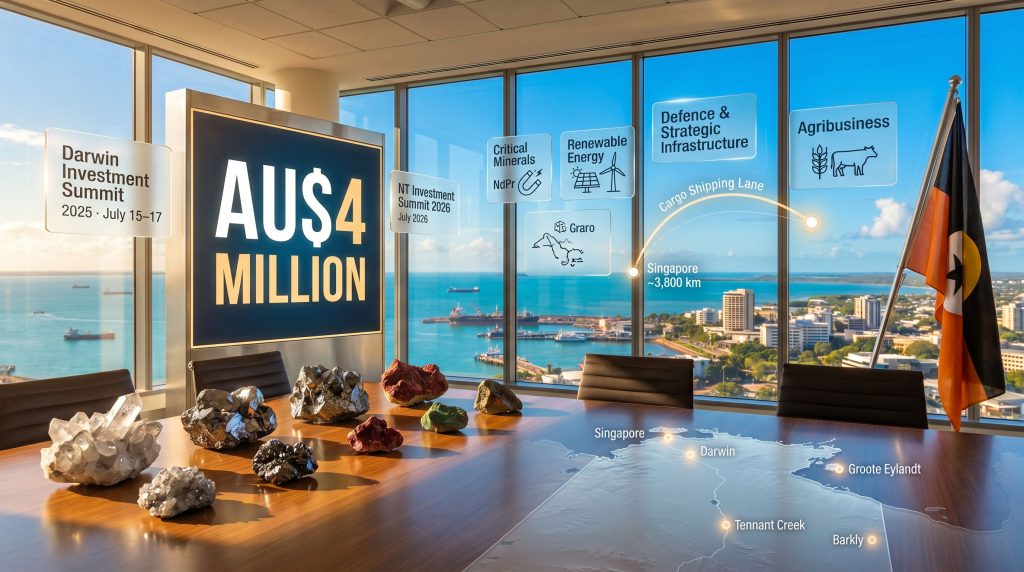
The Northern Territory Government's decision to allocate AU$4 million over two years to its investor engagement program is not simply a marketing budget. It represents an institutional acknowledgment that capital attraction is now an operational function, not an occasional activity.
This funding is embedded within the government's overarching Year of Growth, Certainty and Security policy framework, which prioritises economic diversification, sovereign capability building in critical minerals, and infrastructure development to reduce the operational friction of investing in remote Northern Australia.
NT Minister for Trade, Business and Asian Relations Robyn Cahill has been direct about the stakes involved, noting publicly that global competition for investment is intensifying and that failing to maintain active engagement risks capital and investor attention migrating to rival jurisdictions. Cahill has also emphasised that the Territory's natural advantages — spanning world-class critical minerals, productive agricultural land, renewable energy capacity, and geographic proximity to Southeast Asian and Indo-Pacific markets — constitute a genuinely compelling proposition that requires active promotion rather than passive display.
The framing here is instructive: even jurisdictions with demonstrably superior natural assets must now compete on the quality of their investor relationships, not just the quality of their geology.
What Is the Northern Territory Investment Summit in Darwin?
The Northern Territory Investment Summit in Darwin functions as a high-level matchmaking forum designed to close the gap between institutional capital and investment-ready opportunities across the Territory's priority sectors. Rather than operating as an open-registration conference, the event is structured as an invite-only platform, deliberately curating participation to ensure that the ratio of credible capital allocators to project proponents remains high.
This curation strategy reflects a sophisticated understanding of how institutional investors actually make decisions. Large-scale capital commitments do not emerge from crowded trade expos. They develop through structured dialogue between decision-makers who have conducted preliminary due diligence and project proponents who can articulate clear risk-adjusted return profiles.
The 2026 edition of the summit, scheduled for July 2026 in Darwin, is explicitly positioned as a mechanism to convert investor interest into final investment decisions (FID) rather than simply building awareness. This is a materially more ambitious commercial objective than the typical investment forum.
Key Characteristics of the Summit Format
- Invite-only structure to maximise engagement quality between capital allocators and project owners
- Multi-sector framing covering critical minerals, defence, agribusiness, renewable energy, and tourism
- Integration of government, business, and community voices within a single structured forum
- Emphasis on presenting shovel-ready opportunities with advanced feasibility work and clear capital requirements
- Designed as the central pillar of a two-year, continuous investor engagement program rather than a standalone event
The Sectors Driving Northern Territory Investment Interest
One of the more strategically intelligent aspects of the NT's investment proposition is its deliberate diversification across multiple high-growth sectors. Rather than presenting itself as a single-commodity destination, the Territory has constructed a multi-thesis investment case that can speak to a broad range of institutional mandates.
Critical Minerals and the Energy Transition
Critical minerals represent the highest-urgency opportunity vector within the NT's investment proposition. The global energy transition is generating structural demand for battery metals, rare earth elements, and industrial minerals that cannot be satisfied by existing production pipelines. Furthermore, critical minerals and energy security concerns are increasingly shaping how sovereign wealth funds and institutional investors evaluate resource jurisdictions worldwide.
What makes the NT's critical minerals story particularly nuanced is the exploration-stage nature of many deposits. Investors evaluating this sector must differentiate between producing assets with defined reserve bases and earlier-stage projects that carry both higher upside potential and higher development risk. The NT's investment promotion program acknowledges this by emphasising shovel-ready opportunities, signalling that project proponents will be expected to arrive at the summit with substantive technical work already completed.
Defence, Renewable Energy, and Agribusiness
Beyond minerals, the NT's investment thesis spans sectors with distinct but equally compelling structural drivers:
- Defence and strategic infrastructure: The Territory's geographic position relative to the Indo-Pacific strategic theatre creates natural demand for defence-adjacent infrastructure. In addition, Australia's defence critical materials strategy is increasingly directing capital towards Northern Territory projects with dual-use potential, with the existing presence of Australian Defence Force assets providing a foundation for further development
- Renewable energy: High solar irradiance levels and large-scale land availability underpin a credible case for utility-scale solar, wind, and potentially green hydrogen export infrastructure targeting Asian energy markets
- Agribusiness: Productive land with proximity to high-growth Asian food markets offers a differentiated agricultural investment story, though water security and climate variability remain risk factors that sophisticated investors will interrogate
- Tourism: Unique cultural and natural assets represent an underdeveloped opportunity, with international visitation remaining well below the Territory's potential
Geographic Proximity as a Structural Advantage
The NT's most defensible competitive advantage is one that no policy intervention can replicate: its geographic position as Australia's closest major jurisdiction to Southeast Asia. Darwin sits closer to key Southeast Asian capitals than any other Australian city, a fact that carries tangible commercial implications across every sector the summit promotes.
For critical minerals, shorter shipping distances translate directly into lower logistics costs and faster supply chain response times for Asian manufacturing customers. For defence infrastructure, proximity to the Indo-Pacific theatre is self-evidently strategic. For agribusiness, access to the world's fastest-growing food consumption markets via relatively short supply chains is a genuine differentiator versus southeastern Australian producers.
Geographic advantages are among the most durable investment theses available, precisely because they cannot be replicated by competing jurisdictions regardless of policy effort or capital expenditure.
This is why Cahill's characterisation of NT's proximity to Southeast Asian and Indo-Pacific markets as "unmatched" is analytically accurate rather than merely promotional.
Why Passive Investment Attraction No Longer Works
Understanding why the NT has committed $4 million to proactive engagement requires appreciating the macro-level forces reshaping capital allocation for resource and infrastructure projects globally.
The Competitive Landscape Has Fundamentally Changed
Several structural pressures are making capital attraction more contested than at any previous point in Australia's mining history:
- Indo-Pacific jurisdictions are developing their own critical minerals extraction and processing capabilities, offering institutional investors alternative exposure to the same thematic demand drivers
- Other Australian states including Western Australia, Queensland, and South Australia are each running sophisticated, well-funded investment attraction programs targeting overlapping global capital pools
- Geopolitical realignment driven by ongoing supply chain restructuring is creating a narrowing but significant window during which jurisdictions perceived as stable and strategically aligned can secure long-term capital commitments
- Higher cost of capital environments mean that projects must demonstrate clearer risk-adjusted return profiles to compete for funding against a broader opportunity set than existed during low-rate regimes
Against this backdrop, Australia's resource export challenges are compounding the urgency for the NT to differentiate itself, making the government's decision to fund sustained in-market engagement a rational response to changed competitive conditions rather than discretionary spending.
The next major ASX story will hit our subscribers first
The Northern Australia Infrastructure Facility: De-Risking the Proposition
One element of the NT investment ecosystem that deserves careful attention from capital allocators is the role of the Northern Australia Infrastructure Facility (NAIF), a Commonwealth financing vehicle with a mandate to support infrastructure development across Northern Australia.
NAIF's involvement in the NT investment landscape is strategically significant for several reasons:
- It can provide concessional debt financing to projects that may not qualify for conventional commercial lending at viable rates, improving the bankability of earlier-stage infrastructure
- Its participation in the investment summit ecosystem signals alignment between Territory-level and federal-level investment objectives
- For co-investors alongside NAIF-backed projects, the facility's involvement can modify the sovereign risk premium attached to NT exposure, improving risk-adjusted return calculations
For institutional investors evaluating Northern Australia for the first time, understanding NAIF's financing toolkit is essential context for assessing how project capital structures can be assembled.
How the NT Investment Summit Compares in Australia's Events Landscape
| Forum | Location | Primary Focus | Format |
|---|---|---|---|
| NT Investment Summit | Darwin, NT | Critical minerals, defence, agribusiness, renewables | Invite-only, multi-sector |
| Mines and Money Online Connect | Online (July 14-15, 2026) | Global mining investment | Virtual, open registration |
| Northern Tasmanian Investment Conference | Tasmania | Regional development, resources | Regional, mixed format |
The NT Investment Summit's geographic specificity and explicit Indo-Pacific orientation give it a distinct identity that generalist mining investment forums cannot replicate. For investors specifically evaluating Northern Australia exposure, it functions as the primary structured engagement opportunity in the calendar. The Northern Territory exploration initiative further strengthens this position by expanding the pipeline of investment-ready projects that can be showcased at such events.
What Capital Allocators Should Know Before July 2026
For institutional investors, sovereign wealth representatives, and infrastructure funds considering participation in the Northern Territory Investment Summit in Darwin, several analytical frameworks are worth applying before arrival.
A Risk-Adjusted Assessment of NT's Core Investment Factors
| Strategic Factor | NT Advantage | Key Risk Consideration |
|---|---|---|
| Geographic position | Closest Australian jurisdiction to SE Asia | Remote infrastructure cost premiums |
| Critical minerals endowment | Diversified battery and industrial metals | Exploration-stage risk on many deposits |
| Renewable energy potential | High solar irradiance, abundant land | Grid connectivity and storage investment required |
| Defence alignment | Indo-Pacific proximity | Geopolitical sensitivity in certain sectors |
| Agribusiness | Productive land, Asian market access | Water security and climate variability |
| Policy framework | Two-year funded engagement program | Policy continuity across election cycles |
The most sophisticated investors will arrive at Darwin with a clear understanding of where each potential investment sits on the development spectrum, from early-stage exploration requiring patient capital to infrastructure-ready projects capable of absorbing institutional scale commitments in the near term.
The NT Government's emphasis on shovel-ready opportunities is a meaningful signal in this respect. Project proponents who cannot demonstrate advanced feasibility work, defined capital requirements, and a credible path to financial close are unlikely to meet the threshold that serious capital allocators require. Consequently, the junior mining investment landscape is also evolving in response, with smaller explorers increasingly structuring their projects to meet institutional due diligence standards ahead of summit participation.
The 2026 Northern Territory Investment Summit in Darwin represents a concentrated opportunity to evaluate a jurisdiction that combines geological substance, strategic geographic positioning, and a government demonstrably committed to making investment processes work. Whether that combination translates into capital commitment depends ultimately on the quality of individual project propositions, but the platform to make that case — hosted by Darwin Major Business Group alongside government and industry partners — has never been better resourced.
Disclaimer: This article contains forward-looking statements and analysis based on publicly available information as of the date of publication. It does not constitute financial or investment advice. Readers should conduct independent due diligence and consult qualified advisers before making investment decisions. Forecasts, projections, and opinions expressed herein are subject to change without notice.
Want to Identify the Next Major ASX Mineral Discovery Before the Market Does?
Discovery Alert's proprietary Discovery IQ model delivers real-time alerts on significant ASX mineral discoveries across the critical minerals and resources sectors driving Northern Territory investment interest — instantly converting complex geological announcements into actionable insights for both short-term traders and long-term investors. Explore historic discoveries and their exceptional returns, then begin your 14-day free trial at Discovery Alert to position yourself ahead of the broader market.