June 6, 2026
Europe's Energy Architecture and the Strategic Logic of Offshore Licensing
The architecture of European energy supply has never been more scrutinised than in the years following the continent's forced reckoning with Russian pipeline dependency. Long before individual licensing announcements make headlines, the structural decisions made inside national energy ministries determine whether Europe faces supply shortfalls in the mid-2030s or manages a controlled and well-supplied energy transition. Exploration licensing is not a short-cycle business. The wells drilled under licenses awarded in 2027 may not contribute meaningful production volumes until the following decade, meaning decisions made today carry disproportionate long-term weight.
Against this backdrop, the Norway APA 2026 licensing round represents something considerably more consequential than a routine administrative exercise. It is an expansion of the exploration frontier across three geological basins, a consolidation of two parallel licensing pathways into a single coherent framework, and a policy signal from one of the world's most transparent petroleum administrations that the Norwegian Continental Shelf remains open, investable, and strategically oriented toward European supply. Furthermore, energy transition pressures across the continent make this kind of long-range supply planning increasingly critical.
When big ASX news breaks, our subscribers know first
What the Norway APA 2026 Licensing Round Actually Is
The Awards in Predefined Areas process operates on an annual rhythm that distinguishes it fundamentally from conventional numbered licensing rounds. Rather than opening episodic, large-scale competitive processes across broad frontier territories every several years, the APA framework identifies geologically mature zones of the Norwegian Continental Shelf and makes them available for competitive application on a predictable, annual basis.
The Norway APA 2026 licensing round was formally announced by the Norwegian Ministry of Energy on May 5, 2026, with applications required to be submitted to the Norwegian Offshore Directorate by September 1, 2026. Production license awards are scheduled for announcement during Q1 2027, providing companies with a defined six-month evaluation window between submission and outcome.
The round covers exploration acreage across all three major basins of the Norwegian Continental Shelf:
- The North Sea, the most infrastructure-dense and geologically mature of the three basins
- The Norwegian Sea, occupying an intermediate exploration maturity position with established but less dense infrastructure
- The Barents Sea, the highest-latitude and most frontier-oriented basin on the shelf
A feature that sets APA rounds apart from frontier numbered rounds is the binding work program requirement. Every APA licensee must commit to a specific programme of exploration activities, defined timelines, and technical deliverables before a license is awarded. Non-performance results in mandatory relinquishment, a mechanism deliberately constructed to prevent speculative acreage hoarding and ensure active stewardship of Norwegian petroleum resources.
The Key Dates and Numbers at a Glance
| Milestone | Date |
|---|---|
| APA 2026 Officially Announced | May 5, 2026 |
| Application Deadline | September 1, 2026 |
| Expected License Awards | Q1 2027 |
| Total New Blocks Added vs. APA 2025 | 70 blocks |
A Deliberate Northward Shift: The Basin-by-Basin Breakdown
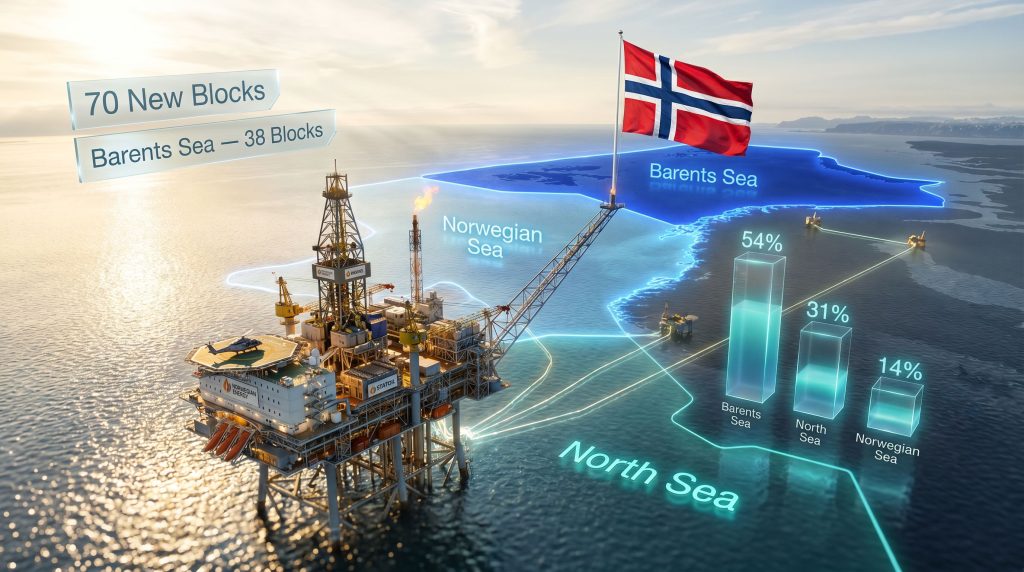
The 70 new blocks added to the APA 2026 predefined area since APA 2025 are not distributed evenly, and that asymmetry is analytically significant. The Norwegian Offshore Directorate confirmed that since APA 2025, the predefined areas have been expanded by 22 blocks and parts of blocks in the North Sea, 10 blocks in the Norwegian Sea, and 38 blocks in the Barents Sea.
| Basin | Blocks Added Since APA 2025 | Share of Total Expansion |
|---|---|---|
| Barents Sea | 38 | ~54% |
| North Sea | 22 | ~31% |
| Norwegian Sea | 10 | ~14% |
| Total | 70 | 100% |
The Barents Sea's dominance of the expansion, accounting for more than half of all new blocks, reflects a deliberate strategic reorientation. This high-latitude basin has historically been underexplored relative to its estimated geological potential, partly due to infrastructure constraints, partly due to exploration risk perception, and partly due to the political complexity surrounding arctic frontier development.
Why the Barents Sea Expansion Matters
The Barents Sea presents a different exploration risk-reward calculus compared to the more mature North Sea. Subsurface characterisation data is less abundant, infrastructure is sparse relative to southern basin density, and development costs for any discoveries are materially higher. Yet the Norwegian government's repeated prioritisation of Barents Sea acreage in successive APA expansions reflects long-standing resource assessments suggesting significant undiscovered volumes in the basin.
What makes this expansion particularly notable is the timeline implication. Discoveries made under APA 2026 Barents Sea licenses, assuming successful exploration, would not realistically enter production until the late 2030s at the earliest. The Norwegian government is consequently making infrastructure and development commitments today for energy supply that European markets may depend on in a decade or more.
For the North Sea, the 22 additional blocks represent an incremental extension of already well-characterised acreage. The strategic logic here differs from the Barents Sea: near-infrastructure discoveries in the North Sea carry materially lower development costs and shorter timelines to first production, potentially contributing volumes within five to seven years of a successful exploration well. This makes North Sea APA acreage particularly attractive to operators managing portfolio-level production decline curves.
Why Norway Chose Expansion Over Contraction
The timing of this expansion is not incidental. Norwegian Prime Minister Jonas Gahr Støre's public statement at the announcement directly connected the petroleum sector's continued development to four distinct national and continental objectives: the creation of substantial societal value, sustaining employment across Norwegian regions, protecting collective welfare, and contributing to European energy security.
This framing matters because it reflects the Norwegian government's explicit rejection of the contraction narrative that has dominated energy transition discourse in some European capitals. Rather than treating petroleum licensing as a rearguard action in a retreating industry, the Støre administration positions APA 2026 as an affirmative investment in European supply resilience. In addition, elevated European gas prices in recent years have reinforced the political logic of maintaining domestic supply development.
The economic rationale is substantial. Norway's petroleum sector generates fiscal revenues that flow into the Government Pension Fund Global, the sovereign wealth fund that underpins Norwegian public finances. Sustained exploration success maintains the production pipeline that funds this contribution. As legacy fields on the Norwegian Continental Shelf mature and decline, new exploration discoveries provide the replacement volumes necessary to sustain output at commercially and fiscally meaningful levels.
The Consolidation of the 26th Numbered Licensing Round
One of the more structurally significant aspects of APA 2026 is what it absorbed. Acreage that companies nominated for the proposed 26th numbered licensing round during autumn 2025 has been incorporated into the APA 2026 predefined area portfolio. As a direct consequence, the Norwegian Ministry of Energy confirmed that a separate 26th numbered licensing round will not be held in 2026, though work on the 26th round framework continues in parallel for future deployment.
This consolidation reflects administrative efficiency and portfolio coherence rather than any retreat from exploration ambition. The effect is to concentrate competitive licensing activity into a single, unified APA process rather than maintaining two parallel tracks demanding separate applications, evaluations, and award processes from both operators and regulators.
How APA 2025 Established the Competitive Baseline
Understanding APA 2026's competitive landscape requires a clear picture of what preceded it. In January 2026, 57 production licenses were awarded to 19 companies across the Norwegian Continental Shelf under the APA 2025 round. The previous application deadline was September 2, 2025, and 20 companies had submitted applications, indicating near-universal conversion of applicants to awardees.
| APA 2025 Metric | Detail |
|---|---|
| Total Production Licenses Awarded | 57 |
| Companies Receiving Licenses | 19 |
| North Sea Licenses | 31 |
| Norwegian Sea Licenses | 21 |
| Barents Sea Licenses | 5 |
| Application Deadline | September 2, 2025 |
| Total Applicants | 20 companies |
The distribution of licenses across basins in APA 2025 tells its own story: the North Sea's 31 licenses versus the Barents Sea's 5 licenses illustrates the profound maturity gap between the basins. The APA 2026 Barents Sea expansion of 38 new blocks signals intent to shift that balance over successive rounds.
Who Dominated APA 2025
The competitive landscape in APA 2025 was characterised by a relatively concentrated award distribution among established NCS operators, with Equinor maintaining its position as the dominant participant:
| Operator | Licenses Offered | Operator Roles |
|---|---|---|
| Equinor Energy AS | 35 | 17 |
| Aker BP ASA | 22 | 12 |
| DNO Norge AS | 17 | 4 |
| Vår Energi | 14 | Not specified |
| Harbour Energy Norge AS | 9 | 4 |
Equinor's position across 35 licenses with 17 operator roles reflects the company's dual function on the NCS: as both the largest single participant in exploration and as the de facto infrastructure backbone operator across multiple basin regions. This infrastructure advantage creates compounding competitive benefits in APA rounds, as proximity to existing Equinor-operated infrastructure lowers development cost thresholds for adjacent exploration acreage.
For smaller independents, the APA framework offers niche opportunities in areas where major operators have lower strategic interest, particularly in the Norwegian Sea where basin-scale exploration campaigns may favour focused, high-conviction players over portfolio-driven majors.
The Infrastructure Proximity Variable: What Separates Mature from Frontier Acreage
A critical but frequently underappreciated dimension of APA block evaluation is infrastructure proximity. On the Norwegian Continental Shelf, the economic viability of a discovery is often determined less by its geological size and more by its distance from existing production infrastructure.
Tie-back economics fundamentally change the development threshold for smaller discoveries. A field that would be sub-commercial as a standalone development can become economically viable if it sits within tie-back distance of an existing production platform or pipeline system. This dynamic makes APA acreage in the mature North Sea particularly attractive to operators managing existing infrastructure utilisation, as incremental exploration success can extend platform life and improve overall asset economics.
Partial block availability within the APA predefined area also creates strategic opportunities for smaller operators. Rather than competing for entire blocks, companies can apply for partial blocks adjacent to existing interests, allowing targeted exploration of specific prospects without the cost burden of holding larger acreage positions.
The next major ASX story will hit our subscribers first
Norway's APA Model Versus Global Offshore Licensing Frameworks
The Norwegian APA structure is genuinely distinctive by international comparison. Annual licensing, predefined area methodology, binding work programs, and near-universal awardee conversion ratios combine to create a framework that prioritises active exploration over speculative land banking. However, understanding Norway's approach also benefits from considering broader shifts in global LNG supply dynamics and how those shifts influence national licensing strategies.
| Framework Attribute | Norway APA | UK Offshore Licensing | Brazil Pre-Salt Rounds |
|---|---|---|---|
| Frequency | Annual | Periodic | Periodic |
| Target Areas | Predefined mature zones | Open competitive | Defined pre-salt blocks |
| Work Program Binding | Yes, mandatory | Yes | Yes |
| State Participation | Equinor (partial) | No direct state entity | Petrobras (mandatory) |
| Award Timeline | ~6 months post-deadline | Varies | Varies |
The Brazilian pre-salt model requires mandatory Petrobras participation in every license, introducing a state-enterprise layer that can complicate operational decision-making. UK offshore licensing, while broadly competitive, lacks Norway's annual rhythm and predefined area discipline, creating less predictable access to mature acreage.
Norway's approach is often cited among petroleum industry practitioners as a benchmark for mature basin management, offering regulatory predictability, geological transparency through comprehensive Norwegian Offshore Directorate data sharing, and a fiscal regime designed to maintain exploration attractiveness across commodity price cycles. For further detail, the Norwegian Offshore Directorate's licensing position provides authoritative documentation on APA 2026 block maps and predefined area boundaries.
Long-Term Production Implications: What APA 2026 Means for the 2030s
The exploration decisions made under APA 2026 licenses have a production timeline that extends well beyond the immediate term. For the North Sea, discoveries made under 2026-awarded licenses could realistically reach production by the early 2030s given existing infrastructure density and shorter development timelines. For the Norwegian Sea and particularly the Barents Sea, the timeline extends further, with large frontier developments potentially requiring until the late 2030s or beyond to achieve first production.
This is precisely why the Norway APA 2026 licensing round carries implications for European energy security that extend far beyond 2026-2027. The decisions made by the Norwegian Ministry of Energy today are functionally energy policy decisions for the mid-2030s energy landscape, a period when Europe's energy transition trajectory and residual fossil fuel demand will become considerably clearer. Comparisons with decisions such as the North West Shelf extension in Australia illustrate how governments globally are wrestling with similar long-range supply planning challenges.
As legacy fields across the NCS continue their natural production decline, the pipeline of exploration licenses being awarded in successive APA rounds provides the mechanism for reserve replacement. Without consistent exploration activity, Norwegian Continental Shelf output would face accelerating decline in the 2030s, removing a critical pillar of European gas supply at precisely the period when transition-related demand uncertainty peaks. Furthermore, oil market impacts from geopolitical disruption make this kind of supply-side resilience even more strategically valuable.
Frequently Asked Questions: Norway APA 2026
What is the deadline to apply for the APA 2026 licensing round?
Applications must be submitted to the Norwegian Offshore Directorate by September 1, 2026.
How many new blocks have been added to the APA 2026 predefined areas?
A total of 70 new blocks have been added since APA 2025, spanning all three NCS basins.
Will the 26th numbered licensing round still proceed?
A separate 26th round will not be held in 2026. Nominated acreage has been absorbed into APA 2026. The Norwegian Ministry of Energy continues developing the 26th round framework for future use.
When will APA 2026 license awards be announced?
Awards are expected during Q1 2027.
What basins are covered under APA 2026?
The round covers the North Sea (22 new blocks), the Norwegian Sea (10 new blocks), and the Barents Sea (38 new blocks).
Which companies participated in APA 2025?
Twenty companies applied, with 19 receiving production licenses. Major participants included Equinor Energy AS, Aker BP ASA, DNO Norge AS, Vår Energi, and Harbour Energy Norge AS.
Key Takeaways: Norway APA 2026 at a Glance
- 70 new blocks have been added to the predefined area since APA 2025, spanning all three major NCS basins
- The Barents Sea received the largest expansion with 38 new blocks, representing over half of total additions and signalling a deliberate northward strategic shift
- The application deadline is September 1, 2026, with awards expected in Q1 2027
- The 26th numbered licensing round will not be held in 2026, with nominated acreage consolidated into the APA 2026 framework
- Binding work programs remain mandatory for all APA licenses, ensuring active exploration stewardship and preventing speculative acreage hoarding
- APA 2025 awarded 57 production licenses to 19 companies across the North Sea, Norwegian Sea, and Barents Sea in January 2026
- The round reflects Norway's continued commitment to European energy security and long-term supply resilience at a time of sustained continental supply pressure
This article is based on publicly available information from the Norwegian Ministry of Energy and the Norwegian Offshore Directorate as reported by the Oil & Gas Journal (May 5, 2026). Forecasts regarding production timelines, competitive dynamics, and energy market outcomes are inherently speculative and subject to change based on geological, regulatory, commercial, and geopolitical factors. Nothing in this article constitutes financial or investment advice. Readers should consult official Norwegian Offshore Directorate and Norwegian Ministry of Energy resources at sodir.no and regjeringen.no for authoritative licensing documentation, APA 2026 block maps, and production license registries.
Want to Capitalise on the Resource Discoveries Driving the Next Decade of Energy Supply?
Discovery Alert's proprietary Discovery IQ model delivers real-time alerts on significant ASX mineral discoveries — transforming complex geological data into actionable investment insights for both short-term traders and long-term investors. Explore why major mineral discoveries can generate exceptional market returns and begin your 14-day free trial today to position yourself ahead of the broader market.