July 23, 2026

When Concentrated Ownership Meets World-Class Geology: The Case for Full Consolidation
The history of large-scale gold project development is littered with examples where shared ownership became the single greatest obstacle to advancement. Joint ventures that once made financial sense during early exploration phases often calcify into bureaucratic stalemates as projects mature toward production decisions. Capital allocation debates, diverging strategic priorities, and misaligned timelines between partners can delay projects by years, even decades. Against that backdrop, the announcement of the Novagold Paulson Donlin Gold merger represents something genuinely unusual in modern mining: a deliberate, structured move to consolidate full control of a generational asset under one roof before the critical development clock begins ticking.
Understanding why this transaction matters requires looking beyond the headline figures and examining the underlying geology, the ownership evolution, and the financial architecture being assembled around what could become the most significant gold mine in American history. Furthermore, the broader gold market outlook makes the timing of this consolidation particularly instructive for investors tracking large-scale development assets.
When big ASX news breaks, our subscribers know first
The Asset at the Center of Everything: What Makes Donlin Gold Exceptional
Not all gold deposits are equal, and Donlin Gold sits in a category occupied by very few projects globally. Located in western Alaska along the Kuskokwim River corridor, the deposit contains one of the largest undeveloped gold resource bases anywhere in the world. What elevates it beyond raw size is the combination of grade, scale, and projected output duration.
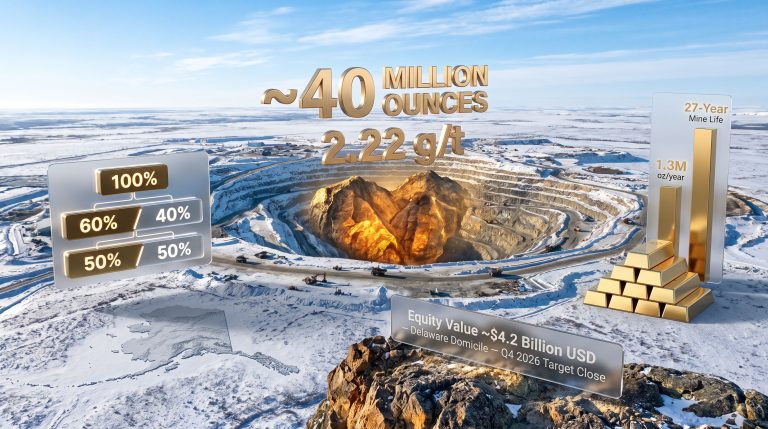
The project is designed to produce approximately 1.3 million ounces of gold annually during its first decade of operation, before settling into a sustained output rate of around 1.1 million ounces per year across a total mine life of 27 years. To place that in perspective:
| Project | Location | Est. Annual Production | Mine Life |
|---|---|---|---|
| Donlin Gold | Alaska, USA | 1.3M oz (first decade) | 27 years |
| Detour Lake | Ontario, Canada | ~700,000 oz | 22+ years |
| Canadian Malartic | Québec, Canada | ~600,000 oz | 15+ years |
| Goldrush/Fourmile | Nevada, USA | ~400,000 oz (est.) | TBD |
Most assets classified as Tier 1 gold mines globally produce between 500,000 and 1 million ounces annually. Donlin's projected peak output sits firmly above that range, placing it in elite company alongside operations like Muruntau in Uzbekistan and Olimpiada in Russia. In a North American context, no development-stage project comes close.
The Grade Advantage: Why Donlin's Geology Is Difficult to Replicate
One detail that frequently gets overlooked in coverage of Donlin Gold is the significance of its ore grade relative to other large open-pit gold systems. Many bulk-tonnage gold operations rely on grades below 0.5 grams per tonne to justify their economics, particularly in low-cost jurisdictions. Donlin's resource grade profile is materially higher, which fundamentally improves the project's economic sensitivity to gold price movements.
Higher grade deposits generate more ounces per tonne of ore processed, which directly compresses unit costs per ounce produced. In an environment where the gold price outlook has trended through historically elevated levels, the leverage embedded in a high-grade, long-life system like Donlin becomes increasingly compelling for institutional capital seeking exposure to the metal.
The deposit is hosted within a series of intrusion-related gold systems, a geological setting that tends to produce continuous, predictable mineralisation rather than the erratic, high-nugget-effect bodies that complicate grade control at many other projects. This geological consistency is, consequently, a material advantage when modelling production profiles across a multi-decade mine life.
How Ownership of Donlin Gold Evolved: The Three-Phase Restructuring
The current transaction did not emerge in isolation. It is the culmination of a deliberate ownership restructuring that began in earnest in April 2025, when Novagold and Paulson Advisers jointly acquired Barrick Gold's 50% stake in Donlin Gold for $1 billion in cash. That transaction marked a pivotal inflection point, removing a major mining company from the ownership structure and replacing it with a more focused, development-oriented investor base.
| Period | Ownership Structure |
|---|---|
| Pre-April 2025 | Novagold 50%, Barrick Gold 50% |
| April 2025 to July 2026 | Novagold 60%, Paulson Advisers 40% |
| Post-Merger (expected Q4 2026) | NovaGold Corporation 100% |
The interim two-party structure between Novagold and Paulson was always understood to be a transitional arrangement. With Barrick's exit, both parties had signalled a shared conviction in Donlin's potential, but a joint venture between a listed mining company and a private investment adviser still carries structural friction. The Novagold Paulson Donlin Gold merger resolves that friction entirely by bringing both economic interests under a single publicly listed entity.
Why the Barrick Exit Was a Strategic Catalyst, Not Just a Transaction
Barrick's decision to divest its Donlin stake deserves more analytical attention than it typically receives. For Barrick, Donlin represented a long-dated, high-capital-intensity development project in a remote jurisdiction with no near-term production timeline. For a major producer managing a global portfolio and shareholder expectations around near-term cash flow, such assets are difficult to prioritise.
For Novagold and Paulson, however, Donlin was precisely the kind of asset worth holding. Both parties demonstrated a willingness to deploy $1 billion in cash to acquire that stake, signalling genuine long-term conviction rather than opportunistic positioning. That conviction is now being formalised through full consolidation.
The Novagold Paulson Donlin Gold Merger: Transaction Structure and Key Terms
The transaction announced on July 22, 2026, involves Novagold Resources acquiring Paulson's 40% interest in Donlin Gold through an all-share exchange. No cash changes hands. Paulson receives approximately 35% ownership in the new entity on a fully diluted basis, while existing Novagold shareholders retain approximately 65% of the combined company.
*Taking into account Paulson's pre-existing equity stake in Novagold, its total economic interest in NovaGold Corporation rises to approximately 40%, while its voting rights are structurally capped at 19.99% to protect minority shareholders.*
Key Transaction Details:
| Metric | Detail |
|---|---|
| Transaction Type | All-share acquisition |
| Acquirer | Novagold Resources (TSX/NYSE) |
| Asset Acquired | Paulson's 40% interest in Donlin Gold |
| Pre-Deal Novagold Ownership | 60% of Donlin Gold |
| Post-Deal Ownership | 100% of Donlin Gold |
| New Entity Name | NovaGold Corporation |
| Listing Exchange | NYSE |
| Implied Equity Value | ~$4.2 billion |
| Paulson Equity (fully diluted) | ~35% |
| Paulson Economic Interest (total) | ~40% |
| Paulson Voting Cap | 19.99% |
| Expected Close | Q4 2026 |
Why an All-Share Structure Matters for Existing Shareholders
The mechanics of an all-share transaction have specific implications for Novagold's existing shareholder base. Unlike a cash acquisition, where capital leaves the balance sheet, a share-based deal preserves liquidity while diluting existing ownership percentages. The critical question is whether the value added per share through acquiring the remaining 40% of Donlin outweighs the dilution effect.
Novagold's management has indicated the deal is accretive across multiple key metrics, including:
- Net asset value per share, with 100% of Donlin's NPV now attributed to NovaGold Corporation shareholders
- Gold reserves and resources per share, as the attributable ounce base increases without a corresponding increase in overhead
- Projected attributable production per share, where moving from 60% to 100% ownership materially changes the production profile assigned to each share
The denominator effect of share issuance is more than offset, in management's assessment, by the numerator gains from full ownership of a project of this scale.
Governance Architecture: Balancing Paulson's Influence With Minority Protections
One of the more technically sophisticated elements of this transaction is the governance framework constructed around Paulson's substantial economic interest. Holding approximately 40% of the economic interest in any public company would traditionally confer significant influence over corporate direction. The structure here, however, deliberately separates economic participation from voting control.
Paulson's voting rights are capped at 19.99%, preventing it from exercising de facto control while preserving its financial upside. The company's board will expand from 10 to 11 directors, with Paulson retaining the right to nominate two directors provided its equity ownership remains above the 15% threshold.
If Paulson's shareholding were to fall below 15% through secondary market activity or dilutive capital events, it would forfeit the right to nominate a second board director. This creates a structural incentive for Paulson to maintain a substantial long-term position rather than reduce its stake through open market sales.
Proposed Leadership Structure of NovaGold Corporation:
| Role | Individual |
|---|---|
| Co-Chair | Dr. Thomas Kaplan |
| Co-Chair | John Paulson |
| Paulson Board Designee 1 | John Paulson |
| Paulson Board Designee 2 | Marcelo Kim |
| Total Board Size | 11 Directors |
Dr. Thomas Kaplan's long-standing conviction about Donlin Gold's place in the global gold landscape has been a defining narrative thread throughout the project's development history. His characterisation of Donlin as the defining prize for gold mining investors underscores the degree to which this transaction is driven by strategic vision rather than short-term financial engineering.
John Paulson's involvement brings a different but complementary dimension: the perspective of an investor who made one of the most celebrated macro trades in financial history through his thesis on the US housing market, and who subsequently built a substantial position in gold as both a monetary hedge and a long-duration value play. His transition from fund manager to active project developer through this merger represents a meaningful evolution of that thesis.
The $4.2 Billion Valuation: Is the Price Justified?
Evaluating whether the $4.2 billion implied equity value of NovaGold Corporation is defensible requires examining multiple valuation frameworks simultaneously.
| Valuation Factor | Relevance to the $4.2B Figure |
|---|---|
| Gold price environment | Elevated spot prices amplify the NPV of long-dated assets |
| Full ownership consolidation | Eliminates the joint venture discount markets previously applied |
| US-domiciled asset | Geopolitical and supply chain security considerations add premium |
| 27-year mine life | Long-duration cash flows support higher enterprise value multiples |
| 1.3M oz/year peak production | Tier 1 scale justifies institutional-grade valuation frameworks |
At gold prices trading near historical highs in 2026, the net present value of a project producing over 1 million ounces annually for nearly three decades is inherently sensitive to the discount rate applied and the long-term price assumption used. Modest increases in gold price assumptions produce outsized NPV gains for long-life, high-volume assets, a dynamic that currently favours projects like Donlin.
The removal of the joint venture discount is particularly significant. Markets consistently apply a discount to projects where ownership is split between parties with potentially divergent timelines and capital priorities. Full consolidation eliminates that analytical haircut entirely. This dynamic is consistent with broader gold M&A activity trends, where single-entity control is increasingly being rewarded by institutional investors.
The next major ASX story will hit our subscribers first
Risks That Sophisticated Investors Must Weigh
No honest analysis of the Novagold Paulson Donlin Gold merger is complete without a clear-eyed assessment of the challenges that remain.
Development-Stage Risks:
- Donlin's location in remote western Alaska requires significant infrastructure development including power generation, transportation corridors, and water management systems, all of which add to capital costs
- Federal and state mining permits for large-scale projects in Alaska are complex and involve multiple regulatory agencies alongside Indigenous land and community consultation requirements
- The capital requirement to bring Donlin to production is substantial, and securing that financing under a newly restructured entity will require robust market conditions and strong institutional appetite
Transaction-Specific Risks:
- All-share dilution affects existing Novagold shareholders proportionally, and the accretion thesis depends on gold price assumptions and execution timelines that remain uncertain
- Paulson's concentrated economic interest, while voting-capped, still represents a significant block that could influence secondary market dynamics if positions are ever reduced
- The Q4 2026 transaction close is conditional on shareholder approval and regulatory clearance, introducing timeline uncertainty
This article does not constitute financial advice. Investors should conduct independent due diligence and consider their personal risk tolerance before making investment decisions related to any securities mentioned.
What Full Ownership Changes for Donlin's Development Path
The most consequential operational benefit of the Novagold Paulson Donlin Gold merger is the elimination of joint venture decision-making friction. Under a 60/40 split structure, every major capital allocation decision, every change in development strategy, and every contractor engagement required alignment between two distinct entities with separate boards, separate fiduciary obligations, and potentially different views on timing.
Under single-entity control, NovaGold Corporation can pursue development decisions with a speed and coherence that joint venture structures fundamentally cannot replicate. Key milestones still ahead include:
- Formal transaction close in Q4 2026, triggering the legal restructuring of Donlin Gold ownership
- Infrastructure planning advancement for power, transport, and site access in a remote Alaskan setting
- A definitive feasibility study progression and capital cost confirmation
- Capital raise strategy development under the new NovaGold Corporation balance sheet
- Regulatory and permitting engagement at both state and federal levels
The Broader Signal: What This Merger Says About US Gold Development
The decision to domicile NovaGold Corporation in Delaware and list exclusively on the NYSE rather than maintaining the TSX dual-listing carries strategic implications beyond administrative convenience. It positions the company squarely within the US institutional investment ecosystem at a moment when domestic resource security has become a more prominent theme in policy and portfolio construction discussions.
Large domestic gold producers reduce dependence on foreign-sourced precious metals and contribute to supply chain resilience in ways that are increasingly valued across different investor categories. For a project of Donlin's scale, advancing toward production would represent a transformative event not only for the company and its shareholders, but for Alaska's broader mining economy and the domestic gold supply landscape.
The Novagold Paulson Donlin Gold merger is, at its core, a bet on a very specific thesis: that the combination of exceptional geology, full ownership clarity, elevated gold prices, and aligned long-term capital can overcome the considerable infrastructure and permitting challenges that have defined Donlin's long journey toward development. Whether that thesis proves correct will depend on execution, capital markets, and a commodity price environment that remains inherently unpredictable.
What is undeniable is that this transaction has fundamentally changed the structure of that bet, placing it in the hands of a single, focused entity rather than a divided joint venture, and providing that entity with a balance sheet and governance architecture designed for the long game.
Want to Track the Next Major Gold Discovery Before the Market Does?
Discovery Alert's proprietary Discovery IQ model scans ASX announcements in real time, instantly identifying significant mineral discoveries and delivering actionable alerts to subscribers — explore historic discoveries and the returns they generated, then begin your 14-day free trial to position yourself ahead of the broader market.