
July 25, 2026
What Does NSW's Coal Mining Moratorium Actually Mean for Australia's Energy Policy?
New South Wales halts new coal mines in a landmark policy shift that reflects Australia's complex navigation between climate commitments and economic imperatives. This regulatory transformation creates unprecedented challenges for the resource sector while maintaining crucial export revenues and regional employment. The decision represents a sophisticated approach to energy exports challenges that acknowledges both environmental responsibilities and economic realities.
The evolving regulatory framework reflects broader shifts in energy policy architecture, where state governments balance immediate economic needs against long-term environmental responsibilities. Furthermore, these challenges extend beyond simple binary choices between coal and renewables, encompassing sophisticated compliance mechanisms and workforce transition strategies. The transformation will reshape Australia's mining landscape for decades, incorporating mining decarbonisation benefits into strategic planning processes.
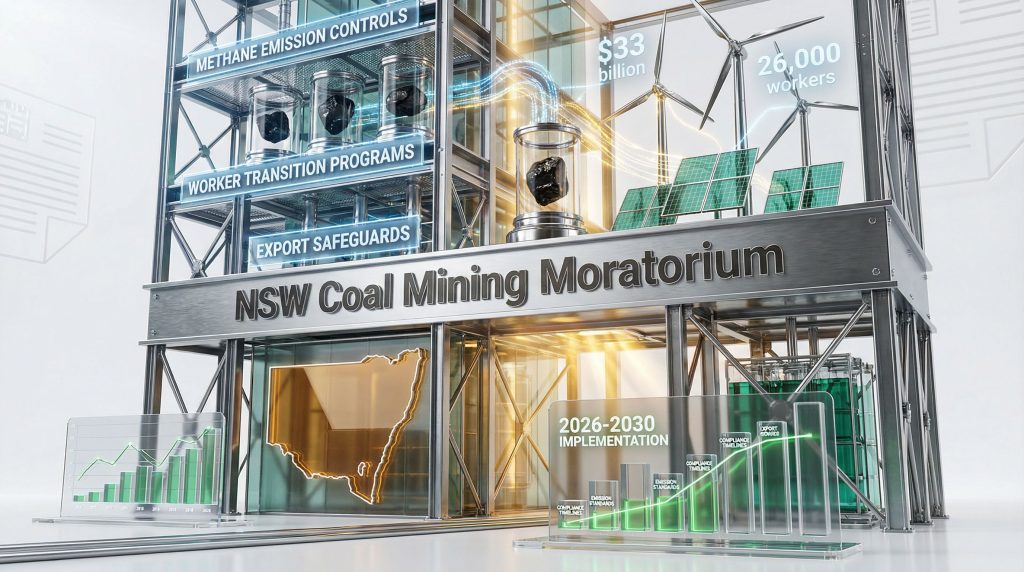
The moratorium establishes a clear distinction between different categories of mining activity, creating a regulatory pathway that protects current economic contributions while preventing further expansion of the coal extraction footprint. Consequently, this approach acknowledges the complex reality of managing a $33 billion annual export industry while meeting climate commitments. The policy framework demonstrates how states can implement critical minerals strategy initiatives alongside traditional resource management.
Defining the Scope of Greenfield Coal Restrictions
The policy framework creates specific definitions around what constitutes prohibited new development versus permissible expansion. However, greenfield restrictions apply to entirely new mining operations that would require fresh environmental approvals and community consultation processes.
This classification system allows existing operators to continue their activities and potentially expand operations adjacent to current sites, provided they meet enhanced environmental standards. In addition, the regulatory structure recognizes the difference between establishing new extraction sites and optimizing existing infrastructure.
Existing Operations vs. New Development Classifications
Under the new framework, coal producers can maintain output levels through operational efficiency improvements and limited expansion projects that demonstrate compliance with updated emission standards. This creates a pathway for industry adaptation without immediate economic disruption while supporting sustainability transformation objectives.
The policy acknowledges that abrupt cessation of all coal activity would create significant economic and social challenges for regional communities dependent on mining employment. Instead, it establishes controlled transition mechanisms that protect jobs while gradually reducing environmental impact through systematic industry evolution trends.
Federal vs. State Jurisdiction in Coal Policy Implementation
The NSW policy operates within Australia's complex federal system, where state governments control mineral rights and mining approvals while federal authorities oversee environmental protection and export regulations. This jurisdictional framework creates both opportunities and challenges for coordinated policy implementation.
State-level initiatives like the NSW moratorium can serve as policy laboratories that inform national approaches to resource transition. However, they also create potential inconsistencies across states that could affect investment decisions and market dynamics.
When big ASX news breaks, our subscribers know first
How Will Methane Emission Regulations Transform Coal Mining Operations?
The introduction of mandatory methane capture and treatment requirements represents one of the most significant operational changes facing NSW coal producers. These regulations target a major source of greenhouse gas emissions while creating new technological and compliance obligations for mining companies.
Methane emissions from coal mining operations differ fundamentally from other sources, as they release fossil methane stored underground for millions of years. Furthermore, this distinction makes coal mining methane particularly problematic from a climate perspective.
EPA's New Capture and Treatment Requirements
The Environmental Protection Authority has mandated that all major coal mining operations must capture, treat, or convert methane gas rather than releasing it directly into the atmosphere. This requirement applies to both active mining operations and legacy sites showing methane leakage.
| Regulation Type | Current Standard | New Requirement | Compliance Timeline |
|---|---|---|---|
| Gas Drainage | Voluntary | Mandatory capture | 2027-2030 |
| Flaring Systems | Basic standards | Advanced conversion | 2026-2028 |
| Seam Resealing | Limited scope | All legacy sites | 2026-2035 |
The technical requirements encompass multiple approaches to methane management, from pre-drainage systems that extract gas before mining begins to post-extraction treatment technologies. Consequently, companies must demonstrate continuous improvement in emission reduction performance.
Technology Compliance Pathways for Existing Miners
Coal producers face several technological options for meeting new methane emission standards. These range from enhanced gas drainage systems that capture methane for beneficial use to advanced flaring technologies that convert methane to carbon dioxide.
The compliance pathways recognize that different mining operations face varying geological and operational constraints. For instance, underground mines with high methane content may require different solutions than surface operations or older mines with complex gas migration patterns.
Investment requirements for compliance technology vary significantly based on mine characteristics, gas concentrations, and existing infrastructure. Some operations may achieve compliance through operational modifications, while others require substantial capital investments in new equipment and monitoring systems.
Enforcement Mechanisms and Penalty Structures
The regulatory framework includes comprehensive monitoring and reporting requirements that enable authorities to track compliance performance across all covered operations. Companies must submit baseline assessments, implement continuous monitoring systems, and undergo regular third-party audits.
Penalty structures are designed to ensure compliance costs remain lower than non-compliance penalties, creating clear economic incentives for technological investment. However, the enforcement approach emphasizes technical assistance and compliance support rather than purely punitive measures.
What Economic Safeguards Protect NSW's $33 Billion Coal Export Industry?
The policy framework includes specific provisions designed to protect NSW's substantial coal export revenues while gradually reducing the sector's environmental footprint. These safeguards recognize coal's continued importance to state finances and regional economies.
Coal exports from NSW primarily serve thermal power generation markets in China, Japan, and Taiwan, with established supply contracts and trading relationships. The policy aims to preserve these commercial relationships while preventing further expansion of extraction capacity.
Export Market Stability Provisions
The moratorium specifically protects existing export operations through grandfathering provisions that allow current producers to maintain market share and fulfil long-term supply contracts. This approach provides certainty for international customers while preventing market disruption.
*NSW thermal coal exports generate approximately $33 billion annually, with primary markets including China (35%), Japan (28%), and Taiwan (18%). The moratorium specifically protects these existing trade relationships through grandfathering provisions.*
Trade relationships in thermal coal markets depend on consistent supply reliability and quality specifications that have been developed over decades. Abrupt policy changes could damage Australia's reputation as a reliable supplier and create opportunities for competing exporters.
Adjacent Expansion Criteria and Approval Processes
While new greenfield development is prohibited, existing operations may apply for expansion approvals if they demonstrate compliance with enhanced environmental standards. This pathway allows for continued investment in efficiency improvements and infrastructure optimisation.
Expansion criteria include demonstration of advanced methane management, community consultation processes, and alignment with regional transition planning. In addition, the approval process balances economic benefits against environmental impact assessments and community concerns.
Investment Protection Mechanisms for Current Operations
The policy includes provisions to protect existing capital investments in coal mining infrastructure and equipment. This recognition of sunk costs helps maintain investor confidence while establishing clear parameters for future investment decisions.
Protection mechanisms extend to supporting infrastructure including rail lines, port facilities, and processing equipment that serve multiple mining operations. These shared infrastructure systems require coordinated planning to ensure continued viability.
How Does the Future Jobs and Investment Authority Address Workforce Transition?
The establishment of a Future Jobs and Investment Authority represents a comprehensive approach to managing the social and economic impacts of coal sector transition. This body will coordinate retraining programmes and economic development initiatives for affected communities.
NSW's coal industry directly employs an estimated 26,000 workers across mining operations, processing facilities, and supporting services. These jobs are concentrated in specific regional areas where coal mining represents a major source of local economic activity and community identity.
Parliamentary Review Process and Legislative Timeline
The Future Jobs and Investment Authority requires parliamentary approval before commencing operations, reflecting the significance of workforce transition challenges and the need for broad political support. The review process will examine funding mechanisms, governance structures, and performance measures.
Legislative consideration includes consultation with unions, industry associations, and regional communities to ensure the authority's mandate addresses practical transition needs. Consequently, the timeline for establishment affects how quickly support programmes can begin operation.
Retraining Programs for 26,000 Coal Industry Workers
Workforce transition programmes will focus on transferable skills that coal industry workers can apply in renewable energy, critical minerals extraction, and advanced manufacturing sectors. Many mining skills translate directly to other resource extraction and processing activities.
The retraining initiatives recognise that coal industry workers possess valuable technical expertise in equipment operation, safety management, and industrial processes. Furthermore, these programmes aim to build on existing capabilities rather than requiring complete skill replacement.
Key transition programme elements include:
• Technical certification in renewable energy installation and maintenance
• Equipment operation training for critical minerals mining
• Safety management skills applicable to new energy technologies
• Project management capabilities for infrastructure development
• Environmental monitoring and compliance expertise
Land Repurposing Strategies for Former Mining Sites
The authority will coordinate plans to repurpose existing mining land and infrastructure for new industrial applications, potentially including renewable energy generation or advanced manufacturing facilities. This approach maximises the value of existing investments while creating new employment opportunities.
Land repurposing strategies must address environmental rehabilitation requirements while identifying beneficial uses for mining infrastructure. Former mining sites may offer advantages for certain industrial applications due to existing power supply, transportation access, and industrial zoning.
Which Regulatory Precedents Influenced NSW's Policy Framework?
The NSW approach draws from international experience with coal sector transition while adapting to Australian economic and political realities. European coal phase-out programmes provide models for managed transition, though Australia's export-oriented industry presents different challenges.
Germany's coal phase-out programme offers insights into workforce transition and economic support mechanisms, while maintaining industrial competitiveness during the transition period. However, Australia's role as a major coal exporter creates additional complexity around international market relationships.
International Coal Phase-Out Models and Adaptation
Several European countries have implemented structured coal phase-out programmes that balance economic, social, and environmental objectives. These precedents demonstrate both successful strategies and potential pitfalls in managing large-scale industrial transitions.
According to The Guardian, the Netherlands and Belgium have implemented coal power plant closures with compensation mechanisms for affected workers and communities. Their experience highlights the importance of early planning and stakeholder engagement in managing transition impacts.
Spain's coal mining closure programme included regional development initiatives and alternative economic opportunities for mining communities. These precedents inform approaches to economic diversification and community support during industry transitions.
Interstate Policy Coordination with Queensland and Victoria
New South Wales halts new coal mines while neighbouring states pursue different approaches to coal development and climate policy. Queensland continues to approve new coal projects while Victoria has implemented restrictions on brown coal extraction.
Interstate coordination challenges include maintaining consistent environmental standards while respecting state sovereignty over mineral resources. For instance, policy differences between states can create competitive advantages or disadvantages for mining investment.
Federal Net-Zero Commitment Alignment Strategies
The NSW policy aligns with Australia's national net-zero commitment while maintaining flexibility for state-level implementation. This approach recognises that different states face varying economic and technical challenges in meeting emission reduction targets.
Federal policy coordination includes carbon accounting methodologies, international reporting obligations, and trade policy consistency. Consequently, state-level initiatives must complement rather than contradict national commitments and international agreements.
What Compliance Challenges Will Coal Companies Face Under New Standards?
The implementation of enhanced environmental standards creates multiple compliance challenges for coal mining operations, ranging from technical capability requirements to reporting and monitoring obligations. Companies must navigate these requirements while maintaining operational efficiency.
Compliance challenges vary significantly based on mine characteristics, existing infrastructure, and operational scale. Larger operations may have more resources for compliance investment but also face higher absolute emission reduction requirements.
Environmental Protection Authority Reporting Requirements
The EPA's new reporting framework requires comprehensive documentation of methane emission sources, abatement measures, and performance outcomes. This creates substantial administrative burdens alongside technical compliance requirements.
Key compliance steps include:
- Submit methane emission baseline assessments
- Install approved capture or conversion technology
- Implement continuous monitoring systems
- File quarterly emission reduction reports
- Undergo annual third-party audits
Reporting requirements extend beyond simple emission measurements to include detailed technical specifications, operational procedures, and continuous improvement plans. Furthermore, companies must demonstrate ongoing progress rather than one-time compliance achievements.
Technology Investment Thresholds and Timelines
Different categories of mining operations face varying investment requirements and compliance timelines based on their emission profiles and technical characteristics. Underground mines with high methane concentrations face more stringent requirements than surface operations.
Investment thresholds recognise the economic realities of compliance technology while ensuring meaningful emission reductions. The timeline structure allows for phased implementation that accounts for technology availability and capital planning cycles.
Legacy Mine Remediation Obligations
Older mining operations that show methane leakage must implement resealing programmes to prevent ongoing emissions from disturbed coal seams. These remediation obligations can extend to sites that are no longer actively producing coal.
Legacy remediation presents unique challenges because it addresses past mining activities that may not have anticipated current environmental standards. Consequently, companies must balance remediation costs against ongoing operational investments.
The next major ASX story will hit our subscribers first
How Will This Policy Impact Australia's Critical Minerals Strategy?
The coal mining moratorium creates opportunities for land use reallocation toward critical minerals extraction, particularly for lithium, rare earth elements, and battery metals essential for renewable energy technologies. This transition supports Australia's strategic position in emerging energy markets.
Critical minerals extraction often requires different geological conditions and processing technologies than coal mining, but some infrastructure and workforce skills remain transferable. The policy framework facilitates this transition through coordinated planning mechanisms.
Land Use Reallocation for Lithium and Rare Earth Projects
Former coal exploration areas and mining leases may contain critical mineral deposits that become more attractive as coal development restrictions take effect. This land use transition requires careful geological assessment and environmental evaluation.
Lithium extraction from hard rock deposits shares some operational similarities with coal mining, including requirements for large-scale earth moving, processing facilities, and transportation infrastructure. These synergies can facilitate workforce and infrastructure transition.
Infrastructure Repurposing Opportunities
Existing coal mining infrastructure including power supply, transportation networks, and processing facilities may support critical minerals operations. This infrastructure value represents significant economic assets that can offset coal transition costs.
Rail lines and port facilities that currently serve coal exports could potentially handle critical minerals shipments with appropriate modifications. This infrastructure repurposing maintains regional economic activity while supporting new industries.
Supply Chain Security Implications for Energy Transition
Australia's critical minerals development supports global energy transition goals while reducing dependence on foreign supply chains for battery metals and renewable energy components. The coal-to-critical minerals transition aligns with national security and economic diversification objectives.
Critical minerals supply chains face different geopolitical dynamics than coal markets, with emphasis on processing capability and technology access rather than simple resource extraction. This creates new strategic considerations for policy development.
What Legal and Regulatory Risks Should Investors Consider?
The implementation of coal mining restrictions creates various legal and regulatory uncertainties that investors must evaluate when making capital allocation decisions. These risks extend beyond immediate compliance costs to include potential policy changes and market access issues.
Regulatory risk assessment requires understanding both current policy provisions and potential future changes as climate policy continues evolving. The precedent of coal mining restrictions may influence other resource sectors and regulatory approaches.
Grandfathering Clause Limitations and Exceptions
While existing operations receive protection under grandfathering provisions, these protections may include limitations or exceptions that create ongoing uncertainty. Companies must carefully evaluate the scope and durability of their regulatory protections.
Grandfathering provisions typically include compliance requirements that could affect operational flexibility or expansion options. Future policy changes might modify these protections through democratic processes or legal challenges.
Potential Federal Government Policy Conflicts
State-level coal restrictions could potentially conflict with federal government policies around resource development, export promotion, or international trade agreements. These jurisdictional tensions create regulatory uncertainty for long-term investments.
Federal policy changes following elections or shifts in political priorities could affect the consistency between state and national approaches to coal development and climate policy. Investors must consider multiple layers of policy risk.
International Trade Agreement Compliance Issues
Australia's international trade agreements include provisions around resource access and investment protection that could interact with state-level mining restrictions. These complex legal frameworks create potential areas of uncertainty.
As reported by Mining Technology, international arbitration mechanisms in trade agreements might provide recourse for foreign investors affected by policy changes. However, these processes create additional legal and financial risks for government policy implementation.
When Will the Full Policy Framework Take Effect?
The implementation timeline for NSW's coal policy spans several years, with different components taking effect according to varying schedules based on technical complexity and stakeholder consultation requirements. This phased approach allows for adjustment and refinement as implementation proceeds.
Understanding the implementation timeline helps companies plan compliance investments and operational adjustments while providing clarity for workforce transition and community support programmes.
Implementation Timeline for Different Regulation Categories
The policy framework includes immediate restrictions on new greenfield coal mine applications alongside longer-term timelines for methane emission compliance and workforce transition programmes. This structure balances immediate environmental objectives with practical implementation constraints.
| Policy Component | Start Date | Full Implementation | Review Period |
|---|---|---|---|
| New mine moratorium | Immediate | Ongoing | Annual |
| Methane regulations | Q2 2026 | 2030 | Biannual |
| Worker transition programmes | Parliamentary approval | 2027 | Triennial |
Timeline variations reflect different technical and administrative requirements across policy components. Furthermore, methane emission regulations require technology development and installation time, while workforce programmes need comprehensive planning and stakeholder consultation.
Monitoring and Review Mechanisms
The policy includes regular review processes that allow for adjustments based on implementation experience and changing circumstances. These mechanisms provide opportunities to refine approaches while maintaining overall policy direction.
Review processes include performance evaluation, stakeholder feedback, and assessment of unintended consequences. Regular monitoring ensures policy objectives remain achievable while addressing practical implementation challenges.
Potential Policy Adjustment Triggers
Several factors could trigger policy adjustments, including significant changes in global energy markets, technological breakthroughs in emission reduction, or major shifts in regional economic conditions. The framework includes mechanisms for responsive policy adaptation.
Economic triggers might include substantial changes in coal export demand or pricing that affect the viability of existing operations. In addition, environmental triggers could involve new scientific evidence about climate impacts or technological capabilities.
FAQ: Understanding NSW's Coal Industry Transition Policy
Can existing coal mines still expand their operations?
Existing coal mining operations may apply for expansion approvals if they demonstrate compliance with enhanced environmental standards and methane emission requirements. These expansions must be adjacent to current operations and undergo rigorous environmental assessment processes.
The approval process includes community consultation requirements and alignment with regional transition planning objectives. Companies must demonstrate that proposed expansions contribute to overall emission reduction goals rather than simply maintaining current emission levels.
What happens to coal exploration licenses already granted?
Existing coal exploration licences remain valid under current terms, but conversion to mining leases may face additional restrictions under the new policy framework. Licence holders must evaluate their projects against updated environmental and emission standards.
The transition period allows for existing commitments to be honoured while preventing new exploration activities that could lead to greenfield development. This approach balances legal obligations with policy objectives.
How will this affect coal prices and export contracts?
The moratorium on new mines may support coal prices by limiting future supply growth, potentially benefiting existing producers in the short term. However, global energy transition trends and international climate policies continue to pressure long-term demand.
Existing export contracts remain protected under grandfathering provisions, providing stability for current market relationships. The policy aims to avoid disrupting established trade relationships while preventing expansion of export capacity.
Will other Australian states adopt similar policies?
Other states are monitoring NSW's approach and may adopt similar policies adapted to their specific economic and environmental circumstances. Queensland and Victoria face different pressures around coal development and climate policy implementation.
Interstate policy coordination through federal mechanisms may encourage consistent approaches while respecting state sovereignty over mineral resources. The NSW precedent provides a model that other jurisdictions can evaluate and potentially adapt.
This analysis is for informational purposes only and should not be considered as investment advice. Policy implementation timelines and regulatory requirements may change based on further government announcements and stakeholder consultation processes. Investors should conduct their own research and consult professional advisors before making investment decisions related to coal mining or energy transition investments.
Ready to Capitalise on Australia's Resource Sector Transformation?
Discovery Alert's proprietary Discovery IQ model delivers instant notifications on significant ASX mineral discoveries, particularly in critical minerals that benefit from NSW's land use reallocation away from coal development. With Australia's resource sector undergoing unprecedented transformation, explore Discovery Alert's historic discovery examples to understand how major mineral finds can generate substantial returns, then begin your 14-day free trial today to position yourself ahead of these market-shifting opportunities.