July 23, 2026
Understanding the Nuclear Diplomacy-Energy Price Nexus
The intricate relationship between international diplomatic negotiations and global commodity markets represents one of the most complex dynamics in modern energy trading. When major oil-producing nations engage in high-stakes political negotiations, the ripple effects extend far beyond diplomatic chambers, creating immediate impacts on crude futures, supply chain planning, and investment capital allocation across multiple continents. This interconnected system demonstrates how geopolitical developments can trigger measurable price movements within hours of diplomatic announcements.
The Iran nuclear deal negotiations exemplify this phenomenon perfectly. Recent market data from February 2026 shows that diplomatic signals can produce immediate price responses, with Brent crude futures closing at $70.77 per barrel and WTI crude futures settling at $65.63 per barrel following Iran's indication of willingness to engage constructively in nuclear negotiations. These price movements occurred in direct response to diplomatic developments, with both benchmarks declining by approximately one percent as markets interpreted the diplomatic signals as reducing regional conflict risk.
When big ASX news breaks, our subscribers know first
What Economic Forces Drive Oil Price Volatility During Geopolitical Talks?
Market Psychology and Risk Premium Calculations
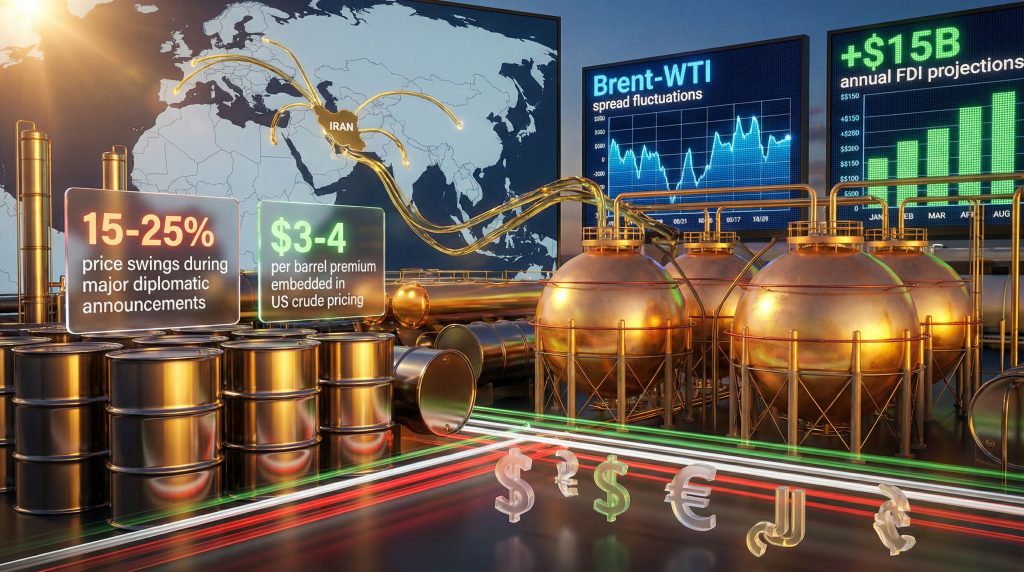
Energy markets incorporate geopolitical uncertainty through measurable risk premiums embedded in crude oil pricing. Current analysis indicates that US crude prices include a $3-4 per barrel geopolitical risk premium specifically attributable to US-Iran tensions, according to North Dakota's Mineral Resources Department. This quantifiable component represents the premium investors demand for holding energy assets during periods of regional instability.
The psychological dimensions of energy trading become particularly pronounced during diplomatic negotiations. Market participants must constantly evaluate the probability of successful talks versus potential escalation, creating volatility patterns that extend beyond fundamental supply and demand calculations. Historical data suggests that major diplomatic announcements can trigger 15-25% price swings as traders rapidly adjust positions based on changing geopolitical assessments.
Key indicators that energy traders monitor during diplomatic negotiations include:
• Trading volume spikes during announcement periods
• Futures positioning changes reflecting institutional sentiment
• Options market activity indicating hedging demand
• Spread differentials between regional benchmarks
Supply Chain Vulnerability Assessment
Iran's position as the third-largest crude producer within OPEC makes its export capacity materially significant to global energy supply calculations. This production scale means that sanctions relief or tightening can affect millions of barrels of daily production capacity, creating substantial supply-side pressure on international markets.
The vulnerability assessment extends beyond immediate production to encompass strategic inventory management. Recent data indicates that energy firms added approximately 1.5 million barrels of crude to storage during late February 2026, suggesting precautionary inventory building as diplomatic talks progressed. This storage pattern reflects industry preparation for potential supply disruptions or normalisation scenarios.
Alternative supply route development has become increasingly critical as companies prepare for various diplomatic outcomes. Furthermore, these developments reflect broader oil price rally insights that examine how geopolitical tensions affect energy markets. The recent restart of Venezuelan oil exports demonstrates how quickly supply chains can adapt to changing geopolitical circumstances, with very large crude carriers being chartered for the first time since the Caracas-Washington supply agreement began implementation.
How Do Sanctions Relief Expectations Reshape Energy Investment Flows?
Capital Allocation Patterns During Diplomatic Windows
Investment flows into energy infrastructure projects become highly sensitive to diplomatic progress during nuclear negotiations. The prospect of sanctions relief creates investment opportunities that can activate dormant projects and attract significant foreign direct investment. Economic modelling suggests that comprehensive sanctions relief could generate $15 billion in annual foreign direct investment flows into Iranian energy infrastructure.
The capital allocation process operates on multiple timeframes simultaneously. Short-term positioning involves currency hedging and futures market positioning, while medium-term planning encompasses project financing and partnership structuring. Long-term strategic planning requires assessment of regulatory stability and political risk evolution over project lifecycles spanning decades.
Investment Flow Projections by Diplomatic Outcome:
| Negotiation Scenario | Oil Price Impact | Regional GDP Effect | Annual FDI Change |
|---|---|---|---|
| Comprehensive Agreement | -8% to -12% | +2.5% Middle East | +$15B |
| Limited Progress | -3% to -5% | +1.2% regional | +$6B |
| Negotiation Breakdown | +5% to +8% | -0.8% regional | -$3B outflow |
Infrastructure Development and Technology Transfer
Sanctions relief scenarios enable technology transfer agreements that have been suspended during periods of international isolation. These agreements typically encompass refinery modernisation, enhanced oil recovery techniques, and pipeline infrastructure development. The magnitude of these projects often requires international partnership structures that can only function within stable regulatory frameworks.
In addition to traditional energy considerations, analysing oil price trade war analysis reveals how diplomatic negotiations interplay with broader trade relationships. The infrastructure development pipeline includes several categories of investment:
• Production facility upgrades requiring advanced extraction technology
• Refinery expansion projects to increase processing capacity
• Pipeline network development for improved export capabilities
• Port infrastructure modernisation to handle increased export volumes
What Role Do Alternative Energy Sources Play in Diplomatic Leverage?
Energy Independence and Strategic Positioning
The evolution toward renewable energy adoption creates new dimensions of diplomatic leverage by reducing dependence on traditional oil trade relationships. Countries investing heavily in solar, wind, and other alternative energy sources can negotiate from positions of reduced energy import vulnerability, fundamentally altering diplomatic power dynamics.
Iran's geographic advantages for solar energy development, combined with substantial natural gas reserves, provide multiple pathways for energy security that extend beyond crude oil exports. This diversification strategy enables more flexible diplomatic positioning while maintaining economic stability through various energy revenue streams.
Strategic petroleum reserve management becomes increasingly sophisticated as countries balance immediate energy security with long-term transition planning. Government stockpile policies must account for both diplomatic disruption scenarios and structural changes in energy mix composition over time.
Renewable Energy Investment Implications
The acceleration of renewable energy adoption creates investment opportunities that operate independently of traditional oil diplomacy cycles. Solar panel manufacturing, wind turbine installation, and grid modernisation projects can provide economic alternatives that reduce reliance on fossil fuel export revenues.
Clean energy technology exports represent emerging diplomatic tools that complement traditional energy trade relationships. Countries developing advanced renewable energy technologies can leverage these capabilities as soft power instruments whilst building economic relationships that transcend conventional energy dependency patterns.
How Do Currency Markets Respond to Energy Diplomacy Developments?
Exchange Rate Volatility and Petrodollar Dynamics
Currency markets respond to energy diplomacy through multiple transmission mechanisms that affect both oil-producing and oil-importing economies. The petrodollar circulation system creates direct linkages between diplomatic outcomes and foreign exchange rate stability, particularly for emerging market currencies tied to energy import costs.
Central bank intervention strategies become critical during periods of diplomatic uncertainty as monetary authorities attempt to maintain currency stability whilst accommodating energy price volatility. The $3-4 per barrel risk premium embedded in current oil pricing translates into measurable currency pressure for energy-importing economies managing their foreign exchange reserves.
Trade Balance Adjustments
Energy diplomacy outcomes create immediate impacts on current account balances for countries across the global economy. Oil-importing nations benefit from diplomatic breakthroughs that reduce energy costs, while oil-exporting economies must adjust to potentially lower revenue streams if geopolitical premiums decline.
The inflation transmission mechanism operates through energy input costs that flow through to consumer prices across multiple economic sectors. Transportation, manufacturing, and electricity generation costs all respond to diplomatic developments affecting oil and natural gas pricing.
Investment Strategies During Diplomatic Transition Periods
Portfolio Positioning and Risk Management
Institutional investors develop sophisticated strategies for navigating energy market volatility during diplomatic negotiations. These approaches typically combine fundamental analysis of supply and demand dynamics with geopolitical risk assessment models that attempt to quantify the probability of various diplomatic outcomes.
Hedging instrument utilisation becomes particularly important for companies with significant energy cost exposure. Derivatives markets provide tools for managing price risk, but the effectiveness of these instruments depends on accurate assessment of diplomatic progress and potential outcomes.
Key investment considerations during Iran nuclear deal negotiations include:
• Sector rotation strategies balancing energy versus alternative investments
• Geographic allocation adjustments based on regional diplomatic progress
• Currency hedging approaches for international energy trade exposure
• Supply contract flexibility enabling rapid sourcing adjustments
Moreover, examining the broader US‑China trade impact provides valuable context for understanding how diplomatic relationships affect global energy flows. These patterns become particularly relevant as investors assess the broader timeline of tensions over Iran's nuclear program that have shaped current market conditions.
Corporate Strategic Responses
Energy-intensive industries must develop operational flexibility to accommodate rapid changes in input costs resulting from diplomatic developments. Multi-sourcing capabilities enable companies to switch between supply sources as geopolitical conditions evolve, reducing vulnerability to single-country diplomatic disruptions.
Joint venture structuring becomes particularly important for projects involving politically sensitive regions. Risk-sharing arrangements can enable project development whilst distributing geopolitical exposure across multiple international partners with different diplomatic relationships.
The next major ASX story will hit our subscribers first
Market Structure Analysis During Nuclear Negotiations
Forward Curve Dynamics and Price Discovery
Energy futures markets provide real-time assessment of how traders expect diplomatic negotiations to affect long-term supply and demand balances. The forward curve structure reveals whether markets anticipate sustained price changes or temporary volatility during negotiation periods.
Current market positioning shows Brent crude trading at $70.77 per barrel, representing a critical threshold where energy executives indicate that sustained pricing above $70 per barrel becomes necessary to justify increased production investment. This price level creates an interesting dynamic where diplomatic success that reduces geopolitical premiums could potentially constrain production growth incentives.
Options Market Implications
Options market activity provides insight into investor expectations for volatility during diplomatic negotiations. Implied volatility measurements indicate how much price movement traders anticipate, whilst put-call ratios reveal directional bias in market positioning.
The relationship between spot prices and derivatives positioning demonstrates sophisticated risk management approaches that institutional investors employ during periods of diplomatic uncertainty. These tools enable precise calibration of exposure levels whilst maintaining flexibility to adjust positions as negotiations progress.
Regulatory Framework Evolution and Compliance Systems
Sanctions Monitoring and Adaptation
The complexity of international sanctions regimes requires sophisticated compliance systems that can adapt rapidly to diplomatic developments. Energy companies must maintain real-time monitoring capabilities for regulatory changes whilst ensuring continued operational compliance across multiple jurisdictions.
Due diligence frameworks for energy trading must incorporate geopolitical risk assessment alongside traditional credit and operational risk analysis. Know-your-customer protocols become particularly critical when diplomatic negotiations might affect the legal status of various counterparties.
International Coordination Mechanisms
Multilateral coordination becomes essential for managing energy market stability during major diplomatic transitions. The International Energy Agency emergency response protocols provide frameworks for coordinated action if diplomatic negotiations affect global supply security.
Technical standards harmonisation enables rapid integration of new suppliers into global energy trade networks as diplomatic relationships normalise. Regulatory alignment across jurisdictions facilitates energy commerce whilst maintaining appropriate oversight and risk management capabilities.
Long-Term Structural Implications for Global Energy Markets
Energy Security and Diversification Strategies
The Iran nuclear deal negotiations highlight broader trends toward energy supply diversification that extend beyond immediate diplomatic considerations. Countries are developing multiple sourcing strategies that reduce vulnerability to any single diplomatic relationship whilst maintaining competitive energy costs.
Infrastructure resilience planning encompasses both physical security and diplomatic risk management, with backup systems designed to accommodate various geopolitical scenarios. However, the US oil production decline adds another layer of complexity to global supply calculations. This approach requires substantial capital investment but provides operational stability during periods of international uncertainty.
Investment Horizon Adjustments and Risk Assessment
Long-term energy project planning must incorporate increasingly sophisticated geopolitical risk modelling that accounts for diplomatic cycle variations. Traditional project finance models require enhancement to address political risk factors that can affect project viability over multi-decade timeframes.
Return on investment calculations now routinely include adjusted discount rates for politically sensitive regions, reflecting the additional risk premium required by international investors. These adjustments significantly affect project economics and capital allocation decisions across the global energy sector.
Furthermore, understanding comprehensive investment strategy basics becomes essential for navigating these complex market dynamics. As diplomatic developments continue to influence energy markets, recent reports suggest that Iran is ready for necessary steps to reach a deal with the US, potentially signalling significant changes ahead.
The intersection of energy diplomacy and global economic systems continues evolving as technological advancement, climate policy, and shifting geopolitical relationships reshape traditional energy market dynamics. The Iran nuclear deal negotiations provide a contemporary example of how diplomatic developments create immediate market impacts whilst contributing to longer-term structural changes in global energy architecture.
Understanding these complex relationships becomes increasingly critical for investors, policymakers, and energy sector participants navigating an interconnected global economy where diplomatic announcements can trigger measurable price movements within hours whilst contributing to fundamental shifts in energy trade patterns that persist for decades.
This analysis is based on publicly available market data and diplomatic developments as of February 2026. Energy market participants should conduct independent research and risk assessment before making investment decisions. Geopolitical developments remain inherently unpredictable and may affect energy markets in ways not anticipated by current analysis.
Ready to Capitalise on Energy Market Volatility?
Discovery Alert's proprietary Discovery IQ model delivers real-time alerts on significant ASX mineral discoveries, instantly empowering subscribers to identify actionable opportunities ahead of the broader market during periods of geopolitical uncertainty. Understand why major mineral discoveries can lead to significant market returns by exploring historic examples, and begin your 14-day free trial today to position yourself ahead of the market.