August 4, 2026
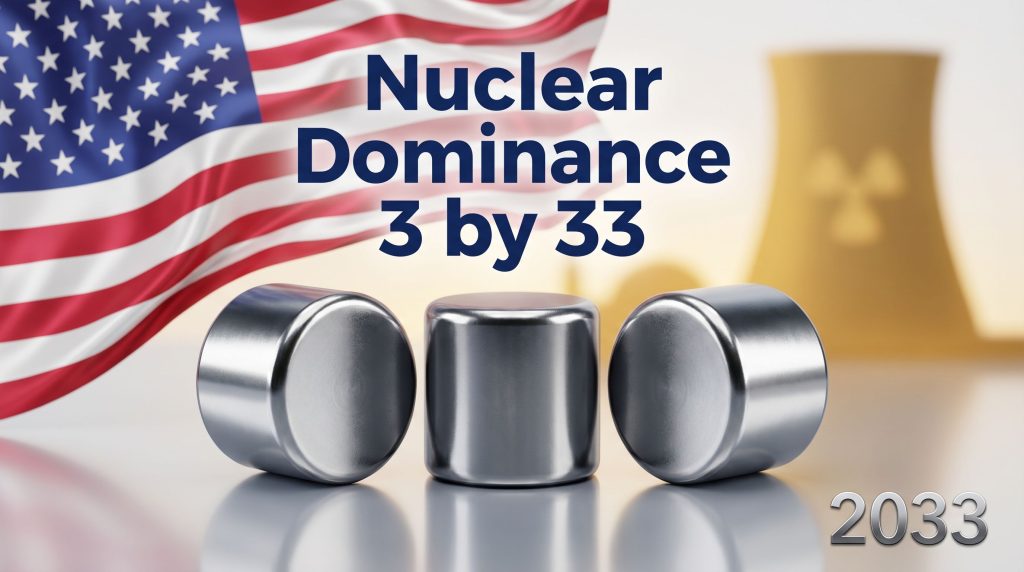
The global energy landscape faces unprecedented transformation as nations scramble to secure reliable baseload power while managing grid stability challenges. Nuclear technology emerges as a critical component in this transition, offering both carbon-free electricity generation and strategic independence from volatile energy markets. Advanced reactor technologies promise to revolutionise how countries approach energy security, yet success depends heavily on domestic fuel cycle capabilities and supply chain resilience. The nuclear dominance 3 by 33 initiative represents America's comprehensive strategy to achieve complete nuclear fuel independence by 2033.
Understanding the Strategic Framework of Nuclear Fuel Independence
Nuclear fuel independence represents far more than energy policy; it constitutes a fundamental pillar of national security strategy. The concept encompasses complete domestic control over every stage of the nuclear fuel cycle, from uranium mining through waste management and recycling. This comprehensive approach ensures that nuclear power generation remains uninterrupted regardless of geopolitical tensions or international supply disruptions.
The timeline extending to 2033 reflects the complex infrastructure requirements necessary for nuclear fuel cycle development. Unlike renewable energy installations that can be deployed relatively quickly, nuclear fuel facilities require extensive regulatory approval, specialised construction capabilities, and highly trained workforces. The decade-long development horizon accounts for these realities while establishing measurable milestones for progress assessment.
Furthermore, the uranium market dynamics continue to influence strategic planning decisions. Market volatility underscores the importance of domestic supply chain development for long-term energy security.
Three Strategic Pillars of Nuclear Dominance
The nuclear dominance framework operates through three interconnected strategic pillars, each addressing specific vulnerabilities in the current energy infrastructure. Domestic supply chain sovereignty eliminates dependencies on potentially unreliable international suppliers, particularly important given the concentration of nuclear fuel services among a limited number of countries.
Advanced reactor deployment positions the United States as a global technology leader while creating demand for domestically produced advanced fuels. These next-generation systems require specialised fuel formulations, including high-assay low-enriched uranium (HALEU), which differs significantly from conventional reactor fuel.
Closed-loop fuel cycle development maximises resource utilisation while minimising waste generation. This approach transforms nuclear waste from a liability into a strategic asset, recovering valuable fissile materials for continued energy production.
When big ASX news breaks, our subscribers know first
Building America's Self-Sufficient Nuclear Fuel Supply Chain
Current nuclear fuel dependencies expose critical vulnerabilities in America's energy security architecture. The United States currently relies on foreign suppliers for significant portions of its nuclear fuel requirements, creating potential chokepoints that adversaries could exploit during geopolitical crises. The US uranium import ban exemplifies efforts to reduce these dependencies.
| Fuel Cycle Stage | Domestic Capacity | Import Dependency | Key Foreign Suppliers |
|---|---|---|---|
| Uranium Mining | 5% | 95% | Kazakhstan, Canada, Australia |
| Conversion | 0% | 100% | Canada, France |
| Enrichment | 25% | 75% | UK, Netherlands, Germany |
| Fuel Fabrication | 85% | 15% | France, Sweden |
Expanding Domestic Nuclear Infrastructure
Comprehensive supply chain development requires coordinated expansion across multiple industrial sectors. Mining and milling operations must increase domestic uranium production capacity significantly, targeting high-grade deposits in established mining regions while exploring new resource areas. Current domestic production satisfies less than 5% of reactor requirements, necessitating substantial capacity additions.
Conversion facility development represents perhaps the most critical near-term priority, as the United States currently lacks any domestic uranium conversion capability. These facilities transform uranium concentrates into uranium hexafluoride, the feedstock for enrichment operations. New conversion plants require specialised equipment and environmental controls, with construction timelines extending 5-7 years.
Enrichment capacity expansion builds upon existing domestic capabilities while incorporating advanced centrifuge technologies. However, US uranium production technology continues advancing to meet increased demand efficiently. Next-generation enrichment facilities must accommodate both conventional low-enriched uranium production and higher enrichment levels required for advanced reactor systems.
Defense Production Act Implementation
Critical Infrastructure Acceleration: The Defense Production Act provides federal authorities with extraordinary powers to prioritise nuclear fuel projects, allocate scarce materials, and coordinate private sector resources for national security objectives.
The DOE Nuclear Dominance 3 by 33 campaign represents an unprecedented mobilisation of industrial resources under wartime authorities. This comprehensive strategy coordinates efforts across the entire nuclear supply chain to achieve fuel independence within a decade.
The Nuclear Fuel Cycle Consortium operates under Defense Production Act authority, bringing together more than 90 companies across the nuclear supply chain. This unprecedented coordination mechanism enables rapid information sharing, resource allocation, and technology transfer between participants.
Federal investment mechanisms include loan guarantees, direct funding, and risk-sharing arrangements that make large-scale nuclear infrastructure projects financially viable. These tools address the substantial capital requirements and long payback periods that typically discourage private investment in nuclear fuel facilities.
Advanced Reactor Technologies and Fuel Requirements
Next-generation nuclear technologies demand specialised fuel formulations that differ substantially from conventional reactor requirements. Small modular reactors (SMRs) utilise enriched uranium at concentrations up to 20%, compared to 3-5% enrichment in traditional large reactors. This higher enrichment enables longer operating cycles and enhanced safety margins.
High-assay low-enriched uranium (HALEU) production represents a critical bottleneck for advanced reactor deployment. HALEU enrichment levels between 5-20% require specialised enrichment facilities and handling procedures. Current global HALEU production capacity remains extremely limited, with only a few facilities worldwide capable of producing these fuel grades.
Molten salt and fast reactor systems present even more complex fuel requirements, utilising specialised fuel forms and compositions. These advanced systems can operate on recycled nuclear materials, thorium-based fuels, or mixed oxide formulations, each requiring dedicated production capabilities.
| Reactor Type | Fuel Requirements | Commercial Deployment | Key Advantages |
|---|---|---|---|
| Light Water SMRs | LEU (5-20%) | 2028-2030 | Enhanced safety, modularity |
| Molten Salt | HALEU/Thorium | 2030-2035 | High efficiency, waste reduction |
| Fast Reactors | Mixed oxide fuels | 2032-2040 | Fuel recycling, waste burning |
Deployment Timeline and Market Penetration
Advanced reactor commercialisation follows a staged deployment strategy beginning with demonstration projects and scaling toward widespread adoption. Technology readiness levels vary significantly across reactor designs, with some SMR concepts approaching commercial deployment while others remain in early development phases.
Market penetration forecasts suggest gradual adoption initially, accelerating as operating experience demonstrates reliability and economics. Early deployments target specific applications such as industrial process heat, remote power generation, and grid reliability enhancement. The nuclear dominance 3 by 33 strategy recognises these staged deployment requirements in its timeline development.
Nuclear Fuel Cycle Closure and Resource Optimisation
Closed fuel cycle implementation transforms nuclear waste management from a cost center into a strategic resource recovery operation. Spent fuel reprocessing recovers valuable uranium and plutonium for continued energy production, reducing both waste volumes and fresh fuel requirements.
Advanced reprocessing technologies separate fissile materials while minimising proliferation risks through integrated safeguards and monitoring systems. These facilities require substantial capital investment but provide long-term economic and environmental benefits through resource conservation.
Resource Efficiency Metrics
| Fuel Cycle Type | Uranium Utilisation | Waste Volume | Energy Output |
|---|---|---|---|
| Once-through cycle | 1-2% | 100% baseline | 1x baseline |
| Thermal recycling | 15-20% | 85% reduction | 10x increase |
| Fast reactor cycle | 60-80% | 95% reduction | 50x increase |
Closed fuel cycles demonstrate dramatic improvements in resource utilisation efficiency while substantially reducing waste disposal requirements. These advantages become increasingly important as uranium prices rise and waste storage capacity constraints intensify.
International Technology Competition
Global nuclear fuel cycle leadership involves intense competition between major nuclear powers. French reprocessing capabilities at La Hague represent current industry standards, while Russian integrated fuel services dominate many international markets through competitive pricing and comprehensive service offerings.
Technology transfer restrictions and export controls limit international cooperation while protecting sensitive nuclear technologies. Advanced fuel cycle capabilities provide significant diplomatic and economic advantages through technology exports and international partnership opportunities.
Economic Analysis of Nuclear Dominance Investment
Nuclear fuel cycle development requires unprecedented capital commitments across multiple industrial sectors. Infrastructure development costs range from billions for individual facilities to hundreds of billions for complete domestic capabilities.
| Investment Category | Estimated Cost Range | Timeline | Expected Returns |
|---|---|---|---|
| Mining expansion | $5-15 billion | 2026-2030 | Commodity price driven |
| Conversion facilities | $3-8 billion | 2027-2032 | Long-term contracts |
| Enrichment capacity | $10-25 billion | 2028-2035 | Technology advantage |
| Advanced fuel production | $8-20 billion | 2030-2040 | Premium market capture |
Market Impact Assessment
Nuclear industry expansion creates substantial investment opportunities across the supply chain. Uranium mining companies benefit from increased domestic demand and strategic stockpiling requirements. Nuclear services firms gain access to protected domestic markets while developing export capabilities.
Technology developers securing early market positions in advanced reactor systems or fuel cycle technologies potentially capture significant market share during industry expansion. These first-mover advantages often persist for decades due to nuclear industry conservatism and regulatory barriers.
Grid reliability benefits provide additional economic justification for nuclear expansion. Baseload capacity values increase substantially as grid penetration of variable renewable sources grows, creating premium markets for dispatchable clean energy sources.
Workforce Development and Regional Economic Impact
Nuclear industry expansion demands substantial workforce development across highly specialised technical fields. Skills gap analysis reveals critical shortages in nuclear engineering, health physics, quality assurance, and specialised trades required for nuclear facility construction and operation.
Training and Education Infrastructure
University partnerships provide essential research capabilities and graduate-level education programs. Nuclear engineering programs require substantial investment in specialised facilities, reactor simulators, and laboratory equipment.
Apprenticeship programs address immediate workforce needs for skilled trades including welders, electricians, and instrumentation technicians. These programs typically require 3-4 years to complete, necessitating early initiation to meet construction timelines.
Regional economic development opportunities concentrate in areas with existing nuclear infrastructure or favourable geological conditions. Nuclear facilities generate substantial economic multiplier effects through high-paying jobs and extensive local procurement requirements.
The next major ASX story will hit our subscribers first
Implementation Challenges and Risk Assessment
Multiple factors could potentially derail the nuclear dominance 3 by 33 timeline, requiring proactive risk management strategies. Regulatory bottlenecks represent persistent challenges, as Nuclear Regulatory Commission approval processes traditionally require extended timelines for new facility licensing.
Critical Technical Milestones
Key Success Factors: HALEU production capacity must reach commercial scale by 2029, advanced reactor demonstrations must prove operational reliability, and fuel cycle facilities must achieve cost competitiveness with international suppliers.
Technology development risks include potential delays in advanced reactor commercialisation, cost overruns in facility construction, and performance shortfalls in new fuel cycle technologies. These risks require contingency planning and alternative technology pathways.
Supply chain coordination challenges involve synchronising development across dozens of companies and multiple industrial sectors. Quality assurance standards and delivery schedules must align precisely to avoid cascading delays.
Financial and Political Sustainability
Capital cost management remains critical given historical nuclear project cost overruns. Electricity market dynamics affect nuclear economics, particularly in regions with low natural gas prices or substantial renewable energy penetration.
Political continuity across multiple presidential administrations poses significant risks to long-term nuclear programmes. Policy frameworks must demonstrate bipartisan support to attract necessary private sector investment. The recent mineral production executive order demonstrates ongoing federal commitment to domestic energy infrastructure development.
Global Strategic Implications and Export Opportunities
Nuclear fuel independence positions the United States to influence global nuclear development through technology leadership and fuel supply capabilities. Geopolitical leverage increases substantially when domestic nuclear capabilities reduce dependence on potentially hostile suppliers while creating export opportunities.
Alliance cooperation benefits from reliable nuclear technology and fuel supplies, strengthening partnerships with nations seeking energy security solutions. Advanced reactor exports could generate substantial economic returns while extending American technological influence.
Clean energy diplomacy utilises nuclear technology exports to support global decarbonisation efforts while advancing American strategic interests. Nuclear power provides essential grid stability services that complement renewable energy development in international markets.
Competitive Positioning Analysis
Success in global nuclear markets requires technological superiority, competitive pricing, and comprehensive service offerings. Chinese nuclear expansion presents formidable competition through state-supported financing and integrated supply chains. Russian nuclear services maintain market leadership through competitive fuel cycle offerings and reactor technology exports.
American nuclear dominance strategy must overcome these competitive disadvantages through technological innovation, superior safety performance, and strategic financing mechanisms. Furthermore, the executive order on critical minerals supports broader mineral security initiatives that complement nuclear fuel independence efforts.
Critical Success Factors for 2033 Achievement
Achieving nuclear dominance 3 by 33 requires simultaneous progress across multiple complex technical and institutional challenges. Policy continuity across political administrations provides essential stability for long-term infrastructure investments.
Industry coordination through the Nuclear Fuel Cycle Consortium must evolve into effective execution mechanisms that deliver measurable progress on accelerated timelines. Technology maturation in advanced reactor systems and fuel cycle technologies must proceed according to optimistic development schedules.
Financial sustainability depends on maintaining political support for substantial federal investments while attracting necessary private sector participation. The scale of required investment demands unprecedented cooperation between public and private stakeholders.
The DOE Nuclear Fuel Cycle strategy outlines comprehensive partnerships with private sector entities to achieve these ambitious goals through coordinated public-private collaboration.
In conclusion, the nuclear dominance framework represents an ambitious yet achievable strategy for American energy independence, technological leadership, and strategic advantage in global clean energy markets. Success requires sustained commitment, coordinated execution, and strategic flexibility to address emerging challenges while capitalising on technological opportunities.
Ready to Invest in the Next Major Mineral Discovery?
Discovery Alert instantly alerts investors to significant ASX mineral discoveries using its proprietary Discovery IQ model, turning complex mineral data into actionable insights. Understand why historic discoveries can generate substantial returns by visiting Discovery Alert's dedicated discoveries page, showcasing historic examples of exceptional outcomes, and begin your 14-day free trial today to position yourself ahead of the market.