August 22, 2026
Industrial Framework of Nuclear Energy Production
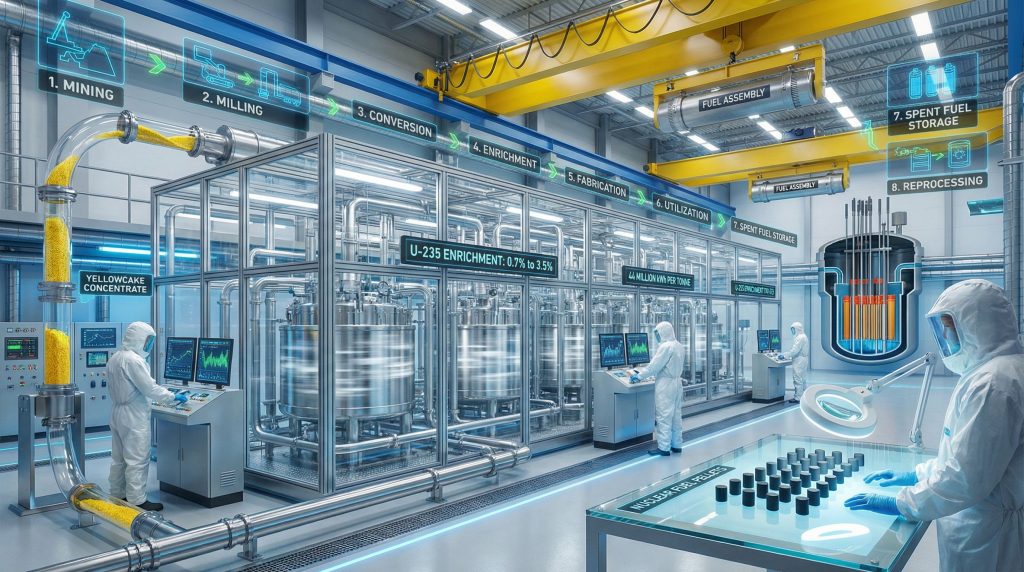
The transformation of raw uranium ore into electricity-generating nuclear fuel represents one of modern industry's most sophisticated manufacturing processes. This multi-stage uranium fuel cycle operates through specialized facilities distributed across continents, requiring unprecedented coordination between mining operations, chemical processing plants, and precision manufacturing centers.
Unlike conventional energy commodities, nuclear fuel production involves eight distinct industrial phases, each governed by strict regulatory frameworks and non-proliferation controls. The process spans approximately 24-36 months from initial ore extraction to reactor-ready fuel assemblies, with materials frequently crossing multiple international borders during transformation.
When big ASX news breaks, our subscribers know first
Extraction Technologies and Global Mining Distribution
Modern uranium extraction employs three primary methodologies, each optimized for specific geological conditions and ore characteristics. The selection between these approaches depends largely on deposit depth, ore grade distribution, and environmental considerations.
In-Situ Recovery Dominance
Kazakhstan has revolutionised global uranium production through exclusive deployment of in-situ recovery (ISR) technology, becoming the world's largest uranium producer. This method involves chemical dissolution through underground well systems, eliminating the need for traditional pit excavation or underground shaft development.
The ISR process operates by circulating leaching solutions through uranium-bearing formations via injection wells, with pregnant solutions recovered through production wells. Furthermore, this approach minimises surface disturbance while enabling extraction from deposits previously considered uneconomical through conventional methods. Advanced ISR technology continues to evolve, offering improved extraction efficiency and environmental protection.
Conventional Mining Operations
Open-pit extraction remains economically viable for shallow, high-grade deposits where overburden removal costs justify the operational investment. Major operations in Canada and Australia demonstrate this method's continued relevance for specific geological settings.
Underground mining targets deeper, concentrated ore bodies through shaft-based access systems. These operations typically focus on higher-grade deposits where extraction costs can be offset by superior uranium concentrations.
Global Production Landscape
Current uranium mining spans over 15 countries, though production concentration remains significant:
- Kazakhstan: Dominates global output through ISR-exclusive operations
- Canada: Second-largest producer utilising both underground and open-pit methods
- Australia: Major contributor with large-scale open-pit operations
- Secondary producers: Namibia, Niger, and Uzbekistan maintain substantial operations
This geographic distribution creates both supply diversity and potential bottleneck risks, particularly given the specialised nature of uranium processing infrastructure. Consequently, uranium market volatility can arise from both geopolitical tensions and infrastructure limitations.
Chemical Transformation Processes
The conversion from raw uranium ore to reactor-ready material involves multiple chemical transformations, each requiring specialised facilities and technical expertise. Understanding the nuclear fuel cycle is essential for grasping these complex processes.
Milling and Concentration Operations
Uranium ore processing begins with physical preparation through crushing and grinding operations designed to optimise surface area for chemical leaching. The subsequent acid leaching process dissolves uranium oxides using either sulfuric acid solutions or alkaline treatments, depending on ore mineralogy.
Ion exchange separation represents a critical purification stage where uranium ions bind reversibly to specially selected resins while impurities wash away. This process yields uranium oxide concentrate (U₃O₈), commonly termed yellowcake due to its characteristic appearance.
Conversion Infrastructure Constraints
Global conversion capacity concentrates in only five countries: Canada, China, France, Russia, and the USA. This geographic limitation creates significant supply chain vulnerabilities, as conversion facilities transform yellowcake into uranium hexafluoride (UF₆) gas—the exclusive feedstock for enrichment operations.
The chemical transformation from U₃O₈ to UF₆ requires sophisticated processing capabilities, explaining the limited number of commercial facilities worldwide. Recent geopolitical tensions have highlighted these constraints, particularly following US uranium import ban legislation and subsequent Russian export restrictions.
Enrichment Technologies and Market Dynamics
Uranium enrichment increases the concentration of fissile uranium-235 from natural levels of approximately 0.7% to reactor specifications through gas centrifuge technology.
Centrifuge Separation Mechanisms
Modern gas centrifuges exploit minute mass differences between uranium isotopes by spinning uranium hexafluoride gas at extremely high speeds within vacuum casings. As rotors operate, heavier uranium-238 molecules concentrate near cylinder walls whilst lighter uranium-235 molecules accumulate toward the centre, enabling physical separation.
Enrichment Requirements by Reactor Type
Standard Reactor Fuel (LEU):
- Enrichment range: 3.5-5% uranium-235
- Used in conventional light-water reactors globally
- Represents majority of current market demand
Advanced Reactor Fuel (HALEU):
- Enrichment range: 5-20% uranium-235
- Required for small modular reactors and Generation IV designs
- Creates emerging market segment with limited current supply
Natural Uranium Applications:
- CANDU reactors operate without enrichment requirements
- Eliminates enrichment service dependencies for certain reactor designs
Global Enrichment Capacity Distribution
| Provider | Geographic Operations | Annual Capacity (Million SWU) |
|---|---|---|
| Rosatom | Russia | 26.6 |
| Urenco | UK, Netherlands, Germany, USA | 18.5 |
| CNNC | China | 13.0 |
| Orano | France | 7.5 |
This capacity concentration among four major providers creates market dependencies, particularly evident during recent geopolitical disruptions affecting Russian enrichment services. Indeed, US–China trade tensions further complicate global supply chain dynamics.
Fuel Assembly Manufacturing
The fabrication of enriched uranium into reactor-ready fuel assemblies requires precision manufacturing capabilities and reactor-specific design expertise.
Multi-Stage Fabrication Process
Chemical Reconversion:
Uranium hexafluoride gas undergoes reconversion to uranium dioxide (UO₂) powder, the ceramic material used in fuel pellets.
Pellet Formation and Sintering:
UO₂ powder is pressed into cylindrical pellets and sintered at approximately 1,800°C to achieve required density and structural integrity.
Rod Assembly and Bundling:
Sintered pellets are loaded into zircaloy tubes, creating fuel rods that are subsequently arranged in reactor-specific assemblies.
Quality Assurance Requirements
Nuclear fuel assemblies undergo extensive testing for dimensional accuracy, pellet density uniformity, and containment integrity. Each assembly must meet reactor-specific tolerances and regulatory standards before reactor deployment approval.
International Trade and Market Structure
The uranium fuel cycle operates through complex international markets characterised by both spot transactions and long-term contractual arrangements. Uranium investment strategies must account for these diverse trading mechanisms.
Trading Mechanisms
Spot Market Operations:
- Daily price discovery for immediate delivery requirements
- Influenced by financial investors and trading speculation
- Represents smaller portion of total uranium transactions
Term Contract Arrangements:
- 3-15 year agreements providing price stability for utilities
- Majority of uranium trade occurs through these mechanisms
- Prices often linked to spot market levels at delivery
Material Exchange Systems:
- Physical swaps avoiding unnecessary international transport
- Example: Australian uranium converted in Canada, enriched in UK, fabricated in Sweden for South African reactor
Market Differentiation Factors
Unlike standardised commodities, nuclear fuel represents engineered products requiring reactor-specific designs and regulatory compliance. Fuel assemblies cannot be considered fungible commodities but rather high-technology products with specialised support requirements.
The next major ASX story will hit our subscribers first
Critical Supply Chain Vulnerabilities
Several structural factors create potential disruption points within the global uranium fuel cycle.
Geographic Concentration Risks
Conversion Bottlenecks:
Limited to five countries globally, conversion capacity represents the most significant constraint in the fuel cycle. Facility maintenance or geopolitical restrictions can create immediate supply shortages.
Enrichment Service Dependencies:
Capital-intensive enrichment operations concentrate among few global suppliers due to:
- Non-proliferation oversight requirements preventing weapons-grade production capabilities
- Multi-billion dollar facility investment barriers
- Specialised centrifuge technology access limitations
Recent Supply Chain Disruptions
US-Russia Trade Restrictions:
2024 legislation banning Russian LEU imports through 2040 has created market realignments, with insufficient US domestic enrichment capacity to meet requirements independently.
HALEU Supply Constraints:
Advanced reactor deployment faces material availability challenges, as current global HALEU production capacity remains limited compared to projected demand from small modular reactor programmes.
Reactor Operational Lifecycle
Nuclear fuel assemblies typically remain in reactor cores for approximately three years, with utilities replacing one-third of fuel assemblies annually during scheduled outages.
Performance Monitoring Systems
Continuous surveillance tracks fuel assembly structural integrity, neutron flux distribution, and fission product accumulation throughout the operational period. Advanced monitoring enables optimisation of fuel utilisation whilst maintaining safety margins.
Energy Yield Characteristics
Each tonne of natural uranium generates approximately 44 million kilowatt-hours of electricity through the complete uranium fuel cycle. This is equivalent to displacing roughly 20,000 tonnes of coal or 8.5 million cubic metres of natural gas combustion, as detailed in the nuclear fuel cycle overview.
Spent Fuel Management Strategies
Post-reactor fuel management involves critical decisions between direct disposal and reprocessing for material recovery.
Open Cycle Approach
Direct Disposal Strategy:
- Used fuel treated as high-level waste requiring geological disposal
- Predominant approach in countries including the United States
- Simpler regulatory framework with established waste management protocols
Closed Cycle Operations
Reprocessing for Material Recovery:
- Uranium recovery (approximately 96% of original material)
- Plutonium extraction for mixed oxide fuel production
- Waste volume reduction to 3-4% of original fuel assembly mass
- Implementation in France, UK, and Japan demonstrates commercial viability
Cooling and Storage Requirements
Immediate post-reactor handling requires cooling pool storage for thermal decay and radioactive reduction before long-term management decisions. Dry cask storage provides intermediate-term solutions whilst permanent disposal or reprocessing infrastructure develops.
Environmental Impact Assessment
The uranium fuel cycle presents both environmental challenges and climate benefits requiring comprehensive lifecycle analysis.
Mining-Associated Impacts
Radiological Considerations:
- Radon gas emissions from mine tailings require long-term monitoring
- Groundwater protection measures essential for in-situ recovery operations
- Heavy metal dispersal management during extraction and processing
Site Remediation Requirements:
Long-term restoration obligations extend decades beyond mining cessation, with specific protocols for tailings stabilisation and environmental monitoring.
Carbon Footprint Analysis
Nuclear fuel cycle operations produce minimal direct carbon dioxide emissions during electricity generation, offering significant climate advantages compared to fossil fuel alternatives. Lifecycle assessments demonstrate net carbon savings despite energy-intensive enrichment operations.
Advanced Reactor Fuel Requirements
Emerging reactor technologies create new fuel cycle demands and market opportunities.
HALEU Market Development
Small modular reactors and Generation IV designs require high-assay low-enriched uranium (5-20% uranium-235), representing a distinct market segment from conventional reactor fuel. Current global HALEU production capacity remains insufficient for projected deployment schedules.
Innovation Trajectories
Accident-Tolerant Fuel Development:
Enhanced safety margin fuels incorporating advanced cladding materials and fuel compositions designed to withstand extreme reactor conditions.
Alternative Fuel Cycles:
Thorium-based fuel cycles offer potential resource diversification, though commercial implementation requires substantial infrastructure development.
Advanced Recycling Technologies:
Next-generation reprocessing methods promise improved resource utilisation efficiency whilst reducing waste volumes and proliferation risks.
The uranium fuel cycle continues evolving through technological advancement and changing energy policy priorities, with supply chain resilience and sustainability considerations driving industry transformation.
Disclaimer: This analysis contains forward-looking projections regarding nuclear fuel markets, advanced reactor deployment, and uranium supply dynamics. Actual market developments may differ significantly from these assessments due to regulatory changes, technological developments, or geopolitical events. Readers should conduct independent research before making investment or policy decisions based on this information.
Looking to Capitalise on Nuclear Fuel Cycle Opportunities?
Discovery Alert's proprietary Discovery IQ model delivers real-time alerts on significant uranium and nuclear energy discoveries across the ASX, instantly empowering subscribers to identify actionable opportunities ahead of the broader market. Understand why major mineral discoveries can lead to substantial returns by exploring Discovery Alert's dedicated discoveries page, showcasing historic examples of exceptional outcomes, and begin your 30-day free trial today to position yourself ahead of the market.