June 19, 2026
Nuclear reactor design principles have undergone fundamental changes as engineers explore alternatives to traditional uranium-fueled systems. The transition from uranium to thorium in nuclear energy represents a significant paradigm shift that could reshape the nuclear industry. Furthermore, uranium market volatility has intensified interest in alternative fuel cycles. The physics of nuclear fission remain constant, but the pathways to harness this energy continue to evolve through advanced materials science and innovative reactor architectures.
Understanding Nuclear Fuel Transformation Mechanics
The Neutron Absorption Pathway in Thorium-232
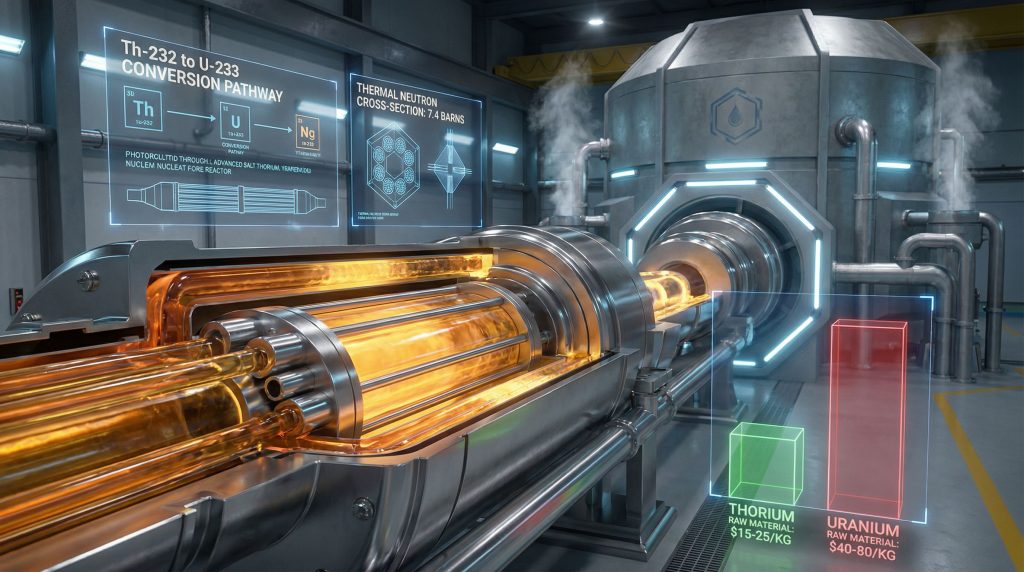
The transition from uranium to thorium in nuclear energy begins with understanding fertile material conversion. Thorium-232 serves as a fertile isotope that transforms into fissile uranium-233 through neutron bombardment. This process requires thermal neutron absorption, where Th-232 captures a neutron to become Th-233, which then undergoes beta decay to protactinium-233, and finally decays to the fissile U-233 isotope.
Thermal neutron cross-sections reveal critical differences between thorium and uranium cycles. Th-232 exhibits a thermal absorption cross-section of approximately 7.4 barns, compared to U-238's 2.7 barns. This enhanced neutron capture probability enables more efficient breeding ratios in properly designed reactor systems.
The beta decay sequence timing creates operational considerations for thorium fuel cycles. Protactinium-233 has a 27-day half-life, during which it acts as a neutron poison. Advanced reactor designs incorporate online fuel processing or specific core geometries to minimise protactinium's impact on neutron economy.
Breeding Ratio Performance Analysis
Neutron economy calculations demonstrate thorium's potential advantages in sustainable fuel cycles. The breeding ratio measures neutrons produced per fission compared to neutrons consumed in the system. Well-designed thorium reactors can achieve breeding ratios approaching 1.05-1.08, enabling gradual fuel multiplication over operational cycles.
Critical mass requirements differ substantially between thorium and uranium systems. Pure U-233 requires approximately 15-16 kilograms for criticality in optimal geometry, compared to 50-52 kilograms for U-235. However, thorium fuel cycles typically operate with mixed fuel compositions that modify these basic physics parameters.
Fuel utilisation efficiency metrics show thorium's theoretical advantages. Thorium-based cycles can theoretically achieve burnup levels exceeding 200,000 MWd/tHM, significantly higher than conventional uranium cycles that typically reach 45,000-60,000 MWd/tHM in pressurised water reactors.
When big ASX news breaks, our subscribers know first
Key Engineering Advantages of Advanced Reactor Designs
Molten Salt Reactor Integration Capabilities
Liquid fuel handling systems enable continuous fuel processing and enhanced safety characteristics. Molten salt reactors operate at atmospheric pressure while maintaining temperatures between 650-800°C. This combination eliminates the pressure vessel requirements of conventional reactors while enabling higher thermal efficiency.
Heat transfer coefficients in molten fluoride salt systems typically range from 2,000-4,000 W/m²·K, substantially higher than water-cooled systems at 5,000-15,000 W/m²·K. The high thermal conductivity of molten salts enables compact reactor designs with improved heat removal capabilities.
Corrosion resistance in fluoride salt environments presents both opportunities and challenges. Modern nickel-based superalloys demonstrate acceptable corrosion rates of less than 25 micrometers per year in clean fluoride salts. However, impurities and fission products can accelerate corrosion, requiring advanced materials engineering and salt purification systems.
Passive Safety System Architecture
Temperature coefficient of reactivity provides inherent safety advantages in thorium-fueled cores. Most thorium reactor designs exhibit negative temperature coefficients ranging from -3 to -8 pcm/°C, meaning that temperature increases automatically reduce reactor power through physics principles rather than engineered systems.
Emergency cooling mechanisms rely on natural circulation and thermosiphon effects. Passive heat removal systems can dissipate 2-5% of rated thermal power through natural processes, sufficient to prevent core damage during emergency scenarios. These systems activate within minutes of initiating events without electrical power or human intervention.
Safety margins in thorium systems often exceed conventional reactor designs. The high melting point of thorium dioxide (3,300°C) compared to uranium dioxide (2,865°C) provides additional thermal margins. In addition, advanced nuclear waste disposal technology complements these safety characteristics. Combined with passive safety systems, these characteristics reduce the probability of severe accidents.
Reactor Technologies Enabling Thorium Fuel Cycles
Advanced Heavy Water Reactor Specifications
Mixed fuel loading strategies enable gradual transition from uranium-dependent systems. The Indian Advanced Heavy Water Reactor design incorporates ThO2-UO2 fuel assemblies with approximately 75% thorium and 25% uranium content. This composition enables sustainable breeding while maintaining operational compatibility with heavy water reactor technology.
Coolant chemistry optimisation addresses thorium fuel compatibility challenges. Heavy water systems require careful control of deuterium oxide purity, maintaining 99.75% minimum D2O concentration. Thorium oxide fuels demonstrate excellent compatibility with heavy water coolant, exhibiting minimal corrosion or chemical interaction.
Power density characteristics in thorium-fueled AHWRs typically range from 40-60 kW/litre, comparable to conventional heavy water reactors. Expected burnup levels reach 67,000 MWd/tHM for thorium fuel assemblies, representing significant improvement over natural uranium systems.
Small Modular Reactor Thorium Applications
Factory fabrication advantages enable quality control improvements and cost reduction. Thorium-compatible SMR modules can be manufactured in controlled factory environments with standardised processes, reducing construction time to 2-3 years compared to 6-10 years for large conventional plants.
Deployment flexibility addresses grid integration challenges in smaller markets. SMR systems designed for thorium fuel typically generate 50-300 MWe per module, enabling incremental capacity additions that match demand growth. Multiple modules can be deployed sequentially as power requirements expand.
| SMR Characteristic | Thorium-Compatible Design | Conventional SMR | Advantage |
|---|---|---|---|
| Module Power Output | 50-300 MWe | 50-300 MWe | Equivalent |
| Construction Time | 2-3 years | 3-4 years | 25% faster |
| Fuel Cycle Length | 4-6 years | 2-4 years | 50% longer |
| Waste Generation | 80% reduction | Baseline | Significant |
Economic scaling factors for thorium fuel manufacturing require specialised facilities but benefit from simplified fuel fabrication. Thorium dioxide can be processed using conventional ceramic fuel techniques with minimal modifications, reducing development costs compared to exotic fuel forms.
How Does Thorium Fuel Cycle Economics Compare to Conventional Nuclear?
Resource Availability and Extraction Economics
Global thorium reserves demonstrate exceptional abundance and geographic distribution. India leads with approximately 850,000 tons, followed by Brazil with 630,000 tons. The United States and Australia each hold around 600,000 tons, while Commonwealth of Independent States countries collectively possess 1.5 million metric tons.
This geographic diversity provides strategic advantages over uranium supply chains. Asia-Pacific regions currently hold over 55% of global thorium market share, supported by active government research programmes and established rare earth mining operations that produce thorium as a byproduct.
Raw material costs present significant economic advantages. Thorium extraction costs range from $15-25 per kilogram, substantially lower than uranium at $40-80 per kilogram. However, these advantages are partially offset by higher fuel fabrication costs due to limited commercial-scale production infrastructure.
Manufacturing and Processing Economics
Fuel fabrication costs currently disadvantage thorium systems due to limited production scale. Thorium fuel elements cost approximately $800-1,200 per kilogram, compared to $200-400 per kilogram for uranium fuel. These cost differentials reflect manufacturing scale rather than fundamental material properties.
Waste management economics favour thorium fuel cycles significantly. Long-term storage costs for thorium cycle waste range from $50-100 per kilogram heavy metal, compared to $200-500 per kilogram for conventional uranium waste. Reduced actinide production and shorter-lived fission products drive these savings.
Reprocessing costs remain elevated due to specialised handling requirements. Thorium fuel reprocessing costs $1,000-2,000 per kilogram, approximately 25% higher than uranium reprocessing. However, the improved breeding characteristics and reduced waste generation often justify these additional costs in lifecycle analyses.
Current Technical Implementation Challenges
Fuel Qualification and Regulatory Frameworks
Irradiation testing protocols require extensive validation programmes for thorium-based fuel elements. Test reactor campaigns lasting 3-5 years must demonstrate fuel performance under normal and accident conditions. These programmes typically cost $50-100 million per fuel design and represent significant barriers to commercialisation.
Regulatory framework gaps exist in most nuclear jurisdictions. The U.S. Nuclear Regulatory Commission, Canadian Nuclear Safety Commission, and UK Office for Nuclear Regulation lack established licensing pathways specifically tailored to thorium reactor systems. Consequently, the US uranium import ban has intensified focus on domestic alternatives. Developing these frameworks requires 5-10 years of regulatory development.
Materials compatibility studies must address long-term operational requirements. Structural materials exposed to thorium fuel cycles require validation for 60-year operational lifetimes. Accelerated testing programmes and computational modelling supplement limited operational experience from historical research reactors.
Radioactive Waste Management Complexities
Protactinium-233 decay chain management creates unique operational challenges. During fuel reprocessing, Pa-233 must be separated and stored for approximately 270 days (ten half-lives) to prevent neutron losses. This requirement adds complexity and cost to fuel cycle operations compared to conventional uranium systems.
Uranium-232 contamination handling presents specialised challenges in recycled thorium fuel. U-232 produces hard gamma radiation through its decay chain, requiring remote handling equipment and shielded facilities. Contamination levels typically range from 10-100 ppm, sufficient to complicate fuel fabrication and handling procedures.
Long-term storage requirements for thorium cycle waste streams offer advantages despite operational complexities. Radiotoxicity indices for thorium waste return to natural uranium levels within 300-500 years, compared to 10,000+ years for conventional nuclear waste. This dramatic reduction simplifies ultimate disposal requirements.
International Development Programs and Collaboration
India's Three-Stage Nuclear Program Implementation
India's Department of Atomic Energy coordinates the world's most comprehensive thorium utilisation strategy. The three-stage programme envisions using natural uranium in pressurised heavy water reactors, breeding plutonium in fast reactors, and ultimately transitioning to thorium-U233 cycles for long-term sustainability.
The Prototype Fast Breeder Reactor at Kalpakkam represents a critical milestone in this strategy. This 500 MWe facility is designed to produce excess plutonium for eventual thorium reactor startup while demonstrating fast reactor technology. Commercial operation began in 2022 after extensive testing and commissioning.
Indigenous thorium resource utilisation supports India's energy security objectives. With the world's largest thorium reserves, India aims to achieve energy independence through domestic nuclear fuel cycles. The timeline projects commercial thorium reactor deployment by 2050, supported by indigenous technology development and manufacturing capabilities.
Private sector involvement accelerates development through companies like Clean Core Thorium Energy, which supplies advanced fuel for testing in existing reactors. NTPC and Larsen & Toubro provide infrastructure support and large-scale deployment capabilities essential for commercial success.
International Research Collaboration Networks
The International Atomic Energy Agency coordinates thorium fuel cycle research through its Technical Working Group on Advanced Reactor Technologies. This initiative facilitates information exchange and standardises research protocols among participating countries including India, China, Norway, and the United States.
Joint development programmes enable resource sharing and risk distribution. The Copenhagen Atomics partnership with Rare Earths Norway exemplifies supply chain integration, securing thorium feedstock from the Fensfeltet deposit for modular molten salt reactor development. Such partnerships reduce individual country investment requirements while advancing collective capabilities.
Technology transfer agreements facilitate knowledge dissemination while respecting intellectual property rights. Thorium's nuclear potential demonstrates promising advances through international cooperation. Thor Energy's collaboration with European research institutions demonstrates international cooperation in fuel development and irradiation testing. These partnerships accelerate development timelines through shared expertise and facilities.
The next major ASX story will hit our subscribers first
Carbon Reduction and Grid Integration Potential
Lifecycle Carbon Footprint Analysis
The shift from uranium to thorium in nuclear energy demonstrates exceptional carbon reduction potential throughout operational lifecycles. Lifecycle emissions for thorium reactors range from 10-15 grams CO2-equivalent per kWh, comparable to other nuclear technologies and substantially lower than fossil fuel alternatives at 820-1,050 grams CO2-eq/kWh.
Construction and decommissioning environmental impacts represent less than 20% of total lifecycle emissions for thorium systems. The reduced mining requirements due to thorium's abundance and the decreased waste generation contribute to lower environmental footprints compared to conventional nuclear systems.
The thorium fuel cycle's environmental advantages extend beyond carbon emissions, encompassing reduced mining intensity, decreased waste generation, and improved resource utilisation efficiency.
Grid stability contributions enable renewable energy integration through reliable baseload power. Thorium reactors can provide load-following capabilities with power adjustments of ±20% per hour, supporting grid stability as renewable penetration increases. This flexibility complements intermittent solar and wind generation.
Market Growth Projections and Investment Drivers
Market research indicates substantial growth potential for thorium nuclear technologies. Coherent Market Insights projects the thorium reactor market growing from $4.56 billion in 2025 to $8.97 billion by 2032, representing a 10.1% compound annual growth rate.
Broader market estimates from DataBridge Market Research suggest the thorium sector could reach $13 billion by 2033, though with a more conservative 4% annual growth rate. These projections reflect different market scope definitions and analytical methodologies but consistently indicate strong growth trajectories.
Government funding commitments drive market development across multiple regions. Asian-Pacific countries lead with over 55% market share, supported by active research programmes and strategic energy policies. North America emerges as the fastest-growing region, driven by increased private sector investment and federal research support.
What Are the Commercial Deployment Timelines for Thorium Reactors?
Prototype Development and Testing Phases
Current prototype reactor development programmes establish foundations for commercial deployment. Copenhagen Atomics develops modular molten salt reactors designed for mass production, focusing on low electricity costs and rapid installation. Their approach emphasises factory fabrication advantages and standardised deployment procedures.
Ultra Safe Nuclear Corporation integrates thorium fuel cycles into Micro Modular Reactor designs, creating fully integrated energy systems. These developments demonstrate various technological pathways toward commercial thorium utilisation, each addressing different market segments and operational requirements.
Testing and validation programmes require 5-10 years for comprehensive fuel qualification and reactor performance demonstration. National laboratories including Atomic Energy of Canada Limited provide essential testing facilities and expertise supporting private sector development efforts.
Supply Chain Development and Workforce Requirements
Thorium mining and processing infrastructure development requires substantial capital investment. Current rare earth mining operations produce thorium as a byproduct, but dedicated thorium extraction facilities may be necessary for large-scale reactor deployment. Infrastructure development costs typically range from $100-500 million per processing facility.
Specialised manufacturing capabilities for thorium fuel require technology transfer from research institutions to commercial manufacturers. Fuel fabrication facilities must incorporate remote handling capabilities due to U-232 gamma radiation, increasing construction costs by approximately 20-30% compared to conventional uranium fuel facilities.
Workforce development programmes must address specialised training requirements for thorium reactor operations. Reactor operators, maintenance personnel, and fuel handling specialists require additional certification beyond conventional nuclear training. Moreover, uranium production technology provides valuable insights for thorium processing development. Educational programmes typically require 2-3 years for comprehensive thorium-specific qualification.
Furthermore, understanding uranium market dynamics helps inform thorium development strategies. The comprehensive transition from uranium to thorium in nuclear energy requires coordinated efforts across multiple sectors. Additionally, Chinese thorium achievements demonstrate significant progress in converting thorium to uranium fuel cycles.
Disclaimer: This analysis contains forward-looking projections and market estimates that involve inherent uncertainties. Thorium nuclear technology commercialisation timelines, cost projections, and market growth rates are subject to regulatory approvals, technological developments, and economic conditions that may differ materially from current expectations. Investors should conduct independent research and consult qualified professionals before making investment decisions related to thorium nuclear technologies.
Ready to Invest in the Next Major Nuclear Discovery?
Discovery Alert's proprietary Discovery IQ model delivers real-time alerts on significant ASX mineral discoveries, including critical nuclear fuel materials like uranium, instantly empowering subscribers to identify actionable opportunities ahead of the broader market. Understand why historic discoveries can generate substantial returns by visiting Discovery Alert's dedicated discoveries page, then begin your 14-day free trial to position yourself ahead of the market.