May 15, 2026
The nuclear fuel cycle represents one of the most sophisticated industrial systems ever developed, encompassing the complete transformation of uranium ore into electricity and managing its aftermath for millennia. This intricate network of mining, processing, enrichment, fabrication, reactor operation, and waste management has evolved into a critical determinant of national energy security, particularly as geopolitical tensions reshape global energy markets. Understanding the importance of nuclear fuel cycle infrastructure becomes essential as nations worldwide reassess their energy independence strategies amid unprecedented climate commitments and supply chain vulnerabilities.
Unlike conventional energy systems that rely on continuous fuel deliveries, nuclear power plants operate on multi-year fuel cycles, creating unique strategic advantages and technical challenges. A single uranium pellet the size of a fingertip contains as much energy as a ton of coal, yet realising this potential requires a complex industrial ecosystem spanning multiple countries and decades-long investment horizons. The importance of nuclear fuel cycle security has intensified as governments recognise that energy independence extends beyond domestic generation to encompass the entire fuel supply chain.
The Complete Nuclear Fuel Value Chain Architecture
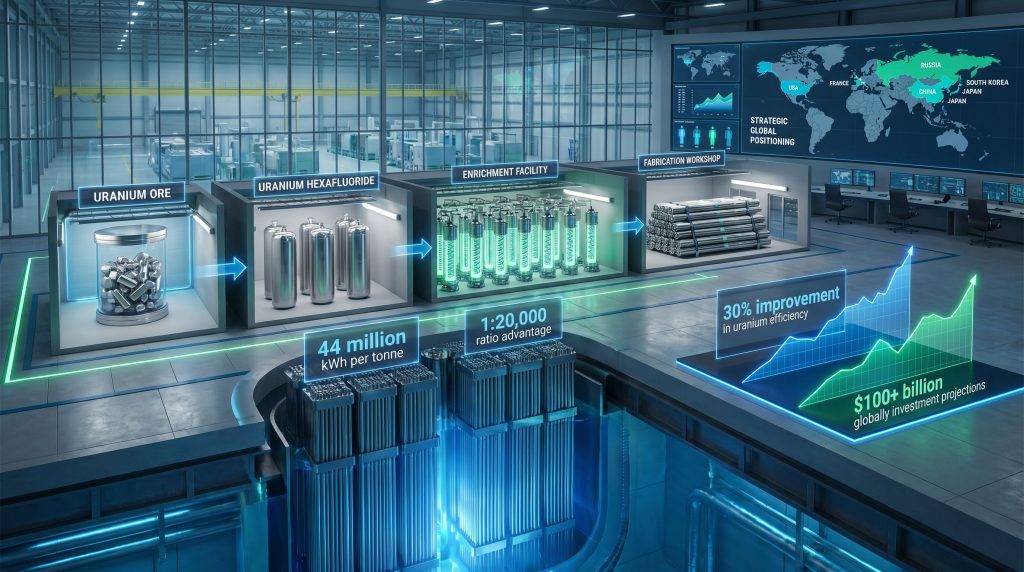
Nuclear fuel cycle operations encompass an interconnected series of industrial processes that transform raw uranium into electricity while managing radioactive materials throughout their lifecycle. The front-end operations begin with uranium mining and milling, where ore concentrations typically ranging from 0.1% to 20% uranium are processed into uranium concentrate, commonly known as yellowcake. This material then undergoes conversion into uranium hexafluoride gas, enabling the enrichment process that increases the concentration of fissile uranium-235 from its natural 0.7% to approximately 3-5% for most commercial reactors.
The fuel fabrication stage transforms enriched uranium into precisely engineered fuel assemblies containing hundreds of fuel rods, each filled with uranium dioxide pellets manufactured to exacting specifications. These assemblies must maintain their integrity under extreme conditions including temperatures exceeding 2,000°F, intense radiation fields, and high-pressure water environments for up to six years of operation. Furthermore, the entire process requires precise documentation and tracking systems to ensure quality control and regulatory compliance.
Back-end operations present equally complex challenges, requiring long-term storage solutions for spent nuclear fuel and potential reprocessing to recover unused uranium and plutonium. Countries like France have developed closed fuel cycles that recycle these materials into new fuel, extending uranium resources and reducing waste volumes. However, the importance of nuclear fuel cycle planning extends far beyond technical considerations to encompass economic optimisation and strategic resource management.
Key Front-End Process Parameters:
- Uranium ore grades: Range from 0.1% in some deposits to over 20% in exceptional cases
- Enrichment capacity: Global capacity approximately 60 million separative work units annually
- Fuel assembly design: Typically contains 50,000-100,000 individual fuel pellets
- Enrichment levels: Commercial reactors require 3-5% U-235, research reactors may require 20%+
The World Nuclear Association's nuclear fuel cycle overview highlighted how industry leaders increasingly recognise that fuel supply security has become inseparable from energy security itself. As World Nuclear Association Director General Sama Bilbao y León emphasised, governments worldwide understand that energy security and fuel supply security are more critical than ever in the current geopolitical environment. However, she noted that whilst momentum builds across global markets, much progress remains largely aspirational, requiring concrete policy support and financial alignment with clean energy objectives.
When big ASX news breaks, our subscribers know first
Advanced Fuel Cycle Economics and Resource Optimisation
The economics of nuclear fuel cycles present unique characteristics that distinguish them from other energy commodities. Unlike fossil fuels, where fuel costs represent a significant portion of electricity generation expenses, nuclear fuel costs typically account for only 10-15% of total generation costs. This economic structure provides inherent price stability for nuclear electricity, insulating consumers from volatile commodity markets that affect coal and natural gas generation.
Extended fuel cycles through higher burnup technologies offer substantial economic advantages by reducing refuelling frequency and improving uranium utilisation. Modern reactor designs achieve burnup levels exceeding 50,000 megawatt-days per metric ton of uranium, compared to earlier reactors that achieved 30,000-35,000 megawatt-days per metric ton. These improvements translate directly into reduced fuel cycle costs and lower radioactive waste generation per unit of electricity produced.
Economic Performance Metrics:
| Fuel Cycle Parameter | Traditional Approach | Advanced Optimisation | Economic Impact |
|---|---|---|---|
| Burnup Level | 35,000 MWd/MTU | 50,000+ MWd/MTU | 30% fuel cost reduction |
| Refuelling Frequency | 12-18 months | 18-24 months | Lower outage costs |
| Uranium Utilisation | 0.5-0.6% of mined uranium | 1.0%+ with recycling | Resource extension |
| Waste Volume | Baseline | 40% reduction | Lower disposal costs |
Closed fuel cycles offer additional economic optimisation through uranium and plutonium recovery from spent fuel. France's experience with reprocessing demonstrates that recovered uranium can supply approximately 15% of reactor fuel requirements, whilst mixed oxide (MOX) fuel fabricated from recovered plutonium provides another 10% of fuel needs. These recycling processes effectively multiply uranium resources by factors of 1.3 to 1.5 compared to once-through fuel cycles.
The importance of nuclear fuel cycle economics extends beyond immediate cost considerations to encompass long-term resource availability and price predictability. Unlike renewable energy technologies that require continuous material inputs for expansion, nuclear fuel cycles offer decades-long fuel security from relatively modest uranium inventories. A typical 1,000-megawatt reactor requires only 25-30 tons of enriched uranium annually, enabling strategic fuel reserves that would be impractical for coal or gas-fired generation.
Industry leaders emphasised that economic optimisation requires balanced policy support to ensure adequate fuel cycle capacity without creating overcapacity situations. Framatome Senior Executive Vice President Lionel Gaiffe noted that whilst policy incentives could drive fuel cycle capacity expansion, such support must be realistic to match supply growth with demand projections, avoiding market distortions that could undermine long-term economic viability.
Strategic Sovereignty in Nuclear Fuel Supply Chains
Energy security considerations have elevated nuclear fuel supply chain sovereignty to a critical strategic priority for nuclear-powered nations. The importance of nuclear fuel cycle independence became starkly apparent as geopolitical tensions disrupted traditional energy trade relationships, prompting comprehensive reassessments of fuel supply dependencies across the nuclear industry. Furthermore, recent developments in uranium market volatility and the US Senate uranium ban have intensified these concerns.
European Union energy policy exemplifies this strategic shift toward fuel cycle sovereignty. The REPowerEU plan, adopted by the European Commission in 2022, explicitly aims to reduce EU dependence on Russian fossil fuels whilst strengthening domestic clean energy capabilities. Emmanuel Brutin, Director General of nucleareurope, emphasised that Brussels increasingly recognises Europe's continued dependence on imported fossil energy as both expensive and strategically vulnerable.
Regional Fuel Cycle Capacity Distribution:
- North America: Significant uranium mining, conversion, and enrichment capabilities
- Europe: Strong fuel fabrication and reprocessing infrastructure, limited uranium production
- Asia-Pacific: Rapid expansion in all fuel cycle stages, particularly enrichment capacity
- Russia/Former Soviet Union: Comprehensive fuel cycle capabilities serving domestic and export markets
The European approach to fuel cycle sovereignty leverages existing industrial capabilities whilst addressing strategic vulnerabilities. As Brutin noted, nuclear power represents a net-zero energy source with a value chain entirely based in Europe, making it a strategic asset for the bloc. The European Investment Bank has provided substantial financing for fuel cycle projects, including Orano's Georges Besse II conversion facility expansion, demonstrating institutional commitment to supply chain resilience.
"Strategic Infrastructure Investment: European Investment Bank financing for nuclear fuel cycle projects exemplifies how sovereign fuel supply development requires coordinated public-private investment strategies that leverage modest public funding to attract larger private capital commitments."
Nuclear fuel cycle sovereignty offers unique advantages compared to other energy independence strategies. Unlike renewable energy supply chains that depend on critical minerals concentrated in specific geographic regions, nuclear fuel cycles can achieve high degrees of domestic control through strategic planning and infrastructure investment. Uranium resources exist on every continent, and fuel cycle technologies, whilst complex, are well-established and transferable.
The importance of nuclear fuel cycle sovereignty extends beyond immediate supply security to encompass technological capabilities and industrial expertise. Countries with comprehensive fuel cycle capabilities maintain strategic flexibility in reactor technology choices, fuel performance optimisation, and waste management approaches. This technological sovereignty proves particularly valuable as advanced reactor designs introduce new fuel requirements and operational parameters.
However, achieving fuel cycle sovereignty requires substantial capital investments and long development timelines. Enrichment facilities typically require 5-7 years for construction and commissioning, whilst establishing comprehensive fuel cycle capabilities may require 10-15 years of sustained investment. These timelines underscore the importance of strategic planning and policy consistency in fuel cycle development initiatives. Additionally, developments in US uranium production and uranium spot price dynamics continue to influence these strategic considerations.
Policy Frameworks Enabling Fuel Cycle Investment
Effective policy frameworks serve as the foundation for sustained nuclear fuel cycle investment, creating regulatory clarity and financial incentives necessary to support decade-long development timelines and capital-intensive infrastructure projects. The importance of nuclear fuel cycle policy coordination has intensified as governments recognise that energy security requires comprehensive supply chain planning beyond reactor construction.
The European Union's evolving policy landscape demonstrates both the potential and challenges of fuel cycle policy integration. Whilst nuclear generation achieved recognition as environmentally sustainable under the EU Taxonomy Regulation, the nuclear fuel cycle itself remains excluded from this sustainable finance framework. This policy gap creates investment barriers, as noted by industry leaders who emphasise that including fuel cycle activities in the EU Taxonomy would significantly enhance investor attractiveness and capital availability.
Key Policy Enablers for Fuel Cycle Investment:
- Regulatory Streamlining: Risk-informed licensing approaches that maintain safety whilst reducing approval timelines
- Financial Incentives: Tax credits, loan guarantees, and accelerated depreciation schedules for fuel cycle infrastructure
- Strategic Classification: Designation of fuel cycle facilities as critical national infrastructure
- Research Support: Government funding for advanced fuel cycle technologies and process optimisation
- International Coordination: Bilateral agreements ensuring fuel supply security and technology cooperation
The REPowerEU plan represents a comprehensive approach to energy policy integration that encompasses fuel cycle considerations within broader energy security objectives. Adopted in response to geopolitical supply disruptions, this policy framework aims to rapidly reduce EU fossil fuel dependencies whilst strengthening domestic clean energy capabilities. However, as industry representatives note, the legislation defining specific REPowerEU policies remains under development, creating uncertainty about implementation timelines and support mechanisms.
Public financing mechanisms prove particularly important for fuel cycle development, where private capital may be reluctant to commit to projects with extended payback periods and regulatory uncertainties. The European Investment Bank's support for Orano's Georges Besse II expansion illustrates how strategic public investment can catalyse larger private commitments. As Emmanuel Brutin observed, even modest EU funding can attract substantial additional investment, leveraging public resources to maximise private capital mobilisation.
Risk-informed regulatory frameworks represent another critical policy enabler, allowing proportional safety requirements that reflect actual risk profiles rather than prescriptive approaches that may impose unnecessary costs. Modern fuel cycle facilities benefit from decades of operational experience and technological advancement, enabling regulatory approaches that maintain safety excellence whilst optimising economic efficiency.
The importance of nuclear fuel cycle policy extends to international coordination mechanisms that ensure fuel supply reliability across national boundaries. Bilateral agreements, multilateral frameworks, and international safeguards create the institutional infrastructure necessary for fuel trade and technology cooperation. These agreements prove particularly valuable for countries with partial fuel cycle capabilities that must coordinate with international partners to ensure complete supply chain security.
Policy timing considerations prove crucial, as fuel cycle infrastructure requires years for development whilst energy security needs may emerge rapidly. Effective policy frameworks anticipate future requirements and begin infrastructure development before acute supply constraints emerge, avoiding the emergency policy responses that often prove economically inefficient and strategically suboptimal. In addition, successful uranium investment strategies require stable, long-term policy environments.
Technical Challenges in Modern Fuel Cycle Management
Contemporary nuclear fuel cycle operations face unprecedented technical challenges as the industry simultaneously supports existing reactor fleets whilst preparing for advanced reactor deployments that may require fundamentally different fuel specifications and supply chain capabilities. The importance of nuclear fuel cycle technical advancement becomes critical as utilities extend reactor operating lives, increase capacity factors, and optimise fuel performance to unprecedented levels.
Advanced reactor technologies present particularly complex fuel cycle challenges, with designs ranging from high-temperature gas-cooled reactors requiring specialised TRISO fuel to fast spectrum reactors operating on recycled plutonium and uranium. Unlike conventional light water reactors that utilise standardised uranium dioxide fuel, these advanced designs may require unique fuel forms, enrichment levels, or fabrication processes that existing fuel cycle infrastructure cannot readily accommodate.
Technical Specifications for Advanced Reactor Fuels:
- High-Assay Low-Enriched Uranium (HALEU): Enrichment levels between 5-20%, requiring specialised enrichment capacity
- TRISO Fuel: Tri-structural isotropic particles designed for high-temperature applications
- Metal Fuels: Metallic uranium or plutonium alloys for fast reactor applications
- Molten Salt Fuels: Liquid fuel forms requiring continuous processing capabilities
Supply chain bottlenecks represent immediate technical challenges that could constrain nuclear growth regardless of reactor technology readiness. Global enrichment capacity, whilst sufficient for current reactor fleets, may face constraints as nuclear capacity expands and advanced reactors require higher enrichment levels. Similarly, conversion facility capacity remains concentrated in a limited number of countries, creating potential supply vulnerabilities that technical solutions must address.
Fuel performance optimisation presents ongoing technical challenges as utilities seek to maximise economic value whilst maintaining safety margins. Higher burnup fuel designs require enhanced materials science, improved cladding technologies, and sophisticated modelling capabilities to predict fuel behaviour under extended irradiation conditions. These technical requirements drive continuous innovation in fuel design, manufacturing processes, and quality assurance systems.
"Critical Technical Constraint: The transition to advanced reactors requiring HALEU fuel faces significant technical barriers, as current enrichment facilities primarily support conventional reactor requirements, necessitating substantial infrastructure modifications or new facility construction."
Back-end fuel cycle management presents equally complex technical challenges, particularly as countries evaluate options for long-term waste management and potential fuel recycling. Geological disposal facilities require sophisticated technical systems capable of containing radioactive materials for thousands of years, whilst reprocessing technologies must balance economic efficiency with proliferation resistance and environmental protection.
The importance of nuclear fuel cycle technical innovation extends to digital technologies and advanced manufacturing processes that could revolutionise fuel cycle operations. Additive manufacturing, artificial intelligence for process optimisation, and advanced materials science offer potential breakthroughs in fuel cycle efficiency and economics. However, integrating these technologies into highly regulated nuclear fuel cycle operations requires extensive validation and licensing processes that may extend development timelines.
Quality assurance represents a fundamental technical challenge throughout the fuel cycle, as nuclear fuel must meet exacting specifications whilst maintaining complete traceability and documentation. Modern fuel cycle facilities implement sophisticated quality management systems that track individual fuel pellets from uranium ore through final disposal, requiring technical systems capable of managing vast amounts of data whilst ensuring absolute reliability.
Workforce technical capabilities present another critical challenge, as fuel cycle operations require highly specialised expertise that may take years to develop. Technical training programmes must prepare workers for complex chemical processes, radiation protection protocols, and precision manufacturing requirements that exceed those found in most industrial applications.
Nuclear Fuel Cycles and Climate Change Mitigation
Nuclear fuel cycles play an essential role in global climate change mitigation strategies through their ability to provide large-scale, reliable, low-carbon electricity generation with minimal lifecycle greenhouse gas emissions. The importance of nuclear fuel cycle optimisation for climate goals extends beyond operational power generation to encompass the entire industrial system supporting nuclear energy deployment worldwide.
Lifecycle carbon emissions analysis demonstrates nuclear power's exceptional climate performance compared to fossil fuel alternatives. Modern nuclear fuel cycles generate electricity with lifecycle emissions typically ranging from 10-40 grams of CO2 equivalent per kilowatt-hour, compared to coal-fired generation at 820-1,050 grams and natural gas at 350-490 grams per kilowatt-hour. These dramatic differences reflect nuclear fuel's energy density advantages and the minimal combustion requirements throughout the fuel cycle.
Comparative Lifecycle Emissions (grams CO2-eq/kWh):
| Energy Source | Construction | Fuel Cycle | Operation | Decommissioning | Total Range |
|---|---|---|---|---|---|
| Nuclear | 8-15 | 2-8 | 0.3-1.5 | 1-3 | 10-40 |
| Coal | 10-30 | 2-5 | 800-1,000 | 0.2-2 | 820-1,050 |
| Natural Gas | 8-15 | 5-15 | 330-450 | 0.5-2 | 350-490 |
| Solar PV | 25-50 | 1-5 | 0 | 2-5 | 30-80 |
Resource efficiency advantages of nuclear fuel cycles contribute significantly to climate benefits by minimising land use requirements and material extraction needs per unit of energy produced. A typical nuclear power plant generating 1,000 megawatts requires approximately one square kilometre of land area, compared to wind farms requiring 50-100 square kilometres or solar installations requiring 20-30 square kilometres for equivalent reliable electricity output.
Advanced fuel cycle technologies offer additional climate benefits through improved uranium utilisation and waste minimisation. Fast reactor systems operating on recycled plutonium can extract 50-60 times more energy from uranium resources compared to once-through cycles, effectively multiplying available uranium reserves whilst dramatically reducing waste generation per unit of electricity produced. These closed fuel cycle approaches prove particularly important for countries with limited uranium resources but substantial nuclear deployment ambitions.
The importance of nuclear fuel cycle contributions to grid stability enhances climate mitigation effectiveness by enabling higher renewable energy penetration. Nuclear power plants provide essential grid services including frequency regulation, voltage support, and spinning reserves that facilitate wind and solar integration whilst maintaining system reliability. This complementary relationship allows power systems to achieve higher renewable energy shares than would be possible with intermittent sources alone.
"Climate Optimisation Strategy: Closed nuclear fuel cycles can reduce lifecycle carbon emissions by an additional 15-25% compared to once-through systems whilst simultaneously extending uranium resources by factors of 30-60, demonstrating how fuel cycle optimisation amplifies climate benefits."
Long-term sustainability metrics demonstrate nuclear fuel cycles' potential for multi-generational climate mitigation. Known uranium resources could support current global nuclear capacity for 130+ years using once-through fuel cycles, or thousands of years using closed cycles with fast reactors. Additionally, thorium fuel cycles offer virtually unlimited resource potential, with thorium reserves exceeding uranium by factors of 3-4 and offering similar energy density advantages.
Carbon reduction potential through nuclear expansion depends critically on fuel cycle capacity development, as reactor construction programmes require assured fuel supplies throughout multi-decade operating periods. Countries planning substantial nuclear deployment must simultaneously develop fuel cycle infrastructure to avoid supply constraints that could limit climate mitigation contributions. This coordination challenge underscores the importance of nuclear fuel cycle planning in national climate strategies.
Climate policy integration increasingly recognises nuclear fuel cycles' contributions to decarbonisation objectives. The EU Taxonomy framework's inclusion of nuclear generation as environmentally sustainable represents growing policy recognition of nuclear power's climate benefits, though the exclusion of fuel cycle activities creates inconsistencies that may limit investment in supporting infrastructure essential for nuclear deployment.
The next major ASX story will hit our subscribers first
Investment Opportunities in Nuclear Fuel Cycle Infrastructure
Global nuclear fuel cycle infrastructure represents a multi-billion dollar investment opportunity driven by expanding nuclear capacity, fuel supply security concerns, and the transition to advanced reactor technologies requiring specialised fuel cycle capabilities. The importance of nuclear fuel cycle investment extends beyond immediate market opportunities to encompass strategic positioning in the evolving global energy system.
Market demand projections indicate substantial growth requirements across all fuel cycle stages. The World Nuclear Association projects nuclear capacity could double by 2050, requiring proportional expansion in uranium mining, conversion, enrichment, and fuel fabrication capabilities. Advanced reactor deployments add complexity to these requirements, as many designs require High-Assay Low-Enriched Uranium (HALEU) that current commercial enrichment facilities cannot readily provide.
Investment Opportunity Segments:
- Uranium Mining Expansion: New mine development and existing mine capacity upgrades
- Conversion Facility Modernisation: Technology upgrades and capacity expansion for uranium hexafluoride production
- Enrichment Infrastructure: HALEU-capable centrifuge cascades for advanced reactor support
- Fuel Fabrication: Specialised fuel assembly production for diverse reactor designs
- Waste Management: Interim storage expansion and geological repository development
Geographic investment patterns reflect regional nuclear expansion plans and fuel cycle sovereignty initiatives. North America presents significant opportunities in uranium mining revival and HALEU production, driven by domestic nuclear expansion and supply chain security concerns. European investment focuses on fuel cycle integration and advanced technology development, supported by EU policy frameworks and institutional financing.
The European Investment Bank's support for fuel cycle infrastructure demonstrates institutional recognition of investment opportunities in this sector. Financing for projects like Orano's Georges Besse II expansion signals growing institutional appetite for fuel cycle investments, particularly when aligned with energy security and climate objectives. As Emmanuel Brutin noted, strategic public investment can leverage substantial private capital for fuel cycle development.
Regional Investment Priorities:
| Region | Primary Focus | Investment Drivers | Key Opportunities |
|---|---|---|---|
| North America | HALEU production, mining revival | Energy independence, advanced reactors | $15-25 billion potential |
| Europe | Fuel fabrication, reprocessing | Energy sovereignty, EU taxonomy | $8-15 billion potential |
| Asia-Pacific | Comprehensive fuel cycle | Nuclear expansion, supply security | $20-40 billion potential |
| Middle East | Enrichment, fuel services | Nuclear programme development | $5-10 billion potential |
Technology investment opportunities span both established and emerging fuel cycle processes. Conventional uranium mining faces increasing environmental and social requirements that drive investment in in-situ recovery and heap leaching technologies. Similarly, enrichment technology continues evolving toward more energy-efficient centrifuge designs that offer competitive advantages in electricity-intensive markets.
Advanced reactor fuel requirements create entirely new investment categories. TRISO fuel for high-temperature gas-cooled reactors requires specialised manufacturing capabilities that no commercial facility currently provides at scale. Similarly, metallic fuels for fast reactors demand unique fabrication technologies and handling systems that represent substantial investment opportunities for first movers.
The importance of nuclear fuel cycle investment timing relates to long development periods and regulatory requirements that may delay project returns. Successful fuel cycle investments require patient capital willing to support 5-10 year development timelines whilst navigating complex regulatory frameworks. However, these barriers also limit competition and create sustainable competitive advantages for established operators.
"Investment Strategy Consideration: Fuel cycle infrastructure investments typically require 7-12 years from initial planning to commercial operation, necessitating long-term capital commitments whilst offering potential for multi-decade revenue streams once operational."
Risk factors affecting fuel cycle investments include regulatory approval uncertainties, market demand fluctuations, and technological obsolescence possibilities. However, nuclear fuel demand demonstrates remarkable stability compared to other energy commodities, with fuel supply agreements often spanning multiple years and providing predictable revenue streams. Additionally, the strategic importance of fuel cycle infrastructure provides some protection against pure market-driven volatility.
Financial structures for fuel cycle investments increasingly involve public-private partnerships that share risks and rewards between government stakeholders seeking energy security and private investors seeking commercial returns. These arrangements prove particularly effective for large-scale infrastructure projects where strategic and commercial objectives align but neither sector can efficiently bear all risks independently. Furthermore, the U.S. Energy Information Administration's nuclear fuel cycle guide provides valuable insights for investors evaluating market fundamentals.
Future Outlook: Nuclear Fuel Cycle Evolution Through 2040
The nuclear fuel cycle landscape faces transformational changes over the next fifteen years as the industry adapts to advanced reactor deployments, sustainability requirements, and evolving geopolitical realities that prioritise energy independence and supply chain resilience. The importance of nuclear fuel cycle evolution extends beyond technical advancement to encompass fundamental shifts in market structure, regulatory frameworks, and international cooperation patterns.
Small Modular Reactor (SMR) deployment represents a significant driver of fuel cycle evolution, with potential implications for fuel utilisation patterns, manufacturing approaches, and supply chain requirements. SMR designs typically feature longer fuel cycles and higher burnup rates compared to large conventional reactors, potentially reducing fuel throughput requirements per megawatt of capacity whilst demanding enhanced fuel performance specifications.
Technology Roadmap Projections 2025-2040:
- 2025-2028: First commercial HALEU production facilities operational
- 2028-2032: Advanced reactor fuel fabrication capabilities established
- 2030-2035: Small modular reactor fuel supply chains mature
- 2035-2040: Generation IV reactor fuel cycles demonstrate commercial viability
Advanced reactor fuel requirements will necessitate substantial fuel cycle infrastructure modifications or new facility construction. High-Assay Low-Enriched Uranium production requires enrichment facilities capable of achieving 5-20% U-235 concentrations, compared to the 3-5% levels required for conventional reactors. Current commercial enrichment facilities would require significant modifications to provide HALEU economically and safely.
Digital transformation presents opportunities for fuel cycle optimisation through artificial intelligence, advanced process control, and predictive maintenance systems. Smart fuel cycle facilities could optimise uranium utilisation, minimise waste generation, and reduce operational costs through real-time process adjustments and predictive maintenance schedules. However, implementing digital technologies in nuclear facilities requires extensive cybersecurity measures and regulatory approval processes.
Sustainability requirements increasingly influence fuel cycle development as environmental, social, and governance (ESG) considerations affect investment decisions and regulatory approvals. Future fuel cycle facilities must demonstrate enhanced environmental performance, community engagement, and worker safety compared to earlier installations. These requirements drive innovation in mining techniques, waste minimisation, and facility design.
The importance of nuclear fuel cycle internationalisation may evolve significantly as countries balance sovereignty objectives with economic efficiency. Whilst energy security concerns drive domestic fuel cycle development, economic optimisation may favour regional specialisation and cooperative arrangements that maintain supply security whilst capturing scale economies and technical expertise advantages.
"Strategic Projection: By 2040, nuclear fuel cycles may operate under hybrid sovereignty models where countries maintain strategic capabilities in critical fuel cycle stages whilst participating in international cooperation frameworks for economic optimisation and technology development."
Market demand scenarios reflect substantial uncertainty about nuclear growth rates and technology mix evolution. Conservative projections suggest nuclear capacity growth of 25-50% by 2040, whilst aggressive scenarios envision capacity doubling or tripling driven by climate policies and advanced reactor deployment. These dramatically different scenarios require fuel cycle planning approaches that maintain flexibility whilst ensuring adequate capacity development.
Regulatory evolution toward risk-informed, performance-based frameworks could accelerate fuel cycle development by reducing approval timelines and costs whilst maintaining safety standards. International regulatory cooperation may standardise fuel cycle technologies and facilitate cross-border fuel trade, though national security considerations will likely limit such cooperation in sensitive areas like enrichment and reprocessing.
Investment requirement estimates for global fuel cycle expansion range from $100-300 billion through 2040, depending on nuclear growth scenarios and technology mix evolution. These investments must address capacity expansion, technology advancement, and infrastructure modernisation simultaneously whilst navigating complex regulatory environments and international coordination requirements.
Critical Success Factors for Future Fuel Cycle Development:
- Integrated Planning: Coordinated development across fuel cycle stages to avoid bottlenecks
- Technology Innovation: Advanced manufacturing and digital optimisation capabilities
- Regulatory Efficiency: Streamlined approval processes maintaining safety excellence
- International Cooperation: Balanced sovereignty and collaboration frameworks
- Financial Innovation: Risk-sharing mechanisms supporting long-term infrastructure investment
The importance of nuclear fuel cycle evolution ultimately depends on the industry's ability to adapt established technologies and develop new capabilities whilst maintaining the safety excellence and reliability that enable nuclear power's contributions to global energy security and climate objectives. Success requires unprecedented coordination among governments, industry, and international organisations to ensure fuel cycle development matches nuclear deployment ambitions whilst addressing legitimate security and environmental concerns.
Ready to Capitalise on Nuclear Fuel Infrastructure Opportunities?
Discovery Alert's proprietary Discovery IQ model delivers instant notifications on significant ASX mineral discoveries, including uranium and nuclear fuel-related opportunities, empowering subscribers to identify actionable investments ahead of the broader market. Understand why major mineral discoveries can generate substantial returns by exploring historic examples of exceptional outcomes, then begin your 14-day free trial today to position yourself strategically in evolving nuclear fuel markets.