
May 14, 2026
Strategic Nuclear Fuel Diversification Patterns in Asian Energy Markets
Asian nuclear energy expansion strategies increasingly demonstrate sophisticated supply chain management approaches that balance domestic resource development with international procurement diversification. This strategic framework has become particularly evident as regional powers navigate complex geopolitical landscapes while pursuing ambitious clean energy targets that require substantial uranium fuel security arrangements.
The evolution of nuclear fuel procurement strategies reflects broader shifts in energy security thinking, where traditional bilateral supplier relationships expand into multi-continental supply networks designed to mitigate geopolitical risks and optimise fuel cycle economics across diverse reactor technologies.
When big ASX news breaks, our subscribers know first
India's Nuclear Fuel Import Architecture and Supply Chain Evolution
India uranium import strategies represent one of the most sophisticated dual-track systems in global nuclear commerce. The country maintains strict operational separation between domestic uranium resources designated for strategic applications and internationally sourced fuel supplies that enter the civilian nuclear program under International Atomic Energy Agency monitoring protocols.
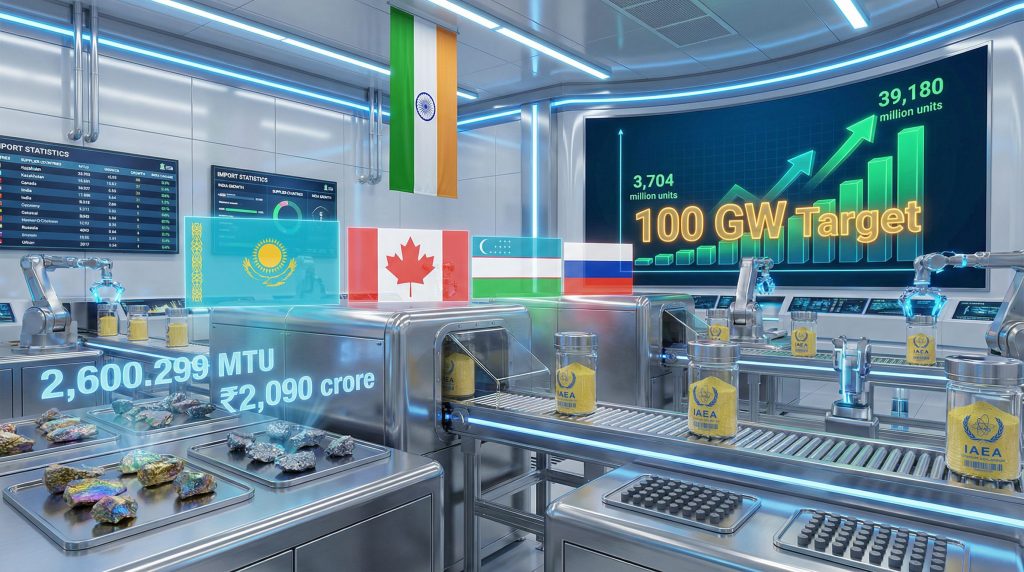
This architectural separation enables India to participate extensively in international nuclear trade while preserving strategic autonomy over indigenous uranium resources. The framework has facilitated massive expansion in civilian nuclear electricity generation, with uranium import-powered generation increasing from 3,704 million units in 2009-10 to 39,180 million units in 2024-25, representing approximately 957% growth over fifteen years.
Government data reveals that India imported 18,842.60 metric tonnes of uranium in various forms between 2008-09 and 2024-25, all under IAEA safeguards protocols. This substantial import volume, averaging approximately 1,108 metric tonnes annually, demonstrates the scale of international fuel dependency required to support India's nuclear expansion objectives.
The economic implications of this import strategy extend beyond simple fuel procurement costs to encompass technology transfer opportunities, reactor design cooperation, and fuel cycle service development that accelerate indigenous nuclear capabilities while maintaining international supply chain access.
International Supplier Portfolio Management and Geographic Diversification
India's uranium supplier relationships span multiple continents, reflecting deliberate risk management strategies that minimise exposure to regional political instability or trade disruptions. This geographic diversification approach represents sophisticated supply chain thinking that goes beyond traditional bilateral energy partnerships.
Kazakhstan Partnership Dynamics
Kazakhstan's position as the world's largest uranium producer, controlling approximately 40% of global production capacity, makes it a critical supplier for India's nuclear fuel security. The relationship leverages Kazakhstan's state-owned Kazatomprom's massive production capabilities while providing India access to competitively priced natural uranium suitable for pressurised heavy water reactor operations.
Recent developments in this partnership indicate potential expansion beyond traditional yellowcake supply arrangements into joint venture mining operations and comprehensive fuel cycle services, suggesting evolving bilateral cooperation that could enhance India's uranium supply chain resilience.
Canadian Strategic Alliance Framework
The 2010 India-Canada nuclear cooperation agreement established comprehensive legal frameworks that resolved earlier non-proliferation concerns and enabled substantial commercial uranium transactions. This partnership has evolved into one of India's most significant long-term supply relationships, with major contracted volumes extending through 2035.
Canada's uranium industry, led by established producers with decades of operational experience, provides India with access to high-grade uranium deposits and advanced uranium production technologies that complement domestic production capabilities while ensuring reliable fuel supply continuity.
Emerging Supplier Relationships
Uzbekistan's emergence as a uranium supplier reflects India's strategy to expand beyond established partnerships and develop relationships with emerging uranium producers. These newer supplier relationships often involve spot market purchases that provide procurement flexibility during favourable pricing periods while testing potential for longer-term supply agreements.
Russia's specialised role in providing enriched fuel products demonstrates how different suppliers serve specific reactor technology requirements within India's diverse nuclear fleet. This technical specialisation ensures optimal fuel specifications across pressurised heavy water reactors, light water reactors, and future advanced reactor deployments.
Regulatory Framework Integration and Safeguards Implementation
The International Atomic Energy Agency safeguards framework governing all uranium imports represents a critical component of India's nuclear fuel strategy. Every metric tonne of the 18,842.60 tonnes imported between 2008-09 and 2024-25 entered India's civilian nuclear program under comprehensive IAEA monitoring, ensuring complete separation from unsafeguarded domestic uranium production.
This regulatory compliance framework enables India to maintain access to global uranium markets despite its non-Nuclear Non-Proliferation Treaty status, demonstrating how technical safeguards arrangements can facilitate international nuclear commerce while addressing non-proliferation concerns.
Operational Safeguards Protocols
IAEA safeguards implementation involves sophisticated material accountancy systems, containment and surveillance technologies, and regular inspector access that monitors uranium flow from import facilities through fuel fabrication, reactor operations, and spent fuel management. These protocols ensure complete transparency in civilian fuel cycle operations while protecting sensitive information related to unsafeguarded activities.
The dual-track operational framework requires sophisticated logistics management to maintain strict separation between safeguarded and unsafeguarded nuclear materials throughout the fuel cycle, demonstrating advanced nuclear program management capabilities.
Domestic Production Constraints and Import Dependency Analysis
India's domestic uranium production capacity faces significant geological and economic constraints that necessitate continued reliance on international fuel supplies even as indigenous mining operations expand. Current annual production levels of approximately 600 tonnes contrast sharply with growing demand requirements that approach 1,800 tonnes annually and project toward 3,000+ tonnes by 2032.
Geological Challenges and Ore Quality Factors
India's uranium deposits predominantly consist of low-grade ore formations that require extensive processing compared to high-grade deposits found in Kazakhstan, Australia, and Canada. This geological reality results in:
- Higher extraction costs per tonne due to increased processing requirements
- Greater waste-to-product ratios that complicate environmental management
- More complex beneficiation processes that extend project development timelines
- Elevated water consumption and chemical processing needs
Production Capacity Expansion Constraints
Uranium Corporation of India Limited operates mining facilities including the Jadugora Mill in Jharkhand and associated production infrastructure, with expansion plans focusing on the Tummalapalle deposit development in Andhra Pradesh. However, expansion faces multiple challenges:
- Environmental clearance processes that extend project development timelines
- Land acquisition complexities in mineral-rich regions
- Technical challenges associated with remote deposit locations
- Regulatory requirements for radioactive material handling and waste management
Recent policy reforms allowing private sector participation in uranium mining aim to accelerate domestic production, though reprocessing and enrichment activities remain under exclusive government control to maintain strategic oversight and non-proliferation compliance.
Nuclear Capacity Expansion Targets and Fuel Requirements
India's nuclear expansion roadmap targeting 100 GW of installed capacity represents one of the world's most ambitious nuclear development programs. The current installed capacity of 8.78 GW is projected to reach approximately 22 GW by 2031-32 through completion of projects currently under construction or advanced planning stages.
Phased Development Strategy
| Development Phase | Timeline | Capacity Addition | Reactor Technologies |
|---|---|---|---|
| Phase 1 | 2025-2032 | 8.78 GW to 22 GW | Indigenous PHWRs, imported LWRs |
| Phase 2 | 2032-2047 | 22 GW to 54 GW | Mixed technology deployment |
| Phase 3 | 2047+ | 54 GW to 100 GW | Advanced reactor integration |
The Nuclear Power Corporation of India Limited plans an additional 32 GW of capacity beyond 2032, comprising indigenous pressurised heavy water reactors and light water reactors developed through foreign cooperation agreements. This substantial expansion requires sustained india uranium import volumes averaging approximately 9,000 metric tonne units between 2025-2033.
Technology Integration and Fuel Specifications
India's reactor fleet diversity necessitates different uranium fuel specifications:
- Pressurised Heavy Water Reactors: Utilise natural uranium (typically 0.7% U-235) supplied as yellowcake concentrate
- Light Water Reactors: Require enriched uranium (3-5% U-235) processed into fabricated fuel assemblies
- Fast Breeder Reactors: Utilise plutonium fuel cycles derived from reprocessed spent fuel
- Future Thorium Reactors: Will leverage India's substantial thorium resources for long-term fuel independence
This technological diversity explains why different international suppliers provide specialised fuel products optimised for specific reactor requirements within India's expanding nuclear fleet.
The next major ASX story will hit our subscribers first
Economic Impact Analysis and Strategic Benefits
Uranium imports enable substantial economic benefits beyond simple electricity generation expansion. The ten-fold increase in nuclear electricity production from imported uranium between 2009-10 and 2024-25 demonstrates the economic multiplier effects of international nuclear fuel trade.
Energy Security and Carbon Emission Reduction
Nuclear electricity generation from imported uranium contributes significantly to India's carbon emission reduction commitments while maintaining energy independence from volatile fossil fuel imports. The reliable baseload electricity production supports industrial development and grid stability requirements that complement intermittent renewable energy sources.
Technology Transfer and Industrial Development
International uranium supply agreements frequently include provisions for nuclear technology cooperation, reactor design sharing, and fuel cycle service development. These partnerships accelerate indigenous nuclear technology capabilities while providing access to advanced reactor designs and fuel cycle innovations.
Recent examples include comprehensive cooperation frameworks that extend beyond simple commodity trading to encompass:
- Joint reactor development programs
- Fuel fabrication technology transfer
- Nuclear safety and security cooperation
- Advanced reactor design collaboration
- Waste management technology sharing
Risk Management and Supply Chain Resilience
India's india uranium import strategy emphasises sophisticated risk management approaches that address multiple potential disruption scenarios. The geographic diversification across four continents reduces dependency on any single geopolitical region while providing flexibility to adapt procurement strategies based on evolving market conditions. Furthermore, these strategic partnerships help mitigate potential impacts from events like the Russian uranium import ban affecting global supply chains.
Strategic Reserve Management
India maintains substantial uranium inventory levels that provide operational flexibility during supply disruptions and enable strategic purchasing during favourable market conditions. These reserve strategies reduce vulnerability to short-term price volatility and geopolitical tensions affecting individual supplier relationships.
Market Price Optimisation Strategies
Diversified supplier relationships enable sophisticated procurement optimisation through:
- Competitive bidding processes between multiple suppliers
- Strategic timing of purchase agreements during market downturns
- Long-term contract arrangements that provide price stability
- Spot market purchases that capture favourable pricing opportunities
Future Scenarios and Strategic Implications
Several potential developments could significantly impact India's uranium import requirements and supply chain strategies over the next two decades. However, global market conditions could be influenced by U.S. uranium market risks and broader geopolitical tensions affecting international nuclear fuel trade.
Domestic Production Acceleration Scenario
Successful implementation of private sector mining reforms and accelerated development of identified uranium deposits could reduce import dependency by 30-40% by 2035. However, international supplies would remain necessary for reactor technology diversification and strategic reserve maintenance given the scale of capacity expansion targets.
Advanced Reactor Technology Integration
Deployment of thorium-based reactor technology and commercial fast breeder reactor operations could fundamentally alter uranium import requirements. India's substantial thorium resources, estimated among the world's largest, provide potential for long-term fuel cycle independence through advanced reactor deployment.
Furthermore, innovations in extraction methods, including Alta Mesa uranium boost technologies, could enhance global production efficiency and potentially reduce costs for importing nations like India.
Global Supply Chain Disruption Responses
Geopolitical tensions affecting major uranium producers could necessitate expanded supplier relationships with African producers (Namibia, Niger) and Australian operations, requiring new bilateral nuclear cooperation agreements and supply chain infrastructure development.
Climate policy acceleration scenarios could increase global uranium demand competition, requiring India to secure long-term supply contracts and potentially invest in overseas mining operations to ensure fuel security for expanding nuclear capacity.
Strategic Assessment and Market Outlook
India's india uranium import strategy represents a sophisticated balance between nuclear fuel security, economic optimisation, and strategic autonomy that supports one of the world's most ambitious nuclear expansion programs. The demonstrated success in scaling nuclear electricity generation through international fuel procurement provides a foundation for continued capacity expansion toward the 100 GW target.
The projected requirement for approximately 9,000 metric tonne units of uranium imports through 2033 underscores the critical importance of international nuclear cooperation to India's energy transition objectives. Success in achieving these import volumes while maintaining supply chain resilience will determine the feasibility of India's nuclear expansion timeline. For additional insights into the strategic importance of nuclear energy in Asia, experts can refer to India's nuclear fuel revolution analysis.
Key Strategic Considerations
- Supply chain diversification across multiple continents provides resilience against regional disruptions
- Technology integration across diverse reactor types requires specialised fuel procurement strategies
- Long-term contract arrangements balance price stability with supply security requirements
- Domestic production expansion offers partial import substitution while maintaining international supply relationships
- Advanced reactor deployment could transform long-term fuel requirements through thorium utilisation
The evolution of India's uranium import strategy will likely emphasise continued geographic diversification, expanded long-term supply agreements, and integration of domestic production expansion with international procurement optimisation. This approach positions India to achieve nuclear expansion objectives while maintaining energy security and strategic flexibility in an evolving global nuclear fuel market. According to World Nuclear Association's India profile, these strategic partnerships remain crucial for meeting growing electricity demand.
This analysis is based on publicly available government data and industry information. Nuclear energy investments involve significant regulatory, technical, and market risks that require careful evaluation. Readers should consult official government sources and qualified professionals for specific investment or policy decisions.
Ready to Capitalise on the Next Major Uranium Discovery?
Discovery Alert's proprietary Discovery IQ model delivers real-time alerts on significant ASX mineral discoveries, including uranium finds that could benefit from India's massive import demand and global supply chain developments. Understand why historic discoveries can generate substantial returns by exploring major mineral discoveries, then begin your 14-day free trial today to position yourself ahead of the market.