May 12, 2026
Nuclear Fuel Independence Through Strategic Infrastructure Investment
America's nuclear energy sector stands at a critical juncture where technological capability meets geopolitical necessity. The intersection of domestic energy security and advanced reactor deployment has created unprecedented opportunities for supply chain transformation. While uranium mining operations have gradually recovered from previous downturns, the specialized infrastructure required for nuclear fuel processing remains concentrated beyond American borders, creating vulnerabilities that extend far beyond technical considerations into strategic national interests.
The complexity of nuclear fuel production involves multiple sophisticated stages, each requiring distinct technological capabilities and industrial infrastructure. Mining represents only the initial phase of a multi-step process that culminates in reactor-ready fuel assemblies. Between raw uranium extraction and final fuel fabrication lies the critical enrichment phase, where uranium isotopic composition is adjusted to meet specific reactor requirements through advanced separation technologies.
Recent developments in federal energy policy reflect recognition that nuclear fuel supply chains require the same strategic attention traditionally reserved for defense manufacturing or critical infrastructure systems. The convergence of aging reactor fleets requiring sustained fuel supplies with emerging advanced reactor technologies demanding specialized fuel specifications has created a unique moment for comprehensive supply chain rebuilding.
When big ASX news breaks, our subscribers know first
Understanding the Strategic Context Behind DOE Uranium Enrichment Funding
Nuclear fuel enrichment represents one of the most technically complex and capital-intensive processes in the entire nuclear fuel cycle. The process involves separating uranium-235, which comprises less than 1% of natural uranium, from the more abundant uranium-238 isotope. This separation requires sophisticated centrifuge facilities or alternative technologies capable of exploiting minute mass differences between isotopes.
For commercial reactor operations, uranium must be enriched to approximately 3-5% uranium-235 concentration, while advanced reactor designs often require High-Assay Low-Enriched Uranium (HALEU) with enrichment levels between 5-20%. These specifications demand different technological approaches and production capabilities, creating distinct market segments within the broader enrichment industry.
The strategic vulnerability in American nuclear fuel supply chains has developed over decades as domestic enrichment capacity contracted whilst reactor operations continued expanding. This gradual shift transformed what was once a primarily technical and economic consideration into a broader national security concern, particularly as geopolitical tensions highlighted the risks of depending on foreign-controlled enrichment services.
Current domestic enrichment capacity remains insufficient to support the nation's 94 operating commercial reactors without substantial foreign service contracts. Furthermore, this dependency extends beyond immediate operational concerns to encompass long-term planning challenges for utilities, advanced reactor developers, and national energy security planners who require reliable fuel supply forecasts extending decades into the future.
The russian uranium ban impact has intensified focus on domestic capacity development. Moreover, the DOE uranium enrichment funding initiative addresses these vulnerabilities through a comprehensive approach that combines immediate capacity expansion with longer-term technology development. The program structure reflects recognition that domestic enrichment capability requires both substantial capital investment and sustained federal commitment to achieve commercial viability and strategic independence.
Breaking Down the Three Major Enrichment Contracts
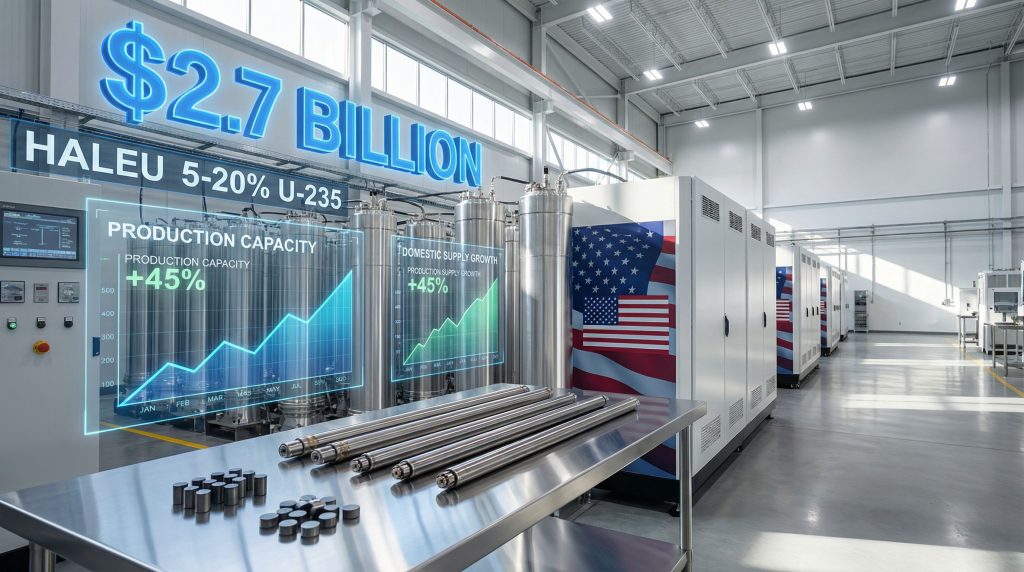
The distribution of DOE uranium enrichment funding across three primary contractors represents a calculated approach to balancing risk whilst maximising technological diversity. The US Department of Energy awarded $2.7 billion worth of orders to boost domestic uranium enrichment capabilities. Each $900 million award targets specific aspects of the enrichment ecosystem, from conventional reactor fuel supplies to advanced reactor requirements and emerging technology development.
American Centrifuge Operating: Establishing HALEU Production Infrastructure
American Centrifuge Operating received authorisation for up to $900 million to establish domestic enrichment capacity specifically targeting high-assay low-enriched uranium production. This award addresses one of the most critical gaps in current American nuclear fuel capabilities, as HALEU production has remained almost entirely dependent on foreign suppliers, particularly Russian entities that have historically dominated this specialised market segment.
The technical requirements for HALEU production differ substantially from conventional LEU enrichment, requiring enhanced centrifuge configurations and more sophisticated isotope separation capabilities. HALEU enrichment to levels between 5-20% uranium-235 demands greater precision and typically involves longer processing times compared to conventional reactor fuel enrichment.
American Centrifuge Operating's approach builds upon existing gas centrifuge technology whilst adapting systems specifically for higher enrichment applications. The company's connection to the former Piketon, Ohio enrichment facility provides access to existing infrastructure that can potentially be modernised and expanded for current production requirements.
General Matter: Developing Next-Generation Enrichment Capabilities
General Matter's $900 million award focuses on developing high-assay low-enriched uranium enrichment capability through what appears to be innovative technological approaches. The company represents a newer entrant in the enrichment sector, potentially bringing fresh perspectives to traditional centrifuge-based separation methods.
The emphasis on "developing" HALEU enrichment capability suggests General Matter may be pursuing alternative technological pathways or advanced centrifuge designs that could offer competitive advantages in efficiency, throughput, or operational costs. This technological diversity within the DOE funding portfolio reduces risks associated with depending on single enrichment approaches.
General Matter's selection alongside more established industry participants indicates DOE's willingness to support innovative approaches that could potentially transform enrichment economics or technical capabilities. The substantial funding commitment reflects confidence in the company's technical approach and management capabilities.
Orano Federal Services: Expanding Conventional Reactor Fuel Supply
Orano Federal Services received $900 million to expand American low-enriched uranium enrichment capacity for commercial reactor fuel, addressing the immediate needs of the nation's existing 94-reactor fleet. This award focuses on conventional enrichment services that constitute the bulk of current nuclear fuel demand.
Orano's international experience in enrichment operations provides valuable expertise for developing American capacity. In addition, the company operates enrichment facilities globally and possesses deep technical knowledge regarding large-scale centrifuge operations, quality control systems, and integration with broader nuclear fuel supply chains.
The focus on LEU expansion complements the HALEU-focused awards to American Centrifuge Operating and General Matter, creating a comprehensive domestic enrichment capability spanning both current and future reactor fuel requirements. This balanced approach ensures that neither existing reactor operations nor advanced reactor development will be constrained by enrichment capacity limitations.
Advanced Technology Development: Global Laser Enrichment Innovation
Beyond the three major centrifuge-based enrichment contracts, DOE allocated $28 million to Global Laser Enrichment for continued development of next-generation uranium enrichment technology. This smaller but strategically important award represents investment in potentially transformative enrichment methods that could reshape industry economics and capabilities.
Laser enrichment technology operates on fundamentally different principles compared to gas centrifuge separation. Rather than exploiting mass differences through mechanical rotation, laser enrichment utilises precisely tuned laser wavelengths to selectively excite uranium-235 atoms, enabling separation through photochemical rather than mechanical processes.
The theoretical advantages of laser enrichment include potentially lower energy consumption per unit of separated work, reduced facility footprint requirements, and greater flexibility in enrichment level adjustments. These characteristics could prove particularly valuable for HALEU production, where conventional centrifuge cascades require extensive modification to achieve higher enrichment levels efficiently.
Global Laser Enrichment's continued funding indicates promising progress in translating laboratory-scale laser enrichment concepts into commercial-scale production systems. However, the December 2025 competitive solicitation that led to this award suggests DOE conducted comprehensive technical evaluations comparing multiple advanced enrichment approaches.
The relatively modest funding level compared to centrifuge-based awards reflects the earlier development stage of laser enrichment technology whilst maintaining federal support for potentially revolutionary technological advancement. This balanced approach ensures that proven centrifuge technology can address immediate capacity needs whilst laser enrichment development continues toward future commercial deployment.
Strategic Supply Chain Implications
The transformation of American nuclear fuel supply chains through domestic enrichment development extends far beyond technical production capabilities to encompass fundamental changes in energy security, economic planning, and international strategic positioning. Furthermore, the uranium market volatility has created additional urgency for establishing reliable domestic supply chains.
Redefining Energy Independence in Nuclear Fuel
Energy independence in nuclear fuel context differs significantly from conventional energy independence discussions focused on oil or natural gas imports. Nuclear fuel represents a unique commodity where small quantities contain enormous energy potential, but production requires specialised infrastructure and technical expertise concentrated in relatively few global locations.
The current structure of global enrichment markets has created situations where reactor operators in multiple countries depend on enrichment services from a limited number of suppliers. This concentration creates both economic and strategic vulnerabilities, particularly when geopolitical tensions affect supplier relationships or trade policies.
Domestic enrichment capacity development addresses these vulnerabilities by providing American reactor operators with reliable, long-term fuel supply options that remain insulated from international political considerations. Consequently, this supply security enables more confident long-term planning for reactor operations, life extensions, and new reactor development projects.
Economic Impact on Nuclear Power Operations
Enrichment services typically represent a significant component of total nuclear fuel costs, which in turn constitute a substantial portion of nuclear power plant operating expenses. Domestic enrichment availability could potentially stabilise fuel costs and reduce exposure to international market volatility.
The milestone-based contracting structure employed by DOE creates accountability mechanisms designed to ensure that federal investments translate into reliable commercial services at competitive prices. This approach balances public investment with private sector efficiency incentives.
Long-term fuel supply certainty enables utilities to make more confident investment decisions regarding reactor maintenance, upgrades, and life extensions. The knowledge that domestic enrichment capacity will be available reduces uncertainties that have historically complicated nuclear power economic planning.
Advanced Reactor Market Development
The development of domestic HALEU production capability through the American Centrifuge Operating and General Matter awards directly enables advanced reactor deployment by addressing one of the most significant fuel supply bottlenecks facing next-generation nuclear technologies. The us uranium production technology advances complement these enrichment developments.
HALEU Requirements for Next-Generation Reactors
Advanced reactor designs, including small modular reactors (SMRs) and various Generation IV concepts, typically require HALEU fuel with enrichment levels significantly higher than conventional reactor specifications. This requirement reflects design choices that optimise for enhanced safety characteristics, longer fuel cycles, or improved thermal efficiency.
| Reactor Technology | Enrichment Level | Strategic Significance |
|---|---|---|
| Current Commercial Reactors | 3-5% U-235 | Immediate supply security |
| Small Modular Reactors | 5-12% U-235 | Near-term deployment enabler |
| Advanced Reactors | 12-20% U-235 | Long-term innovation support |
The absence of reliable domestic HALEU supply has created a fundamental constraint on advanced reactor development and deployment schedules. Reactor developers have faced uncertainty regarding fuel availability that complicated project financing, regulatory approval processes, and commercial deployment timelines.
Market Size and Growth Projections
HALEU demand projections depend heavily on advanced reactor deployment rates, which remain subject to regulatory approval timelines, project financing availability, and market acceptance factors. However, multiple advanced reactor projects have received federal support through programs like the Advanced Reactor Demonstration Program, creating a foundation for HALEU demand growth.
The DOE uranium enrichment funding represents a coordinated policy approach where fuel supply development parallels reactor technology advancement. This coordination reduces risks for both advanced reactor developers and enrichment service providers by ensuring demand and supply development proceed simultaneously.
Early HALEU production capability also positions American companies to potentially serve international advanced reactor markets, creating export opportunities that could enhance the economic returns on federal enrichment investments.
The next major ASX story will hit our subscribers first
Regulatory and Policy Framework Integration
The DOE uranium enrichment funding initiative operates within a broader regulatory and policy framework that includes import restrictions, reactor development incentives, and national security considerations. Understanding these interconnections reveals the comprehensive nature of federal nuclear energy strategy.
Coordination with Russian Import Restrictions
Federal legislation has established timelines for restricting Russian uranium imports, creating definitive deadlines by which domestic enrichment capacity must be operational. The 2028 import prohibition timeline creates a clear market transition schedule that requires domestic enrichment development to proceed according to specific milestones.
The milestone-based contracting approach employed in the DOE uranium enrichment funding directly addresses these regulatory timelines by establishing accountability mechanisms that ensure domestic capacity development remains on schedule. Contractor performance will be measured against specific deliverables tied to the broader policy implementation schedule.
Emergency waiver provisions in the import restriction legislation provide flexibility for situations where domestic capacity development experiences delays, but the intent is clearly to minimise dependence on such exceptions through proactive capacity development.
Integration with Advanced Reactor Policy Support
The DOE uranium enrichment funding complements other federal initiatives supporting advanced reactor development, including the previously announced $700 million HALEU program and various reactor demonstration projects. This coordination ensures that fuel supply development aligns with reactor technology advancement schedules.
Department of Defense requirements for advanced reactor technologies add another dimension to HALEU demand projections, as military applications may require fuel supplies that meet additional security and reliability standards beyond commercial specifications.
Export control considerations affect both enrichment technology development and international market opportunities. The development of domestic enrichment capability must comply with non-proliferation obligations whilst enabling legitimate commercial export opportunities.
Economic Impact Assessment and Return on Investment
The $2.7 billion federal investment in uranium enrichment capacity represents substantial public expenditure that requires careful analysis of economic returns, job creation potential, and broader strategic benefits that may not be immediately quantifiable through conventional economic metrics.
Direct and Indirect Employment Effects
Enrichment facility development creates multiple categories of employment opportunities, from highly specialised technical positions requiring nuclear engineering expertise to manufacturing, construction, and support roles that can benefit broader regional economies. The capital-intensive nature of enrichment infrastructure typically generates substantial construction employment during facility development phases.
Long-term operations employment at enrichment facilities tends to be relatively stable and well-compensated, given the technical expertise required for safe and efficient operations. These positions often become anchor employment opportunities in their communities, supporting local economic development and tax base enhancement.
Supply chain effects extend employment benefits beyond direct facility operations to include specialised equipment manufacturing, maintenance services, transportation, and various professional services required for regulatory compliance and ongoing operations.
Strategic Value Beyond Direct Economic Returns
The economic value of domestic enrichment capacity includes strategic benefits that are difficult to quantify through conventional financial analysis. Energy security, reduced geopolitical vulnerability, and enhanced negotiating position in international energy markets represent intangible but valuable returns on federal investment.
Risk mitigation value emerges from reduced exposure to international supply disruptions that could affect both existing reactor operations and advanced reactor development schedules. This insurance value becomes particularly significant during periods of international tension or trade disputes.
Technology leadership benefits arise from maintaining domestic expertise in advanced enrichment technologies, positioning American companies to compete in global markets and potentially export enrichment services to allied nations seeking supply chain diversification.
Risk Mitigation and Success Factors
The scale and complexity of developing domestic enrichment capacity creates multiple categories of risk that require careful management to ensure federal investment achieves intended strategic objectives. Understanding these risks enables better evaluation of program design and implementation approaches.
Technical Execution Challenges
Enrichment technology deployment involves sophisticated engineering systems that must meet stringent safety, security, and performance standards. The precision required for isotope separation creates narrow tolerances for equipment performance and operational procedures.
Scaling from demonstration or pilot facilities to commercial production capacity often reveals unexpected technical challenges that can affect timelines and costs. The milestone-based contracting approach provides mechanisms for addressing such challenges whilst maintaining accountability for federal investment.
Quality assurance requirements for nuclear fuel applications demand consistent performance that meets reactor safety specifications. Developing and maintaining these quality systems requires substantial technical expertise and ongoing investment in testing and certification capabilities.
Market Demand and Pricing Considerations
The economic viability of domestic enrichment capacity depends on sustained demand at pricing levels that support operational costs and capital recovery. Market demand projections for both conventional LEU and HALEU must account for reactor deployment schedules, fuel cycle management strategies, and potential competition from alternative technologies.
Advanced reactor market development remains subject to regulatory approval timelines, project financing availability, and utility acceptance factors that could affect HALEU demand growth rates. This uncertainty requires enrichment capacity development to maintain flexibility regarding production level adjustments.
International enrichment market dynamics continue evolving as various countries pursue supply chain diversification strategies similar to American initiatives. The us uranium market disruptions could affect both demand for American enrichment services and competitive pricing pressures.
Future Outlook and Strategic Implications
The successful development of domestic uranium enrichment capacity through the DOE uranium enrichment funding initiative could fundamentally reshape both American nuclear energy capabilities and global enrichment market dynamics. Understanding these potential transformations provides insight into the strategic significance of current investments.
Transformation of Global Uranium Markets
American entry as a major enrichment service provider could alter global market concentration patterns that have historically favoured a limited number of suppliers. This market diversification could benefit reactor operators worldwide by providing additional supply options and potentially moderating pricing through increased competition.
Strategic partnerships with allied nations seeking enrichment supply diversification could create export opportunities for American providers whilst strengthening international energy security cooperation. Such partnerships might involve joint development projects, technology sharing, or coordinated capacity expansion programs.
The demonstration of successful domestic enrichment development could encourage similar initiatives in other countries, potentially leading to more distributed global enrichment capacity and reduced strategic vulnerabilities for nuclear energy sectors worldwide.
Integration with Clean Energy Transition
Nuclear power's role in decarbonisation strategies requires reliable fuel supplies that support both existing reactor operations and advanced reactor deployment. Furthermore, domestic enrichment capacity ensures that climate policy objectives are not constrained by fuel supply uncertainties or geopolitical considerations.
The baseload power characteristics of nuclear generation complement intermittent renewable energy sources by providing consistent electricity supply during periods when wind and solar generation may be limited. Reliable fuel supplies enhance the value of this complementary relationship.
Advanced reactor technologies designed for industrial applications, including hydrogen production and process heat applications, require HALEU fuel supplies that enable their deployment as decarbonisation solutions for sectors beyond electricity generation.
Investment Implications and Strategic Recommendations
The Centrus Energy wins $900m award highlights the scale of private sector involvement in this transformation. The DOE uranium enrichment funding creates multiple opportunities and considerations for various stakeholders in the nuclear energy ecosystem, from utilities and reactor developers to investors and policy makers seeking to understand the implications of transformative supply chain development.
Utility Sector Planning Considerations
Electric utilities operating nuclear reactors can begin incorporating domestic enrichment availability into long-term fuel supply strategies and contract negotiations. The increased supply options may provide leverage in price negotiations and reduce risks associated with foreign supplier concentration.
Long-term fuel supply contracts with domestic providers could offer price stability advantages and reduced exposure to international market volatility. Utilities should evaluate the timing of contract transitions to optimise economic benefits whilst maintaining fuel supply security.
Advanced reactor development projects can proceed with greater confidence regarding HALEU availability, potentially accelerating deployment schedules and improving project financing prospects. This fuel supply certainty may encourage utilities to more seriously evaluate advanced reactor options for fleet modernisation.
Technology Developer and Investor Opportunities
The substantial federal commitment to enrichment capacity development creates opportunities for companies providing specialised equipment, services, and technologies supporting enrichment operations. These opportunities span from centrifuge manufacturing to facility construction and ongoing maintenance services.
Investment opportunities may emerge in companies positioned to benefit from enrichment capacity expansion, including those providing supporting technologies, logistics services, or downstream fuel fabrication capabilities that complement enrichment operations.
International market opportunities could develop as American enrichment capabilities mature and seek global customers, particularly among allied nations pursuing supply chain diversification strategies similar to current American initiatives.
The success of the DOE uranium enrichment funding initiative represents more than just industrial capacity development. It embodies a strategic approach to energy security that recognises the critical intersection of technological capability, economic competitiveness, and national security considerations. The comprehensive program structure, spanning immediate capacity needs through advanced technology development, positions American nuclear energy infrastructure for sustained long-term growth whilst reducing strategic vulnerabilities that have constrained the sector for decades.
The industry innovation trends suggest this enrichment capacity development aligns with broader technological advancement patterns across the nuclear fuel cycle.
This analysis is based on publicly available information and should not be construed as investment advice. Nuclear energy investments involve various risks including regulatory, technical, and market uncertainties that require careful evaluation by qualified professionals.
Want to Stay Ahead of Strategic Infrastructure Investment Opportunities?
Nuclear fuel enrichment developments signal just one area where strategic infrastructure investments are reshaping entire industries, creating substantial opportunities for informed investors. Discovery Alert's proprietary Discovery IQ model tracks these emerging trends across the resources sector, delivering real-time alerts when significant discoveries and infrastructure developments hit the ASX, giving subscribers actionable insights before broader market awareness develops.