August 6, 2026
Understanding Nuclear Fuel Market Fundamentals and Price Formation
The nuclear fuel ecosystem operates as a complex interplay of geological constraints, technological requirements, and strategic policy decisions that collectively influence pricing mechanisms across global uranium markets. Unlike conventional energy commodities, uranium exhibits unique market characteristics driven by its dual nature as both an industrial commodity and a strategic national security asset, with uranium market volatility creating additional complexity for market participants.
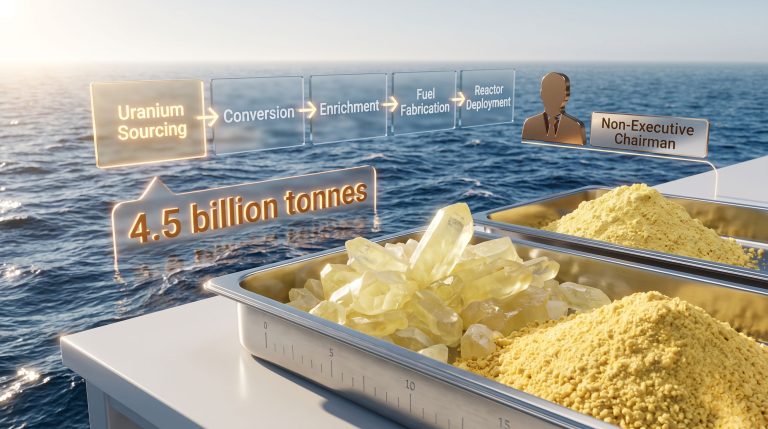
Nuclear fuel cycles require precise isotopic compositions and enrichment levels that create distinct supply chain bottlenecks between raw uranium extraction and reactor-ready fuel assemblies. This technical complexity generates price premiums that reflect not merely commodity scarcity, but also processing capacity constraints and regulatory compliance costs.
The uranium market's evolution during 2024-2026 demonstrates how geopolitical tensions, energy security priorities, and technological advancement converge to create sustained price elevation beyond traditional supply-demand fundamentals.
When big ASX news breaks, our subscribers know first
Supply-Side Structural Constraints Driving Market Tension
Kazakhstan's dominant position in global uranium production creates systemic vulnerability throughout the nuclear fuel supply chain. Controlling approximately 40 percent of worldwide uranium output, production variations from Kazatomprom facilities generate disproportionate market impacts that extend far beyond regional supply considerations.
Operational challenges across major uranium-producing regions have created compounding supply constraints during the 2024-2026 period:
- Primary production bottlenecks from weather-related mining disruptions
- Transportation logistics complications affecting uranium concentrate shipments
- Regulatory compliance delays extending mine permitting timelines
- Labor shortage impacts reducing extraction efficiency rates
Mining Infrastructure Challenges
The uranium industry's capital-intensive nature creates long lead times between investment decisions and production capacity additions. In-situ recovery (ISR) mining operations, which represent the majority of global uranium production, require extensive wellfield development and processing infrastructure that cannot rapidly respond to price signals.
Furthermore, advanced mining techniques employed in Kazakhstan and other major producing regions involve sophisticated groundwater management systems and environmental monitoring protocols that add operational complexity. These technical requirements create natural production ceilings that limit supply elasticity even during periods of elevated pricing. Meanwhile, US ISR uranium production continues to face regulatory hurdles that constrain domestic supply growth.
Secondary Supply Depletion Patterns
Historical sources of secondary uranium supply have experienced significant depletion during recent market cycles:
- Weapons-grade material conversion programs nearing completion phases
- Utility inventory drawdowns reducing strategic stockpile levels
- Recycling capacity limitations constraining fuel cycle efficiency
- Enrichment service bottlenecks creating processing delays
Critical Market Insight: The transition from abundant secondary uranium sources to primary production dependence represents a fundamental structural shift that supports higher long-term price floors across the nuclear fuel cycle.
Demand Transformation Beyond Traditional Utility Requirements
Electricity consumption patterns have undergone dramatic transformation as artificial intelligence computing infrastructure drives unprecedented power demand growth. Data center operations require consistent baseload electricity generation that aligns with nuclear power's operational characteristics, creating new demand categories beyond traditional utility procurement cycles.
The $80 billion Westinghouse contract announced in October 2025 specifically targets AI-driven electricity requirements, representing a paradigm shift in nuclear capacity planning. This massive infrastructure commitment demonstrates how technology sector electricity consumption is reshaping long-term uranium demand projections.
Government Strategic Positioning
Federal intervention in uranium markets has intensified through multiple policy mechanisms designed to enhance domestic fuel cycle capabilities. Additionally, understanding uranium investment strategies becomes crucial as government policies reshape market dynamics:
| Policy Initiative | Investment Value | Implementation Timeline | Market Impact |
|---|---|---|---|
| HALEU Enrichment Contracts | $2.7 billion | 2024-2028 | Supply security |
| Strategic Reserve Building | Undisclosed | Ongoing | Demand floor |
| Import Diversification | Policy-driven | 2024-2026 | Supply constraints |
| Regulatory Streamlining | Administrative | 2025-2027 | Capacity additions |
These coordinated policy interventions create sustained demand sources independent of traditional utility procurement patterns, establishing price support mechanisms that operate regardless of commercial reactor requirements.
Energy Security as Strategic Priority
National security considerations have elevated uranium from a commercial commodity to a strategic resource requiring domestic supply chain resilience. Government agencies now participate directly in uranium markets through stockpile accumulation and long-term contracting arrangements that function as market makers.
However, the regulatory streamlining for uranium conversion facilities addresses critical bottlenecks in the nuclear fuel cycle where uranium hexafluoride (UF6) gets processed into reactor-usable forms. Conversion capacity limitations create supply chain chokepoints that government intervention aims to eliminate through expedited permitting processes.
Price Performance Analysis and Historical Context
Uranium prices reached their highest level since February 2024 during January 2026, with Cameco reporting spot prices of $94.28 per pound at month-end. This pricing milestone represents significant recovery from the March 2025 low of $64.23 per pound, demonstrating market volatility that exceeds most conventional commodities.
2025-2026 Price Trajectory Analysis
The uranium market experienced substantial price movements throughout 2025, with Trading Economics documenting futures price fluctuations that reflected changing supply-demand dynamics:
- March 2025: $64.23/lb spot price (annual low)
- September 2025: $82.63/lb spot price (annual high)
- January 2026: $94.28/lb spot price (near February 2024 levels)
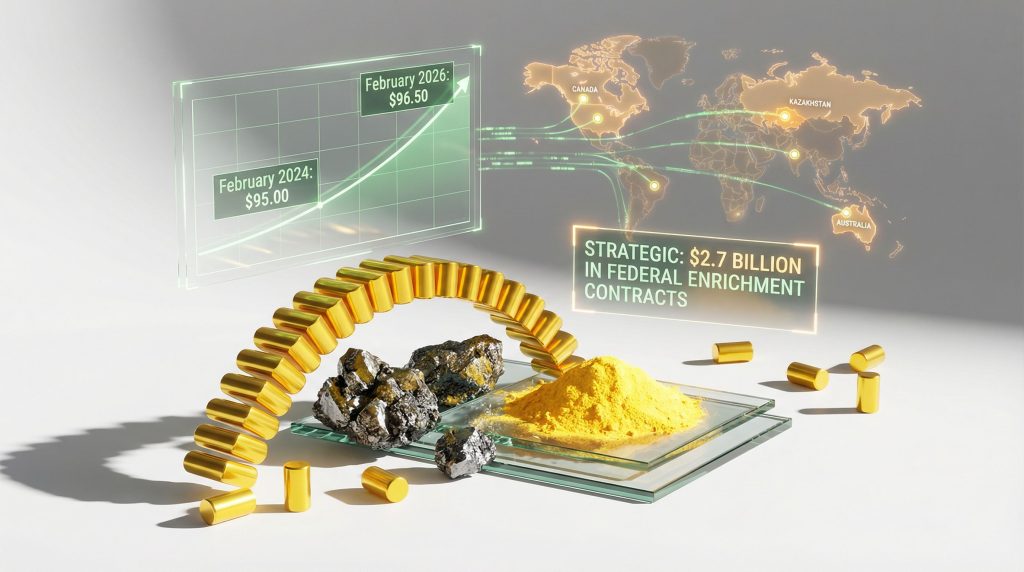
- February 2026: $96.50/lb futures price with 17.68% monthly gain
This 32.55 percent year-over-year increase demonstrates sustained upward price momentum driven by fundamental supply-demand rebalancing rather than speculative trading activity.
Futures Market Premium Structure
Uranium futures contracts consistently trade at premiums to spot prices, reflecting storage costs, financing expenses, and market expectations about future supply availability. The $2-5 per pound futures premium observed during 2025-2026 indicates market confidence in sustained higher pricing levels.
Market Structure Evolution: Uranium futures markets now incorporate strategic reserve building, energy security considerations, and technology sector demand alongside traditional utility procurement cycles.
Geopolitical Influences on Supply Chain Resilience
Import restrictions on Russian uranium supply have created significant supply chain disruptions affecting approximately 20 percent of global uranium trade. These policy-driven supply constraints force importing nations to develop alternative sourcing arrangements that often involve higher-cost production sources. Consequently, the US Senate uranium import ban has accelerated this market transformation.
Regional Production Capacity Development
North American uranium production initiatives have gained momentum through government support mechanisms and private sector investment responding to higher price expectations:
- Anfield Energy's Velvet Wood mine construction commenced November 2025 in southeastern Utah
- Canadian mining expansion targeting domestic fuel cycle integration
- Australian project development accelerating through streamlined environmental approvals
- African production partnerships diversifying supply source geography
The Langer Heinrich mine in Namibia, operated by Paladin Resources, remains operational as one of the world's largest independent uranium producers, contributing significant supply volumes to global markets despite previous reports suggesting care-and-maintenance status.
Strategic Partnership Development
International cooperation agreements have become essential for ensuring reliable uranium supply access as geopolitical tensions reshape traditional trading relationships. The U.S.-Saudi Arabia nuclear energy cooperation deal announced in November 2025 exemplifies how strategic partnerships extend beyond commercial arrangements into comprehensive nuclear technology cooperation frameworks.
In contrast, the Nova Scotia uranium ban demonstrates how regional environmental policies can also influence supply dynamics across North American markets.
Investment Capital Allocation and Market Psychology
Physical uranium funds have emerged as significant market participants, accumulating uranium inventory based on expectations of sustained higher demand. These specialised investment vehicles create additional demand sources that compete directly with utility procurement programs for available uranium supply.
Institutional Investment Strategy Evolution
Investment approaches to uranium exposure have diversified beyond traditional mining equity positions to include:
- Direct physical uranium holdings through specialised investment trusts
- Long-term supply contract participation securing future delivery at fixed prices
- Conversion and enrichment service investments capturing fuel cycle value-added processing
- Strategic partnership equity stakes in integrated nuclear fuel companies
ESG-focused investment funds have increased allocation to nuclear-related investments as climate policy priorities emphasise low-carbon electricity generation. However, specific ESG fund flow quantification remains limited due to diverse classification methodologies across fund management organisations.
Risk Management Framework Considerations
Uranium market participants employ sophisticated risk management strategies that account for price volatility, supply chain disruptions, and regulatory changes:
| Risk Category | Management Approach | Time Horizon | Effectiveness |
|---|---|---|---|
| Price volatility | Derivative hedging | 1-3 years | High |
| Supply disruption | Geographic diversification | 5-10 years | Medium |
| Regulatory changes | Policy monitoring | Ongoing | Variable |
| Technology shifts | Portfolio diversification | 10+ years | Emerging |
The next major ASX story will hit our subscribers first
Nuclear Industry Demand Fundamentals and Growth Drivers
Global nuclear capacity expansion plans support sustained uranium demand growth beyond current utility requirements. Small modular reactor (SMR) development programs and advanced reactor technologies create additional fuel cycle demand that extends market growth potential.
Advanced Reactor Fuel Requirements
High-Assay Low-Enriched Uranium (HALEU) requirements for advanced reactor designs necessitate specialised enrichment capabilities that create premium pricing for enhanced uranium products. The $2.7 billion in federal enrichment contracts specifically targets HALEU production capacity development to support next-generation reactor deployment.
HALEU enrichment levels between 5-20 percent U-235 content require sophisticated enrichment technologies that exceed conventional light-water reactor fuel specifications. This technical complexity generates value-added processing opportunities that command premium pricing relative to standard uranium concentrates.
Electricity Demand Growth Scenarios
Data center electricity consumption projections indicate substantial baseload power requirements that favour nuclear generation characteristics:
- AI computing infrastructure requiring 24/7 electricity availability
- Cryptocurrency mining operations seeking low-cost, reliable power sources
- Cloud service expansion driving data center capacity additions
- Industrial electrification increasing overall electricity demand
These demand drivers operate independently of traditional utility load growth patterns, creating additional nuclear capacity requirements that support sustained uranium demand expansion.
Market Structure Transformation and Strategic Resource Classification
The uranium market has evolved from a purely commercial commodity exchange to a strategic resource allocation system influenced by national security priorities and climate policy objectives. Government participation in uranium markets now extends beyond regulatory oversight to direct market participation through strategic reserve accumulation and long-term contracting arrangements.
Price Discovery Mechanism Evolution
Traditional uranium price formation mechanisms based on utility procurement cycles have expanded to incorporate strategic government purchasing, investment fund accumulation, and technology sector demand. This multi-participant market structure creates price support levels that reflect strategic value beyond immediate commercial utility requirements.
Strategic Transformation: Uranium pricing now reflects strategic resource value encompassing energy security, climate policy implementation, and technological infrastructure development rather than solely commercial electricity generation economics.
Future Market Trajectory Considerations and Investment Implications
Current uranium market dynamics suggest sustained price support above $80 per pound with potential for testing previous high levels during periods of supply constraint or demand acceleration. Technical analysis indicators demonstrate momentum continuation patterns that support bullish price expectations.
Scenario Analysis Framework
Market participants employ scenario modelling approaches that incorporate multiple variables affecting uranium price trajectories:
| Scenario Framework | Price Projection Range | Probability Assessment | Primary Catalysts |
|---|---|---|---|
| Base case scenario | $85-$105/lb | 60% probability | Steady demand growth |
| Supply disruption scenario | $110-$130/lb | 25% probability | Production constraints |
| Demand slowdown scenario | $65-$85/lb | 15% probability | Policy changes |
These projections incorporate government strategic reserve building, technology sector electricity requirements, and nuclear capacity expansion plans alongside traditional utility procurement forecasting.
Long-Term Structural Support Factors
Multiple converging factors provide fundamental support for sustained higher uranium valuations:
- Energy security policy prioritisation creating strategic demand floors
- Climate policy implementation favouring low-carbon electricity generation
- Technology sector growth requiring reliable baseload power sources
- Nuclear renaissance momentum expanding global reactor construction
- Supply chain resilience building reducing import dependency risks
Investment Disclaimer: Uranium markets involve significant price volatility and regulatory risks that can materially affect investment returns. This analysis represents market assessment based on available information and should not constitute investment advice. Market participants should conduct independent due diligence and consult qualified professionals before making investment decisions.
The uranium market's transformation toward strategic resource classification suggests sustained price elevation reflects fundamental structural changes rather than temporary market imbalances. Understanding these dynamics enables more informed decision-making across mining operations, utility procurement strategies, and investment portfolio construction approaches.
Looking to Capitalise on ASX Uranium Mining Opportunities?
Discovery Alert's proprietary Discovery IQ model delivers real-time alerts on significant uranium and mineral discoveries across the ASX, instantly empowering subscribers to identify actionable opportunities ahead of the broader market. Begin your 14-day free trial today and discover why historic discoveries can generate substantial returns for informed investors.