August 13, 2026
The Strategic Value of Nuclear Fuel Security
Global energy markets stand at a critical inflection point where supply chain vulnerabilities have become national security imperatives. The complexity of nuclear fuel production creates unique strategic dependencies that extend far beyond simple commodity trading relationships. Unlike fossil fuel imports that can be sourced from multiple suppliers with relatively short lead times, nuclear fuel requires sophisticated industrial infrastructure operating across multiple processing stages, each demanding specialised facilities, technical expertise, and regulatory frameworks that take years to establish.
The nuclear fuel cycle represents one of the most technically demanding industrial processes in modern energy production. This intricate system transforms raw uranium ore through seven distinct stages before reaching reactor-ready fuel assemblies. Each stage requires specific technologies, regulatory approvals, and operational capabilities that cannot be rapidly substituted or relocated. The strategic significance becomes apparent when considering that disruptions at any single stage can compromise an entire nation's nuclear generating capacity, affecting both existing reactor operations and future energy security planning.
Why Nuclear Fuel Security Determines Energy Independence
Current American nuclear fuel dependencies reveal significant strategic vulnerabilities across the production chain. Furthermore, uranium market volatility continues to expose these vulnerabilities. The United States currently lacks domestic high-assay, low-enriched uranium (HALEU) production capacity, creating complete reliance on foreign enrichment services primarily from Russia, France, and the United Kingdom. According to the U.S. Energy Information Administration, uranium imports account for approximately 88% of domestic consumption, with Kazakhstan, Canada, and Uzbekistan serving as primary suppliers for raw materials.
The economic implications extend beyond immediate fuel costs to encompass long-term grid stability and industrial competitiveness. Nuclear facilities typically operate with capacity factors exceeding 90%, providing consistent baseload power that supports manufacturing operations, data centre infrastructure, and grid reliability services. Fuel supply disruptions can force premature shutdowns of these high-value generating assets, creating cascading effects throughout regional electricity markets.
Strategic vulnerabilities manifest most critically during geopolitical tensions when trade relationships face sudden disruption. Recent global events have demonstrated how energy dependencies become leverage points in international relations, affecting everything from domestic electricity prices to industrial production scheduling. However, the US Senate ban impact on Russian uranium has accelerated domestic capacity discussions. The nuclear sector's long planning horizons and capital-intensive infrastructure make it particularly susceptible to supply chain weaponisation.
Complete Nuclear Fuel Cycle Infrastructure Requirements
The nuclear fuel transformation process encompasses seven technically complex stages, each requiring specialised industrial capabilities:
Mining and Milling Operations:
- Extraction of uranium ore through open-pit or underground mining techniques
- Concentration processing to produce yellowcake (U₃O₈) with typical concentrations of 80-85% uranium oxide
- Environmental compliance systems for radioactive material handling and waste management
Conversion and Enrichment Processing:
- Chemical conversion of yellowcake to uranium hexafluoride (UF₆) gas for enrichment processing
- Isotopic separation using advanced centrifuge technology to increase U-235 concentration
- Standard commercial reactor fuel requires 3-5% enrichment levels
- Advanced reactor designs demand HALEU fuel with 5-20% enrichment concentrations
Fabrication and Assembly Manufacturing:
- Deconversion of enriched UF₆ into uranium dioxide (UO₂) powder
- Pellet production, sintering, and quality control testing
- Fuel rod assembly and bundle configuration for specific reactor designs
- Quality assurance protocols ensuring dimensional accuracy and material integrity
Recycling and Reprocessing Capabilities:
- Spent fuel storage and cooling management
- Chemical separation of usable uranium and plutonium from fission products
- Waste stream processing and long-term storage preparation
- Recovery of valuable isotopes for medical and industrial applications
According to the International Atomic Energy Agency, infrastructure gaps currently limit domestic production capacity across multiple fuel cycle stages. The United States operates only one commercial uranium enrichment facility at Paducah, Kentucky, managed by Centrus Energy, with limited HALEU production capability as of 2026. Consequently, US uranium production advances have become essential for addressing these gaps.
When big ASX news breaks, our subscribers know first
Federal Coordination Through Defense Production Act Framework
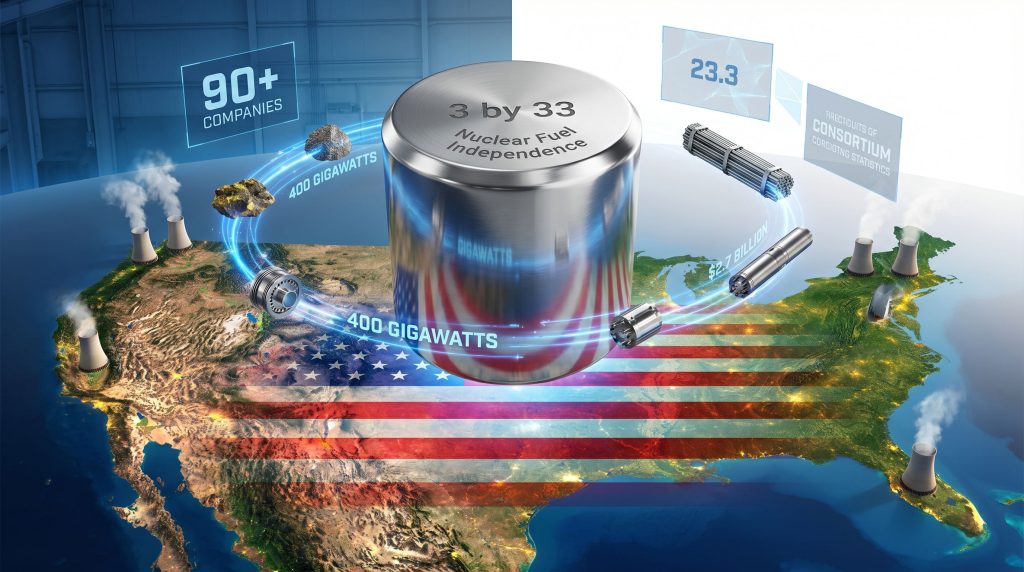
The DOE rallies industry around nuclear fuel through the Defense Production Act Nuclear Fuel Cycle Consortium, representing an unprecedented coordination mechanism bringing together more than 90 companies across the nuclear industrial base. This voluntary agreement framework leverages authorities established under the Defense Production Act of 1950, enabling coordinated industry action without mandatory compliance requirements whilst maintaining antitrust law protections for participating companies.
Consortium Architecture and Participation Structure
The consortium encompasses companies spanning uranium mining operations through reactor manufacturing, creating an integrated approach to fuel cycle development. Participation includes uranium producers, conversion facility operators, enrichment technology developers, fuel fabricators, and advanced reactor manufacturers. This comprehensive industry representation enables coordinated capacity planning, shared technical standards development, and workforce planning alignment across the entire nuclear value chain.
The voluntary agreement mechanism facilitates several critical coordination functions:
- Coordinated procurement and capacity planning across fuel cycle stages
- Shared technical standards and specifications for advanced reactor fuel requirements
- Workforce planning coordination addressing skilled labour shortages
- Information sharing protocols for supply chain constraint identification and mitigation
According to the U.S. Department of Energy's Office of Nuclear Energy, this differs significantly from mandatory production controls, allowing market flexibility whilst maintaining strategic alignment around national energy security objectives.
The "3 by 33" Campaign Strategic Implementation
The initiative establishes three primary strategic pillars targeting completion by 2033:
-
Domestic Fuel Supply Chain Security: Achieving energy independence through integrated domestic production capabilities across all fuel cycle stages
-
Advanced Reactor Deployment Acceleration: Coordinating HALEU fuel production with small modular reactor and advanced reactor commercialisation timelines
-
Closed Fuel Cycle Commercialisation: Developing recycling and reprocessing capabilities to maximise fuel utilisation and minimise waste streams
The campaign employs 60-day sprint methodology for rapid implementation, focusing consortium efforts on near-term deliverables whilst maintaining longer-term capacity building objectives. Assistant Secretary for Nuclear Energy Ted Garrish emphasised the critical timing of these efforts, stating that "the consortium's work comes at a pivotal moment for nuclear energy growth in the United States."
Economic Impact Analysis for Reactor Operations
Domestic nuclear fuel production fundamentally alters the economic structure of reactor operations through multiple cost and risk reduction mechanisms. Current import-dependent fuel costs expose utilities to exchange rate fluctuations, geopolitical supply disruptions, and global commodity market volatility that domestic production could potentially mitigate. In addition, US uranium tariff disruptions highlight the need for supply chain diversification.
Cost Structure Transformation for Nuclear Utilities
Enrichment services typically represent 25-30% of total nuclear fuel costs for utility operators, according to International Atomic Energy Agency economic analyses. Domestic enrichment capacity would theoretically provide price stability benefits by eliminating several cost variables:
- Currency exchange fluctuation exposure affecting international contract values
- Geopolitical risk premiums embedded in foreign supplier pricing
- Transportation and logistics costs associated with international fuel shipments
- Supply chain insurance requirements covering international trade disruptions
However, domestic production initially requires higher capital investments and operational costs compared to established foreign facilities operating at scale. The economic competitiveness timeline depends critically on production volume scaling and operational efficiency improvements achieved through learning curve effects.
Advanced Reactor Fuel Market Opportunities
HALEU fuel requirements create entirely new market segments with different economic dynamics than traditional reactor fuel. Advanced reactor designs including small modular reactors, high-temperature gas reactors, and molten salt reactors require 5-20% uranium enrichment levels unavailable from current domestic production capacity.
The technical specifications for HALEU production demand:
- Advanced centrifuge cascade technology with higher efficiency than traditional enrichment systems
- Enhanced security infrastructure meeting international standards for higher-enrichment material handling
- Specialised safety protocols addressing increased radiological risks during processing
- Certified operator training programmes for personnel working with enriched uranium materials
According to Centrus Energy's technical assessments, HALEU production requires substantial capital investment in specialised equipment and facility modifications beyond conventional enrichment operations.
Market Drivers Accelerating Nuclear Renaissance
Contemporary energy demand patterns driven by artificial intelligence infrastructure and manufacturing reshoring create unprecedented requirements for reliable baseload power generation. These demand drivers align with nuclear power's operational characteristics whilst exposing limitations of intermittent renewable energy sources for critical industrial applications. Furthermore, the US production executive order has reinforced domestic production priorities.
Data Centre and Artificial Intelligence Power Requirements
Artificial intelligence and data centre electricity consumption exhibits exponential growth trajectories that challenge grid planning assumptions. The International Energy Agency projects data centres will account for 2-3% of global electricity demand by 2026-2030, compared to approximately 1-2% in 2022. Major technology companies including Google, Microsoft, Amazon, and Meta have announced plans for gigawatts of new data centre capacity requiring constant, high-reliability power delivery.
Data centre operational requirements align specifically with nuclear power characteristics:
- 24/7 power reliability with uptime requirements exceeding 99.999%
- Consistent power delivery without voltage fluctuations affecting sensitive computing equipment
- Geographic proximity to population centres minimising transmission losses and latency
- Large cooling infrastructure requirements compatible with nuclear facility water needs
Nuclear facilities typically achieve capacity factors above 90%, whilst solar and wind average 25-35% capacity factors due to weather dependency, according to U.S. Energy Information Administration data. This reliability differential becomes critical for AI infrastructure requiring uninterrupted computational processing.
Manufacturing Sector Baseload Power Demands
Federal legislation including the CHIPS and Science Act is driving semiconductor manufacturing expansion requiring stable electricity supply for precision fabrication processes. Electric vehicle production growth similarly demands consistent power for battery manufacturing and assembly operations. These industrial applications cannot accommodate the power interruptions associated with renewable energy intermittency without substantial backup power investments.
Federal officials explicitly framed the nuclear fuel initiative around rising demand for secure and reliable power, driven by industrial manufacturing growth and data centre electricity needs supporting artificial intelligence development. This positioning reflects recognition that intermittent renewable sources may require prohibitively expensive grid infrastructure investments to match nuclear power's reliability characteristics.
Industry Beneficiaries Across Nuclear Value Chain
The nuclear fuel consortium creates distinct opportunities for companies positioned across different fuel cycle stages, though specific competitive advantages depend on existing capabilities, expansion capacity, and strategic positioning within the broader nuclear industrial base.
Uranium Mining and Conversion Sector Positioning
Domestic uranium producers including Energy Fuels Inc. and Cameco's U.S. operations are positioned for potential capacity expansion as domestic fuel demand increases. However, uranium mining expansion requires significant lead times for:
- Mine development and permitting processes typically requiring 5-10 years for new operations
- Milling capacity expansion for yellowcake production scaling
- Environmental compliance systems meeting Nuclear Regulatory Commission standards
- Workforce recruitment and training for specialised mining and processing operations
According to the U.S. Energy Information Administration's uranium industry reports, current domestic production capacity remains well below consumption requirements, creating substantial expansion opportunities for qualified operators with appropriate geological resources and regulatory approvals.
Enrichment Technology and HALEU Production Leaders
Advanced centrifuge technology deployment represents the most capital-intensive and technically challenging aspect of domestic fuel cycle development. Centrus Energy currently operates the only commercial enrichment facility in the United States, creating potential competitive advantages for HALEU production capability development.
HALEU production technical requirements include:
- Specialised centrifuge cascade configurations optimised for higher enrichment levels
- Advanced material handling systems addressing increased security and safety requirements
- Quality control protocols ensuring enrichment uniformity and material purity
- Waste stream management for depleted uranium byproduct processing
The Nuclear Regulatory Commission's licensed facility database indicates limited domestic enrichment infrastructure, creating potential market concentration benefits for companies capable of scaling HALEU production capacity.
International Nuclear Fuel Strategy Comparisons
Global nuclear powers employ diverse fuel cycle strategies reflecting different resource endowments, technological capabilities, and strategic priorities. These international approaches provide instructive models for evaluating American nuclear fuel independence initiatives whilst highlighting unique challenges facing domestic capacity development.
French Integrated Fuel Cycle Model
France operates the world's most comprehensive integrated nuclear fuel cycle through ORANO (formerly AREVA), encompassing uranium mining, conversion, enrichment, fabrication, and reprocessing operations. This vertical integration provides supply chain security whilst creating export revenue from fuel cycle services to other nuclear nations.
French nuclear fuel cycle advantages include:
- Complete fuel cycle control from mining through waste reprocessing
- Economies of scale across integrated operations reducing per-unit costs
- Export market leadership providing revenue from international fuel services
- Technological advancement through coordinated research and development programmes
However, the French model required decades of sustained government investment and faced significant capital cost challenges during facility construction and technology development phases.
Competitive Positioning Against Strategic Rivals
China and Russia maintain state-directed nuclear fuel cycle capabilities integrated with broader geopolitical and economic objectives. Chinese nuclear development emphasises domestic supply chain control whilst building export capacity for Belt and Road Initiative partner nations. Russian nuclear fuel exports have historically provided geopolitical leverage through supply dependency relationships with European and developing nations.
American nuclear fuel independence would fundamentally alter these competitive dynamics by:
- Reducing strategic vulnerabilities associated with foreign fuel dependencies
- Creating export opportunities for allied nations seeking supply diversification
- Supporting technology leadership in advanced reactor and fuel cycle technologies
- Strengthening alliance relationships through secure fuel supply partnerships
The consortium approach enables coordinated industry development whilst maintaining market competition, contrasting with state-controlled models employed by strategic competitors.
The next major ASX story will hit our subscribers first
Implementation Challenges and Strategic Solutions
Nuclear fuel cycle development faces multifaceted challenges spanning workforce development, regulatory frameworks, capital investment requirements, and technological advancement needs. Successful implementation requires coordinated solutions addressing these interconnected obstacles whilst maintaining safety standards and economic competitiveness.
Specialised Workforce Development Requirements
Nuclear fuel cycle operations demand highly skilled personnel with specialised training across multiple technical disciplines. Current workforce shortages affect all fuel cycle stages, from mining and milling operations through enrichment facility operations and fuel fabrication processes.
Critical workforce development needs include:
- Nuclear engineering expertise for facility design and operations management
- Radiological safety specialists ensuring worker and public protection
- Chemical processing technicians operating complex fuel cycle equipment
- Quality assurance personnel maintaining nuclear-grade material standards
- Maintenance and instrumentation specialists supporting facility reliability
The consortium framework enables coordinated training programmes leveraging university partnerships and industry mentorship whilst sharing workforce development costs across multiple companies.
Regulatory Framework Optimisation Strategies
Nuclear Regulatory Commission licensing processes currently require extensive review periods that can delay facility construction and operational startup. Regulatory streamlining initiatives must balance expedited approvals with safety standard maintenance, requiring careful coordination between federal agencies and industry stakeholders.
Optimisation strategies include:
- Standardised facility designs reducing custom review requirements for similar operations
- Risk-informed regulatory approaches focusing oversight on highest-impact safety systems
- Coordinated environmental review streamlining multiple agency approval processes
- Pre-approved site designations expediting location approval for fuel cycle facilities
The Defense Production Act framework provides additional regulatory coordination authorities enabling expedited permitting for facilities deemed critical to national security.
What makes the "3 by 33" timeline realistic for achieving fuel independence?
The campaign leverages existing industrial capabilities whilst targeting specific capacity gaps through coordinated investment and regulatory streamlining. Rather than building entirely new industries, the initiative focuses on scaling proven technologies and filling critical infrastructure gaps across the fuel cycle. The 60-day sprint methodology enables rapid progress on near-term objectives whilst maintaining longer-term capacity building goals.
How will domestic nuclear fuel production affect electricity costs for consumers?
Long-term price stability from reduced import dependence could potentially offset initial higher production costs as domestic capacity scales to competitive volumes. Domestic production eliminates currency exchange risks, geopolitical supply disruption premiums, and international transportation costs affecting current fuel pricing. However, initial domestic production will likely require higher costs until facilities achieve economies of scale comparable to established foreign operations.
Which geographic regions are most likely to host new nuclear fuel facilities?
States with existing nuclear infrastructure, uranium resources, or established manufacturing capabilities represent prime candidates for fuel cycle investments. Regions with nuclear reactor operations already possess regulatory expertise, skilled workforces, and community acceptance facilitating facility development. Areas with uranium resources offer integrated mining-to-fabrication opportunities, whilst manufacturing centres provide industrial infrastructure and technical capabilities transferable to nuclear applications.
Long-Term Nuclear Dominance Strategy
The nuclear fuel independence initiative represents the foundation for broader nuclear capacity expansion targeting 400 gigawatts of generating capacity by 2050. This ambitious vision requires coordinated development across reactor technologies, fuel cycle capabilities, and supporting infrastructure whilst maintaining global technology leadership and export competitiveness.
2050 Nuclear Capacity Expansion Framework
Achieving 400 gigawatts of nuclear capacity requires unprecedented coordination between fuel production scaling and reactor deployment timelines. Current U.S. nuclear capacity approximates 95 gigawatts from 93 operating reactors, indicating the magnitude of expansion necessary to meet 2050 targets.
The expansion pathway encompasses:
- Existing reactor life extensions maximising current asset utilisation through licence renewals
- Small modular reactor deployment enabling distributed nuclear generation in new markets
- Advanced reactor commercialisation utilising HALEU fuel for improved efficiency and safety characteristics
- Grid integration optimisation coordinating nuclear baseload with renewable intermittency management
Fuel cycle capacity must scale proportionally with reactor deployment, requiring coordinated investment timing across mining, enrichment, and fabrication operations.
Innovation Opportunities in Advanced Fuel Cycles
Closed fuel cycle commercialisation represents the most technologically ambitious aspect of nuclear dominance strategy. Advanced recycling technologies could reduce nuclear waste volumes by 85-90% whilst recovering valuable isotopes for medical and industrial applications.
Innovation priorities include:
- Pyroprocessing technology development enabling advanced recycling without weapons proliferation risks
- Accident-tolerant fuel designs improving safety margins for existing and advanced reactors
- Thorium fuel cycle exploration potentially expanding fuel resource availability beyond uranium supplies
- Transmutation technology advancement reducing long-lived radioactive waste through nuclear transformation
The consortium framework provides coordination mechanisms for shared research and development investments whilst maintaining competitive innovation incentives across participating companies.
Research and development coordination through the consortium framework enables breakthrough technologies that individual companies might find prohibitively expensive to pursue independently. This collaborative approach accelerates innovation whilst distributing financial risks across the broader nuclear industrial base. For instance, the Department of Energy's partnership initiatives demonstrate how federal support enhances private sector capabilities.
Disclaimer: This analysis involves forecasts and strategic projections that are inherently uncertain. Nuclear fuel market development depends on numerous factors including regulatory approvals, capital availability, technological advancement, and geopolitical conditions that may differ from current expectations. Investment decisions should consider comprehensive risk assessments and professional financial guidance.
Looking to capitalise on the emerging nuclear fuel renaissance?
Discovery Alert's proprietary Discovery IQ model delivers real-time alerts on significant uranium and nuclear fuel-related discoveries across the ASX, providing subscribers with actionable insights ahead of the broader market. As nuclear fuel security becomes increasingly critical to national energy independence, understanding which companies benefit from Discovery Alert's discoveries page can position you at the forefront of this strategic transformation.