May 19, 2026
Nuclear Fuel Supply Transformation Through Advanced Enrichment Technology
The global nuclear industry stands at a critical juncture where fuel supply security intersects with technological advancement. While traditional uranium enrichment has operated within established parameters for decades, emerging reactor technologies and geopolitical pressures are driving demand for enhanced fuel specifications that bridge conventional and advanced nuclear systems.
The development of Low Enriched Uranium Plus (LEU+) represents a strategic evolution in nuclear fuel production, positioning domestic capabilities to support both existing reactor fleets and next-generation technologies. This intermediate enrichment category operates within the 5-10% U-235 range, creating operational flexibility for utilities while establishing production pathways for future advanced reactor deployment.
Understanding this transformation requires examination of technical capabilities, economic implications, and strategic positioning within America's energy infrastructure. The recent achievement of 8.5% U-235 enrichment at domestic facilities demonstrates technological readiness while revealing broader implications for nuclear industry development and energy security policy. Furthermore, the US Senate uranium import ban has heightened the importance of domestic production capabilities.
When big ASX news breaks, our subscribers know first
Technical Specifications and Manufacturing Capabilities
LEU+ production in U.S. nuclear industry operates within precise technical parameters that distinguish it from conventional enrichment services. The 5-10% U-235 enrichment range represents a significant advancement over traditional reactor fuel specifications, which typically utilise approximately 5% enrichment levels for light-water reactor applications.
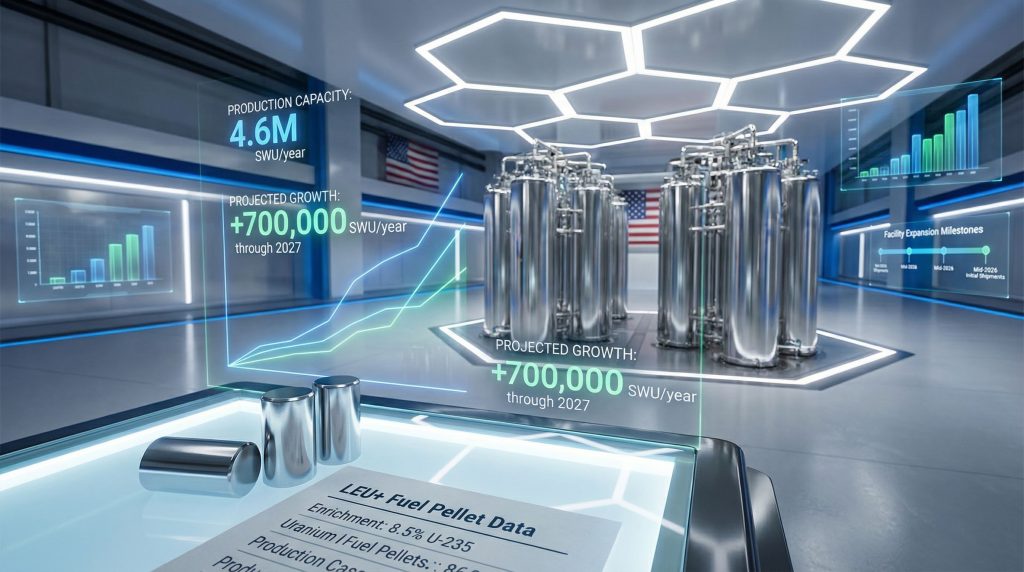
Manufacturing complexity increases substantially at higher enrichment levels, requiring sophisticated centrifuge cascade configurations and enhanced safety protocols. The National Enrichment Facility in Eunice, New Mexico achieved its first commercial-grade 8.5% U-235 enrichment run on December 11, 2025, establishing proof of domestic manufacturing capability.
Advanced Centrifuge Technology Requirements
• Cascade modifications enabling variable enrichment output
• Enhanced containment systems for increased fissile material concentrations
• Precision monitoring equipment for quality assurance protocols
• Specialized handling procedures for higher enrichment products
The regulatory framework governing LEU+ production required comprehensive licensing modifications. On September 30, 2025, the U.S. Nuclear Regulatory Commission authorised production up to 10% U-235 enrichment, establishing the upper boundary for LEU+ classification and enabling flexible production allocation across enrichment levels.
Manufacturing Scale and Production Metrics
Current domestic LEU+ production capability centres on the National Enrichment Facility, which represents $5 billion in private capital investment and employs over 500 specialised personnel. The facility has demonstrated exceptional operational reliability, delivering more than 50 million separative work units (SWU) since beginning operations in 2010, with zero delivery failures recorded across thirteen years of operation.
The ongoing capacity expansion programme will add 700,000 SWU of annual production capability through 2027, with three new cascades installed in 2025 beginning production ahead of schedule. This expansion directly supports growing demand for enhanced enrichment services while reducing dependence on foreign uranium processing capabilities.
Domestic Production Infrastructure and Facility Operations
The United States currently operates one commercial-scale uranium enrichment facility capable of LEU+ production. This concentration of domestic capability highlights both the achievement of establishing independent enrichment capacity and the strategic vulnerability of relying on limited infrastructure for critical energy security needs.
| Facility Component | Specification | Operational Status |
|---|---|---|
| Location | Eunice, New Mexico | Operational since 2010 |
| Employment | 500+ personnel | Full operational staffing |
| Investment Value | $5+ billion | Private capital deployment |
| Production Record | 50+ million SWU | Zero delivery failures |
| Enrichment Authorisation | Up to 10% U-235 | NRC approved September 2025 |
Production Milestone Achievement Timeline
The facility's development trajectory demonstrates consistent capability expansion and technological advancement:
• 2010: Initial operations commenced
• 2012: First product shipment delivered
• 2025: LEU+ production authorisation received
• December 11, 2025: First 8.5% U-235 enrichment achieved
• Mid-2026: Commercial LEU+ deliveries scheduled to begin
This timeline reflects a measured approach to capability development, emphasising safety protocols and regulatory compliance throughout the expansion process. The achievement of LEU+ production represents the culmination of extensive preparation and infrastructure investment spanning multiple years.
What Makes This Operational Excellence Possible?
The facility's operational record provides empirical validation of manufacturing reliability and quality control effectiveness. Delivering every customer order on specification and on schedule over thirteen years of operation represents exceptional performance in industrial manufacturing contexts, particularly for nuclear materials requiring stringent quality assurance protocols.
The National Enrichment Facility serves as America's only commercial-scale uranium enrichment operation, processing approximately one-third of domestic nuclear power plant enrichment requirements while maintaining perfect delivery performance across more than 50 million SWU of production.
This operational excellence demonstrates the viability of domestic enrichment capabilities and provides confidence for expanded production planning and customer commitments extending through the next decade of nuclear industry development. Moreover, this development coincides with broader uranium market volatility affecting global supply chains.
Economic Benefits and Utility Cost Optimisation
LEU+ production in U.S. nuclear industry delivers measurable economic advantages through extended fuel cycle performance and operational cost reductions. Enhanced enrichment levels enable reactor operators to achieve longer operating cycles, reducing the frequency of costly refuelling outages and maintenance intervals.
Traditional reactor operations typically require refuelling every 12-18 months, depending on plant design and operating parameters. LEU+ fuel assemblies can extend these cycles to 18-24 months, representing a 25-50% reduction in outage frequency and associated operational disruptions.
Financial Impact Analysis for Nuclear Utilities
Extended fuel cycles deliver multiple categories of cost savings:
• Reduced outage costs: Fewer scheduled shutdowns for refuelling operations
• Improved capacity factors: Higher percentage of time generating electricity
• Lower maintenance expenses: Reduced frequency of major maintenance activities
• Enhanced fuel utilisation: Higher burnup rates improving uranium efficiency
Each refuelling outage typically costs nuclear utilities millions of dollars in direct expenses plus lost revenue from interrupted electricity generation. Consequently, the economic value of extending operating cycles compounds over the lifetime of reactor operations, creating substantial net present value benefits for plant owners and operators.
Accident-Tolerant Fuel Development Support
LEU+ enrichment levels provide essential compatibility with advanced fuel designs engineered for enhanced safety performance. These accident-tolerant fuel assemblies incorporate materials and designs that maintain structural integrity under extreme conditions while delivering improved thermal performance and fission product retention capabilities.
The deployment of accident-tolerant fuels represents a multi-billion dollar industry initiative spanning multiple reactor vendors and utility operators. LEU+ availability eliminates potential fuel supply constraints that could delay these advanced safety system implementations. In addition, advances in US uranium production technology are supporting this domestic capability development.
Uranium Resource Utilisation Efficiency
Higher enrichment levels enable more complete uranium utilisation through enhanced neutron economy and extended residence time within reactor cores. This improved efficiency reduces the quantity of uranium required per unit of electricity generated while simultaneously reducing the volume of spent fuel requiring long-term storage or disposal.
Enhanced fuel efficiency through LEU+ deployment creates compounding economic benefits by reducing both front-end fuel costs and back-end waste management expenses, while improving overall plant economic performance through extended operating cycles and reduced maintenance requirements.
Advanced Reactor Technology Integration
The emergence of next-generation reactor technologies creates substantial demand for flexible fuel specifications that bridge current capabilities with future requirements. LEU+ production in U.S. nuclear industry provides essential fuel supply security for advanced reactor developers while accelerating deployment timelines through domestic sourcing availability.
Small Modular Reactor Fuel Requirements
Multiple small modular reactor designs specify LEU+ enrichment levels for optimal performance and safety characteristics. These compact reactor systems rely on enhanced enrichment to achieve longer operating cycles and reduced maintenance intervals, making LEU+ compatibility essential for commercial viability.
Current SMR development programmes include designs from established nuclear vendors and emerging technology companies, with projected deployment beginning in the late 2020s. Urenco USA announced significant milestones in producing LEU fuel, demonstrating industry progress toward domestic fuel security. Domestic LEU+ production capability eliminates fuel supply uncertainty that could delay these deployment schedules or require dependence on foreign enrichment services.
Technology Bridge to HALEU Production
LEU+ serves as critical feedstock for High-Assay Low-Enriched Uranium (HALEU) production, which requires 10-20% U-235 enrichment for advanced reactor applications. The availability of domestic LEU+ production establishes the foundation for scaling HALEU manufacturing capabilities without requiring complete infrastructure development from conventional enrichment levels.
Advanced Reactor Deployment Acceleration
Fuel supply availability represents a critical path constraint for advanced reactor development and deployment. Multiple reactor technologies under development require enrichment levels above conventional specifications but below weapons-grade classifications, positioning LEU+ as an enabling technology for industry advancement.
• Molten salt reactors: Enhanced enrichment supporting liquid fuel systems
• High-temperature gas reactors: LEU+ compatibility with TRISO fuel particles
• Fast reactor systems: Bridging fuel for startup core configurations
• Microreactor designs: Compact systems requiring enhanced enrichment levels
The domestic production of LEU+ eliminates foreign dependency concerns that could constrain advanced reactor development or create strategic vulnerabilities in fuel supply chains. Furthermore, this energy security consideration becomes particularly significant for remote installations, military applications, and export opportunities to allied nations.
Regulatory Framework and Safety Implementation
The Nuclear Regulatory Commission's authorisation of LEU+ production required extensive safety analysis and operational protocol development. The September 30, 2025 approval for enrichment up to 10% U-235 represents the culmination of comprehensive regulatory review encompassing facility design, operational procedures, and emergency response capabilities.
Safety Protocol Enhancements for Higher Enrichment
LEU+ production necessitates enhanced safety measures reflecting increased fissile material concentrations and potential criticality considerations. These safety enhancements include:
• Advanced containment systems: Engineered barriers preventing material release
• Enhanced monitoring equipment: Real-time detection of operational anomalies
• Modified handling procedures: Specialised protocols for higher enrichment materials
• Emergency response upgrades: Enhanced preparedness for unlikely accident scenarios
The facility's existing cascade infrastructure received licensing authorisation for LEU+ production across all operational units, providing operational flexibility to allocate production capacity based on customer demand and market requirements.
Compliance and Quality Assurance Standards
Nuclear material production operates under stringent quality control requirements encompassing material composition, isotopic specifications, and chemical purity standards. LEU+ production maintains these existing quality requirements while implementing additional verification procedures for enhanced enrichment levels.
The regulatory framework governing LEU+ production builds upon decades of experience with conventional enrichment operations while incorporating lessons learned from international best practices and advanced safety analysis techniques.
The authorisation process validates the technical and safety readiness of domestic facilities to support both current and future nuclear industry requirements while maintaining the highest safety and security standards established for nuclear material handling and processing operations. However, these developments occur amid falling uranium spot prices that could affect long-term planning.
The next major ASX story will hit our subscribers first
Market Demand Dynamics and Customer Applications
Current market demand for LEU+ emerges from multiple industry segments seeking enhanced fuel performance and operational flexibility. Nuclear utilities operating existing reactor fleets represent the primary near-term customer base, with advanced reactor developers providing longer-term demand growth potential.
Utility Sector Adoption Drivers
Commercial nuclear utilities face increasing pressure to optimise operational costs while maintaining high safety and reliability standards. LEU+ fuel assemblies provide measurable economic benefits through extended operating cycles and reduced maintenance requirements, creating compelling adoption incentives for fleet operators.
The U.S. commercial nuclear fleet operates approximately 93 reactor units across 55 plant sites, representing substantial potential demand for LEU+ fuel assemblies. Even partial adoption across this installed base creates significant production volume requirements and market opportunity for domestic enrichment services.
Commercial Delivery Timeline and Capacity Planning
Production planning indicates commercial LEU+ deliveries beginning in mid-2026, providing sufficient lead time for utility fuel cycle planning and procurement processes. The capacity expansion programme through 2027 positions production capabilities to meet growing demand while maintaining delivery reliability standards established over thirteen years of operations.
Advanced Reactor Development Pipeline
Multiple advanced reactor technologies under development specify LEU+ enrichment levels for initial deployment phases. Centrus launched commercial LEU enrichment activities to support these emerging technologies. These emerging technologies include:
• Next-generation PWR designs: Enhanced safety systems requiring higher enrichment
• Molten salt reactor concepts: Liquid fuel systems utilising LEU+ specifications
• Microreactor applications: Compact systems for remote power generation
• Industrial process heat: High-temperature applications beyond electricity generation
The convergence of utility optimisation requirements and advanced reactor development creates sustained demand growth potential extending through the next decade of nuclear industry evolution.
Supply Chain Integration and Production Scaling
LEU+ production in U.S. nuclear industry requires sophisticated supply chain coordination encompassing uranium feedstock procurement, conversion services, and specialised equipment manufacturing. The integration of enhanced enrichment capabilities within existing infrastructure demonstrates supply chain adaptability while highlighting requirements for continued expansion.
Centrifuge Technology and Equipment Requirements
Advanced centrifuge cascades enable variable enrichment output through precise control of uranium hexafluoride flow rates and stage configurations. The installation of three new cascades in 2025, each beginning production ahead of schedule, demonstrates manufacturing readiness and project execution capabilities essential for continued capacity expansion.
Uranium Feedstock Supply and Conversion Services
LEU+ production requires consistent access to natural uranium concentrates and uranium hexafluoride conversion services. Domestic supply chain security encompasses both imported uranium materials and domestic conversion capabilities, ensuring production continuity independent of international supply disruptions.
Quality Control and Product Specifications
Enhanced enrichment levels necessitate precise quality control procedures encompassing isotopic composition, chemical purity, and physical characteristics. The facility's perfect delivery record across 50+ million SWU of production demonstrates quality control effectiveness and provides confidence for LEU+ production scaling.
Supply chain resilience for LEU+ production encompasses uranium procurement, conversion services, specialised equipment manufacturing, and transportation logistics, requiring coordination across multiple industry participants and regulatory oversight bodies.
Production Capacity Optimisation
The ongoing capacity expansion through 2027 positions domestic production capabilities to meet growing LEU+ demand while maintaining operational flexibility for standard enrichment services. This capacity growth supports both market demand fulfilment and strategic energy security objectives through reduced foreign dependency. For investors, understanding uranium investment strategies becomes increasingly important in this evolving market.
Strategic Energy Security and Industry Development
The establishment of domestic LEU+ production capability addresses critical energy security vulnerabilities while positioning American nuclear technology for global competitiveness. Historical dependence on foreign enrichment services created strategic risks that domestic capability development directly mitigates through supply chain independence.
Geopolitical Risk Mitigation
International uranium enrichment markets historically concentrated production capacity amongst limited suppliers, creating potential vulnerability to supply disruptions from geopolitical tensions or trade restrictions. Domestic LEU+ production provides strategic alternatives that enhance energy security through diversified supply options.
The elimination of foreign dependency for critical nuclear fuel components supports broader energy independence objectives while ensuring continued operation of existing nuclear facilities that provide 20% of U.S. electricity generation and 50% of carbon-free electricity.
Technology Leadership and Export Opportunities
Advanced enrichment capabilities position American nuclear technology companies for international competitiveness in emerging reactor markets. Allied nations developing nuclear programmes require secure fuel supply arrangements that domestic production capabilities can support through established diplomatic and commercial relationships.
Innovation Catalyst for Advanced Nuclear Technologies
LEU+ availability removes critical constraints on advanced reactor development while providing domestic sourcing security for emerging technologies. This fuel supply certainty accelerates private investment in nuclear innovation and supports deployment timeline acceleration for next-generation reactor concepts.
• Research and development support: Enhanced enrichment for testing programmes
• Demonstration project enablement: Fuel security for prototype reactor development
• Commercial deployment acceleration: Reduced regulatory and supply chain uncertainties
• International collaboration facilitation: Secure fuel supplies for allied partnerships
Climate Policy Integration
Nuclear energy expansion represents a critical component of carbon emission reduction strategies, with LEU+ capabilities supporting both existing reactor optimisation and advanced technology deployment. Enhanced fuel efficiency through LEU+ utilisation improves the carbon intensity performance of nuclear electricity generation while extending plant operational lifetimes.
The strategic value of domestic LEU+ production extends beyond immediate economic benefits to encompass energy security, technology leadership, climate policy support, and international competitiveness across multiple dimensions of national energy policy objectives.
Disclaimer: This analysis contains forward-looking statements regarding nuclear industry development, market demand projections, and technology deployment timelines. Actual outcomes may differ based on regulatory decisions, market conditions, technology development progress, and other factors beyond current industry control or prediction capabilities.
Ready to Capitalise on the Nuclear Renaissance?
Discovery Alert's proprietary Discovery IQ model delivers real-time alerts on significant uranium and nuclear energy discoveries across the ASX, transforming complex mineral data into actionable investment insights for this rapidly evolving sector. Begin your 30-day free trial today and position yourself ahead of the market as the nuclear fuel supply chain undergoes this historic transformation.