May 17, 2026
Nuclear fuel transportation represents one of the most technically demanding segments within the broader energy logistics sector, requiring specialised engineering solutions that address both safety and operational efficiency concerns. The complexity increases dramatically when dealing with materials that exceed conventional enrichment thresholds, necessitating entirely new approaches to containment, shielding, and regulatory compliance.
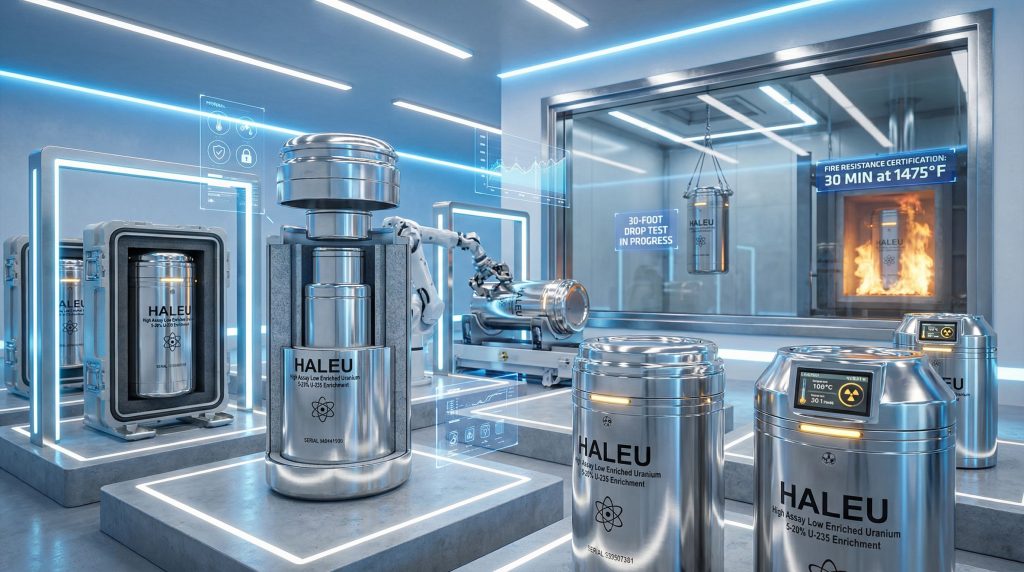
The emergence of advanced reactor technologies has created unprecedented demand for transportation infrastructure capable of handling uranium enriched between 5 and 20 percent U-235. This enrichment range, known as high-assay low-enriched uranium (HALEU), sits between standard commercial fuel and weapons-grade material, creating unique technical challenges that conventional low-enriched uranium transport systems cannot accommodate. Furthermore, the development of high-assay low-enriched uranium transport packages has become a critical bottleneck in the advanced reactor deployment timeline.
Understanding HALEU Transport Infrastructure Requirements
The fundamental distinction between high-assay low-enriched uranium transport packages and conventional uranium shipping systems lies in the elevated neutron emission rates and decay heat generation associated with higher U-235 concentrations. Unlike standard low-enriched uranium (typically below 5 percent U-235), HALEU materials require enhanced containment specifications that account for increased radioactivity levels and more stringent criticality safety margins.
Physical and Chemical Form Variations:
• Uranium oxide powder requiring specialised containment to prevent dispersion
• Metallic uranium forms demanding oxidation prevention protocols
• Liquid uranium compound solutions necessitating double-containment systems
• Pre-fabricated fuel pellets and assemblies with specific geometric constraints
Each form presents distinct engineering challenges. Uranium oxide powder, for instance, increases surface area exposure, complicating criticality control calculations and requiring enhanced moisture prevention systems. Metallic uranium forms generate additional corrosion concerns, while liquid compounds demand pressure management capabilities during thermal cycling operations.
However, the regulatory classification framework for HALEU transport differs substantially from conventional nuclear materials. Enhanced shielding requirements become necessary to attenuate radiation from higher enrichment levels, while specialised cylinder designs must accommodate various uranium compounds without compromising structural integrity. Temperature and pressure management considerations become more critical as decay heat generation increases with enrichment level.
Criticality Safety Engineering Considerations:
| Parameter | Standard LEU | HALEU Requirements |
|---|---|---|
| Maximum enrichment | <5% U-235 | 5-20% U-235 |
| Criticality margin | Standard geometry limits | Enhanced absorber materials |
| Heat generation | Minimal thermal management | Active cooling considerations |
| Shielding requirements | Basic radiation protection | Increased thickness specifications |
When big ASX news breaks, our subscribers know first
Regulatory Framework and Certification Process
The approval pathway for high-assay low-enriched uranium transport packages involves multiple regulatory authorities, each addressing specific safety and security aspects. The Nuclear Regulatory Commission maintains primary federal authority under 10 CFR Part 71, while the International Atomic Energy Agency establishes performance-based criteria through Safety Standards for the Transportation of Radioactive Material (SSR-6 Rev.1).
In addition, the Department of Transportation enforces hazardous materials regulations under 49 CFR Part 173, creating additional compliance requirements that must be satisfied simultaneously with nuclear safety standards. State-level agencies may impose supplementary permitting requirements, particularly for routes traversing multiple jurisdictions. Moreover, industry permitting basics require comprehensive understanding across multiple regulatory frameworks.
NRC Certification Timeline Framework:
- Pre-application phase (6-12 months): Design concept validation and preliminary safety analysis
- Formal review period (12-18 months): Comprehensive safety analysis report evaluation
- Testing phase (6-9 months): Physical testing including drop, fire, and immersion protocols
- Final approval (3-6 months): Operational procedures verification and certificate issuance
The total certification timeline potentially extends from 27 to 51 months, representing a significant investment in both time and resources. This extended development period reflects the comprehensive safety evaluation required for nuclear materials transportation, particularly given the elevated enrichment levels associated with HALEU fuel.
"The layered regulatory approach ensures comprehensive safety assessment but creates complex approval landscapes requiring coordination across multiple jurisdictions and regulatory frameworks."
Certification costs typically range from $3 to $10 million for complex packages, though HALEU-specific data remains limited as most certifications are currently in development phases. The NRC maintains a Certificate of Compliance database, though specific HALEU certifications may not yet be publicly available as development programmes continue.
Engineering and Design Specifications
High-assay low-enriched uranium transport packages must satisfy competing engineering requirements that traditional nuclear packaging has not encountered. The elevated U-235 concentration increases both radiation shielding needs and criticality safety constraints, while simultaneously requiring enhanced thermal management capabilities for extended transport operations.
Accident Test Requirements:
• 30-foot drop test: Structural integrity verification under impact conditions
• Fire resistance: 30 minutes at 1475°F (801°C) temperature exposure
• Water immersion protocols: Sealed integrity under submersion scenarios
• Criticality safety maintenance: Subcritical configuration under damaged conditions
These performance criteria derive from NRC regulations under 10 CFR Part 71, which establishes outcome-based standards rather than prescriptive design specifications. Package developers must demonstrate compliance through analytical modeling, physical testing, and comprehensive safety analysis documentation.
Material Science Challenges
The higher decay heat generation from HALEU materials demands thermal management solutions that traditional steel-based overpacks may not accommodate effectively. Advanced materials selection becomes critical to achieve necessary protection-to-weight ratios while maintaining heat dissipation capabilities.
Composite materials and specialised alloys offer potential solutions, though each material choice requires extensive testing and regulatory qualification. The criticality safety design basis differs fundamentally from standard low-enriched uranium because higher U-235 density requires more stringent geometry, mass, and moderation controls.
Package Architecture Specifications:
| HALEU Form | Containment Requirements | Key Design Considerations |
|---|---|---|
| Metallic uranium | Hermetically sealed stainless steel | Oxidation prevention, radiolytic heating |
| Uranium oxide powder | Vacuum packaging with desiccants | Surface area criticality control |
| Liquid compounds | Double-containment systems | Chemical compatibility, pressure management |
| Fuel assemblies | Structural support frameworks | Dimensional tolerance, movement prevention |
Current Market Development and Industry Players
The December 2025 Department of Energy awards to five companies represent the most significant federal investment in HALEU transport infrastructure development to date. These awards specifically target development, modification, and licensing of transportation packages, indicating urgent recognition of supply chain bottlenecks threatening advanced reactor deployment schedules.
DOE Award Recipients and Strategic Positioning
NAC International brings established nuclear packaging expertise through their existing Legal Weight Truck (LWT) package design for conventional uranium transport. Their multiple Nuclear Regulatory Commission Certificates of Compliance provide regulatory experience directly applicable to HALEU certification processes.
Westinghouse Electric Company contributes integrated fuel cycle knowledge spanning mining, enrichment, fuel fabrication, and reactor operation. Their involvement reflects synergy advantages from direct knowledge of advanced reactor fuel assembly dimensions and specifications, potentially incorporating lessons learned from experimental fuel testing programmes.
Consequently, Container Technologies Industries specialises in custom transport system design for diverse hazardous materials, likely focusing on novel containment geometries specific to HALEU criticality and thermal constraints. Their approach may emphasise specialised systems rather than standardised packages.
Paragon D&E provides advanced materials innovation capabilities, potentially developing heat dissipation solutions through novel material systems. Their contribution may focus on enhanced protection-to-weight ratios through composite materials and specialised alloys.
American Centrifuge Operating (Centrus Energy subsidiary) represents unique supply chain integration, connecting HALEU production directly with transport logistics. This positioning offers potential for co-located enrichment and transport package preparation, streamlining the fuel supply chain from production through delivery.
The historical context for Centrus Energy's involvement traces to their December 2022 contract to complete and operate a demonstration-scale HALEU gaseous centrifuge cascade. This progression from enrichment capability to transport infrastructure development reflects comprehensive fuel cycle integration.
Economic Impact and Supply Chain Considerations
Transportation costs typically represent 5 to 15 percent of total nuclear fuel expenses, making packaging efficiency crucial for advanced reactor economics. Specialised HALEU packaging increases per-shipment expenses compared to conventional uranium transport, though economies of scale from standardised containers may provide cost reduction opportunities.
Cost Structure Analysis:
• Package development: $3-10 million certification investment per design
• Manufacturing costs: Premium pricing for specialised materials and fabrication
• Insurance and liability: Elevated coverage requirements for higher enrichment materials
• Security protocols: Enhanced escort and route approval expenses
Supply chain vulnerabilities without adequate transport packages create cascading risks throughout the advanced reactor deployment timeline. Fuel delivery delays directly impact reactor operations, while limited enrichment facility output utilisation constrains domestic HALEU supply development. Furthermore, uranium market volatility creates additional complexities for transport infrastructure planning.
The current dependency on foreign HALEU sources, particularly from Russia, amplifies the strategic importance of domestic transport infrastructure. Advanced reactor deployment schedules face significant risks without reliable fuel delivery capabilities, potentially delaying commercial viability for multiple reactor technologies simultaneously. For instance, the Russian uranium import ban has created unprecedented urgency for domestic capabilities.
"Without reliable HALEU transport infrastructure, advanced reactor deployment faces potential delays that could undermine domestic nuclear energy competitiveness and strategic energy security objectives."
Safety Protocols and Risk Management
High-assay low-enriched uranium transport packages operate under enhanced security protocols that exceed conventional nuclear materials requirements. Route planning and approval processes involve coordination between federal agencies, state transportation authorities, and local emergency response organisations.
Enhanced Security Measures:
- Dedicated escort requirements: Armed security personnel for high-value shipments
- Real-time monitoring systems: GPS tracking and communication capabilities
- Route approval protocols: Pre-authorised pathways avoiding sensitive areas
- Emergency response coordination: Specialised teams for incident management
Radiation monitoring during transit ensures continuous assessment of package integrity and worker exposure levels. Emergency response protocol development requires coordination with local hazmat teams, though the specific requirements for HALEU incidents differ from conventional radioactive materials scenarios.
The accident scenario design basis for HALEU packages incorporates lessons learned from international transport experience, though the higher enrichment levels create unique considerations. Criticality safety under damaged conditions becomes more challenging as U-235 concentration increases, requiring enhanced analytical modelling and testing verification.
Risk Assessment Framework:
| Scenario Type | HALEU-Specific Considerations | Mitigation Strategies |
|---|---|---|
| Transportation accidents | Enhanced criticality margins | Robust containment design |
| Security incidents | Higher material value | Dedicated escort protocols |
| Emergency response | Specialised expertise required | Pre-positioned equipment |
| Route planning | Population density considerations | Alternative pathway analysis |
The next major ASX story will hit our subscribers first
Future Development Trends and Market Outlook
Innovation in HALEU transport technology focuses on modular container systems that provide flexible capacity scaling based on shipment requirements. Smart monitoring and tracking capabilities integrate with broader nuclear materials safeguards systems, providing real-time visibility throughout the transportation process. Additionally, US uranium production technology advances support integrated fuel cycle development.
Advanced materials research targets significant weight reduction while maintaining or enhancing protective capabilities. Composite materials incorporating boron-containing fibres offer potential solutions for combined shielding and criticality control, though regulatory qualification timelines remain extended.
Emerging Technology Integration:
• Automated loading systems: Reducing worker exposure and improving efficiency
• Predictive maintenance: Sensor networks monitoring package condition
• Blockchain integration: Immutable custody chain documentation
• Machine learning analytics: Route optimisation and risk assessment
The relationship between transport package availability and advanced reactor deployment creates critical path dependencies that industry stakeholders must address proactively. Reactor licensing timelines increasingly incorporate fuel supply assurance as a key consideration, making transport infrastructure a licensing prerequisite.
International market competitiveness depends significantly on domestic transport capabilities. Countries with established HALEU transport infrastructure gain strategic advantages in advanced reactor export markets, as fuel supply assurance becomes a key customer consideration. Moreover, US uranium tariff impact considerations affect strategic planning.
Integration with Advanced Reactor Technologies
Different advanced reactor designs create specific transport package requirements that influence development priorities. Small modular reactors typically utilise fuel assemblies ranging from 2 to 4 feet in length, requiring transport packages optimised for these dimensional constraints.
High-temperature gas reactors employ TRISO fuel particles that necessitate specialised containment to prevent particle damage during transport. The spherical geometry of TRISO fuel creates unique packing considerations compared to traditional fuel assemblies.
Reactor-Specific Transport Requirements:
| Reactor Type | Fuel Characteristics | Transport Considerations |
|---|---|---|
| Small modular reactors | Compact fuel assemblies | Dimensional optimisation |
| High-temperature gas reactors | TRISO particle fuel | Particle integrity protection |
| Fast reactors | Metallic fuel elements | Oxidation prevention protocols |
| Microreactors | Portable fuel cartridges | Field-deployable packaging |
Fast reactor metallic fuel transportation presents unique challenges related to oxidation prevention and thermal management. The metallic fuel form generates different heat distribution patterns compared to oxide fuels, requiring specialised thermal analysis and cooling considerations.
However, microreactor applications may require portable fuel cartridge systems that enable field deployment to remote locations. These applications create additional requirements for rugged packaging capable of surviving transportation over unpaved routes and in extreme environmental conditions.
International Competitiveness and Strategic Considerations
The global landscape for HALEU transport infrastructure reveals significant competitive disparities between nations. Russia maintains established HALEU supply chains with corresponding transport capabilities, providing competitive advantages in international reactor markets.
European transport infrastructure development focuses on coordinated approaches through Euratom frameworks, while Asian markets pursue independent domestic capabilities aligned with national energy security objectives. The United States faces catch-up requirements to establish competitive positioning.
Strategic Supply Security Implications
Export control considerations for advanced transportation technologies create additional complexity for international market participation. Technology transfer and licensing opportunities require careful balance between commercial interests and national security considerations.
Allied nation fuel supply agreements increasingly incorporate transport infrastructure assurance as a key component, making domestic capabilities essential for international reactor export competitiveness. The ability to provide reliable fuel supply throughout reactor operational lifetimes becomes a critical differentiator in global markets. Furthermore, HALEU transportation guidelines establish frameworks for international coordination.
"Domestic HALEU transport infrastructure development represents not only a commercial opportunity but a strategic imperative for maintaining nuclear energy leadership and ensuring energy security partnerships with allied nations."
Geopolitical factors influence transport package development through requirements for domestic supply chain resilience. The current international situation emphasises the importance of reducing dependencies on potentially unreliable foreign sources for critical nuclear infrastructure.
The intersection of advanced reactor commercialisation with international energy security considerations creates unprecedented urgency for establishing reliable domestic HALEU transport capabilities. Success in this development effort will determine whether the United States can maintain leadership in global nuclear energy markets while ensuring energy security for domestic and allied reactor programmes.
Ready to Capitalise on the Growing Nuclear Energy Sector?
Discovery Alert's proprietary Discovery IQ model delivers real-time alerts on significant uranium and nuclear sector discoveries on the ASX, instantly empowering subscribers to identify actionable opportunities ahead of the broader market. Explore why major mineral discoveries can lead to substantial market returns by visiting Discovery Alert's dedicated discoveries page, showcasing historic examples of exceptional outcomes, then begin your 30-day free trial today to position yourself ahead of the market.