August 5, 2026
The Nuclear Fusion Revolution: Why Helium-3 Represents the Ultimate Clean Energy Solution
Nuclear fusion technology stands at a critical juncture, with researchers worldwide seeking the perfect fuel source that could finally make commercial fusion reactors viable. While deuterium-tritium reactions have dominated fusion research for decades, a rare isotope deposited across the lunar surface over billions of years may hold the key to transforming our energy landscape forever.
Furthermore, moon mining helium-3 operations represent far more than simple resource extraction. This isotope offers revolutionary advantages over conventional fusion fuels, producing no neutron radiation, generating zero radioactive waste, and delivering energy densities that could power entire cities with minimal fuel requirements.
The Nuclear Fusion Advantage
Helium-3 fusion reactions fundamentally differ from traditional nuclear processes in ways that could reshape global energy production. Unlike deuterium-tritium fusion, which produces high-energy neutrons that damage reactor materials and create radioactive waste, helium-3 reactions generate only charged particles that can be contained using magnetic fields.
| Fuel Type | Energy Output (MeV) | Radioactive Waste | Neutron Production | Safety Profile |
|---|---|---|---|---|
| Helium-3 + Deuterium | 18.3 | None | Minimal | Extremely Safe |
| Deuterium-Tritium | 17.6 | Significant | High | Moderate Risk |
| Traditional Nuclear | 200 | Extensive | N/A | High Risk |
The energy density calculations for helium-3 reveal staggering potential. A single gram of this isotope could theoretically generate approximately 19 megawatt-hours of electricity, enough to power an average American home for over two years. This energy concentration exceeds petroleum by factors of millions, making even expensive extraction operations economically viable at scale.
Terrestrial Scarcity vs Lunar Abundance
Earth's helium-3 reserves present a stark reality for fusion researchers. Current terrestrial stockpiles contain less than 15 kilograms globally, primarily captured from nuclear weapons programs and atmospheric research. At current consumption rates for research applications, these reserves could be depleted within decades.
The Moon tells a different story entirely. Solar wind bombardment over 4.5 billion years has embedded helium-3 throughout the lunar regolith, creating a reservoir estimated at over one million tons. This abundance stems from the Moon's lack of atmosphere and magnetic field, allowing solar particles to penetrate and accumulate in surface materials without interference.
Concentration mapping through orbital surveys reveals promising extraction zones:
- Mare Tranquillitatis: 15-20 parts per billion average concentration
- Oceanus Procellarum: 12-18 parts per billion with consistent distribution
- Mare Imbrium: 10-15 parts per billion across extensive flat terrain
- Highland regions: 8-12 parts per billion in mineral-rich deposits
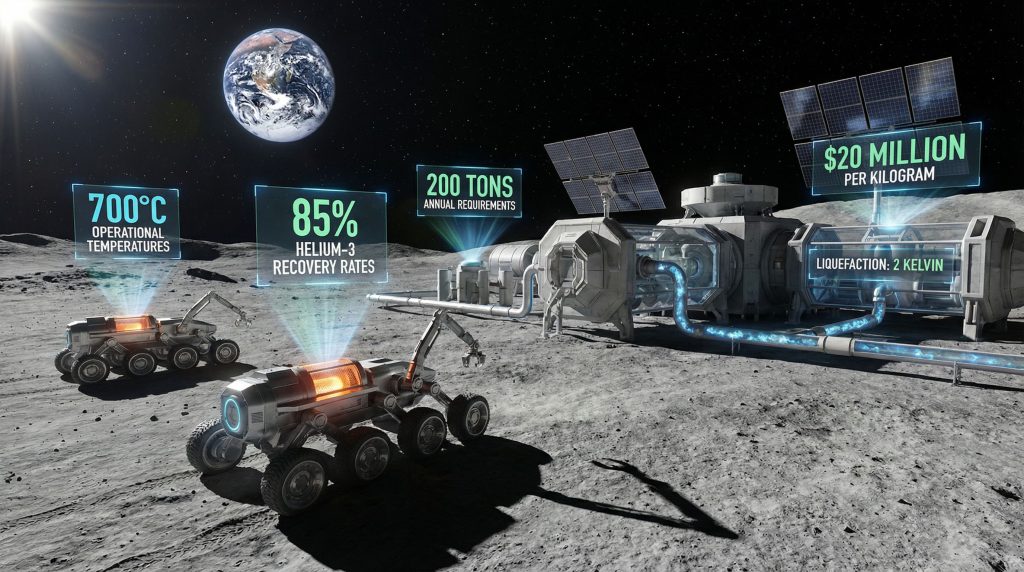
Current market pricing for helium-3 reaches approximately $20 million per kilogram, driven by extreme scarcity and research demand. Even accounting for dramatic price reductions from lunar production, the isotope would maintain significant value given its unique fusion properties and industrial applications.
When big ASX news breaks, our subscribers know first
Advanced Extraction Technologies: From Concept to Operational Reality
Thermal Processing Systems
Moon mining helium-3 operations require sophisticated thermal processing capabilities operating under extreme lunar conditions. The extraction process involves heating regolith to approximately 700°C to liberate trapped gases, then separating helium-3 from other volatile compounds through cryogenic processing.
Modern thermal extraction systems demonstrate 85% helium-3 recovery rates under laboratory conditions. However, lunar operations introduce additional complexity through temperature cycling, power limitations, and equipment durability requirements. Continuous processing demands maintain consistent heating while managing thermal expansion stress across multiple day-night cycles.
Energy consumption calculations reveal significant power requirements:
- Regolith heating: 2.5 kWh per kilogram processed
- Gas separation: 1.8 kWh per cubic meter processed
- Cryogenic cooling: 3.2 kWh for liquefaction systems
- Total system operation: 15-20 kW continuous power minimum
Equipment durability becomes critical given the extreme temperature cycling between lunar day and night. Materials must withstand temperature swings exceeding 250°C while maintaining precision tolerances for gas separation and containment systems.
Mobile vs Stationary Processing Models
Rover-Based Direct Extraction
Mobile extraction platforms offer significant advantages for accessing high-concentration deposits across diverse lunar terrain. These systems integrate onboard processing capabilities with advanced mobility systems designed for extended autonomous operation.
Key specifications for mobile extraction include:
- Onboard liquefaction systems operating at 2 Kelvin
- Solar panel configurations providing 25-30 kW peak power
- Thermal management systems for equipment protection
- Communication arrays for Earth-based remote operation
- Sample storage capacity for 50-100 kg processed helium-3
Central Processing Facilities
Stationary processing models emphasise economies of scale through high-volume operations. These installations would process regolith delivered from multiple collection points, concentrating advanced equipment in fixed locations with comprehensive infrastructure support.
Central facility advantages include:
- Redundant equipment systems ensuring continuous operation
- Maintenance accessibility through modular design approaches
- Waste heat recovery for improved energy efficiency
- Advanced quality control systems for isotope purity
- Bulk storage facilities for large-volume accumulation
Commercial Viability: Scale Requirements and Economic Models
Production Volume Analysis
Meaningful integration of helium-3 into global energy systems requires substantial production volumes that challenge current technological capabilities. Conservative estimates suggest replacing 10% of global electricity generation with fusion power would require approximately 200 tons of helium-3 annually.
Processing calculations reveal enormous operational scale requirements:
- Regolith processing: 630 tons per second at 15 parts per billion concentration
- Continuous operation: 24/7/365 processing for commercial viability
- Fleet requirements: 1,700-2,000 mining vehicles for adequate coverage
- Quality control: 99.9% isotope purity for fusion reactor compatibility
These volumes demand industrial-scale lunar operations far exceeding current space mission capabilities. The infrastructure requirements alone represent one of the largest engineering projects in human history, requiring coordination between multiple space agencies and private entities.
Infrastructure Development Challenges
Moon mining helium-3 at commercial scales necessitates unprecedented lunar infrastructure development. Power generation requirements alone demand approximately 39 GW of continuous electricity supply, equivalent to 30-40 large nuclear power plants operating simultaneously.
Critical infrastructure components include:
- Solar panel arrays covering thousands of square kilometres
- Nuclear reactors for continuous night-time power supply
- Communication networks supporting real-time Earth coordination
- Transportation systems for equipment deployment and maintenance
- Habitation modules for potential human oversight operations
Mass transportation requirements present another significant challenge. Initial estimates suggest deploying 60,000-200,000 tons of equipment to establish commercial-scale operations. This exceeds total historical space launch capacity by orders of magnitude, requiring revolutionary advances in heavy-lift launch systems.
Environmental Obstacles and Engineering Solutions
Surface Condition Management
Lunar environmental conditions create unique operational challenges that terrestrial mining experience cannot adequately address. Temperature extremes ranging from -230°C during lunar night to +120°C in direct sunlight stress materials beyond normal engineering tolerances.
Electrostatic dust represents a particularly insidious challenge for moon mining helium-3 operations. Lunar regolith develops significant electrical charges through solar wind interaction and mechanical disturbance. This dust exhibits sandpaper-like properties that can penetrate seals, jam mechanical components, and degrade solar panel efficiency.
Equipment protection strategies include:
- Hermetically sealed processing chambers with positive pressure maintenance
- Electrostatic discharge systems for dust charge neutralisation
- Brush and airjet cleaning systems for external surfaces
- Redundant filtration systems preventing internal contamination
- Sacrificial protective layers for high-wear components
Vacuum operation requirements eliminate traditional lubrication and cooling methods. All mechanical systems must function in hard vacuum conditions while maintaining precision tolerances for gas separation and containment operations.
Mechanical Disturbance Technologies
Advanced extraction methodologies focus on mechanical liberation techniques that minimise energy consumption compared to traditional thermal processing. These approaches use precise surface agitation to release trapped gases without extensive heating requirements.
Innovative mechanical disturbance systems include:
- Ultrasonic vibration arrays for molecular-level liberation
- Electromagnetic pulse systems creating localised heating
- Precision drilling for targeted high-concentration extraction
- Electrostatic separation enhancing gas capture efficiency
Minimal power consumption approaches become critical given lunar energy limitations. Solar panel efficiency decreases significantly during lunar dust accumulation, requiring cleaning systems that consume substantial power themselves.
Economic Models and Investment Frameworks
Cost-Benefit Analysis Framework
Moon mining helium-3 ventures require unprecedented capital investments with extended payback periods challenging traditional financing models. Initial mission costs ranging from $50-100 billion exceed most corporate and governmental budgets, necessitating international cooperation and public-private partnerships.
Break-even calculations demonstrate scale sensitivity:
- Small-scale operations (1 ton/year): 75-100 year payback period
- Medium-scale operations (10 tons/year): 25-35 year payback period
- Large-scale operations (50+ tons/year): 15-20 year payback period
- Industrial-scale operations (200+ tons/year): 8-12 year payback period
Market price sensitivity analysis reveals critical thresholds for commercial viability. Helium-3 prices must remain above $500,000 per kilogram to justify lunar extraction costs, even with optimistic technology development and launch cost reductions.
Risk-adjusted return projections over 20-year operational periods incorporate multiple failure scenarios including equipment loss, technological obsolescence, and market demand fluctuations. Monte Carlo simulations suggest 60-70% probability of positive returns for large-scale operations under favourable conditions.
Specialised Application Markets
Quantum Computing Industry Demand
Beyond fusion applications, helium-3 serves critical roles in quantum computing systems requiring ultra-low temperature operation. Current quantum computers consume significant helium-3 quantities for dilution refrigeration systems maintaining near absolute zero temperatures.
The quantum computing market projects exponential growth through 2040, potentially creating demand for 10-15 tons of helium-3 annually. This niche market offers immediate commercial viability for initial lunar production, establishing revenue streams while fusion technology matures.
Medical Imaging Applications
Helium-3 enables advanced MRI enhancement technologies providing superior image resolution for cardiac and pulmonary diagnostics. Medical applications require high-purity isotopes but consume relatively small quantities, making premium pricing sustainable.
Timeline projections for specialised markets:
- 2027-2030: Initial lunar production targeting research applications
- 2030-2035: Quantum computing market development and expansion
- 2035-2040: Medical imaging applications achieving commercial scale
- 2040+: Fusion reactor integration beginning large-volume consumption
Regulatory Frameworks and International Coordination
International Space Law Landscape
Moon mining helium-3 operations exist within complex international legal frameworks that remain largely untested for commercial resource extraction. The 1967 Outer Space Treaty establishes basic principles but provides limited guidance for property rights and territorial claims on celestial bodies.
The Moon Agreement of 1984 attempts to address resource extraction more specifically, declaring lunar resources the "common heritage of mankind." However, only 18 nations have ratified this agreement, notably excluding major space powers including the United States, Russia, and China.
Key legal challenges include:
- Property rights establishment for extracted materials
- Territorial jurisdiction for processing facilities
- Environmental protection standards for lunar operations
- Dispute resolution mechanisms for competing claims
- Revenue sharing arrangements with non-space-capable nations
National Legislation Development
Individual nations increasingly develop domestic legislation addressing space resource extraction rights. The US Commercial Space Launch Act of 2015 grants American companies property rights over materials extracted from asteroids and other celestial bodies, establishing important legal precedents.
Luxembourg pioneered European space resource legislation through comprehensive legal frameworks supporting commercial extraction operations. These laws provide regulatory certainty for private investment while establishing licensing requirements and operational oversight.
China's lunar programme operates under different legal frameworks emphasising national sovereignty and strategic resource control. This approach creates potential conflicts with international cooperation models proposed by Western space agencies.
International coordination requirements become increasingly critical as multiple nations develop independent lunar capabilities. Orbital traffic management, communication frequency allocation, and landing zone coordination require unprecedented international cooperation frameworks.
The next major ASX story will hit our subscribers first
Current Mission Progress and Technology Development
Technology Demonstration Programmes
Recent lunar missions provide crucial data supporting helium-3 extraction feasibility assessments. China's Chang'e sample return missions delivered direct regolith composition measurements, confirming helium-3 concentrations predicted by remote sensing data.
NASA's Artemis programme incorporates resource extraction demonstrations as secondary mission objectives. These experiments test equipment durability, power system performance, and communication reliability under actual lunar conditions.
Sample return mission data reveals important variations in helium-3 concentration across different lunar regions and soil depths. Surface concentrations average 10-20 parts per billion, while subsurface deposits show reduced concentrations due to limited solar wind penetration.
Communication delay management presents ongoing challenges for remote operations. Earth-Moon communication delays averaging 1.3 seconds require autonomous operation capabilities and predictive control systems for continuous mining operations.
Private Sector Development Initiatives
Emerging companies focus on different aspects of lunar resource extraction, creating an ecosystem of specialised technologies and capabilities. Some organisations target transportation systems, while others develop processing equipment and storage solutions.
Investment trends show increasing venture capital interest in lunar resource companies. Total private investment in space mining ventures exceeded $500 million in 2024, with significant funding rounds supporting technology development and prototype testing.
Partnership models between established aerospace companies and space agencies provide crucial expertise and risk mitigation for lunar ventures. These collaborations combine private sector innovation with governmental resources and regulatory support.
Technology transfer benefits extend beyond space applications. Moreover, advanced renewable energy mining systems, extreme environment materials, and autonomous operation systems developed for lunar operations find applications in terrestrial industries including deep-sea mining, arctic operations, and hazardous waste management.
Alternative Applications and Market Development
Stepping Stone Market Strategies
Space-Based Manufacturing Applications
Helium-3 could enable advanced manufacturing processes in space environments where ultra-low temperatures and controlled atmospheres provide unique capabilities. Zero-gravity crystal growth and precision alloy formation require specialised environmental control that helium-3 cooling systems could provide.
Orbital Refueling Station Development
Lunar-produced helium-3 could support orbital refueling stations serving deep space missions. These facilities would provide both fuel and life support resources for Mars missions and asteroid mining advances, creating integrated space commerce ecosystems.
Deep Space Mission Fuel Requirements
Advanced ion propulsion systems under development could utilise helium-3 for extended-duration missions to outer planets. The isotope's unique properties enable propulsion systems with higher specific impulse than conventional alternatives.
Technology Transfer Benefits
Moon mining helium-3 development drives innovation across multiple industries through technology transfer and spin-off applications. Advanced robotics systems designed for lunar operation find applications in disaster response, underwater exploration, and hazardous environment cleanup.
Extreme environment robotics development benefits from lunar operational requirements. Systems capable of functioning in vacuum conditions with extreme temperature cycling exceed performance requirements for most terrestrial applications.
Remote operation system improvements driven by lunar communication delays enhance autonomous vehicle capabilities. In addition, predictive control systems and AI-powered mining efficiency applications developed for space mining improve efficiency in terrestrial mining, agriculture, and logistics operations.
Materials science breakthrough applications emerge from lunar equipment requirements. Advanced composites, thermal management systems, and corrosion-resistant alloys developed for space applications often find broader commercial markets.
Assessing the Timeline for Lunar Helium-3 Commercialisation
Near-Term Feasibility Assessment (2025-2035)
Technology readiness level evaluations reveal mixed progress across critical system components. Extraction technologies demonstrate laboratory feasibility, but lunar-qualified systems require extensive development and testing phases extending through the early 2030s.
Funding milestone requirements present significant hurdles:
- Phase 1 (2025-2028): $5-10 billion for technology demonstration missions
- Phase 2 (2028-2032): $20-30 billion for pilot-scale operations
- Phase 3 (2032-2040): $75-150 billion for commercial-scale deployment
- Phase 4 (2040+): $200+ billion for industry-scale lunar infrastructure
Regulatory approval timelines remain highly uncertain given the unprecedented nature of commercial lunar operations. International negotiations could extend approval processes by 5-10 years beyond technological readiness dates.
Market development prerequisites include fusion reactor commercialisation, which faces independent technological and economic challenges. Helium-3 demand remains theoretical until fusion power demonstrates practical viability for electricity generation.
Long-Term Industry Transformation Potential
Global energy sector disruption scenarios assume successful fusion reactor development utilising lunar helium-3. Under optimistic projections, fusion power could provide 25-50% of global electricity generation by 2070, fundamentally restructuring energy markets and geopolitical relationships.
Geopolitical implications of lunar resource control create new forms of international competition and cooperation. Nations capable of lunar resource extraction could gain significant strategic advantages, potentially triggering new forms of resource diplomacy and alliance structures.
Environmental impact comparisons with terrestrial alternatives strongly favour lunar helium-3 extraction. Fusion power generates no greenhouse gases, produces minimal waste, and avoids the environmental disruption associated with fossil fuel extraction and renewable energy infrastructure.
Consequently, mining industry innovation multiplier effects across space industry sectors could transform global commerce. Successful lunar mining operations would drive development of space transportation, manufacturing, and habitation technologies with applications throughout the solar system.
For instance, such developments could significantly impact global investment strategies 2025 and beyond, as space-based resource extraction becomes a new frontier for capital allocation and portfolio diversification.
Disclaimer: This article discusses emerging technologies and speculative commercial ventures that involve substantial risks and uncertainties. Helium-3 fusion technology remains experimental, and commercial lunar mining operations face numerous technical, economic, and regulatory challenges that may prevent successful implementation. Investment in space mining ventures should be considered highly speculative and suitable only for sophisticated investors capable of bearing total loss of invested capital. Timeline projections and economic assessments are based on optimistic assumptions that may not materialise.
Ready to Capitalise on the Next Frontier in Energy Investment?
Discovery Alert's proprietary Discovery IQ model provides instant notifications on significant ASX mineral discoveries, helping investors identify emerging opportunities in sectors ranging from traditional commodities to cutting-edge materials essential for space technology and fusion research. Explore why major mineral discoveries historically generate substantial returns by visiting Discovery Alert's dedicated discoveries page, then begin your 14-day free trial today to position yourself ahead of the market in this rapidly evolving investment landscape.