
August 25, 2026
Nuclear Investment Paradigms Reshape Energy Infrastructure Strategy
The convergence of artificial intelligence power demands and strategic uranium market volatility has accelerated institutional capital allocation toward nuclear energy infrastructure. Traditional uranium exploration models face disruption as integrated reactor-mining platforms emerge, targeting vertical supply chain control from ore extraction through electricity generation. This transformation reflects broader energy transition dynamics where technology companies increasingly evaluate direct relationships with uranium producers rather than relying exclusively on utility intermediaries.
Market psychology around nuclear investment has evolved from post-Fukushima skepticism to strategic necessity, driven by hyperscaler electricity requirements and geopolitical supply chain diversification imperatives. The regulatory environment under current federal leadership provides unprecedented policy support for nuclear development, creating favourable conditions for capital deployment across the uranium fuel cycle.
When big ASX news breaks, our subscribers know first
How SPAC Structures Enable Nuclear Energy Market Entry
Special Purpose Acquisition Companies have become strategic vehicles for nuclear energy companies seeking public market access without traditional IPO complexities. The uranium explorer Eagle Nuclear Energy exemplifies this trend through its February 2026 completion of a blank check merger with Spring Valley Acquisition Corp II, establishing a $30 million capital base for uranium project development.
This transaction structure provides approximately two years of operational funding while positioning the company for Nasdaq trading under ticker symbols NUCL and NUCLW. The timing aligns with renewed investor appetite for domestic uranium production capabilities, particularly as artificial intelligence infrastructure demands strain traditional electricity generation capacity.
SPAC Deployment in Energy Transition Infrastructure
The blank check company model offers several advantages for early-stage nuclear developers:
• Reduced regulatory complexity compared to traditional initial public offerings
• Faster time-to-market for capital raising and public listing
• Professional management teams with sector-specific experience
• Built-in institutional investor networks through SPAC sponsor relationships
Nuclear-focused SPACs represent a subset of the broader energy transition investment theme, where blank check companies target renewable energy, battery technology, and critical minerals platforms. The sector experienced significant contraction during 2021-2023, with total SPAC deal volume declining from approximately $162.9 billion to $10.7 billion according to market data.
Policy Environment Supporting Nuclear Investment
Current federal administration policies create favourable conditions for nuclear energy development through several mechanisms. Executive orders targeting nuclear reactor permitting acceleration provide regulatory streamlining for advanced reactor technologies. The Department of Energy gained authorisation for test reactor approvals without Nuclear Regulatory Commission pre-approval, reducing development timeline uncertainties.
Furthermore, the US production executive order applying Defense Production Act provisions to uranium mining enables expedited Bureau of Land Management lease approvals for critical minerals extraction. These policy shifts address longstanding regulatory bottlenecks that historically constrained nuclear energy project development timelines.
Integrated SMR-Uranium Business Model Analysis
Eagle Nuclear Energy's strategy combines traditional uranium mining with small modular reactor technology development, differentiating the company from pure-play uranium explorers. This vertical integration approach targets mine-to-reactor operational efficiency, potentially capturing value across multiple segments of the nuclear fuel cycle.
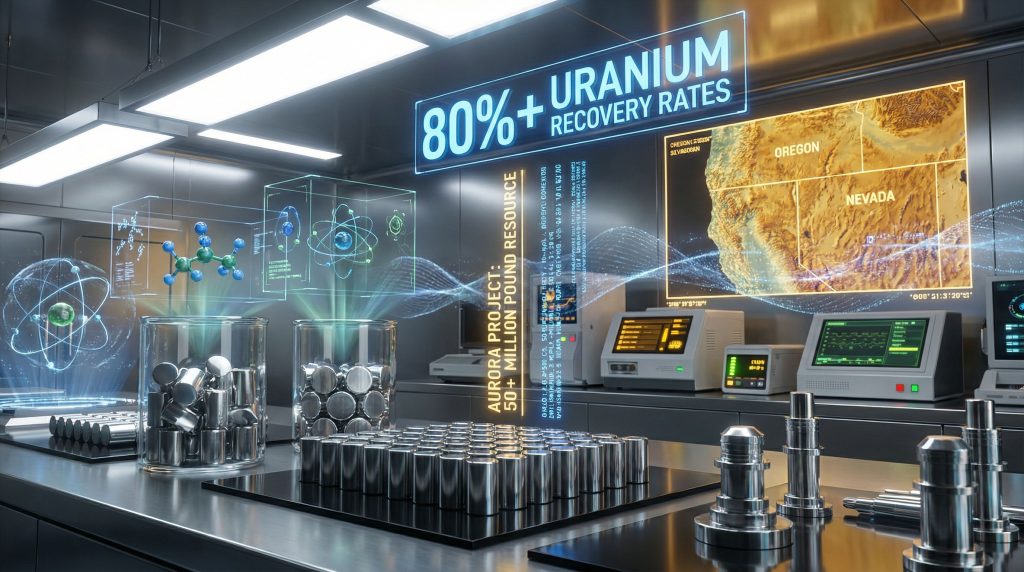
The company's Aurora Project represents one of the largest undeveloped uranium deposits in the United States, situated along the Oregon-Nevada border. Production targets focus on early 2030s supply availability, with potential acceleration under favourable industry conditions.
Vertical Integration Competitive Advantages
Traditional uranium mining operations extract ore for sale to fuel conversion and enrichment facilities, with limited downstream value capture. Integrated SMR-uranium models attempt to control more of the value chain through several mechanisms:
Factory-Assembled Reactor Technology:
• SLLIM/VSLLIM reactor platforms designed for truck-deployable configurations
• Reduced construction timelines compared to traditional nuclear plant development
• Standardised manufacturing processes enabling cost reduction through scale
• Remote deployment capabilities for distributed power generation
University Research Partnerships:
• University of New Mexico collaboration for advanced reactor development
• Cost-efficient R&D through academic institution partnerships
• Access to federal research grants and national laboratory resources
• Student talent pipeline for specialised nuclear engineering capabilities
Metallurgical Performance and Resource Scale
Aurora Project metallurgical testing demonstrates over 80% uranium recovery rates from ore samples, indicating favourable extraction economics. The deposit's location provides dual-state operational benefits, though coordination between Oregon and Nevada regulatory jurisdictions adds complexity to permitting processes.
Step-out drilling programmes at Aurora and associated Cordex deposits continue resource definition activities. Pre-feasibility study completion targeted for 2026 will provide critical economic parameters for production planning and capital allocation decisions.
Risk Assessment Framework for Nuclear Infrastructure Development
Early-stage nuclear infrastructure investments carry multiple risk categories requiring systematic evaluation. Regulatory approval uncertainties represent the primary concern for uranium mining and reactor development projects, particularly given multi-jurisdictional permitting requirements and evolving federal policy landscapes.
Technical execution risks encompass metallurgical performance validation, reactor prototype development timelines, and commercial deployment scalability. Market risks include commodity price volatility, offtake agreement negotiation, and competition from established uranium producers.
Regulatory Environment Navigation Strategies
Multi-Agency Coordination Requirements:
| Agency | Jurisdiction | Key Approvals |
|---|---|---|
| Nuclear Regulatory Commission | Federal | Reactor licensing and safety certification |
| Bureau of Land Management | Federal | Mining lease approvals and environmental assessments |
| Oregon Environmental Quality | State | Water discharge permits and air quality compliance |
| Nevada Environmental Protection | State | Mining operation permits and waste management |
Current administration support provides favourable regulatory momentum through Defense Production Act application to uranium mining and NRC streamlining initiatives. However, regulatory approval timelines remain subject to environmental review processes and local stakeholder engagement requirements.
Technical Development Milestones
Critical technical milestones include pre-feasibility study completion, metallurgical test result validation, and SMR prototype demonstration. The 2032 production startup target assumes successful navigation of permitting processes and favourable industry conditions.
Acceleration potential exists through regulatory streamlining mechanisms and increased federal support for domestic uranium production. However, technical execution risks include:
• Metallurgical recovery rate validation through independent third-party testing
• SMR commercial deployment timeline uncertainties
• Mining infrastructure development costs and logistical complexities
• Multi-jurisdictional permitting coordination challenges
Strategic Uranium Supply Chain Positioning
United States uranium import dependency reaches approximately 87% of commercial nuclear reactor fuel requirements, creating strategic vulnerability to foreign supply disruptions. Domestic production capacity remains minimal, with most historical uranium mining operations suspended due to unfavourable economics during previous uranium price cycles.
Consequently, the US uranium import ban on Russian supplies and geopolitical supply chain diversification imperatives drive federal policy support for domestic uranium production capability development. Russia and Kazakhstan control significant global uranium production capacity, highlighting supply security concerns for U.S. nuclear energy infrastructure.
National Energy Policy Alignment
Current federal energy policy emphasises critical minerals supply chain resilience and domestic uranium production capability expansion. Key policy mechanisms include:
Strategic Resource Independence Initiatives:
• Department of Energy strategic uranium reserve expansion
• Critical minerals supply chain mapping and vulnerability assessment
• Federal procurement preference for domestic uranium production
• Research and development funding for advanced uranium extraction technologies
International Partnership Development:
• Canadian uranium supply agreement negotiations
• Australian uranium import diversification programs
• Allied nation uranium supply chain coordination
• Technology sharing agreements for advanced nuclear fuel cycles
Market Access and Offtake Strategy
Aurora Project currently lacks formalised offtake agreements, though management reports initial market interest from potential buyers. Early 2030s production timeline provides opportunity for offtake negotiation during pre-feasibility study completion and final mine planning phases.
Expected buyer diversification includes traditional utilities and emerging hyperscaler direct procurement. Technology companies evaluating uranium producer relationships represent a new market segment beyond conventional utility customers, potentially expanding demand and improving pricing dynamics.
Financial Metrics and Valuation Framework
Nuclear development company valuation requires specialised metrics reflecting long development timelines, regulatory uncertainties, and commodity price sensitivity. Traditional mining company valuation approaches must incorporate reactor technology development costs and integrated business model complexities.
Key Performance Indicators:
| Metric Category | Eagle Nuclear Benchmarks | Industry Comparatives |
|---|---|---|
| Resource Scale | Aurora Project: 50+ million pounds (estimated) | Cameco Cigar Lake: 14M lbs annual capacity |
| Development Capital | $30 million current funding | 2-year operational runway |
| Technology Integration | SMR development + mining operations | Pure-play uranium developers |
| Market Position | Oregon-Nevada border location | Dual-state regulatory jurisdiction |
Capital Allocation Efficiency Analysis
The $30 million SPAC transaction provides approximately two years of operational funding for pre-feasibility study completion and early development activities. Capital efficiency metrics include cost per pound of uranium resource development and technology integration expenses relative to peer companies.
Integrated SMR-uranium models require higher initial capital investment compared to traditional uranium mining operations. However, potential value capture across multiple segments of the nuclear fuel cycle may justify premium valuation multiples.
Comparative Valuation Benchmarks
Pure-play uranium developers typically trade based on net present value calculations using long-term uranium price assumptions and production cost estimates. Integrated nuclear platforms command technology premiums reflecting reactor development optionality and vertical integration benefits.
Market access advantages include reduced transportation costs through on-site reactor deployment and elimination of fuel conversion intermediaries. These operational efficiencies provide competitive advantages relative to traditional uranium mining business models.
The next major ASX story will hit our subscribers first
Market Catalyst Identification and Timeline Analysis
Several catalysts could accelerate nuclear investment momentum across the sector. Policy-driven growth accelerators include federal nuclear energy tax incentive expansions and state-level renewable energy mandate modifications incorporating nuclear baseload requirements.
Technology adoption tipping points focus on hyperscaler direct uranium producer partnerships and SMR commercial deployment milestone achievements. Grid-scale energy storage integration requirements may favour nuclear baseload generation complementing renewable energy intermittency challenges.
Policy Catalyst Timeline
Near-term Catalysts (2026-2027):
• Pre-feasibility study completion and resource reserve certification
• Federal uranium reserve expansion announcements
• Additional executive orders supporting nuclear energy development
• International uranium supply agreement negotiations
Medium-term Catalysts (2028-2030):
• First SMR commercial deployment demonstrations
• Hyperscaler-uranium producer direct procurement agreements
• Traditional utility long-term offtake contract negotiations
• Advanced reactor licensing approvals from Nuclear Regulatory Commission
Technology Development Milestones
SMR technology commercialisation represents a critical catalyst for integrated uranium-reactor platforms. Factory-assembled reactor deployment timelines depend on regulatory approval processes and demonstration project success rates.
Truck-deployable reactor capabilities enable distributed power generation for remote mining operations and industrial facilities. This deployment flexibility provides competitive advantages over traditional centralised nuclear plant construction approaches.
Long-term Nuclear Fuel Cycle Economic Implications
Global reactor construction pipelines indicate sustained uranium demand growth through 2035 and beyond. Existing mine depletion schedules require replacement production capacity from new uranium developments, supporting favourable supply-demand balance projections.
Secondary supply sources including downblended weapons material and re-enriched uranium provide temporary supply augmentation but cannot substitute for primary uranium production expansion. In addition, efforts to enhance US uranium production capability represent a strategic priority for long-term nuclear fuel cycle economics.
Supply-Demand Balance Projections
Global Uranium Demand Drivers:
• Artificial intelligence infrastructure electricity requirements
• Traditional nuclear fleet capacity factor improvements
• New reactor construction in Asia, Europe, and North America
• Small modular reactor commercial deployment acceleration
Supply Constraint Factors:
• Limited new uranium mine development during previous price cycles
• Existing mine reserve depletion and replacement requirements
• Geopolitical supply chain disruption vulnerabilities
• Environmental permitting timeline uncertainties
Integrated Business Model Scalability
Mine-to-reactor operational efficiency provides scalability advantages through vertical integration cost savings and supply chain control. Regional energy market penetration strategies enable distributed power generation serving industrial customers and grid-isolated applications.
Technology licensing and partnership revenue opportunities expand business model optionality beyond traditional uranium mining operations. University research partnerships facilitate intellectual property development and federal research grant access.
Portfolio Management Strategies for Nuclear Energy Exposure
Nuclear energy sector allocation requires specialised risk management approaches reflecting regulatory uncertainties, long development timelines, and commodity price volatility. Institutional investors increasingly evaluate nuclear infrastructure as critical minerals exposure within broader energy transition portfolios.
Sector rotation timing considerations focus on nuclear versus renewable energy investment cycles and policy environment changes. ESG investment framework compatibility varies among institutional mandates, with nuclear energy classification ranging from clean energy inclusion to fossil fuel exclusion categories.
Risk Management Framework Implementation
Primary Risk Categories:
• Regulatory approval timeline uncertainties affecting development schedules
• Technology development execution risks for SMR commercialisation
• Commodity price volatility impact on project economics
• Market access challenges for offtake agreement negotiation
Mitigation Strategies:
• Portfolio diversification across multiple uranium developers and nuclear technology platforms
• Stage-gate investment approaches tied to development milestone achievement
• Commodity price hedging through uranium futures and derivative instruments
• Regulatory environment monitoring and policy change assessment
Sector Allocation Optimisation
Critical minerals portfolio diversification benefits include exposure to uranium alongside lithium, rare earth elements, and copper development projects. Nuclear energy complements renewable energy infrastructure investments by providing baseload generation capability addressing intermittency challenges.
Investment timeline alignment requires consideration of uranium project development phases and production startup targets. Early-stage exploration investments carry higher risk-return profiles compared to advanced development projects with completed feasibility studies and secured financing.
What About Nuclear Waste Management?
The successful deployment of integrated uranium-reactor business models depends partly on addressing public concerns regarding waste disposal. Moreover, considerations around nuclear waste disposal safety remain crucial for project acceptance and regulatory approval processes.
Advanced SMR technologies often incorporate enhanced safety features and reduced waste generation compared to traditional reactor designs. These improvements support public acceptance initiatives and streamlined permitting approaches for distributed nuclear power deployment.
Furthermore, comprehensive uranium market analysis indicates that integrated platforms may achieve superior risk-adjusted returns through operational diversification and vertical supply chain control.
Disclaimer: This analysis contains forward-looking statements and speculative projections regarding uranium market dynamics, nuclear energy policy developments, and company-specific operational targets. The uranium explorer Eagle Nuclear Energy blank check merger represents one example of evolving nuclear sector financing approaches. Uranium mining and nuclear energy investments carry significant regulatory, technical, and market risks. Past performance of energy sector investments does not guarantee future results. Investors should conduct independent due diligence and consult qualified financial advisors before making investment decisions in nuclear energy infrastructure or uranium exploration companies.
Ready to Invest in the Next Major Mineral Discovery?
Discovery Alert instantly alerts investors to significant ASX mineral discoveries using its proprietary Discovery IQ model, turning complex mineral data into actionable insights. Understand why historic discoveries can generate substantial returns by visiting Discovery Alert's dedicated discoveries page, and begin your 14-day free trial today to position yourself ahead of the market.