August 5, 2026

Nuclear Reactor fleet Growth and Strategic Supply Constraints
Nuclear energy infrastructure development across multiple continents creates an unprecedented demand trajectory for uranium fuel. The global uranium shortage continues to intensify as climate policy commitments, baseload power requirements, and energy security objectives position nuclear power as a cornerstone technology for grid stability and carbon reduction strategies.
More than 70 nations have expressed interest in nuclear energy programs, with approximately 60 gigawatts of reactor capacity currently under construction worldwide. Furthermore, this expansion represents a fundamental shift from the post-Fukushima period of nuclear capacity reductions to active fleet growth planning through 2050.
Artificial Intelligence and Data Center Energy Requirements
The emergence of artificial intelligence computing infrastructure creates substantial new electricity demand concentrated in specific geographic regions. Data centres supporting large language models, machine learning operations, and cryptocurrency mining require consistent, high-capacity baseload power generation that renewable energy sources struggle to provide reliably.
Nuclear power plants offer the dual advantage of carbon-free generation and 24-hour operational availability, making them increasingly attractive for utility-scale contracts supporting technology sector growth. However, this demand segment represents an entirely new market for nuclear fuel beyond traditional grid electricity generation.
Japan's Return to Uranium Procurement
Following the March 2011 Fukushima Daiichi disaster, Japan suspended most reactor operations and reduced uranium purchasing significantly. The gradual restart of reactors from 2015 onwards has created renewed demand from Japanese utilities, with procurement contracts resuming incrementally as regulatory approvals advance.
Japan's return to uranium markets signals the depletion of existing utility stockpiles accumulated during the operational suspension period. This transition from inventory drawdown to active purchasing represents millions of pounds of additional annual demand entering global markets.
When big ASX news breaks, our subscribers know first
Mining Capacity Constraints vs. Theoretical Production
Current Output Reality
Global uranium mine production totals approximately 143 million pounds annually from primary mining operations, though this figure varies based on operational efficiency and market conditions. Secondary supply sources, including government stockpile releases and reactor fuel recycling, contribute additional material but represent declining availability as strategic reserves diminish.
The distinction between nameplate capacity and actual production reflects operational realities that become apparent only during commercial operations. For instance, uranium market volatility affects production planning decisions across major mining operations:
- Metallurgical uncertainties requiring operational adjustments
- Hydrogeological variations affecting extraction efficiency
- Chemical reagent availability constraining throughput
- Learning curves extending 2-3 years post-commissioning
In-Situ Leaching Performance Variables
In‑situ leaching benefits account for approximately 50% of global uranium production, depending on precise groundwater chemistry management and geological conditions. These operations inject chemical solutions into permeable sandstone aquifers, extract uranium-enriched solutions through recovery wells, and process the material at surface facilities.
Kazakhstan's dominance in ISL production creates concentration risk, as 40% of global uranium supply originates from this single country's operations. Technical constraints affecting Kazakhstan's production capacity include:
- Sulfuric acid supply limitations restricting lixiviant availability
- Well field optimisation requiring extensive hydrogeological modelling
- Chemical processing capacity bottlenecks at surface facilities
- Permitting restrictions limiting greenfield exploration
Geographic Concentration and Operational Challenges
Kazakhstan Production Bottlenecks
Kazakhstan's position as the world's largest uranium producer creates systemic supply risk for global nuclear fuel markets. The country's reliance on in-situ leaching technology makes production vulnerable to chemical input availability, particularly sulfuric acid sourcing and processing capacity constraints.
Recent regulatory changes have tightened foreign investment requirements and restricted exploration activities in sensitive border regions. While established operations maintain licences, the regulatory environment limits greenfield development opportunities that would expand long-term supply capacity.
Namibian Infrastructure Limitations
Namibia represents the third-largest global uranium producer, but expansion faces significant infrastructure constraints. The country's desert climate creates genuine water scarcity challenges, with annual rainfall below 100 millimetres in primary mining regions.
Major operations like Paladin Energy's Langer Heinrich mine continue production through substantial water management infrastructure investments, including advanced treatment systems and recycling capabilities. However, these solutions require significant capital investment and operational complexity that affects project economics.
Russian Sanctions and Market Segmentation
Following the US Senate uranium ban, European Union import restrictions implemented in 2023 eliminated approximately 10-15% of global uranium supply from Western market access. Prior to sanctions, Russia and Kazakhstan collectively supplied 40-50% of global uranium to international markets.
This regulatory fragmentation creates a bifurcated market where Western utilities face genuine sourcing constraints independent of physical uranium availability. Chinese-controlled uranium material represents additional supply unavailable to Western utilities due to strategic stockpiling requirements and captive domestic demand.
Development Timeline Realities and Capital Requirements
Sequential Development Phases
Uranium mining project development follows sequential phases that cannot be accelerated through parallel processing. In addition, the following timeline demonstrates the complexity involved:
| Development Phase | Duration | Key Requirements |
|---|---|---|
| Feasibility and Permitting | 2-4 years | Environmental impact assessment, regulatory approval |
| Construction | 3-5 years | Infrastructure development, equipment installation |
| Commissioning and Ramp-up | 1-3 years | Operational optimisation, nameplate capacity achievement |
| Total Timeline | 6-12 years minimum | Often extending to 15+ years with delays |
Environmental assessment processes require comprehensive baseline studies, public consultation periods, and regulatory review cycles. These permitting requirements cannot occur in parallel across jurisdictions, creating sequential bottlenecks that extend development timelines beyond construction duration alone.
Capital Investment Barriers
Major uranium mining projects require multi-billion dollar capital investments with extended payback periods. Development costs typically include:
- Exploration and feasibility studies: $10-30 million
- Pre-construction and permitting: $20-50 million
- Construction capital: $500 million-$2+ billion
- Working capital buffer: $50-100 million
Project financing occurs in volatile commodity markets where investors require confidence in uranium prices 10+ years forward. This financing uncertainty creates development continuity breaks and extended pre-development phases beyond technical requirements.
Technical Expertise Constraints
The uranium mining industry faces genuine shortages of experienced extraction engineers, hydrogeologists, and in-situ leaching specialists. This expertise scarcity constrains project development capacity even when capital funding is available, as specialised knowledge requirements cannot be rapidly developed through training programmes.
Supply-Demand Gap Projections and Market Dynamics
Baseline Deficit Scenarios
Current supply-demand modelling indicates growing uranium shortages through multiple timeframes. According to the World Nuclear Association, global uranium shortage conditions are projected to intensify:
| Timeframe | Annual Supply Gap | Cumulative Impact |
|---|---|---|
| 2027-2030 | 50-75 million lbs/year | Growing inventory depletion |
| 2031-2035 | 100-150 million lbs/year | Critical shortage phase |
| 2036-2040 | 165-185 million lbs/year | Supply crisis peak |
These projections assume current development pipelines proceed without significant delays and no major operational disruptions affect existing production. Upper-scenario modelling suggests potential gaps reaching 200-250 million pounds annually with cumulative deficits of 680,000 metric tonnes by 2040.
Price Volatility and Market Psychology
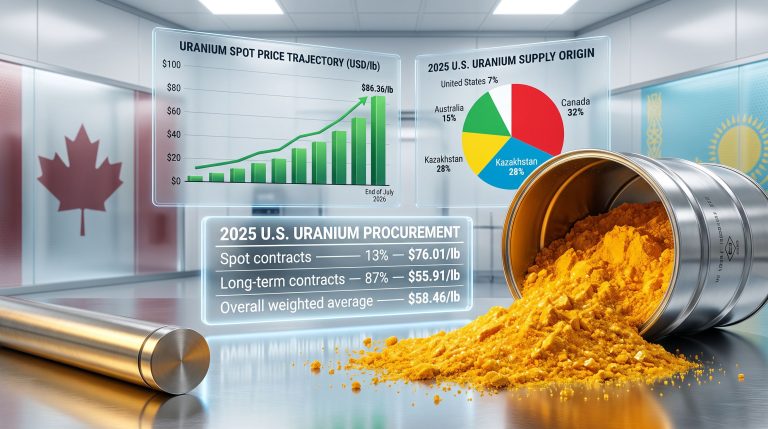
Recent uranium price movements demonstrate the market's sensitivity to supply-demand imbalances. A three-day price spike from $85 to $102 per pound in January 2026 illustrates the extreme volatility characteristics of uranium markets during supply constraint periods.
Analyst forecasts project uranium prices reaching:
- $175 per pound by 2027
- $200 per pound by 2028
- Long-term floor of $120 per pound from 2032
These price projections reflect super-cycle characteristics with extreme movements driven by supply-demand fundamentals rather than financial speculation alone.
Supply Response Mechanisms
Higher uranium prices enable previously uneconomical deposits to become viable, but development timelines remain constrained by permitting and construction requirements. Secondary supply sources include:
- Reactor fuel recycling programmes extracting additional energy from spent fuel
- Government strategic stockpile releases during supply emergencies
- Lower-grade deposit exploitation using advanced extraction technologies
- Extended leaching processes increasing recovery rates from existing operations
Operational Optimisation and Investment Strategies
Mining Company Adaptation Approaches
Existing uranium producers implement operational modifications to maximise output within resource constraints. US uranium production highs demonstrate how companies adapt operational strategies:
Well Field Design Optimisation: Larger well spacing in in-situ leaching operations creates more efficient uranium recovery by extending leaching contact time. This approach enables lower cut-off grades and higher overall recovery rates, though requiring more simultaneous well fields to maintain production targets.
Grade Tolerance Adjustments: Lower cut-off grades expand economically viable resource bases, allowing extraction of previously marginal mineralisation. This strategy increases mine life and total production but may affect operating costs and processing requirements.
Technology Integration: Automation investments and remote operations capabilities reduce operational risks and improve extraction efficiency, particularly important in remote locations with limited workforce availability.
Boss Energy Operational Case Study
Boss Energy's Honeymoon mine development illustrates real-world uranium project challenges. Despite acquiring existing infrastructure and mining licences, the company identified significant deviations from original feasibility assumptions:
- Less continuity of higher-grade mineralisation than modelled
- Reduced leachability characteristics requiring operational redesign
- Smaller optimal well field configurations affecting production profiles
- Impact on life-of-mine production and costs from FY27 onwards
The company maintains FY26 production guidance of 1.6 million pounds at A$75-80/lb all-in sustaining cost, demonstrating operational flexibility within constrained resource parameters. A revised feasibility study expected by Q3 2026 will provide updated production profiles reflecting operational learning.
The next major ASX story will hit our subscribers first
Inventory Management and Strategic Stockpiling
Current Stockpile Assessment
Utility uranium inventories have reached historically low levels as procurement strategies shifted from strategic stockpiling to just-in-time purchasing during periods of uranium oversupply. Combined utility holdings are estimated at 100-150 million pounds, representing approximately 18-24 months of global reactor fleet requirements.
Government strategic reserves vary significantly by country but generally prove insufficient for extended supply disruptions. The United States maintains approximately 40 million pounds in strategic stockpiles, while other consuming nations hold smaller reserves relative to domestic reactor requirements.
Commercial Inventory Dynamics
Mobile uranium inventory available for trading totals tens of millions of pounds, significantly below the hundreds of millions required for sustained supply security. This inventory concentration among few major holders creates market vulnerability during supply disruption scenarios.
Secondary supply sources from government stockpile releases and reactor fuel recycling currently represent 30-40% of total supply, but this contribution is declining as strategic reserves deplete and recycling capacity faces technical limitations.
Technological Innovation and Alternative Supply Sources
Advanced Reactor Efficiency
Small modular reactors (SMRs) and Generation IV reactor designs offer improved fuel efficiency compared to conventional light-water reactors. These technologies can extract 30-50% more energy from equivalent uranium fuel inputs, effectively reducing demand per unit of electricity generated.
Thorium-based reactor development represents a long-term alternative reducing uranium dependency, though commercial deployment remains 10-15 years from widespread implementation. Current thorium reactor programmes in India and China focus on demonstrating technical feasibility rather than immediate commercial deployment.
Extraction Technology Advancement
Enhanced in-situ leaching techniques using improved chemical formulations and artificial intelligence optimisation can increase recovery rates from existing deposits. These technological improvements may add 10-20% additional production from established operations without new mine development.
Seawater uranium extraction research continues at laboratory and pilot scales, with estimates of 4 billion tonnes of uranium dissolved in ocean water. However, extraction costs remain 5-10 times higher than conventional mining, limiting commercial viability under current market conditions.
Sector-Specific Impact Analysis
Utility Planning Implications
Nuclear power plant operators must incorporate uranium supply risk assessments into long-term generation planning. Utilities increasingly negotiate 10-15 year uranium supply contracts to secure fuel availability, contrasting with previous spot-market purchasing strategies.
Nuclear plant capacity factor optimisation becomes critical during supply constraint periods. Extending fuel cycle lengths and improving reactor efficiency reduces uranium consumption per megawatt-hour generated, providing operational flexibility during supply shortages.
Investment Market Effects
Uranium equity valuations reflect scarcity premiums as supply-demand imbalances intensify. Mining company share prices demonstrate extreme volatility correlating with uranium spot price movements rather than traditional mining sector fundamentals.
Exchange-traded funds and commodity investment vehicles show increasing uranium exposure as institutional investors recognise supply constraint investment opportunities. Sovereign wealth funds implement strategic uranium investments as commodity reserves rather than traditional equity positions.
Long-Term Strategic Implications
Energy Security Considerations
National energy independence strategies increasingly incorporate uranium supply security alongside oil and natural gas reserves. International cooperation frameworks for uranium resource sharing become critical for countries with significant nuclear generation but limited domestic uranium resources.
Strategic alliance formation among uranium-consuming nations creates procurement security through diversified supply arrangements and emergency sharing protocols. These frameworks provide supply stability during geopolitical disruptions affecting major producing regions.
How Will These Changes Impact Future Energy Policy?
Higher uranium prices affect nuclear power competitiveness relative to alternative generation sources. Consequently, global uranium shortage conditions may increase nuclear electricity generation costs, potentially slowing nuclear capacity expansion despite climate policy support.
Environmental impact assessments for accelerated mine development must balance increased uranium production against conservation objectives. Social licence considerations in uranium-rich regions become critical for maintaining operational approval and community support.
Furthermore, energy transition and security requirements will drive policy decisions regarding domestic uranium production capabilities and strategic reserve maintenance.
The interaction between nuclear energy's role in decarbonisation and uranium supply constraints creates a complex policy landscape. Governments must balance climate objectives with energy security considerations whilst managing geopolitical risks affecting critical mineral supply chains.
As highlighted in a recent Wall Street Journal analysis, rising demand for nuclear power continues to pressure uranium supply chains, requiring coordinated international responses to ensure adequate fuel availability for expanding reactor fleets.
Important Disclaimer: This analysis contains forward-looking projections based on current market conditions and industry trends. Uranium market dynamics involve significant uncertainties including regulatory changes, technological developments, and geopolitical factors that may materially affect actual outcomes. Investment decisions should consider these risks and consult qualified financial advisors.
Looking to Navigate the Uranium Investment Opportunity?
Discovery Alert's proprietary Discovery IQ model delivers real-time notifications on significant uranium and mineral discoveries across the ASX, instantly empowering subscribers to identify actionable opportunities ahead of the broader market. Explore historic examples of exceptional returns from major mineral discoveries by visiting Discovery Alert's dedicated discoveries page and begin your 14-day free trial today to secure your market-leading advantage.