
August 25, 2026
Understanding Canada's Multi-Layered Nuclear Repository Oversight System
Nuclear waste management represents one of the most complex regulatory challenges facing modern industrialized nations. The intersection of environmental protection, public safety, Indigenous rights, and long-term stewardship creates governance frameworks that must balance competing interests while maintaining scientific rigor across generational timelines. Canada's approach to nuclear waste disposal repository regulation exemplifies this complexity through its integrated multi-agency coordination model, consent-based community selection process, and parallel Indigenous governance pathways.
The Canadian regulatory framework for spent fuel repository approval operates through a sophisticated institutional architecture designed to address both immediate licensing requirements and century-spanning operational oversight. Furthermore, this system reflects evolving principles of environmental justice, technological innovation, and democratic participation in high-stakes infrastructure decisions that will affect multiple generations of Canadian communities.
When big ASX news breaks, our subscribers know first
Canada's Integrated Regulatory Architecture for Nuclear Waste Repository Approval
Dual-Agency Coordination Framework
Canada's regulatory approval process for spent fuel repository licensing operates through a carefully structured partnership between the Impact Assessment Agency of Canada (IAAC) and the Canadian Nuclear Safety Commission (CNSC). This integrated approach, characterised as "one project, one review," attempts to streamline regulatory complexity while maintaining rigorous oversight across environmental and technical safety domains.
The IAAC holds primary responsibility for environmental evaluation mandates, including comprehensive impact assessment protocols, public consultation coordination, and Indigenous engagement requirements. Meanwhile, the CNSC maintains technical licensing authority over nuclear safety standards, operational procedures, and long-term containment performance criteria.
This coordination mechanism emerged from recognition that traditional regulatory silos create inefficiencies and potential oversight gaps in mega-projects requiring both environmental protection and nuclear safety expertise. The framework aims to provide unified assessment timelines while preserving specialised agency competencies.
Legislative Foundation and Compliance Architecture
Canada's repository regulatory framework rests on three foundational legislative pillars, each addressing distinct aspects of nuclear waste management governance:
| Legislation | Primary Authority | Key Oversight Areas |
|---|---|---|
| Impact Assessment Act | Environmental evaluation protocols | Public consultation, Indigenous engagement, ecosystem protection |
| Nuclear Safety and Control Act | Technical safety standards | Phased licensing, safety case validation, operational compliance |
| Nuclear Fuel Waste Act | Long-term waste governance | Institutional stewardship, funding assurance, multi-generational responsibility |
These legislative frameworks establish overlapping but complementary regulatory jurisdictions designed to ensure comprehensive oversight throughout the repository's operational lifecycle. However, the Nuclear Fuel Waste Act specifically addresses long-term institutional arrangements, recognising that repository oversight extends far beyond traditional project timelines.
Indigenous Governance Integration and Parallel Assessment Authority
A distinctive feature of Canada's regulatory approach involves the formal recognition of Indigenous regulatory authority through parallel assessment processes. The Wabigoon Lake Ojibway Nation has established its own regulatory assessment and approval pathway under a formal agreement with the Nuclear Waste Management Organization, creating a dual-track approval system that recognises Indigenous sovereignty while maintaining federal regulatory coordination.
This arrangement represents a significant evolution in Canadian resource project governance, acknowledging that Indigenous communities possess inherent regulatory authority over projects affecting their territories. Consequently, the parallel assessment framework requires both federal agency approval and Indigenous community consent, creating multiple veto points within the licensing process.
Canada's Phased Repository Licensing System: A Multi-Stage Approach
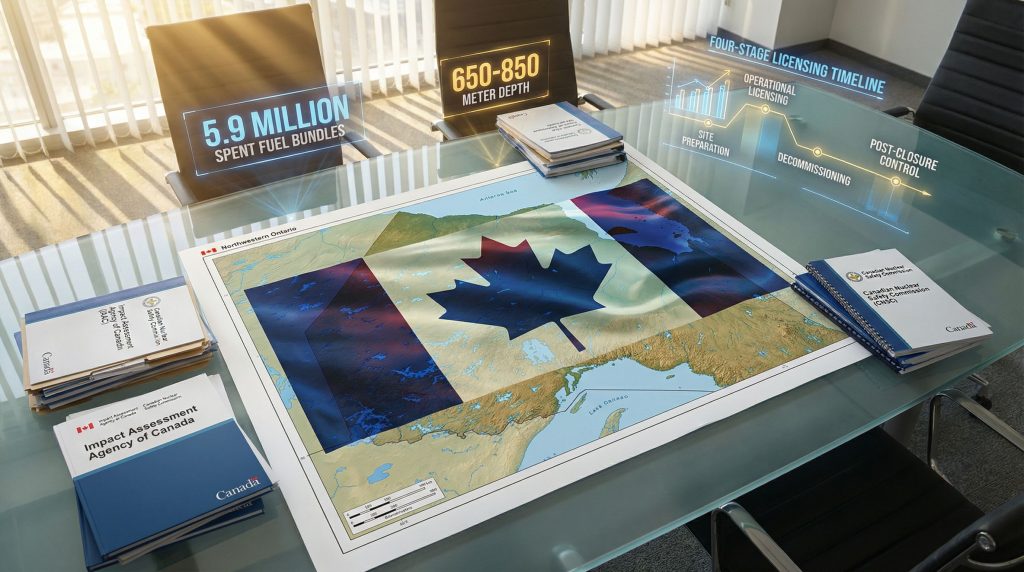
Four-Stage Regulatory Timeline Structure
Canada's deep geological repository licensing follows a phased approach designed to match regulatory oversight intensity with project development stages. This system recognises that early-stage activities pose different risks than operational phases involving radioactive material handling.
The initial Site Preparation and Construction Phase focuses on non-nuclear infrastructure development, including water management facilities, worker accommodations, and surface support systems. This phase allows regulatory agencies to evaluate construction competency and environmental management practices before authorising nuclear material handling.
The Operational Licensing Period encompasses approximately 50 years of active waste emplacement, during which spent fuel bundles are transported, processed, and placed within the geological repository. This phase requires the most intensive regulatory oversight, with continuous compliance monitoring and periodic license renewals.
Decommissioning and Closure Authorisation governs the facility sealing process and transition from active operations to passive containment. This phase involves complex engineering decisions about barrier system integrity and long-term monitoring requirements.
Finally, Post-Closure Institutional Control establishes multi-generational surveillance protocols and regulatory oversight mechanisms for the repository's passive containment phase, potentially lasting thousands of years.
Current Regulatory Status and Timeline
The Nuclear Waste Management Organization submitted its initial project description to Canadian regulatory authorities on January 5, 2026, officially initiating the federal approval process. This foundational document was posted on the Impact Assessment Agency of Canada's evaluation portal, triggering a 30-day public comment period that closed on February 4, 2026.
According to NWMO officials, the initial project description serves as more than a regulatory requirement, integrating engineering specifications, environmental impact assessments, Indigenous knowledge systems, and community perspectives into a comprehensive project framework. This document provides preliminary impact assessments and mitigation strategies that will guide subsequent detailed licensing applications.
The next critical milestone involves submitting a comprehensive impact statement alongside an initial license application to the Canadian Nuclear Safety Commission. For instance, this initial license application will authorise preliminary site work, water management facility construction, and non-nuclear supporting infrastructure development.
Technical Requirements and Safety Case Development
Repository licensing requires extensive technical documentation demonstrating long-term containment performance across multiple barrier systems. The proposed facility design calls for waste emplacement at depths between 650-850 metres within crystalline rock formations, utilising both engineered barriers and geological containment mechanisms.
Safety case development represents the most technically complex aspect of the licensing process, requiring detailed modelling of containment performance across extended timeframes. These analyses must demonstrate repository safety under various scenarios, including climate change impacts, geological evolution, and potential human intrusion pathways.
Environmental monitoring protocols must establish baseline conditions and ongoing surveillance capabilities throughout the repository's operational and post-closure phases. Worker safety and emergency response planning requires comprehensive protocols for handling radioactive materials and responding to potential facility incidents.
Environmental and Safety Assessment Framework Integration
Comprehensive Impact Assessment Methodology
Canada's integrated environmental assessment approach encompasses multiple evaluation dimensions designed to capture the repository's full environmental footprint across its operational timeline. The assessment methodology addresses both direct project impacts and cumulative effects within regional ecosystems.
Groundwater protection and hydrogeological modelling represents a critical assessment component, given the repository's reliance on geological containment for long-term waste isolation. Hydrogeological analyses must demonstrate containment performance under various groundwater flow scenarios and potential climate change impacts on regional hydrology.
Ecosystem impact evaluation and biodiversity conservation requires comprehensive baseline studies and long-term monitoring protocols for affected terrestrial and aquatic systems. The assessment must address both construction-phase habitat disruption and potential long-term ecological effects from repository operations.
Air quality and radiological exposure pathway analysis involves detailed modelling of potential radioactive material release scenarios and exposure pathways affecting both workers and surrounding communities. These assessments must consider both routine operational emissions and potential accident scenarios.
Public Participation and Consultation Architecture
Canada's regulatory approval process for spent fuel repository mandates extensive public engagement throughout multiple licensing phases. Formal public hearing processes provide opportunities for community input during each major licensing milestone, while ongoing consultation protocols ensure continuous stakeholder engagement.
Indigenous Traditional Knowledge integration requirements recognise that Indigenous communities possess unique environmental and cultural knowledge relevant to repository assessment. Consultation protocols must accommodate Indigenous decision-making processes and knowledge systems while meeting federal regulatory requirements.
Stakeholder engagement protocols extend beyond affected communities to include regional municipalities, environmental organisations, and technical experts. The consultation framework aims to ensure that diverse perspectives inform regulatory decision-making while maintaining technical rigour in safety assessments.
International Standards Alignment and Peer Review
Canada's repository development programme aligns with International Atomic Energy Agency safety standards and participates in international peer review mechanisms. Comparative analysis with global repository programmes, including Finland's operational Onkalo facility and France's developing Cigéo project, provides technical benchmarks and lessons learned for Canadian regulatory development.
International peer review processes involve technical experts from established nuclear waste management programmes who evaluate Canada's safety case development, regulatory framework, and operational planning. These reviews provide independent validation of technical approaches while identifying potential improvement opportunities.
Consent-Based Siting and Community Engagement Integration
Community Agreement Prerequisites and Democratic Participation
Canada's consent-based siting process represents a fundamental departure from traditional top-down approaches to nuclear facility siting. The framework requires formal consent from both municipal and Indigenous communities before repository development can proceed, creating multiple democratic checkpoints within the approval process.
Community agreement prerequisites extend beyond simple approval votes to encompass comprehensive benefit-sharing arrangements, local hiring commitments, and long-term oversight participation mechanisms. These agreements aim to ensure that hosting communities receive tangible benefits while maintaining ongoing influence over repository operations.
The Township of Ignace and Wabigoon Lake Ojibway Nation both agreed to enter the regulatory decision-making phase in November 2024, culminating a consent-based process that began in 2010. This extended timeline reflects the complexity of community engagement and the importance of democratic legitimacy in major infrastructure decisions.
Northwestern Ontario Geological Advantages
The selected Northwestern Ontario site offers several geological characteristics favourable for long-term waste containment. The Canadian Shield's crystalline bedrock provides stable rock formations with minimal seismic activity and proven long-term geological integrity spanning billions of years.
Hydrogeological conditions in the region feature low groundwater flow rates and favourable chemical conditions for waste containment. The crystalline rock structure provides natural barriers to groundwater migration while offering predictable long-term stability.
Geological stability reflects the Canadian Shield's ancient rock formations, which have demonstrated stability across geological timescales far exceeding repository operational requirements. In addition, minimal seismic activity and absence of significant geological hazards provide favourable conditions for underground facility development.
Regional Economic Development and Infrastructure Considerations
Repository development creates significant regional economic opportunities through direct employment, infrastructure investment, and secondary economic activity. The project will require substantial workforce development programmes and training initiatives to build local capacity for specialised nuclear waste management operations.
Transportation logistics for waste package delivery require comprehensive planning for safe transport of spent fuel bundles from reactor sites across Canada to the Northwestern Ontario facility. These logistics involve specialised transport equipment, route planning, and coordination with multiple jurisdictions.
Regional infrastructure development will support not only repository operations but broader Northwestern Ontario economic development objectives. Investment in transportation, utilities, and community facilities provides lasting regional benefits beyond the repository project itself.
Financial Oversight and Operational Governance Mechanisms
Polluter Pays Implementation and Financial Assurance
Canada's nuclear waste management financial framework operates on the principle that nuclear utilities bear full responsibility for waste management costs throughout the repository's lifecycle. This approach ensures that waste management costs are internalised within nuclear electricity generation rather than transferred to taxpayers or future generations.
Segregated trust fund management provides financial assurance for long-term stewardship obligations extending far beyond typical project timelines. These funds must demonstrate sufficiency for all operational phases, including decommissioning, closure, and extended post-closure monitoring requirements.
Financial assurance mechanisms must account for inflation, technological change, and unforeseen circumstances across the repository's 160-year operational timeline. Regular financial reviews ensure fund adequacy while providing transparency regarding long-term cost projections.
Repository Operational Parameters and Capacity Planning
The proposed deep geological repository will accommodate 5.9 million spent fuel bundles, representing the complete projected inventory from Canada's current nuclear reactor fleet through end-of-life operations. This capacity planning reflects comprehensive analysis of national spent fuel generation projections and disposal requirements.
Operational timeline planning encompasses approximately 160 years of total project duration, including site preparation, construction, active waste emplacement, facility closure, and extended monitoring phases. The active waste emplacement phase spans approximately 50 years, during which spent fuel bundles will be transported and placed within the geological repository.
Furthermore, the mining permitting process for such complex projects requires extensive coordination between regulatory bodies. Post-closure monitoring establishes multi-generational institutional oversight mechanisms designed to provide ongoing surveillance and emergency response capability throughout the repository's passive containment phase.
Regulatory Compliance Monitoring and Adaptive Management
Continuous Canadian Nuclear Safety Commission inspection and compliance verification ensures ongoing adherence to safety standards throughout repository operations. Regular inspection protocols provide real-time assessment of operational performance while identifying potential improvement opportunities.
Annual safety performance reporting requirements create transparency mechanisms for both regulatory authorities and public stakeholders. These reports must demonstrate compliance with safety standards while providing data for ongoing safety case validation and regulatory decision-making.
Adaptive management protocols provide flexibility for incorporating technological advances and lessons learned from international repository programmes. This approach recognises that repository operations will span timescales during which significant technological and regulatory evolution will occur.
The next major ASX story will hit our subscribers first
International Comparison and Best Practices Integration
Global Repository Regulatory Models and Comparative Analysis
International nuclear waste repository programmes provide valuable insights into regulatory approaches and institutional arrangements for long-term waste management. Finland's successful Onkalo repository deployment demonstrates the feasibility of deep geological disposal while offering lessons learned regarding regulatory processes and technical implementation.
Finland's streamlined regulatory model relies on a single technical regulator (STUK) with comprehensive authority over repository licensing and oversight. This approach prioritises technical efficiency while maintaining rigorous safety standards through concentrated regulatory expertise.
France's parliamentary milestone approach requires legislative approval at major project stages, creating political accountability mechanisms while ensuring democratic oversight of long-term waste management decisions. France's Cigéo repository recently received satisfactory safety review from nuclear regulatory authorities, advancing toward construction authorisation.
Sweden's municipal veto authority provides local communities with definitive decision-making power over repository siting, similar to Canada's consent-based approach. Sweden's recent site selection completion demonstrates the viability of community-centred siting processes.
Adaptive Phased Management Innovation
Canada's Adaptive Phased Management approach incorporates flexibility mechanisms for technological advancement integration and continuous improvement based on international experience. This framework recognises that repository development occurs within rapidly evolving technological and regulatory environments, similar to current industry evolution trends affecting various sectors.
Reversibility provisions during operational phases provide options for waste retrieval if technological advances or changing circumstances warrant alternative approaches. These provisions balance long-term disposal objectives with flexibility for future decision-making.
Continuous improvement protocols ensure that Canadian repository operations incorporate lessons learned from international programmes while adapting to evolving safety standards and technical capabilities.
Critical Regulatory Milestones and Implementation Timeline
Immediate Regulatory Pathway (2026-2027)
The immediate regulatory timeline focuses on comprehensive impact assessment preparation and initial licensing applications. Impact statement development requires extensive technical analysis, environmental baseline studies, and stakeholder consultation integration.
Initial Canadian Nuclear Safety Commission licence applications for site preparation activities will authorise preliminary construction work while establishing regulatory oversight mechanisms for subsequent operational phases. Environmental assessment panel establishment will create formal mechanisms for public input and technical review.
Indigenous consultation protocol finalisation ensures that Traditional Knowledge integration and consent mechanisms align with federal regulatory requirements while respecting Indigenous governance systems and decision-making processes.
Medium-Term Licensing Objectives (2027-2030)
Medium-term regulatory objectives centre on comprehensive safety case documentation demonstrating long-term containment performance across multiple barrier systems and operational scenarios. This documentation represents the most technically complex aspect of repository licensing.
Final environmental impact statement approval requires resolution of all significant environmental concerns and demonstration of adequate mitigation measures for identified impacts. Construction licence issuance for non-nuclear infrastructure authorises facility development while maintaining separation between nuclear and conventional construction phases.
Community benefit agreement implementation ensures that negotiated arrangements between the Nuclear Waste Management Organization and hosting communities are formally established and operationalised according to agreed timelines and performance criteria.
Long-Term Operational Transition Planning
Long-term planning addresses the complex transition from facility construction to nuclear material handling and waste emplacement operations. Nuclear material transportation licensing coordination involves multiple regulatory agencies and transportation jurisdictions across Canada.
Operational staff training and certification programmes must develop specialised expertise in deep geological repository operations, drawing on international experience while addressing Canadian-specific regulatory requirements and operational procedures. This parallels the sustainability transformation occurring across resource industries.
International peer review and technical validation processes provide ongoing external assessment of repository performance and regulatory compliance, contributing to continuous improvement in operational safety and environmental protection.
Regulatory Challenges and Innovation Opportunities
Coordination Complexity and Institutional Capacity
Multi-jurisdictional approval coordination presents significant administrative challenges requiring sophisticated inter-agency coordination mechanisms and clear authority delineation. The integration of federal, provincial, and Indigenous regulatory systems creates complexity while providing comprehensive oversight.
Technical standard evolution and adaptive regulation needs reflect the reality that repository operations will span decades during which significant technological and regulatory advancement will occur. Regulatory frameworks must balance stability with flexibility for incorporating innovation and lessons learned.
Public confidence building in long-term institutional capacity represents an ongoing challenge requiring transparent communication, consistent performance demonstration, and sustained political commitment across multiple electoral cycles and generational transitions.
Technological Innovation and Enhanced Safety Assurance
Digital monitoring technology integration offers opportunities for enhanced safety assurance through real-time performance monitoring, predictive analysis, and automated response systems. These technologies can provide unprecedented visibility into repository performance while reducing human intervention requirements, similar to advances in data-driven operations across various industries.
Indigenous knowledge systems incorporation in long-term stewardship planning recognises that Traditional Knowledge offers unique insights into environmental change, ecosystem dynamics, and sustainable resource management across extended timescales.
Climate resilience planning for multi-generational facility operation requires sophisticated analysis of potential climate change impacts on repository performance, including changes in regional hydrology, extreme weather events, and long-term environmental conditions.
Economic Development and Regional Innovation
Northern Ontario economic diversification through nuclear sector expertise development creates opportunities for regional specialisation in advanced nuclear technologies and waste management systems. This expertise can support both domestic operations and international consulting opportunities.
Advanced manufacturing and engineering service sector development provides opportunities for Canadian companies to develop specialised capabilities in repository technology, monitoring systems, and long-term stewardship innovations.
International nuclear waste management consulting export potential offers economic opportunities for Canadian expertise in consent-based siting, Indigenous engagement, and integrated regulatory frameworks that could benefit other countries developing repository programmes.
Conclusion: Canada's Regulatory Innovation in Nuclear Waste Governance
Integrated Framework Strengths and Global Leadership
Canada's nuclear waste repository regulatory framework represents significant innovation in democratic governance of long-term environmental challenges. The integration of multi-agency coordination, Indigenous rights recognition, and consent-based siting creates a comprehensive approach that addresses both technical safety requirements and social licence considerations.
The adaptive management principles embedded within Canada's regulatory approach provide flexibility for technological innovation while maintaining rigorous safety standards across extended operational timelines. This balance between stability and adaptability offers valuable lessons for other nations developing repository programmes.
Critical Success Factors and Implementation Requirements
Sustained public confidence through transparent assessment processes remains essential for regulatory success and social acceptance of long-term waste management solutions. Technical excellence in safety case development and peer review provides the scientific foundation for regulatory decision-making and public trust.
Effective coordination between federal, provincial, and Indigenous governance systems requires ongoing institutional development and relationship building across multiple political and cultural contexts. Success depends on maintaining collaborative approaches while respecting diverse governance traditions and decision-making processes.
Canada's regulatory approval process for spent fuel repository development demonstrates the complexity and importance of comprehensive institutional frameworks for managing nuclear waste across generational timelines. The integration of technical excellence, democratic participation, and adaptive management principles provides a model for addressing some of humanity's most challenging long-term stewardship responsibilities.
Interested in Nuclear Sector Investment Opportunities?
Discovery Alert provides instant notifications on significant ASX mineral discoveries, including strategic metals crucial to nuclear technologies, powered by its proprietary Discovery IQ model. Stay ahead of the market by exploring Discovery Alert's dedicated discoveries page to understand why major mineral discoveries can generate substantial returns, or begin your 30-day free trial today to gain immediate access to actionable investment insights across the entire commodities spectrum.