
August 25, 2026
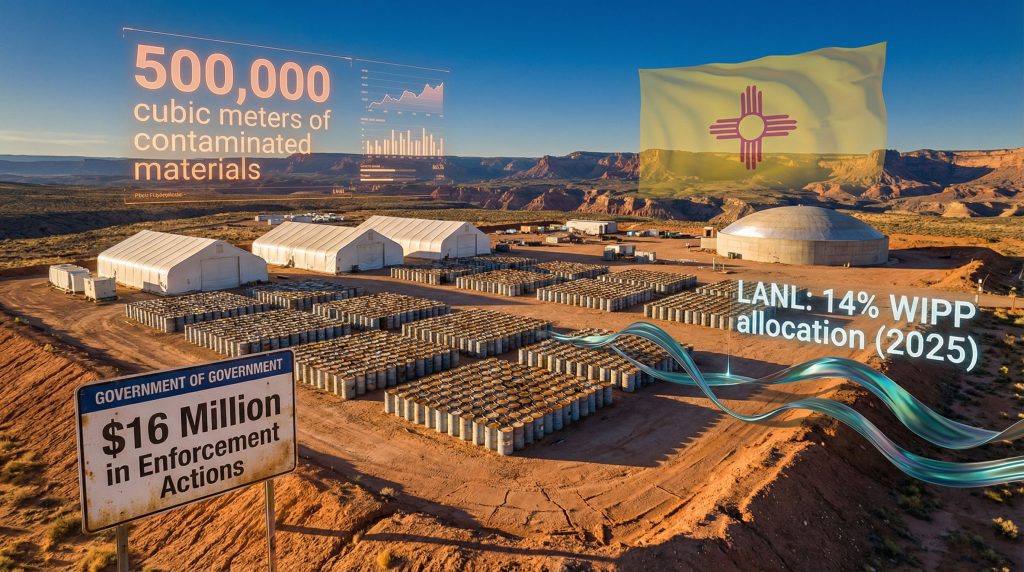
The nuclear cleanup landscape across American national laboratories has reached a pivotal regulatory moment, with enforcement mechanisms and interstate waste allocation disputes fundamentally reshaping decades-old management strategies. Complex federal-state jurisdictional frameworks now intersect with tribal sovereignty concerns, groundwater protection mandates, and deep geological repository capacity constraints in ways that challenge traditional approaches to New Mexico LANL waste disposal remediation.
State environmental authorities possess unprecedented leverage through hazardous waste permitting systems, creating enforcement pathways that bypass traditional federal immunity protections. This regulatory architecture enables direct intervention in facility operations, disposal prioritisation schemes, and cleanup timeline enforcement through civil penalty structures designed to compel compliance rather than generate revenue.
The intersection of transuranic waste classification systems, repository allocation protocols, and groundwater contamination pathway analysis reveals systemic inefficiencies in current management approaches that extend far beyond individual facility boundaries.
Current Nuclear Waste Management Challenges at Los Alamos National Laboratory
Los Alamos National Laboratory confronts a multifaceted legacy contamination crisis spanning eight decades of nuclear weapons research and production activities. The facility's waste inventory encompasses transuranic materials, mixed radioactive-hazardous compounds, heavy metals, and volatile organic compounds distributed across multiple disposal areas and storage configurations.
Manhattan Project operations beginning in the 1940s established contamination patterns that persist throughout the Cold War era, creating complex remediation challenges that intersect with modern environmental protection standards. Current storage systems include above-ground containment structures and temporary facilities designed for short-term management rather than permanent isolation.
Legacy Waste Categories at LANL:
- Transuranic materials requiring deep geological disposal
- Mixed waste containing both radioactive and RCRA-regulated hazardous components
- Heavy metal contamination including chromium, mercury, and lead compounds
- Volatile organic compounds from solvent and chemical processing operations
- Contaminated soil and debris from historical disposal practices
The Department of Energy's Office of Environmental Management maintains responsibility for cleanup operations, operating under Resource Conservation and Recovery Act permits issued by state environmental authorities. Furthermore, this regulatory framework creates dual federal-state oversight mechanisms that enable direct state intervention in cleanup prioritisation and timeline enforcement.
Contemporary storage approaches utilise engineered containment systems designed for waste characterisation and temporary management pending final disposal pathway implementation. Technical Area 54 serves as the primary staging location for transuranic waste destined for the Waste Isolation Pilot Plant repository in southeastern New Mexico.
When big ASX news breaks, our subscribers know first
New Mexico's $15.8 Million Enforcement Action Against Federal Operations
The New Mexico Environment Department issued comprehensive enforcement actions totalling $15,810,627 in civil penalties on February 11, 2026, targeting specific regulatory violations and systemic management deficiencies at Los Alamos National Laboratory. These enforcement mechanisms demonstrate state authority over federal facility operations through hazardous waste permitting frameworks.
Detailed Enforcement Action Breakdown:
| Violation Category | Civil Penalty | Regulatory Basis | Required Response |
|---|---|---|---|
| Hazardous Waste Management | $6,026,124 | Chromium plume off-site migration | Revised interim measures plan |
| Groundwater Standards | $9,784,503 | Aquifer protection violations | 60-day corrective action plan |
| Administrative Compliance | No penalty | MDA-C cleanup deferral | Justification documentation |
The enforcement actions specifically address groundwater contamination pathways that extend beyond laboratory boundaries onto tribal lands belonging to the San Ildefonso Pueblo community. In addition, this off-site migration triggers enhanced regulatory oversight under both state environmental protection standards and federal trust responsibility obligations.
NMED Secretary James Kenney emphasised the state's unique position in national nuclear waste management, noting that New Mexicans have stepped up to help solve the nation's cleanup problem in a way that residents of no other state have. However, the enforcement actions require the Department of Energy to prioritise health and welfare concerns by expediting cleanup operations and ensuring adequate repository capacity for New Mexico LANL waste disposal.
Compliance Timeline Requirements:
- Corrective action plan development: 60 days from enforcement action
- Revised groundwater discharge permit application submission
- MDA-C cleanup justification documentation within 30 days
- Implementation schedule for chromium plume mitigation measures
The enforcement strategy utilises administrative compliance orders combined with substantial financial penalties to compel operational changes and accelerated remediation timelines. This approach reflects state regulatory authority under Resource Conservation and Recovery Act frameworks that enable direct oversight of hazardous waste management at federal facilities.
WIPP Disposal Allocation System and Interstate Waste Management
The Waste Isolation Pilot Plant operates under a complex allocation system that has systematically disadvantaged New Mexico LANL waste disposal in favour of materials from other Department of Energy facilities. Between 2021 and 2025, Idaho National Laboratory disposed of five times more waste volume at WIPP compared to Los Alamos National Laboratory, despite New Mexico hosting both the contaminated facility and the disposal repository.
WIPP Allocation Trends (2021-2025):
- LANL waste representation: 30% (2023) declining to 14% (2025)
- Idaho National Laboratory: Consistently higher disposal volumes
- Total DOE complex waste allocation disparities
- Capacity utilisation inefficiencies for New Mexico materials
The New Mexico Environment Department approved WIPP's 10-year hazardous waste permit renewal in October 2023, establishing regulatory authority for ongoing enforcement actions and operational modifications. Consequently, this permit framework enables state-level control over federal repository operations through explicit waste acceptance standards and performance metrics.
Permit Modification Initiative
The enforcement actions include initiation of a department-driven permit modification requiring explicit standards and metrics for LANL waste disposal at WIPP. This regulatory mechanism addresses allocation disparities through mandatory performance requirements rather than voluntary coordination between DOE facilities.
NMED sent formal notification letters to the DOE Carlsbad Field Office and WIPP contractor Salado Isolation Mining Contractors LLC on February 11, 2026, initiating the modification process. Furthermore, public comment periods are scheduled for spring 2026, enabling community input on disposal prioritisation requirements.
The permit modification approach represents a regulatory innovation that leverages state hazardous waste authority to influence federal repository operations and waste acceptance protocols. This mechanism bypasses traditional federal facility immunity protections through Resource Conservation and Recovery Act compliance requirements.
Environmental and Public Health Risk Assessment
Groundwater contamination pathways present the most immediate environmental risk from LANL operations, with chromium plume migration extending beyond laboratory boundaries onto San Ildefonso Pueblo tribal lands. This off-site contamination affects drinking water sources and triggers enhanced regulatory oversight under both state environmental standards and federal trust responsibilities.
Contamination Pathway Analysis:
- Regional aquifer vulnerability to heavy metal migration
- Surface water interconnection with groundwater systems
- Tribal land impacts requiring consultation protocols
- Drinking water alternative supply requirements
The chromium plume represents a specific case study in groundwater protection failure, with contamination levels exceeding state discharge standards and requiring corrective action under a 2024 consent order. However, migration patterns indicate inadequate containment measures and insufficient monitoring protocols for heavy metal transport.
State regulatory authorities have identified systematic groundwater protection deficiencies requiring immediate corrective measures and long-term aquifer restoration strategies.
Risk Mitigation Requirements:
- Enhanced groundwater monitoring network installation
- Plume containment and migration control systems
- Alternative water supply provisions for affected communities
- Tribal consultation and consent protocols for remediation activities
Above-ground storage vulnerabilities include temporary containment structures designed for short-term waste management rather than long-term environmental protection. These facilities require enhanced fire protection, structural integrity monitoring, and emergency response capability development.
For instance, the enforcement actions specifically address inadequate prioritisation of legacy waste removal and insufficient groundwater protection measures, indicating systematic management deficiencies requiring comprehensive operational reforms.
Material Disposal Area C Remediation Priority
Material Disposal Area C represents the most significant individual contamination challenge at Los Alamos National Laboratory, encompassing an 11.8-acre unlined landfill containing radioactive waste, heavy metals, and hazardous chemicals. The facility's proximity to regional aquifer systems creates enhanced contamination risk requiring immediate remediation priority.
The New Mexico Environment Department contests DOE's current deferral strategy for MDA-C cleanup, recommending exhumation and transportation of waste materials to WIPP for final disposal. This position reflects state regulatory preference for accelerated remediation rather than continued containment and monitoring approaches.
MDA-C Characteristics and Challenges:
- Unlined landfill construction enabling groundwater infiltration
- Mixed waste inventory requiring specialised handling protocols
- Heavy metal contamination including chromium, mercury, and lead
- Radioactive materials necessitating transuranic waste classification
- Proximity to drinking water aquifer systems
The enforcement action issued February 11, 2026, requires DOE to submit comprehensive documentation supporting the cleanup deferral request within 30 days. This administrative compliance order establishes formal state objection to continued delay and demands technical justification for alternative management approaches, particularly given the mining permitting insights available for similar environmental challenges.
Remediation Options Analysis:
- Complete exhumation and WIPP disposal (NMED preference)
- Enhanced containment with long-term monitoring
- Partial waste removal with engineered barriers
- Groundwater treatment system installation
Current containment approaches rely on administrative controls and periodic monitoring rather than engineered isolation systems designed for permanent waste management. This strategy creates ongoing contamination risk and potential liability for future regulatory non-compliance.
The state's recommendation for complete exhumation and WIPP disposal represents the most technically sound approach for permanent risk elimination, though implementation requires significant logistical coordination and transportation safety protocols.
Federal-State Regulatory Jurisdiction Conflicts
Complex federal-state regulatory relationships create enforcement challenges and compliance timeline disputes that fundamentally affect cleanup operation efficiency. The New Mexico Environment Department maintains explicit authority over hazardous waste management through Resource Conservation and Recovery Act permitting, enabling direct oversight of federal facility operations despite traditional sovereign immunity protections.
Regulatory Authority Framework:
- State RCRA permit authority over federal facilities
- Civil penalty assessment and enforcement mechanisms
- Permit modification and operational requirement authority
- Public participation and environmental justice oversight
The October 2023 WIPP permit renewal establishes a 10-year regulatory framework enabling ongoing state oversight and enforcement action implementation. This permit structure creates accountability mechanisms that transcend traditional federal facility management autonomy, particularly as recent developments in the uranium import ban affect national nuclear material priorities.
Enforcement Timeline Compliance
DOE faces multiple concurrent deadlines requiring comprehensive response coordination:
- 60-day corrective action plan for groundwater contamination mitigation
- 30-day MDA-C justification documentation for cleanup deferral
- Revised groundwater discharge permit application submission
- Implementation schedule development for chromium plume management
These overlapping requirements create operational complexity requiring integrated management approaches and enhanced coordination between DOE program offices and contractor organisations.
State regulatory authority extends beyond traditional environmental oversight to include explicit waste disposal prioritisation requirements through WIPP permit modifications. Consequently, this mechanism enables direct intervention in federal repository allocation decisions and waste acceptance protocols, especially relevant given broader policy changes such as the executive permit order affecting federal facility operations.
Interstate Coordination Challenges:
- Multi-state DOE facility waste competition for WIPP capacity
- Transportation logistics and safety protocol coordination
- Regulatory consistency between state environmental authorities
- Federal facility cleanup budget allocation disparities
The enforcement actions represent systematic state intervention in federal cleanup prioritisation, utilising regulatory authority to compel operational changes and accelerated remediation timelines through financial penalty mechanisms.
The next major ASX story will hit our subscribers first
Long-Term Nuclear Legacy Management Solutions
Comprehensive nuclear waste management strategies require integration of disposal capacity expansion, treatment technology development, and enhanced regulatory coordination mechanisms. Current approaches emphasise repository disposal for transuranic materials while developing alternative pathways for mixed waste and hazardous chemical components.
Integrated Management Strategy Components:
- Accelerated WIPP disposal scheduling for priority waste streams
- On-site treatment and volume reduction technology deployment
- Enhanced characterisation and segregation protocols
- Alternative disposal pathway development for non-transuranic materials
Volume reduction technologies offer significant potential for repository capacity optimisation, including thermal treatment systems, chemical separation processes, and advanced packaging methodologies. Furthermore, these approaches can reduce disposal volume requirements while maintaining safety and environmental protection standards.
The broader implications of these management strategies extend beyond New Mexico LANL waste disposal, particularly as national security concerns affect the nuclear fuel cycle. Recent uranium market disruption events highlight the interconnected nature of nuclear material management and disposal priorities.
Economic and Environmental Justice Considerations:
- Community impact mitigation and compensation programmes
- Tribal consultation and consent protocol development
- Regional economic development opportunity integration
- Workforce transition and training programme implementation
Long-term sustainability requires balancing accelerated cleanup timelines with community protection and economic development objectives. New Mexico communities have provided disproportionate support for national nuclear waste management while experiencing limited economic benefits from these operations.
Technology Integration Opportunities:
- Advanced waste characterisation and sorting systems
- Remote handling and processing capability development
- Enhanced transportation container design and safety systems
- Real-time environmental monitoring and response networks
The regulatory framework established through current enforcement actions creates precedent for enhanced state oversight and community protection requirements that may influence cleanup operations at other DOE facilities nationwide.
National Laboratory Cleanup Programme Comparisons
Comparative analysis of cleanup progress across the DOE complex reveals significant variations in regulatory approach, funding allocation, and remediation timeline achievement. Hanford Site operations in Washington state provide relevant case studies for large-scale waste retrieval and treatment system implementation.
Hanford Site Remediation Metrics:
- Single-shell tank waste retrieval milestone achievement
- Direct-feed low-activity waste treatment system deployment
- Groundwater treatment system operational performance
- Regulatory agreement compliance timeline management
Hanford's tank waste retrieval programme demonstrates successful coordination between federal operations and state regulatory oversight, with Washington Department of Ecology maintaining enforcement authority similar to New Mexico's approach at LANL and WIPP.
Savannah River Site Operations:
- H Canyon uranium recovery restart implications for fuel cycle management
- Integrated approach to high-level waste vitrification
- Salt waste processing facility operational optimisation
- Enhanced safety and environmental protection protocol implementation
Savannah River's operational restart activities illustrate successful integration of cleanup operations with ongoing mission requirements, providing models for LANL operational efficiency improvement. However, these operations must navigate the same uranium market volatility affecting national nuclear material management.
Best Practice Integration Opportunities:
- Enhanced regulatory coordination and compliance tracking systems
- Accelerated waste characterisation and treatment protocol development
- Advanced technology deployment and performance optimisation
- Community engagement and environmental justice programme implementation
The comparative analysis reveals that successful cleanup programmes require sustained regulatory oversight, adequate funding allocation, and innovative technology integration combined with effective community engagement and protection protocols.
Monitoring and Compliance Implementation
Comprehensive environmental monitoring systems require integration of groundwater quality assessment, waste transportation tracking, and regulatory compliance documentation to ensure effective oversight and public protection. Current protocols emphasise real-time contamination detection and rapid response capability development.
Groundwater Protection Monitoring:
- Enhanced chromium contamination tracking system implementation
- Regional aquifer protection network installation
- Tribal land impact assessment and mitigation protocols
- Alternative water supply contingency planning and implementation
The chromium plume monitoring system requires expanded detection capability and enhanced data integration to support corrective action implementation and long-term aquifer restoration activities. Current approaches emphasise containment and migration control rather than comprehensive restoration.
Waste Transportation and Disposal Tracking:
- LANL-to-WIPP shipment documentation and verification systems
- Interstate waste movement regulatory compliance protocols
- Performance metric reporting and accountability mechanisms
- Emergency response and incident management capability development
Transportation safety protocols require enhanced coordination between state regulatory authorities and federal transportation agencies to ensure adequate protection during waste movement operations. Consequently, current systems emphasise regulatory compliance rather than operational optimisation.
Performance Accountability Systems:
- Real-time compliance status reporting and verification
- Public access to monitoring data and regulatory documentation
- Community notification and emergency response protocols
- Long-term environmental impact assessment and mitigation planning
The enforcement actions establish precedent for enhanced monitoring and compliance requirements that may influence cleanup operations at other federal facilities. For instance, the New Mexico Environment Department's recent actions demonstrate comprehensive regulatory oversight that creates systematic improvements in environmental protection and community safety protocols.
Effective monitoring systems require sustained funding allocation, advanced technology integration, and enhanced coordination between federal operations and state regulatory oversight mechanisms to ensure long-term environmental protection and public safety achievement.
Are You Tracking Nuclear Cleanup Investment Opportunities?
Nuclear waste management enforcement actions like New Mexico's $15.8 million penalty against Los Alamos demonstrate how regulatory pressures drive substantial infrastructure and technology investments across the industry. Discovery Alert's proprietary Discovery IQ model monitors ASX announcements from uranium and nuclear services companies, delivering real-time alerts when significant developments could create actionable trading opportunities. Begin your 14-day free trial today to position yourself ahead of evolving nuclear sector developments.