June 20, 2026
India's Energy Infrastructure Revolution: Deconstructing the Numaligarh Refinery Expansion Project
Energy security in developing economies depends heavily on strategic infrastructure investments that can transform regional supply chains while supporting national self-sufficiency goals. The Numaligarh Refinery expansion project represents a pivotal development in India's petroleum refining sector, addressing both immediate demand pressures and long-term energy security trends. Furthermore, the complexity of modern refinery expansion involves simultaneous engineering, financial, environmental, and logistical challenges that require sophisticated project management approaches aligned with emerging renewable energy transformations.
When big ASX news breaks, our subscribers know first
Strategic Geographic Positioning for Regional Energy Dominance
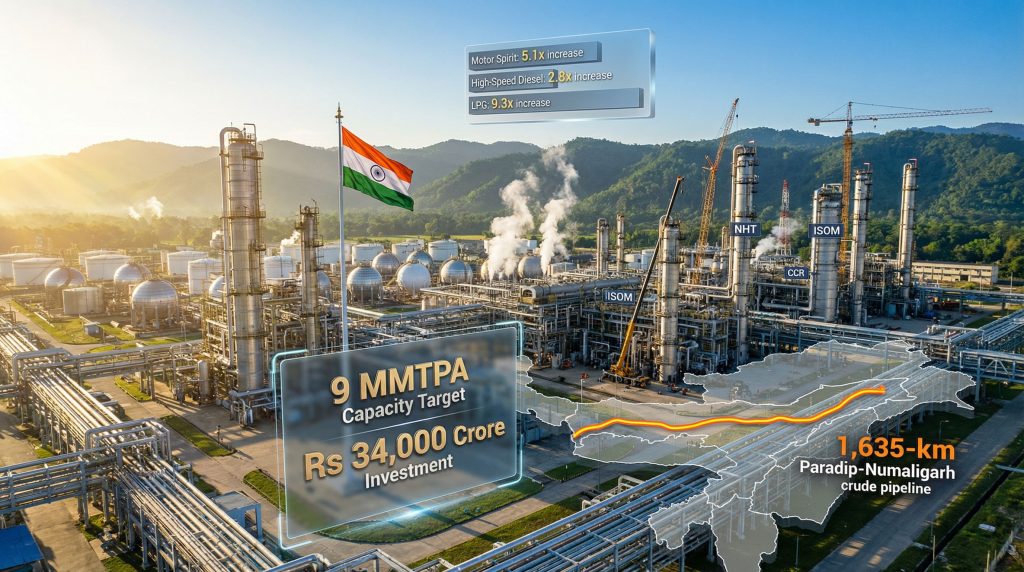
The Numaligarh Refinery expansion project represents a fundamental shift in India's northeastern energy landscape, transforming the facility from a regional processor into a nationally significant petroleum hub. Located in Golaghat district, Assam, this brownfield expansion project aims to triple processing capacity from 3 million metric tonnes per annum (MMTPA) to 9 MMTPA by December 2026.
The strategic importance extends beyond simple capacity metrics. Northeast India has historically depended on petroleum product transportation from refineries in western and southern regions, creating supply chain vulnerabilities and elevated distribution costs. The expanded facility addresses these constraints by establishing local processing capability that serves seven northeastern states directly.
Transportation economics favour the Numaligarh location due to direct pipeline connectivity with Paradip port on India's eastern coast. This 1,635-kilometre crude oil pipeline system with 9 MMTPA capacity eliminates traditional multi-modal transportation requirements while reducing per-barrel logistics costs significantly. Moreover, the infrastructure creates opportunities for cross-border trade with Bangladesh and Myanmar, potentially establishing India as a regional petroleum product supplier.
Geographic advantages include:
- Direct access to international crude oil markets through Paradip import terminal
- Proximity to emerging Southeast Asian energy markets
- Strategic positioning for military and civilian fuel security in border regions
- Natural pipeline routing through established industrial corridors
Financial Architecture and Cost Evolution Analysis
The Numaligarh Refinery expansion project demonstrates the financial complexities inherent in large-scale industrial infrastructure development. Original project estimates of ₹22,594 crore in 2019 have escalated to approximately ₹34,000 crore by February 2026, representing a cumulative increase of ₹11,307 crore over seven years.
| Timeline Phase | Approved Budget | Escalation Amount | Primary Factors |
|---|---|---|---|
| 2019 Launch | ₹22,594 crore | Baseline | Initial engineering estimates |
| November 2021 | ₹28,026 crore | ₹5,432 crore | Advanced technology adoption |
| February 2026 | ₹33,901 crore | ₹5,875 crore | COVID-19, monsoons, vendor rates |
Project financing follows a 70:30 debt-equity structure managed by a consortium of 12 banks led by State Bank of India. This financing model distributes risk across multiple financial institutions while maintaining manageable debt service requirements for NRL's operational cash flows, especially crucial given global oil production challenges affecting the energy sector.
Cost escalation factors reflect both external market conditions and project-specific challenges:
- COVID-19 disruptions: Pandemic-related delays affected construction schedules and material procurement timelines
- Regional weather impacts: Heavy monsoon seasons in Assam created site access difficulties and extended construction periods
- Vendor rate inflation: Procurement costs increased substantially due to supplier price adjustments across multiple equipment categories
- Technology enhancement: Advanced process unit specifications increased capital requirements beyond original estimates
"Project cost estimates and completion timelines are subject to further revision based on market conditions, regulatory approvals, and unforeseen operational challenges. Investors should consider potential additional escalations when evaluating project returns."
Production Capacity Transformation and Market Impact
The threefold capacity expansion creates dramatic shifts in individual product output volumes that will reshape regional fuel supply dynamics. Production increases vary significantly across different petroleum products, indicating strategic optimisation for specific market demands.
Detailed Product Output Analysis
Motor Spirit (Petrol) Production:
- Current output: 384 MMTPA
- Post-expansion target: 1,956 MMTPA
- Capacity multiplier: 5.1x increase
- Absolute volume addition: 1,572 MMTPA
High-Speed Diesel Production:
- Current output: 1,900 MMTPA
- Post-expansion target: 5,270 MMTPA
- Capacity multiplier: 2.8x increase
- Absolute volume addition: 3,370 MMTPA
Liquefied Petroleum Gas (LPG):
- Current output: 60 MMTPA
- Post-expansion target: 560 MMTPA
- Capacity multiplier: 9.3x increase
- Absolute volume addition: 500 MMTPA
The disproportionate LPG expansion reflects strategic targeting of rural household energy access improvements across northeastern states. With approximately 8-10 million additional household connections possible from 500 MMTPA increased production, the project addresses critical energy equity objectives.
Diesel production represents the largest absolute volume increase at 3,370 MMTPA, supporting agricultural mechanisation and industrial development requirements in the region. In addition, motor spirit increases approach the equivalent of an entirely new 1,572 MMTPA refinery, demonstrating the transformational scale of capacity enhancement.
Pipeline Infrastructure and Logistics Revolution
The integrated pipeline network represents one of India's most ambitious petroleum transportation projects, creating direct connectivity between eastern coast import facilities and northeastern distribution markets.
Critical Infrastructure Components
Crude Oil Transportation System:
- Pipeline length: 1,635 kilometres from Paradip to Numaligarh
- Capacity: 9 MMTPA crude oil throughput
- Geographic coverage: Five states across Eastern and Northeastern India
- Terminal facilities: 10 storage tanks of 60,000 cubic metres each at Paradip
Product Distribution Network:
- Pipeline length: 610 kilometres from Numaligarh to Siliguri
- Capacity: 5.5 MMTPA finished petroleum products
- Storage infrastructure: Three tanks each for diesel and petrol at Siliguri Marketing Terminal
- Market reach: North Bengal, Sikkim, and northern distribution corridors
The crude pipeline capacity of 9 MMTPA matches exactly with expanded refinery throughput requirements, indicating precise engineering coordination between transportation and processing capabilities. However, the product pipeline capacity of 5.5 MMTPA creates potential bottlenecking constraints that may require additional evacuation infrastructure as operations reach full capacity.
Storage infrastructure provides approximately 600,000 cubic metres of crude oil buffer capacity, equivalent to roughly four days of refinery operations at full throughput. Furthermore, this buffer enables operational flexibility during supply disruptions while maintaining consistent processing schedules.
Engineering challenges include terrain navigation across Eastern Ghats mountainous regions and Gangetic plains flood-prone areas. Consequently, pipeline routing requires specialised techniques for river crossings, geological fault zones, and environmentally sensitive areas throughout the five-state corridor.
Environmental Integration and Sustainability Framework
Modern refinery expansion projects must balance increased processing capacity with environmental stewardship requirements that align with national climate objectives and local air quality standards. For instance, the Numaligarh Refinery expansion project demonstrates how large-scale industrial developments can integrate with industry evolution trends towards sustainability.
What Green Technology Innovations Are Being Implemented?
NRL has established a comprehensive net-zero emissions roadmap targeting 2038 completion, representing a 12-year timeline from current baseline measurements. This commitment aligns with India's broader carbon neutrality objectives while addressing local environmental concerns.
Green Hydrogen Plant Specifications:
- Production capacity: 300 kilograms per hour
- Power requirement: 18 MW dedicated capacity
- Integration: Direct supply to refinery hydrotreating and hydrocracking processes
- Strategic alignment: National Green Hydrogen Mission compliance
Green hydrogen production addresses dual objectives by reducing external energy dependencies while supporting onsite catalytic processes that require high-purity hydrogen inputs. The 300 kg/hour production rate supplies approximately 0.2% of estimated total refinery energy requirements, indicating initial pilot-scale implementation with expansion potential.
Environmental management systems include:
- Waste heat recovery: Integration with existing process units for thermal efficiency optimisation
- Water treatment infrastructure: Closed-loop recycling systems to minimise freshwater consumption
- Air quality monitoring: Continuous emission tracking for urban proximity compliance
- Soil and groundwater protection: Containment systems for potential hydrocarbon releases
"Actual environmental performance depends on operational practices, regulatory compliance, and unforeseen technical challenges. Emissions reduction targets are projections subject to technological capabilities and regulatory requirements."
The next major ASX story will hit our subscribers first
Technical Execution Challenges and Timeline Risks
Large-scale refinery expansion requires simultaneous construction and operational activities that create complex coordination challenges affecting project completion schedules. Furthermore, these projects must adapt to evolving technological standards and regulatory requirements.
Current Progress Assessment
As of February 2026, project completion stands at 85% with ₹27,601 crore expenditure against the revised ₹33,901 crore budget. This progress rate indicates approximately 15% remaining scope requiring completion within 10 months to meet the December 2026 target timeline.
The original 2019 project announcement anticipated completion by approximately 2023, indicating 3+ years of timeline extension beyond initial estimates. Delays resulted from multiple factors including pandemic disruptions, monsoon construction constraints, and vendor procurement challenges.
Engineering Complexity Factors
Brownfield Construction Challenges:
- Maintaining 3 MMTPA operational capacity during construction activities
- Process unit integration requiring temporary shutdown coordination
- Safety protocols for construction activities near active petroleum processing
- Quality control systems for BS-VI fuel production standards implementation
Critical Technical Integration Points:
- Advanced process units: Naphtha hydrotreating (NHT), isomerisation (ISOM), continuous catalytic reforming (CCR)
- Residue upgradation facilities: Maximum crude oil utilisation optimisation
- Environmental compliance systems: Real-time monitoring and control integration
- Digital control systems: Automated process management for increased capacity
Weather-dependent construction scheduling presents ongoing risks, particularly during Assam's intensive monsoon periods that can halt outdoor activities for extended periods. Consequently, equipment procurement diversification strategies aim to reduce vendor-specific delays, while skilled workforce development programmes address specialised technical requirements.
Ownership Structure and Strategic Governance
NRL operates under a multi-stakeholder ownership model that influences project decision-making processes and strategic priorities across federal, state, and technical expertise dimensions.
Ownership Distribution:
- Oil India Limited: 69.63% controlling stake
- Assam Government: 26% regional development interest
- Engineers India Limited: 4.37% technical consulting contribution
Oil India's controlling position provides operational management authority while ensuring alignment with national petroleum policy objectives. The Assam Government's substantial minority stake reflects state-level economic development priorities and ensures regional benefit optimisation.
NRL's Navaratna status provides enhanced operational autonomy and investment decision-making capabilities compared to standard public sector enterprises. This designation enables faster procurement processes, international partnership opportunities, and strategic initiative implementations without extensive bureaucratic approvals.
Corporate Governance Framework:
- Public Investment Board oversight: Budget approval and milestone monitoring
- Ministry of Petroleum coordination: Policy alignment and regulatory compliance
- State infrastructure integration: Regional development project coordination
- Performance tracking systems: Financial, operational, and environmental metrics
The company maintains ₹5,000 crore authorised capital with ₹1,759 crore paid-up capital, indicating substantial expansion capacity for additional investment requirements or strategic initiatives beyond current project scope.
Regional Economic Development and Employment Impact
Major industrial projects create multiplier effects extending beyond direct operational activities to encompass broader regional economic transformation and workforce development opportunities.
Employment Generation Analysis
Direct Employment Creation:
- Construction phase workforce requirements across multiple specialised trades
- Operational staffing for tripled refinery capacity operations
- Technical management positions for advanced process unit operations
- Safety and environmental compliance specialised roles
Indirect Economic Opportunities:
- Transportation services for increased product distribution volumes
- Maintenance contracting for expanded facility infrastructure
- Vendor ecosystem development for operational supply requirements
- Service sector expansion supporting increased industrial activity
What Are the Economic Multiplier Effects?
Reduced fuel transportation costs benefit regional businesses through lower operational expenses, potentially improving industrial competitiveness across northeastern states. The infrastructure development creates opportunities for additional petrochemical investments, including the planned 360 KTPA polypropylene project valued at ₹7,231 crore.
Tax revenue generation provides Assam state government with increased funding for public infrastructure and social development programmes. Furthermore, the strategic location enables potential industrial cluster development around the expanded refinery complex, creating synergistic business opportunities.
National Energy Security Integration
The Numaligarh Refinery expansion project aligns with India's comprehensive energy security strategy addressing import dependency reduction, regional supply chain resilience, and strategic petroleum reserve optimisation.
Policy Framework Alignment
Hydrocarbon Vision 2030 Integration:
- Domestic refining capacity enhancement contributing to national targets
- Regional fuel self-sufficiency improvement for strategically sensitive border areas
- Import dependency reduction through increased processing capability
- Strategic petroleum reserves coordination with national stockpiling objectives
Geopolitical Considerations:
- Northeast region connectivity to national energy distribution grid
- Border area energy security enhancement for military and civilian requirements
- Crude oil supplier diversification through Paradip import terminal capabilities
- Regional cooperation frameworks with Bangladesh and Myanmar energy sectors
The facility's strategic positioning enables rapid fuel supply to military installations across northeastern border regions, supporting national defence infrastructure requirements. In addition, cross-border energy trade opportunities could establish India as a regional petroleum product supplier while generating foreign exchange revenue.
Future Expansion Pathways and Technology Integration
The completed refinery expansion creates a foundation for additional value-added industrial development that could establish northeastern India as a comprehensive petrochemical manufacturing hub. These developments require sophisticated investment strategy components to ensure optimal resource allocation.
Petrochemical Integration Opportunities
Planned Development Projects:
- Polypropylene production: 360 KTPA capacity requiring ₹7,231 crore investment
- Downstream chemical manufacturing: Plastic and polymer production capabilities
- Value-added product development: Specialised chemical compounds for regional industrial requirements
- Export market targeting: Southeast Asian chemical demand fulfilment
Technology Advancement Initiatives:
- Digital refinery management: Artificial intelligence optimisation for process efficiency improvement
- Renewable energy integration: Solar and wind power supplementation for operational requirements
- Carbon capture research: Technology development for emissions reduction enhancement
- Advanced materials processing: High-value specialty chemical production capabilities
The integrated approach positions NRL for transition from traditional petroleum refining toward advanced chemical manufacturing that generates higher profit margins while supporting India's industrial diversification objectives. Moreover, this transformation reflects broader trends in how refinery operations are evolving to meet changing market demands.
"Future expansion projects are subject to market conditions, regulatory approvals, technological feasibility, and financing availability. Projected returns and completion timelines represent estimates that may require revision based on operational experience and market developments."
Industrial cluster development around the expanded facility could attract international petrochemical companies seeking regional manufacturing bases, creating additional employment opportunities and technology transfer benefits for northeastern India's industrial ecosystem.
Looking for Opportunities in India's Expanding Energy Infrastructure?
Discovery Alert's proprietary Discovery IQ model delivers real-time alerts on significant mineral discoveries, instantly empowering subscribers to identify actionable opportunities ahead of the broader market. Begin your 14-day free trial today and secure your market-leading advantage.