
June 25, 2026
The Permit Gauntlet: Why Arctic Copper Projects Face a Different Set of Rules
Building a copper mine anywhere in the world is a long game. Building one above the Arctic Circle, in a jurisdiction with some of the world's most rigorous environmental standards and a legally protected Indigenous population, is something else entirely. The regulatory journey for Nussir mine permits and contractors typically spans years rather than months, involving overlapping legal frameworks, community consultation requirements, and sequential permit approvals that must each survive political and legal challenge before construction can begin in earnest.
This is precisely the context in which the Nussir copper-silver-gold mine in Arctic Norway now finds itself at an inflection point. With a full suite of primary permits secured and major contractors appointed, the project has crossed a threshold that few Arctic mining developments reach. Understanding what that means, and what still lies ahead, requires a close look at the permits, the people behind the construction, and the pressures that continue to shape the project's path forward.
When big ASX news breaks, our subscribers know first
What Makes Nussir Strategically Significant Beyond Its Ore Body
Copper is not a commodity that politely waits for permitting systems to resolve themselves. Global refined copper demand is projected to rise substantially through the 2030s, driven by electrification infrastructure, EV battery systems, and grid expansion. Meanwhile, the copper supply crunch remains a persistent concern, with major copper discoveries becoming rarer and average ore grades at producing mines declining globally over recent decades.
Europe sits in a particularly exposed position. The continent consumes significant volumes of refined copper but produces a fraction of what it needs domestically. The EU's Critical Raw Materials Act, which formally designated copper as a strategic raw material, has sharpened political attention on projects capable of shortening that dependency. Furthermore, Europe's critical minerals supply chain is under increasing scrutiny, making Nussir — located in Repparfjord, Finnmark County in northern Norway — one of the few undeveloped copper deposits in the European Arctic that has reached construction-ready status.
The project is owned by Blue Moon Metals, a Toronto-headquartered company, and the deposit carries copper as its primary commodity alongside silver and gold as economically meaningful co-products. The polymetallic nature of the ore body improves the project's unit economics, since revenues from silver and gold effectively reduce the net cost of copper production — a structural advantage in a commodity cycle where the copper price forecast remains sensitive to macroeconomic conditions.
Nussir Mine Permits and Contractors: The Full Regulatory Picture
Four Primary Approvals and What Each One Covers
Norwegian mining law requires operators to navigate a multi-agency approval process before any extraction can legally proceed. For Nussir, that process has now been completed across four distinct permit categories:
| Permit Type | Issuing Authority | Status as of Mid-2026 |
|---|---|---|
| Operating License | Norwegian Directorate of Mines | Approved |
| Extraction Permit | Norwegian Ministry of Trade, Industry and Fisheries | Upheld on final appeal, Q2 2026 |
| Environmental Permit | Norwegian Environment Agency | Approved |
| Zoning Plan | Municipal and Regional Authority | Approved |
Each of these approvals addresses a distinct dimension of the project's legal standing. The Operating License establishes the right to conduct mining activity on the specific tenement. The Extraction Permit governs the volumes and methods of resource removal. The Environmental Permit sets the parameters for how the mine manages its ecological footprint. The Zoning Plan confirms that land use at the site is legally consistent with regional planning frameworks.
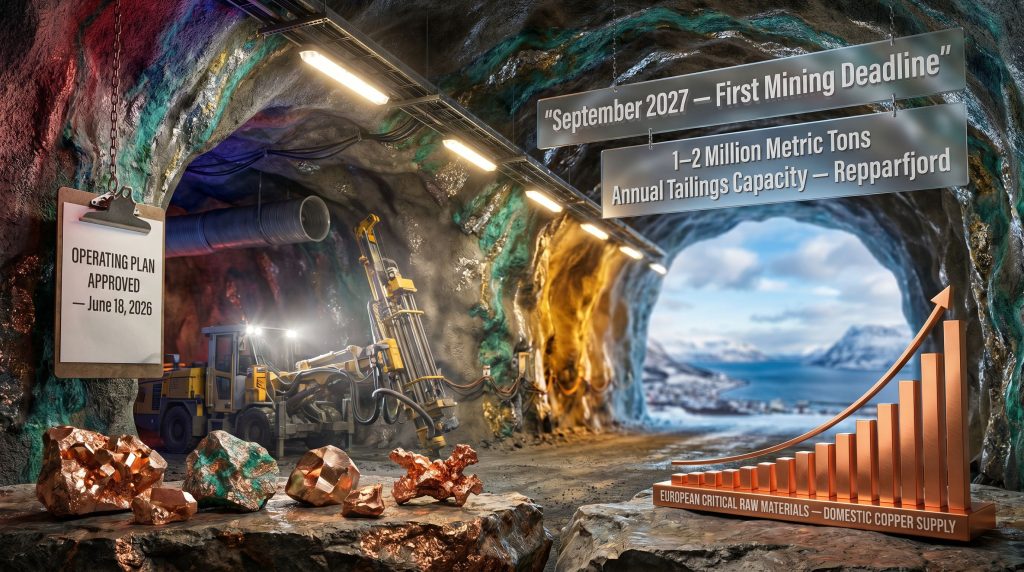
The June 18, 2026 Operating Plan Approval
On June 18, 2026, the Norwegian Directorate of Mines granted formal approval of Blue Moon Metals' updated operating plan for the Nussir project. This document is more than an administrative formality. An operating plan in the Norwegian system covers the full technical architecture of how a mine will function, including extraction sequences, ore processing specifications, safety protocols, and the eventual rehabilitation of the site at closure.
Critically, approval of the operating plan served as the final gateway to unrestricted construction mobilisation. Without it, contractors working on site would be operating under regulatory uncertainty, which carries both legal and financial risk. The June 18 approval removed that ambiguity and gave the project a clean regulatory foundation for the construction phase — a milestone comparable in significance to completing a definitive feasibility study in terms of investor confidence.
Mine Waste Management and the Repparfjord Tailings Decision
One of the most technically and politically significant permit decisions involved the Mine Waste Management Plan, which was approved by the Norwegian Environment Agency in Q2 2026. This approval included an amendment to the original 2016 Discharge Permit, authorising the placement of between one and two million metric tons of mine tailings per year into Repparfjord through a submarine tailings disposal system.
Submarine tailings disposal, or STD, is a method used in select coastal and fjord mining operations where tailings are piped to depth in adjacent water bodies rather than stored in conventional surface impoundments. Proponents argue that in deep, cold-water fjord environments with limited benthic biodiversity at the target depths, the ecological impact can be comparable to or lower than surface tailings storage under certain conditions. Critics contest this assessment, and the Repparfjord disposal plan has been the focal point of sustained environmental and Indigenous opposition to the project.
The permit amendment carries monitoring obligations that will require ongoing environmental data collection throughout the life of the mine, including assessment of sediment dispersal, water column impacts, and effects on fish populations within Repparfjord.
The approval of submarine tailings disposal into Repparfjord remains the single most contested technical decision in the Nussir permitting history. It has been the catalyst for much of the ongoing opposition from Sámi reindeer herding communities and environmental organisations.
The Final Appeal: What Its Resolution Means
The Extraction Permit was subject to a formal appeal process that was resolved by Norway's Ministry of Trade, Industry and Fisheries in Q2 2026. The ministry upheld the permit, effectively clearing the last major legal barrier that opponents of the project had been able to engage through the regulatory system. This outcome does not preclude future legal action through Norwegian courts, but it represents the exhaustion of the primary administrative appeal pathway.
MOMEK Services AS: The EPC Contractor Appointed for Processing
What an EPC Structure Means in Practice
Engineering, Procurement, and Construction contracts place a single entity responsible for the integrated delivery of a facility from design through to operational handover. In greenfield mining contexts, and particularly in remote or Arctic environments, this structure is preferred because it reduces the coordination risk between separate design, supply, and construction firms. A single contractor carries accountability for schedule and cost performance across all three phases.
Blue Moon Metals appointed MOMEK Services AS, a member of the MOMEK Group, as EPC contractor for the Nussir processing plant. The scope of this contract spans:
- Civil and structural engineering works
- Mechanical systems installation, including crushing, grinding, and flotation circuit infrastructure
- Piping and process fluid management systems
- Integration with the broader site infrastructure at Repparfjord
MOMEK Group is a Norwegian industrial services company with a track record in demanding industrial environments across the country's north. For Arctic mining projects, the selection of a contractor with existing operational presence in northern Norway is strategically important. Supply chain logistics, subcontractor networks, and familiarity with seasonal construction constraints in Finnmark are all factors that affect delivery risk in ways that are difficult to price from a distance.
The Underground Mining Contractor Search
While the processing plant EPC contract has been awarded, the selection of the underground mining contractor was still in progress as of mid-2026. Underground copper mining in a sub-Arctic environment requires a contractor with specific capabilities in mechanised hard rock extraction, ground support management in potentially challenging geological conditions, and the ability to maintain operational continuity through the extreme weather variability of the Finnish-Norwegian Arctic winter.
Blue Moon Metals has structured its approach around a dedicated Mine Manager role, whose function is to oversee contractor performance, manage cost control disciplines, and ensure that underground operations integrate effectively with surface processing. This model is common in mid-tier mining projects where the owner maintains operational oversight without self-performing the technically specialised underground work.
The September 2027 deadline for first mining activity places real urgency on finalising this appointment. Contractor mobilisation in remote Arctic locations typically requires six to twelve months of preparation, including equipment procurement, personnel recruitment, and site establishment. Consequently, every month of delay in awarding the underground contract compresses the buffer between mobilisation completion and the regulatory deadline.
Construction Timeline and the September 2027 Regulatory Deadline
The construction sequence for the Nussir mine follows a phased structure:
- 2025: Pre-construction underground drilling campaign initiated, with a US$30 million budget allocated to reserve conversion drilling and site preparation activities.
- April 2026: Official commencement of full mine construction following resolution of the permit appeal process.
- June 18, 2026: Formal approval of the updated operating plan by the Norwegian Directorate of Mines.
- Q2 2026: Mine Waste Management Plan approved and amended Discharge Permit issued by the Norwegian Environment Agency.
- September 2027: Hard regulatory deadline for first mining activity to preserve operating licence validity.
The September 2027 mining commencement requirement is a non-negotiable licence condition. Missing this deadline would not simply delay the project; it would require Blue Moon Metals to re-engage the Norwegian regulatory system from a materially weakened position, with significant cost and timeline consequences.
The Mid-June 2026 Tunnel Work Suspension
In mid-June 2026, tunnel work at the Nussir site was temporarily suspended following permit compliance questions raised by the Fiettár reindeer grazing district and environmental advocacy organisations. The suspension lasted only days, with operations resuming on June 18, 2026 — the same date as the operating plan approval — following formal regulatory clarifications from the relevant Norwegian authorities.
While brief, this episode is instructive. It demonstrates that even a fully permitted Arctic mining project operates within a stakeholder environment capable of triggering operational interruptions through procedural channels. For contractors and investors, this highlights the value of maintaining active regulatory relationships and rapid-response protocols rather than treating permit approval as a definitive endpoint.
Sámi Opposition and the Social Licence Dimension
A Dispute That Predates 2026
The Norwegian government issued the original operating permit for the Nussir project in 2019. What followed was a sustained period of legal and political contestation driven primarily by Sámi Indigenous communities and reindeer herding collectives operating in Finnmark. Their objections have remained consistent across this period and centre on three interconnected concerns:
- The mine's infrastructure and associated human activity would disrupt traditional reindeer migration corridors that cross the Repparfjord area — corridors that have been used for generations and carry cultural as well as economic significance for Sámi pastoral communities.
- Submarine tailings disposal into Repparfjord poses risks to the fjord's marine ecosystem, including Atlantic salmon populations that are both ecologically and culturally important to Sámi communities.
- The permitting process, in their assessment, failed to satisfy Norway's obligations under ILO Convention 169 concerning Indigenous and Tribal Peoples, which requires free, prior, and informed consent as a standard for decisions affecting Indigenous lands and resources.
Norway ratified ILO Convention 169 in 1990, making it one of the few countries globally to have done so. The Convention creates legally enforceable consultation requirements that go beyond standard public comment processes. The question of whether consultation was conducted to the required standard has been a persistent point of contention throughout the Nussir mine permits and contractors approval history.
Regulatory Approval Versus Social Licence
It is important to distinguish between holding regulatory permits and holding a social licence to operate. These are not the same thing, and in jurisdictions with legally recognised Indigenous rights — where mining claims and Indigenous rights frequently intersect — the gap between them can become a material operational risk.
ESG-focused investors and institutional lenders increasingly treat unresolved Indigenous opposition as a quantifiable risk factor rather than a reputational footnote. In the context of Nussir, the ongoing objections from Sámi communities, particularly the Fiettár district's permit compliance query in June 2026, signal that social licence pressure will continue irrespective of the regulatory permit stack.
Comparative experience from other Arctic mining jurisdictions reinforces this point. Projects in northern Canada and Greenland that proceeded without meaningful Indigenous consent have encountered work stoppages, legal injunctions, and financing withdrawal in later project stages — sometimes after substantial capital had already been deployed.
The next major ASX story will hit our subscribers first
Financing the Nussir Build: Capital Structure and Risk Exposure
Funding Position as of Mid-2026
Blue Moon Metals has indicated that the project is fully funded through existing cash reserves as of mid-2026, with a US$30 million pre-construction budget covering the 2025 drilling campaign and early site works. The company also holds a Hartree standby credit facility, which provides financial flexibility for construction expenditure without requiring immediate equity dilution or debt drawdown.
Standby credit facilities of this type function as a contingency buffer rather than a primary funding mechanism. They allow a project company to manage payment timing for contractors and suppliers without needing to match capital raising cycles to construction cash flow requirements.
Key Financial Risk Variables
Several financial risk factors deserve attention from a project economics perspective:
- Regulatory deadline exposure: Failure to meet the September 2027 mining commencement requirement would generate costs associated with re-permitting, potential contractor demobilisation, and reputational impact on future financing.
- Secondary permit dependencies: Not all operational permits for the full mine life have been finalised. Phased approvals create cost uncertainty in later construction stages.
- Copper price sensitivity: The project's economic returns are primarily leveraged to copper prices. Co-product revenues from silver and gold provide partial insulation, however a sustained decline in copper prices would affect project net present value and potentially the terms on which future project finance could be arranged.
- Arctic cost premiums: Construction in Finnmark carries meaningful cost premiums relative to temperate mining jurisdictions, including higher logistics costs, seasonal construction windows, and labour market constraints in a remote region.
Norway's Position in Europe's Copper Supply Chain
Norway has historically been a relatively modest contributor to European hard rock mining output compared to Finland and Sweden, both of which have established copper and base metals mining sectors. The Nussir project, if it reaches production, would mark a meaningful expansion of Norway's role as a domestic minerals producer within the European context.
Copper's classification as a critical raw material under EU policy creates a favourable macro backdrop for European production projects broadly, though this framework does not translate into project-specific support or preferential treatment in permitting processes. The value lies in political attention to supply chain resilience, which can facilitate financing conversations and offtake discussions with European industrial buyers.
For the broader European copper supply chain, Nussir's projected output — while not transformative at the continental scale — represents incremental domestic production capacity that would otherwise need to be sourced from Chile, Peru, the Democratic Republic of Congo, or other distant origins with their own geopolitical and supply chain risk profiles.
Frequently Asked Questions: Nussir Mine Permits and Contractors
What permits does the Nussir mine currently hold?
The project holds four primary approvals: an Operating Licence from the Norwegian Directorate of Mines, an Extraction Permit upheld on final appeal in Q2 2026, an Environmental Permit from the Norwegian Environment Agency, and an approved Zoning Plan. The updated operating plan received formal approval on June 18, 2026.
Who is the EPC contractor for the Nussir processing plant?
MOMEK Services AS, part of the Norwegian MOMEK Group, was appointed as EPC contractor in 2026. The scope covers civil and structural works, mechanical systems, and piping infrastructure for the processing plant.
When did construction officially begin?
Full mine construction commenced in April 2026, following the resolution of the Extraction Permit appeal by Norway's Ministry of Trade, Industry and Fisheries.
What is the hard deadline for mining to begin?
Blue Moon Metals must initiate active mining operations by September 2027 to preserve the validity of its operating licence under Norwegian mining law.
What happened during the mid-June 2026 tunnel suspension?
Tunnel operations were briefly paused after the Fiettár reindeer grazing district and environmental groups raised permit compliance questions. Work resumed on June 18, 2026, following clarifications from the relevant Norwegian regulatory authorities.
What does the tailings plan involve?
The Norwegian Environment Agency approved an amendment to the 2016 Discharge Permit, authorising the placement of one to two million metric tons of mine tailings annually into Repparfjord via submarine tailings disposal, subject to ongoing environmental monitoring obligations.
Who opposes the project?
Sámi Indigenous communities, particularly reindeer herding groups in Finnmark including the Fiettár grazing district, have consistently opposed the project on grounds related to cultural rights, reindeer migration disruption, and ecological concerns about the Repparfjord tailings disposal plan. In addition, broader environmental organisations continue to contest the nussir mine permits and contractors approval framework on ecological grounds.
Want to Track the Next Major Mineral Discovery Before the Market Does?
Discovery Alert's proprietary Discovery IQ model delivers real-time alerts the moment significant ASX mineral discoveries are announced, transforming complex data across more than 30 commodities into clear, actionable insights for both traders and long-term investors — start your 14-day free trial today and see why historic discoveries like those made by De Grey Mining and WA1 Resources have generated substantial returns for those positioned early.