July 23, 2026
Why Copper Is the Real Engine Behind Zambia's Inflation Miracle
Most conversations about inflation in developing economies begin and end with monetary policy. Central banks raise rates, credit tightens, demand cools, and prices eventually follow. It is a clean narrative, and it is frequently wrong. Zambia's experience over the first half of 2026 offers a far more instructive story about how commodity wealth, currency dynamics, and agricultural cycles can combine to produce macroeconomic outcomes that no interest rate decision alone could have engineered.
The Zambia inflation rate falls to lowest level in 8 years story is not simply a triumph of central banking. It is a case study in how a resource-rich frontier economy can transition from crisis to stability when multiple structural variables align simultaneously, and what happens when they threaten to diverge again.
When big ASX news breaks, our subscribers know first
The Disinflation Trajectory: Six Months That Rewrote the Narrative
To appreciate the scale of what has occurred, it helps to recall where Zambia stood not long ago. During the severe drought of 2024, the country's consumer price index climbed to approximately 16%, driven by catastrophic maize harvest failures and a sharply depreciating Kwacha. The combination of food scarcity and currency weakness created a textbook inflationary spiral that compressed household purchasing power across the income spectrum.
The reversal since then has been remarkable in both speed and breadth. The following table maps the compression trajectory across the first half of 2026:
| Month | Inflation Rate | Primary Driver |
|---|---|---|
| December 2025 | 11.2% | Residual drought-related food price elevation |
| January 2026 | 9.4% | First single-digit reading since 2023 |
| February 2026 | 7.5% | Kwacha appreciation, early harvest improvements |
| April 2026 | 6.8% | Monetary policy transmission beginning to take hold |
| May 2026 | 6.6% | Lowest reading since February 2018 |
| June 2026 | 6.5% | New 8-year low confirmed |
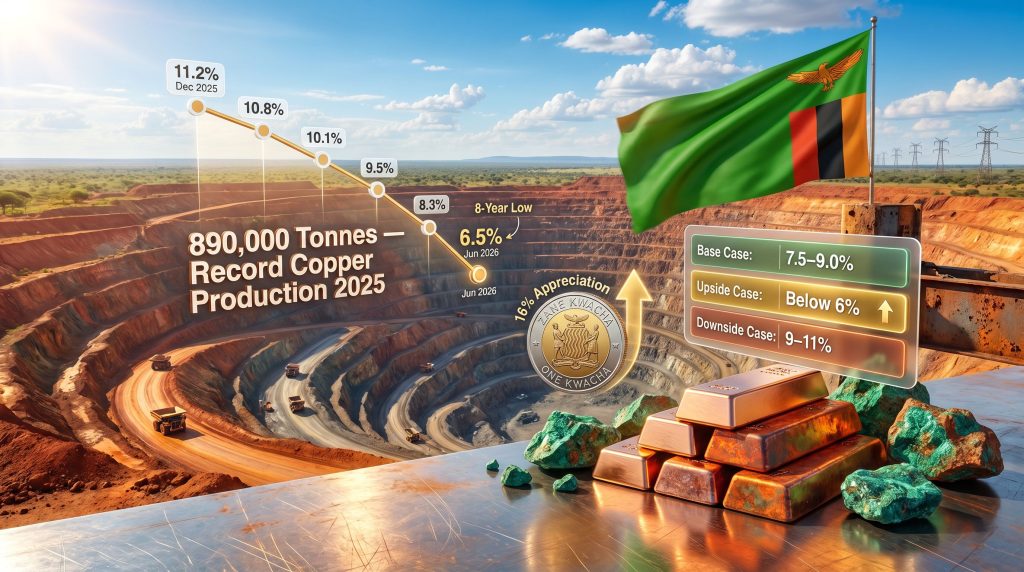
In aggregate, Zambia's inflation rate declined by approximately 30.9% in relative terms over just six months, compressing from 11.2% in December 2025 to 6.5% by June 2026. That rate of disinflation is rarely observed outside of IMF-assisted stabilisation programmes, and it demands explanation beyond the surface narrative.
Three Structural Forces Converging at Once
The speed of this shift reflects the simultaneous operation of three distinct structural forces, each reinforcing the others:
-
Currency appreciation: The Zambian Kwacha strengthened by approximately 16% against the U.S. dollar, directly reducing the domestic cost of imported goods ranging from fuel to manufactured inputs. For an import-dependent economy, exchange rate gains function as an immediate price suppressor across multiple CPI components.
-
Agricultural recovery: A strong maize harvest season reversed the acute food supply shock that had driven inflation toward 16% during the drought cycle. Food represents a disproportionately large share of Zambia's consumer price basket, meaning agricultural normalisation carries outsized CPI weight.
-
Energy and commodity input costs: Reduced global oil prices and stabilising electricity supply costs contributed to easing non-food components of inflation, compounding the disinflationary momentum from the other two factors.
What makes this convergence analytically significant is that none of these three forces is primarily a product of monetary tightening. Each originates outside the direct control of the Bank of Zambia, which raises important questions about the durability of the trend.
Is Zambia's Inflation Now Where Its Central Bank Wants It?
The Bank of Zambia operates with an official inflation target corridor of 6% to 8%. At 6.5% in June 2026, Zambia's consumer price index now sits within that band for the first time in several years, representing a genuine policy milestone rather than a cosmetic one. Furthermore, according to World Bank CPI data for Zambia, this represents one of the most significant sustained improvements in price stability the country has recorded in recent decades.
The central bank demonstrated its institutional confidence in the improving trajectory by cutting its Monetary Policy Rate to 13.25% in April 2026. While that rate remains elevated by historical standards, the direction of travel matters as much as the absolute level. A policy rate reduction signals that the monetary authority considers the disinflationary trend durable rather than transient.
Month-on-Month vs. Year-on-Year: Reading Between the Numbers
Two distinct inflation metrics are worth separating here, because each tells a different story:
-
Year-on-year CPI came in at 6.5% in June 2026, down from 6.6% in May, confirming the continuation of the annual trend.
-
Month-on-month prices advanced by just 0.1%, indicating near-complete price stability at the transactional level in the most recent period.
The month-on-month reading is arguably more important for forward-looking analysis. Base-effect distortions can make year-on-year figures appear favourable even when underlying price pressures are rebuilding. A 0.1% monthly advance suggests that the disinflation is structural rather than optically driven, with genuine price moderation occurring at the ground level of the economy.
The Bank of Zambia cited favourable maize harvests and stable foreign exchange inflows as central justifications for its April 2026 rate reduction, highlighting how agricultural output and currency management function as the twin pillars of Zambia's price stability architecture. (Bloomberg, June 2026)
Copper: The Commodity Beneath the Macroeconomic Story
No analysis of Zambia's economic condition is complete without a deep examination of copper, because the metal is not simply one sector among many. It is the structural foundation upon which the entire macroeconomic recovery rests. Indeed, the critical minerals demand driven by the global energy transition has elevated copper's strategic importance beyond anything previously seen.
Zambia and the Democratic Republic of Congo collectively hold the largest copper reserves on the African continent, a geological endowment that has taken on dramatically increased geopolitical and commercial significance in the context of the global energy transition. Electric vehicles require roughly 2.5 to 4 times more copper per unit than conventional internal combustion vehicles. Grid infrastructure upgrades, renewable energy installations, and data centre buildout are all intensely copper-dependent. This structural demand shift has transformed Zambia's resource position from a legacy industrial commodity story into a critical minerals narrative.
Production Records and the Road to One Million Tonnes
Zambia produced a record 890,000 tonnes of copper in 2025, placing the country within striking distance of the government's near-term production threshold. The zambia copper production growth trajectory reflects an industry undergoing serious operational scaling. The current national target is to surpass one million tonnes of annual output by 2026, with a longer-term ambition to triple that figure to three million tonnes by 2031.
The export trajectory reinforces the production momentum. According to Zambian government data, refined copper exports for the January to February 2026 period reached 155,300 metric tonnes, compared to 140,000 metric tonnes for the same period in 2025, representing a 10.9% year-on-year increase. That is not a marginal improvement; it reflects meaningful operational scaling at the mine and refinery level.
The Copper-Kwacha-Inflation Nexus: How the Loop Works
Understanding why copper matters so directly to inflation requires tracing the transmission mechanism:
-
Rising copper export volumes generate increased hard currency inflows, primarily in U.S. dollars.
-
Greater dollar supply in the domestic foreign exchange market supports Kwacha appreciation.
-
A stronger Kwacha reduces the local currency cost of imports, including food, fuel, and manufactured goods.
-
Lower import costs translate directly into reduced consumer price pressures across multiple CPI components.
-
Stable prices reinforce consumer confidence and reduce inflationary expectations, creating a self-sustaining cycle.
This is the commodity-currency-inflation nexus that distinguishes Zambia's disinflation from a conventional monetary policy success story. The central bank has been an important actor, but it has largely been managing the benefits of a copper-driven external balance improvement rather than generating the stabilisation through interest rate tools alone. The copper price drivers underpinning this dynamic are rooted in structural global demand rather than short-term speculation.
Is This Recovery Built to Last?
The more sceptical interpretation of Zambia's economic turnaround centres on vulnerability concentration. When a single commodity is responsible for driving currency stability, suppressing import inflation, funding fiscal consolidation, and attracting foreign investment simultaneously, the entire architecture rests on conditions that can shift rapidly and without warning.
Risk Factors That Deserve Serious Attention
-
Copper price volatility: Global copper prices are subject to swings driven by Chinese industrial demand, U.S. dollar movements, and speculative positioning in commodity markets. A sustained price correction of 20% or more could meaningfully weaken the Kwacha and reignite import inflation within a matter of quarters.
-
Agricultural and climate exposure: The 2024 drought demonstrated with brutal clarity how quickly food inflation can destabilise an otherwise improving CPI trajectory. El Niño and La Niña cycles affect Southern African rainfall with increasing unpredictability, meaning Zambia's agricultural sector carries persistent systemic risk.
-
Debt sustainability: Zambia's post-sovereign default debt restructuring process is ongoing, and maintaining creditor confidence is essential for continued access to external financing on reasonable terms. Slippage on fiscal targets could rapidly reverse the macroeconomic gains achieved.
-
Economic concentration risk: The copper dependency that currently drives the recovery is also the economy's greatest long-term structural vulnerability. Diversification into manufacturing, services, and value-added mineral processing remains aspirational rather than embedded.
Scenario Analysis: What Copper Price Movements Mean for Inflation
| Scenario | Copper Price Direction | Projected Kwacha Movement | Inflation Outlook |
|---|---|---|---|
| Base Case | Stable to moderate growth | Kwacha holds within 6-8% appreciation band | Inflation remains within 6-8% target |
| Upside Case | Strong demand from EV and grid buildout | Kwacha appreciates further | Inflation potentially falls below 6% |
| Downside Case | Global demand slowdown or price correction | Kwacha depreciates 10-15% | Inflation could rebound toward 9-11% |
Note: Scenario projections are analytical estimates based on commodity-currency transmission modelling and should not be interpreted as financial forecasts. Actual outcomes will depend on a wide range of macroeconomic variables.
How Zambia Stacks Up Against Regional Peers
Zambia's 6.5% inflation rate in June 2026 positions it among the more price-stable economies across Sub-Saharan Africa, a region where elevated inflation has remained stubbornly persistent for many countries. Ghana, which experienced its own debt restructuring process in recent years, has faced more entrenched inflationary dynamics despite significant monetary tightening. Ethiopia has dealt with conflict-related supply disruptions compounding underlying price pressures.
The differentiating factor in Zambia's case is the nature of its primary export commodity. Copper, as a transition-critical metal with robust and growing industrial demand from the clean energy sector, provides a more durable terms-of-trade tailwind than traditional agricultural commodity exporters or oil-dependent economies facing energy transition headwinds. In addition, the copper supply crunch that analysts have forecast for the coming decade positions Zambia advantageously as a major producer.
There is also a broader lesson embedded in Zambia's trajectory for development economists and multilateral institutions designing recovery frameworks for commodity-dependent frontier markets. The evidence from 2024 to 2026 suggests that anchoring currency stability through commodity export earnings can be a more rapid disinflation mechanism than monetary tightening alone, particularly in economies where credit channels are shallow and interest rate transmission is incomplete.
This does not make monetary policy irrelevant. The Bank of Zambia's rate decisions and its management of foreign exchange reserves have been important supporting elements. However, the primary engine of disinflation has been external rather than domestic in origin, which means sustainability depends heavily on factors beyond the central bank's control. Furthermore, India's copper investment in Zambia signals that international confidence in Zambia's copper-backed recovery story is growing.
The next major ASX story will hit our subscribers first
Frequently Asked Questions: Zambia's Inflation Rate and Economic Recovery
What is Zambia's current inflation rate in 2026?
Zambia's inflation rate reached 6.5% in June 2026, its lowest point since early 2018 and an 8-year low, following a sustained decline from 11.2% recorded in December 2025.
Why has Zambia's inflation fallen so rapidly?
The primary drivers are a 16% appreciation of the Zambian Kwacha against the U.S. dollar, stronger agricultural harvests reducing food price pressures, lower global energy costs, and increased copper export revenues strengthening foreign exchange inflows.
Is Zambia's inflation within the central bank's target range?
Yes. The Bank of Zambia's official target corridor is 6% to 8%. At 6.5%, Zambia's inflation now sits comfortably within that band for the first time in several years.
What role does copper play in Zambia's economic recovery?
Copper drives foreign exchange earnings, supports the Kwacha's exchange rate, and indirectly suppresses import-driven inflation. Record production of 890,000 tonnes in 2025 and a 10.9% rise in refined copper exports in early 2026 have been central to the stabilisation process.
What are Zambia's copper production targets?
The government is targeting output exceeding one million tonnes by 2026 and has set an ambitious long-term goal of three million tonnes annually by 2031, supported by international investment attraction efforts.
What was Zambia's inflation rate during its worst recent period?
During the 2024 drought, inflation climbed to approximately 16%, driven by food supply shortages and currency depreciation. The Zambia inflation rate falls to lowest level in 8 years milestone, achieved within roughly 18 months of that peak, represents an exceptional macroeconomic turnaround by any regional benchmark.
Key Takeaways: What Zambia's Milestone Means in Strategic Context
-
Zambia's June 2026 inflation reading of 6.5% marks an 8-year low, restoring price conditions not seen since before the COVID-19 pandemic era.
-
The disinflation was driven by a convergence of currency strength, agricultural recovery, and copper export momentum, rather than monetary tightening alone.
-
The Bank of Zambia's decision to cut its policy rate to 13.25% signals institutional confidence in the trajectory's durability.
-
Copper production ambitions targeting 1 million tonnes in 2026 and 3 million tonnes by 2031 position Zambia as an increasingly significant node in the global energy transition supply chain.
-
Key structural risks remain, centred on commodity price volatility, climate-driven agricultural shocks, debt sustainability, and the long-term imperative of economic diversification beyond copper.
-
For investors and development economists, Zambia's recovery offers a replicable analytical framework for evaluating commodity-backed stabilisation in frontier market economies.
This article is intended for informational purposes only and does not constitute financial or investment advice. Forward-looking statements, scenario projections, and economic forecasts involve inherent uncertainty and should not be relied upon as predictions of actual outcomes.
Want to Track the Next Major Copper Discovery Before the Market Does?
Discovery Alert's proprietary Discovery IQ model delivers real-time alerts the moment significant copper and critical mineral discoveries are announced on the ASX, turning complex geological data into actionable investment insights — explore historic discovery returns on the Discovery Alert discoveries page to see what early positioning in major finds has historically meant for investors, and begin your 14-day free trial at Discovery Alert to ensure you're never the last to know.