August 14, 2026
The intersection of artificial intelligence and energy infrastructure has reached a critical inflection point, with nvidia backs nuclear power for ai data centers becoming a pivotal development. As machine learning workloads consume exponentially more electricity, traditional grid systems struggle to meet the relentless demand for baseload power. This energy bottleneck threatens to constrain the next phase of AI development, forcing technology leaders to explore unconventional solutions that can deliver reliable, carbon-neutral electricity at unprecedented scales.
Recent market movements underscore this urgency, with nuclear energy stocks experiencing dramatic surges as investors recognise atomic power's unique capacity to support AI's 24/7 computational requirements. Furthermore, the convergence of artificial intelligence and nuclear technology represents more than a temporary market trend; it signals a fundamental restructuring of how digital infrastructure will be powered in the coming decades.
The Energy Crisis Behind AI's Exponential Growth
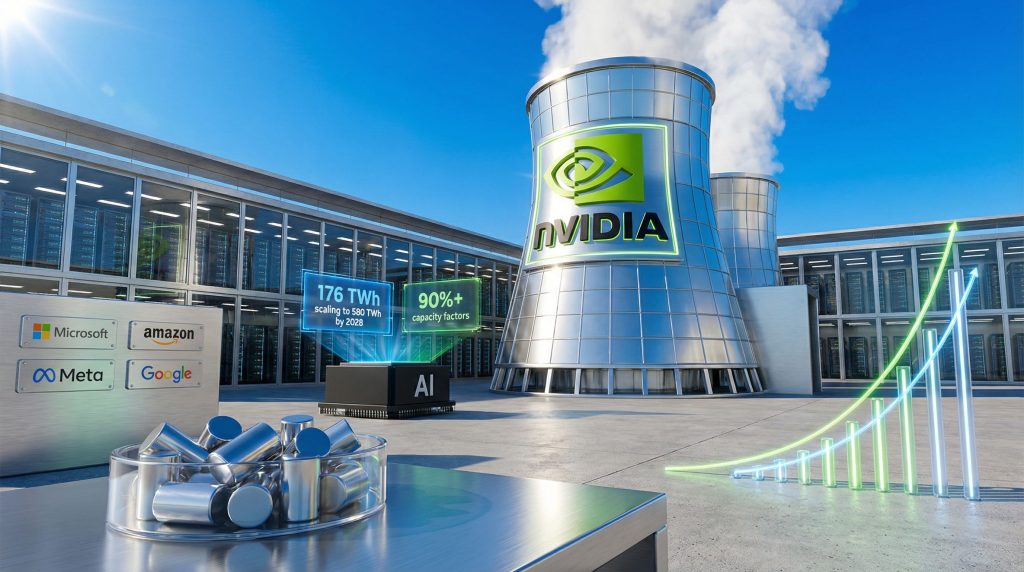
The mathematics of AI energy consumption reveal a sobering trajectory that current electrical grids cannot sustain. According to U.S. Department of Energy projections, American data centres consumed 176 terawatt-hours of electricity in 2023, representing approximately 4.4% of total national power usage. However, AI-driven demand could push this figure to 325-580 TWh by 2028, with artificial intelligence data centres alone potentially doubling total U.S. data centre consumption to nearly 9% of the national grid by 2035.
Globally, data centres may consume over 4% of worldwide electricity by 2035, transforming them into one of the planet's largest power consumers. This exponential growth stems from the computational intensity of next-generation AI models, which require massive parallel processing capabilities operating continuously. Unlike traditional computing workloads that experience natural peaks and valleys, AI training and inference demand consistent, uninterrupted power delivery.
The thermal management challenges compound these energy requirements significantly. Advanced AI processors generate substantial heat density, necessitating sophisticated cooling systems that further increase electricity consumption. Traditional renewable energy sources, while environmentally beneficial, introduce intermittency problems that conflict with AI's need for constant computational availability.
Nuclear power addresses these constraints through several critical advantages:
• Baseload reliability: Nuclear facilities maintain capacity factors exceeding 90%, compared to wind at 35% and solar at 25%
• Carbon neutrality: Nuclear generation produces zero operational emissions while supporting corporate ESG commitments
• Energy density: A single nuclear facility can generate 1,000+ MW from a compact footprint, unlike renewables requiring vast land areas
• Fuel security: Nuclear reactors operate for months or years without refuelling, ensuring uninterrupted AI operations
When big ASX news breaks, our subscribers know first
Corporate Power Purchase Agreement Evolution
Major technology corporations have begun restructuring their energy procurement strategies around nuclear partnerships, recognising that grid-dependent approaches cannot scale with AI demands. These agreements represent long-term commitments that provide both parties with predictable revenue streams and stable electricity costs over decades.
Microsoft's landmark agreement with Constellation Energy exemplifies this strategic shift. The 20-year contract will restart the Three Mile Island Unit 1 reactor, delivering 837 MW of dedicated nuclear capacity to Microsoft's data centres. This agreement not only ensures baseload power for AI operations but also demonstrates corporate willingness to invest in nuclear infrastructure restoration.
Meta has pursued a similar approach through its partnership with Constellation to expand Illinois nuclear capacity by 30 MW, while Amazon Web Services secured a 10-year contract for several hundred megawatts from Talen Energy's Susquehanna nuclear plant. These deals collectively represent billions in committed nuclear power purchases, signalling sustained corporate confidence in atomic energy's role in AI infrastructure.
The Switch-Oklo Master Power Agreement stands as perhaps the most ambitious nuclear-AI partnership to date. This arrangement encompasses 12 gigawatts of advanced reactor deployment through 2044, representing one of the largest corporate clean energy commitments in history. Switch's data centre operations will benefit from Oklo's Aurora powerhouses, small modular reactors capable of delivering 15-75 MW while operating up to 10 years without refuelling.
Strategic Advantages of Nuclear Partnerships
These power purchase agreements provide several strategic advantages:
• Risk mitigation: Direct nuclear partnerships reduce dependence on volatile grid electricity markets
• Cost predictability: Long-term contracts shield buyers from energy price fluctuations over 10-20 year periods
• Regulatory compliance: Nuclear power satisfies renewable energy mandates in many jurisdictions
• Competitive differentiation: Secure energy access becomes a competitive advantage in AI development
However, companies must carefully evaluate investment risk warning signs when entering these partnerships. Additionally, Nvidia's backing of TerraPower demonstrates how tech giants are directly supporting nuclear innovation.
Small Modular Reactor Market Dynamics
The emergence of Small Modular Reactors (SMRs) has created compelling investment opportunities within the nuclear-AI convergence theme. These advanced nuclear technologies offer scalability, safety improvements, and deployment flexibility that traditional large reactors cannot match.
Oklo has emerged as a market leader in this space, developing Aurora powerhouses that utilise fast-neutron technology and recycled nuclear fuel. The company's stock price has experienced remarkable appreciation, with market capitalisation reaching approximately $16.35 billion following recent analyst upgrades. Wedbush analyst Daniel Ives raised Oklo's price target to $150, citing overwhelming demand for reliable clean energy infrastructure.
The company's regulatory progress includes receiving Department of Energy clearance for site characterisation at Idaho National Laboratory, along with permits to access nuclear fuel materials. Oklo has submitted the first custom combined licence application for an advanced fission plant, targeting commercial deployment by 2027-2028.
NuScale Power represents another significant SMR investment opportunity, though the company faces similar regulatory hurdles and revenue generation challenges. NuScale's VOYGR design features 77 MW modules with passive safety systems, targeting deployment in the late 2020s.
Bloomberg Intelligence projects that U.S. nuclear capacity could increase 63% to 159 GW by 2050, requiring approximately $350 billion in investment. This expansion would be driven primarily by AI data centre demands and federal initiatives to triple nuclear capacity.
Investment Considerations for SMR Companies
Investment considerations for SMR companies include:
• Valuation metrics: Pre-revenue nuclear companies trade at 5-7x projected sales versus traditional utilities at 2-3x
• Regulatory timeline risk: NRC approval processes remain lengthy and unpredictable
• Technology deployment risk: Advanced reactor designs require successful commercial demonstration
• Capital requirements: SMR development demands substantial upfront investment before revenue generation
Consequently, investors must monitor uranium market volatility and uranium spot price trends when evaluating these opportunities.
Federal Policy Framework Evolution
The U.S. government has implemented comprehensive policy frameworks designed to accelerate nuclear deployment in response to AI energy demands. The Department of Energy's strategic plan calls for tripling American nuclear capacity from current levels of 100 GW to 300 GW by 2050, representing the most ambitious nuclear expansion since the 1970s.
Federal agencies have identified 190 potential sites at retired coal plants and decommissioned nuclear facilities capable of hosting up to 269 GW of new reactor capacity. This site preparation initiative reduces deployment timelines by utilising existing transmission infrastructure and regulatory frameworks.
The National Nuclear Security Administration has designated four federal sites for AI data centre development: Savannah River Site, Oak Ridge Reservation, Idaho National Laboratory, and Paducah Gaseous Diffusion Plant. These locations will serve as testing grounds for nuclear-powered AI infrastructure integration.
Nuclear Regulatory Commission reforms have introduced streamlined licensing processes through the Part 53 rule, specifically designed for advanced reactor technologies. These regulatory improvements aim to reduce approval timelines from decades to years, enabling faster SMR deployment.
Financial Incentives and Support
Financial incentives under the Inflation Reduction Act provide substantial support for nuclear projects:
• Production Tax Credits: $15/MWh for existing nuclear facilities
• Investment Tax Credits: 30% for new nuclear construction projects
• Advanced Energy Project Credits: Additional incentives for innovative reactor designs
• Domestic Content Bonuses: Extra credits for American-manufactured nuclear components
Moreover, evolving uranium import policy considerations will further shape the domestic nuclear landscape. The focus on critical minerals energy security underscores the strategic importance of nuclear power for AI applications.
Geopolitical Energy Security Implications
The nuclear-AI infrastructure convergence carries significant implications for global energy security and technological competitiveness. Nations that successfully deploy nuclear-powered AI capabilities may gain substantial advantages in artificial intelligence development, economic productivity, and strategic autonomy.
China has announced plans to construct 150 new nuclear reactors by 2035, with many designated specifically for data centre and AI infrastructure support. This massive buildout represents China's recognition that energy security underpins AI leadership in the 21st century.
European Union members are revisiting nuclear policies in response to energy security concerns and AI competitiveness requirements. France's existing nuclear fleet provides a foundation for AI infrastructure development, while other EU nations consider new reactor construction to support digital sovereignty initiatives.
The United States' nuclear renaissance, driven partly by AI demands, could enhance energy independence by reducing reliance on critical mineral imports for renewable energy systems. Nuclear fuel cycles require minimal material inputs compared to solar panels and wind turbines, which depend on Chinese-controlled supply chains.
Strategic Alliance Formations
Developing nations may pursue SMR deployment as a pathway to leapfrog traditional grid infrastructure, particularly where AI applications could drive economic development. Small modular reactors offer deployment flexibility that large centralised plants cannot provide.
Strategic alliance formations between nuclear technology providers and AI companies create new geopolitical dynamics. Nations with advanced reactor capabilities may gain influence through energy technology exports, while AI leaders seek partnerships to ensure adequate power supplies. For instance, AI data centres requiring power equivalent to 10 nuclear reactors illustrates the massive scale of energy requirements.
2030 Deployment Projections
The next six years represent a critical period for nuclear-AI integration, with several commercial deployments expected to demonstrate the viability of this infrastructure model. Oklo targets its first Aurora reactor deployment by 2027-2028, pending successful NRC licensing approval.
NuScale Power aims to bring its first VOYGR plant online by 2029-2030, though regulatory and financing challenges may extend this timeline. The company's Utah Associated Municipal Power Systems project represents the most advanced SMR deployment in the United States.
Industry projections suggest that 50-100 small modular reactors could achieve commercial operation by 2030, with many dedicated to data centre applications. This deployment scale would provide 5-10 GW of new nuclear capacity specifically for AI infrastructure.
Grid integration challenges will require substantial investment in transmission infrastructure and energy storage systems. Nuclear-AI facilities may operate as microgrids to minimise grid dependency while maintaining backup connections for redundancy.
Cost competitiveness remains a critical factor, with nuclear-powered AI operations needing to demonstrate economic advantages over grid-dependent alternatives. Early deployments will establish pricing benchmarks for future projects.
The next major ASX story will hit our subscribers first
2040 Market Maturation Outlook
By 2040, nvidia backs nuclear power for ai data centers initiatives may achieve widespread commercial maturity, with hundreds of small modular reactors dedicated to artificial intelligence applications. The International Atomic Energy Agency projects that SMRs could provide up to 10% of global nuclear capacity by this timeframe.
Advanced reactor technologies, including Generation IV designs, should reach commercial deployment during the 2040s. These systems will offer enhanced safety, efficiency, and fuel utilisation compared to current light-water reactors.
AI workload optimisation may evolve to take advantage of nuclear power characteristics, with computational processes scheduled around reactor operational cycles. This co-optimisation could improve overall system efficiency and economics.
Carbon market integration will likely provide additional revenue streams for nuclear-powered AI facilities, with verified emission reductions generating tradeable credits. This dual revenue model improves project economics and accelerates deployment.
Global standardisation efforts should establish international safety protocols and technical standards for nuclear-AI integration, facilitating technology transfer and reducing regulatory barriers.
Investment Risk Assessment Framework
Nuclear-AI convergence investments require careful evaluation of multiple risk factors that could impact returns over extended timeframes. Regulatory approval timelines remain the primary uncertainty, with NRC licensing processes historically extending beyond initial projections.
Technology deployment risks include potential design flaws, manufacturing challenges, or operational difficulties that could delay commercial operations. SMR designs, while promising, lack extensive operational history compared to traditional reactor technologies.
Market competition dynamics present both opportunities and threats, with established utility companies and technology giants potentially developing internal nuclear capabilities. Direct competition from major corporations could limit market opportunities for smaller nuclear developers.
Capital intensity requirements demand substantial upfront investments with returns dependent on successful commercial operation. Pre-revenue companies like Oklo face particular challenges in accessing affordable financing for reactor development and deployment.
Public acceptance variables could influence project timelines and costs, particularly in communities unfamiliar with nuclear technology. Effective stakeholder engagement becomes critical for project success.
Risk Mitigation Strategies
Recommended risk mitigation strategies include:
• Diversified portfolio approaches: Investing across multiple nuclear technologies and companies rather than concentrating positions
• Timeline contingency planning: Accounting for potential regulatory delays in investment modelling
• Technology readiness evaluation: Prioritising companies with more mature reactor designs and regulatory progress
• Financial strength assessment: Evaluating companies' ability to fund operations through extended development periods
As nvidia backs nuclear power for ai data centers becomes a defining trend, investors must balance the enormous potential returns with inherent risks. Furthermore, the energy security transition implications make this sector increasingly attractive to forward-thinking portfolios.
Disclaimer: This analysis contains forward-looking statements and speculative projections regarding nuclear energy deployment, AI infrastructure development, and market conditions. Actual results may differ materially from these projections due to regulatory changes, technological challenges, market competition, and other factors. Investment in nuclear energy companies involves substantial risks, including regulatory approval uncertainties, technology deployment challenges, and market volatility. Past performance does not guarantee future results. Readers should conduct independent research and consult qualified financial advisors before making investment decisions.
What's the Next Major Discovery in Australia's Mining Sector?
Discovery Alert's proprietary Discovery IQ model delivers real-time alerts on significant ASX mineral discoveries, instantly empowering subscribers to identify actionable opportunities ahead of the broader market. Understanding why major mineral discoveries can lead to substantial market returns by exploring Discovery Alert's dedicated discoveries page, showcasing historic examples of exceptional outcomes, could position you advantageously for the next breakthrough announcement.