May 23, 2026
Ocean Floor Resources Transform Critical Material Security Strategies
Global defense manufacturing increasingly relies on complex supply chains vulnerable to geopolitical disruption. Traditional terrestrial mining operations concentrate critical mineral production in politically unstable regions, creating strategic vulnerabilities for advanced manufacturing sectors. The Cobalt Blue subsea critical minerals consortium exemplifies how ocean floor polymetallic nodules offer a revolutionary alternative approach to securing essential materials through distributed marine resources spanning international waters.
The Clarion-Clipperton Zone represents approximately 6 million square kilometres of abyssal plains containing naturally concentrated deposits of cobalt, nickel, and manganese. These formations develop through biogeochemical processes occurring over millions of years, creating high-grade multi-metal resources suitable for large-scale extraction operations.
When big ASX news breaks, our subscribers know first
Polymetallic Nodule Technology Revolutionises Multi-Metal Recovery
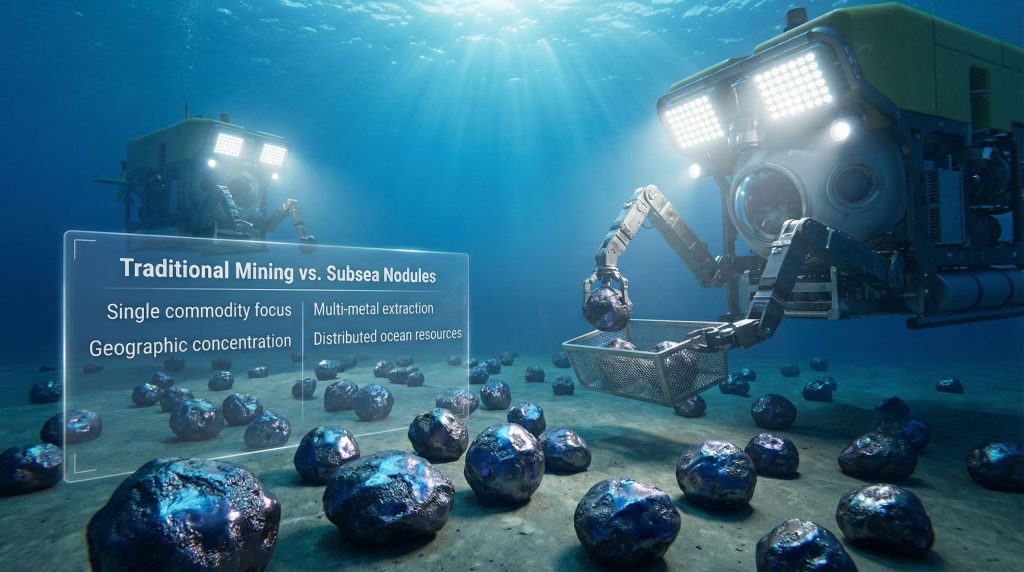
Unlike conventional mining targeting single commodities, seafloor nodule extraction delivers multiple critical elements through unified collection processes. This integrated approach eliminates geographical fragmentation challenges inherent to terrestrial operations while providing consistent feedstock compositions ideal for industrial processing. Furthermore, the polymetallic nodules benefits extend beyond simple resource extraction to encompass strategic supply chain diversification.
Advanced Formation Mechanisms
Polymetallic nodules accumulate through complex precipitation processes in oxygen-minimum zones of deep ocean environments. Natural biogeochemical reactions concentrate cobalt, nickel, and manganese within spherical formations typically measuring 2-10 centimetres in diameter. These formations develop at water depths exceeding 4,000 metres across abyssal plains characterised by minimal sediment accumulation.
The geological timeframe required for nodule formation spans millions of years, creating finite resource deposits with predictable metal compositions. In addition, unlike terrestrial ore bodies requiring extensive overburden removal, ocean floor nodules exist as surface-accessible resources amenable to selective collection techniques.
Resource Distribution and Quality
| Deposit Characteristics | Ocean Floor Nodules | Terrestrial Mining |
|---|---|---|
| Metal diversity | Multi-element extraction | Single commodity focus |
| Geographic distribution | Distributed marine zones | Concentrated land areas |
| Waste generation | Minimal processing residue | High overburden volumes |
| Development timeline | Accelerated deployment | Extended permitting cycles |
Current exploration contracts in the Clarion-Clipperton Zone total approximately 133,000 square kilometres under various international agreements. These holdings represent significant resource potential for commercial-scale extraction operations targeting defence industry supply requirements.
Hydrometallurgical Processing Enables Efficient Metal Separation
Advanced processing technologies utilising aqueous chemical solutions demonstrate high recovery rates for cobalt, nickel, and manganese from nodule feedstock. These hydrometallurgical approaches offer selective extraction capabilities while minimising environmental impact compared to conventional pyrometallurgical methods. However, addressing deep‐sea mining concerns remains crucial for sustainable development.
Processing Technology Framework
Hydrometallurgical systems employ controlled chemical environments to dissolve and separate target metals through:
• Selective leaching protocols optimising pH and temperature conditions for differential metal dissolution
• Solvent extraction techniques enabling high-purity metal recovery from complex solutions
• Precipitation and crystallisation processes producing specification-grade metal products
• Solution recycling systems minimising chemical consumption and waste generation
Technical validation studies indicate achievable recovery rates exceeding conventional terrestrial processing operations. The Cobalt Blue subsea critical minerals consortium has demonstrated promising results through pilot testing at specialised metallurgical facilities in New South Wales, Australia.
Scalability and Infrastructure Requirements
Commercial-scale processing facilities require modular designs accommodating varying nodule compositions and throughput requirements. Integrated processing systems combine collection, transportation, and metallurgical operations to optimise capital efficiency and operational flexibility.
Processing infrastructure development benefits from established hydrometallurgical expertise available through existing industrial operations. For instance, technology transfer from terrestrial cobalt processing enables rapid deployment of subsea nodule processing capabilities without extensive research and development timelines.
Strategic Policy Frameworks Accelerate Development
The recent executive mineral order, Executive Order 14285 signed in April 2025, designated polymetallic nodules as national priority resources requiring expedited regulatory processing. This directive instructs federal agencies to accelerate permitting for domestic processing facilities and U.S.-affiliated extraction operations targeting critical mineral supply chain security.
Regulatory Acceleration Mechanisms
The executive order implementation creates coordinated review processes across multiple federal agencies:
- Environmental assessment streamlining through inter-agency coordination protocols
- Expedited permitting timelines for strategic resource projects
- Multi-agency technical review integrating defence and resource extraction priorities
- Strategic partnership frameworks enabling government-industry collaboration
Consequently, policy implementation recognises subsea resources as critical infrastructure comparable to traditional defence industrial capabilities. This classification enables access to expedited review processes typically reserved for national security projects.
Defence Industry Integration
Critical mineral security directly impacts advanced manufacturing capabilities across aerospace, electronics, and renewable energy sectors. Polymetallic nodule processing addresses supply chain vulnerabilities while supporting domestic manufacturing resilience objectives. Furthermore, the development of a comprehensive critical minerals strategy becomes essential for long-term security.
The integration of ocean floor resources into defence supply chains represents a fundamental shift toward strategic material independence that reduces geopolitical risks inherent to traditional mining operations.
Consortium Development Models Enable Risk Distribution
The Cobalt Blue subsea critical minerals consortium demonstrates effective partnership structures combining complementary expertise across exploration, processing, and technology development. This collaborative approach addresses capital intensity while optimising technical capabilities.
Partnership Architecture
Successful consortium development integrates specialised organisational capabilities:
• Exploration and collection expertise through established marine operations
• Proprietary processing technology adapted for multi-metal feedstock
• Regulatory compliance experience spanning international maritime frameworks
• Capital resources sufficient for commercial-scale facility development
Project Infinity represents the first commercial-scale integration of subsea extraction with domestic processing infrastructure specifically designed for U.S. defence and advanced manufacturing supply chains. Additionally, Cobalt Blue's partnership with Glomar advances this initiative through combined technological expertise.
Investment Structure Considerations
Consortium arrangements enable shared feasibility study costs while distributing technical and commercial risks across multiple stakeholders. Technology licensing agreements provide intellectual property access without requiring extensive internal development programmes.
Joint venture formations facilitate large-scale facility development through combined capital resources and operational expertise. These structures enable accelerated deployment timelines compared to individual company development approaches.
Market Transformation Through Supply Chain Diversification
Ocean floor mining introduces significant disruption potential for critical mineral markets currently dominated by terrestrial operations. Large-scale nodule processing may substantially alter pricing dynamics while creating competitive advantages for early technology adopters. However, implementing effective mining investment strategies remains crucial for success.
Economic Impact Analysis
Polymetallic nodule extraction offers economic advantages through integrated operations:
• Reduced exploration costs through surface-accessible resource deposits
• Lower environmental compliance expenses compared to terrestrial mining operations
• Integrated processing efficiency yielding multiple revenue streams from single extraction operations
• Strategic premium pricing for domestically processed critical materials
Market participants anticipate significant supply additions from ocean floor sources beginning in the early 2030s. Initial pilot facility operations demonstrate commercial viability within 24-36 month development timelines.
Competitive Positioning
First-mover advantages in subsea processing technology create substantial market differentiation opportunities. Companies establishing commercial-scale operations ahead of competitors gain preferential access to government contracts and strategic partnership opportunities.
Investment Considerations:
| Risk Factors | Opportunity Indicators |
|---|---|
| Technology validation requirements | Government policy support |
| Regulatory approval timelines | Established consortium partnerships |
| Capital intensity demands | Proven processing methodologies |
| Market acceptance uncertainty | Strategic defence integration |
The next major ASX story will hit our subscribers first
Environmental Sustainability Through Advanced Collection Methods
Ocean floor extraction methodologies prioritise ecosystem preservation through precision collection techniques and comprehensive monitoring systems. Advanced underwater robotics enable selective nodule harvesting while minimising seafloor disturbance.
Comparative Environmental Impact
Subsea mining operations demonstrate favourable environmental profiles compared to terrestrial alternatives:
• Minimal surface disruption through deep-water collection methods
• Reduced carbon footprint via efficient processing and transportation systems
• Eliminated community displacement through offshore operational areas
• Lower waste generation from high-grade feedstock processing
International regulatory frameworks continue evolving to address environmental protection requirements for commercial-scale ocean floor mining. Industry standards development focuses on sustainable extraction practices compatible with marine ecosystem preservation.
Monitoring and Compliance Systems
Advanced sensor technologies enable real-time environmental monitoring throughout extraction operations. Autonomous underwater systems provide continuous data collection supporting adaptive management approaches and regulatory compliance verification.
Investment Opportunities Across Technology Sectors
Subsea mining infrastructure development creates investment opportunities spanning autonomous systems, specialised metallurgy, and environmental monitoring technologies. Early-stage investors can access emerging markets through technology providers and processing specialists.
Technology Development Priorities
• Autonomous collection systems for precision nodule harvesting operations
• Deep-sea processing equipment enabling offshore metallurgical operations
• Specialised facility design optimised for multi-metal extraction processes
• Environmental monitoring platforms supporting regulatory compliance and ecosystem protection
Market entry strategies favour technology companies with established capabilities in related industrial applications. Hydrometallurgical expertise, marine robotics, and specialised materials handling represent core competency areas supporting rapid market penetration.
Strategic Partnership Development
Investment opportunities exist through established industry participants with proven operational capabilities and regulatory approvals. Consortium participation enables risk distribution while providing access to proprietary technologies and established market relationships.
The Cobalt Blue subsea critical minerals consortium exemplifies successful partnership models combining exploration expertise with advanced processing capabilities specifically targeting U.S. market opportunities.
Advanced Manufacturing Supply Chain Integration
Ocean floor resources provide defence contractors with strategically secure access to critical materials essential for aerospace components, electronic warfare systems, and renewable energy infrastructure. This capability becomes increasingly valuable amid evolving global trade relationships.
Defence Industry Applications
Critical material requirements span multiple defence manufacturing sectors:
- Aerospace component production requiring high-grade cobalt and nickel alloys
- Electronic warfare systems utilising specialised magnetic and conductive materials
- Renewable energy infrastructure incorporating advanced battery technologies
- Next-generation defence platforms integrating multiple advanced material specifications
Domestic processing capabilities enable quality control and supply chain security impossible with foreign material sourcing. Strategic stockpiling becomes feasible through predictable production schedules and verified material specifications.
What Does the Future Hold for Subsea Mining Development?
Commercial-scale subsea mining operations are projected to begin impacting global critical mineral markets by the early 2030s. Initial pilot facilities currently demonstrate technical viability while validating economic models for full-scale deployment.
Scaling Timeline Projections
Industry development indicators suggest accelerating deployment schedules:
• 2026-2027: Pilot facility validation and technology optimisation
• 2028-2029: Commercial-scale facility construction and commissioning
• 2030-2032: Full production ramp-up and market integration
• 2033+: Multiple facility operations and supply chain transformation
Government policy support through expedited permitting and strategic partnership frameworks enables compressed development timelines compared to traditional mining projects requiring decades for full deployment.
Industry Transformation Indicators
Market evolution toward subsea resource dependence reflects convergence of technological innovation, geopolitical strategy, and economic opportunity. Nations establishing early commercial capabilities gain substantial competitive advantages in advanced manufacturing and defence industrial capacity.
Disclaimers: This article contains forward-looking statements regarding technological development timelines, market projections, and regulatory frameworks that involve inherent uncertainties and risks. Investment decisions should consider comprehensive due diligence and professional financial advice. Subsea mining represents an emerging industry with evolving regulatory requirements and unproven commercial scalability at full industrial deployment levels.
The subsea critical minerals sector represents a transformative convergence of technological innovation and strategic resource security that could fundamentally reshape how nations approach critical material sovereignty in an increasingly complex global environment.
Considering Investing in Critical Mineral Security Companies?
Discovery Alert's proprietary Discovery IQ model delivers real-time notifications on significant ASX mineral discoveries across critical materials sectors, instantly empowering subscribers to identify actionable opportunities ahead of the broader market. Begin your 14-day free trial today and secure your market-leading advantage in the evolving critical minerals landscape.