

May 11, 2026
The global offshore energy landscape faces unprecedented complexity as evolving environmental frameworks reshape industrial development strategies. Climate disclosure requirements increasingly challenge traditional resource extraction models, forcing operators to quantify comprehensive carbon footprints that extend far beyond operational boundaries. This regulatory transformation reflects broader institutional shifts toward comprehensive lifecycle accounting, fundamentally altering how major energy projects navigate approval processes and investment strategy components.
Regulatory Evolution in North Sea Environmental Assessment
Modern Emissions Disclosure Requirements
Environmental assessment protocols for UK offshore developments have undergone substantial transformation in recent years. Regulatory frameworks now mandate comprehensive Scope 3 emissions reporting, requiring operators to account for downstream combustion impacts throughout their environmental statements. This represents a significant departure from historical practices that focused primarily on operational emissions during extraction phases.
Key Elements of Enhanced Environmental Reporting:
- Full lifecycle carbon accounting from extraction through end-use combustion
- Integration of climate pathway compatibility assessments
- Mandatory disclosure of transportation and refining emissions
- Alignment with international greenhouse gas accounting standards
- Enhanced scrutiny of long-term climate impact projections
The integration of these comprehensive assessment requirements reflects broader policy alignment with net-zero commitments. Operators must now demonstrate how proposed developments align with climate scenarios limiting global temperature increases to specific thresholds, creating additional layers of regulatory complexity for project approval processes.
Furthermore, these enhanced disclosure requirements create transparency that enables more informed decision-making but also reveal potential challenges related to energy transition challenges that operators must navigate.
Licensing Timeline Implications for Strategic Planning
Current licensing frameworks create specific decision windows that significantly influence development strategies. The extension of production licenses until September 2027 establishes critical deadlines for regulatory approval and final investment decisions. This compressed timeline requires operators to navigate increasingly complex environmental assessment processes while maintaining commercial viability.
Timeline Considerations:
- License renewal requirements by late 2027
- Environmental statement preparation and approval processes
- Integration with broader UK offshore licensing policies
- Alignment with infrastructure availability and connection requirements
- Coordination with evolving climate policy frameworks
These temporal constraints highlight the challenge of developing long-term energy projects within rapidly evolving regulatory landscapes. Projects approved under current frameworks must operate for decades while adapting to potentially stricter future climate policies.
When big ASX news breaks, our subscribers know first
Carbon Impact Analysis: Understanding the 100 Million Tonne Assessment
Comprehensive Emissions Breakdown
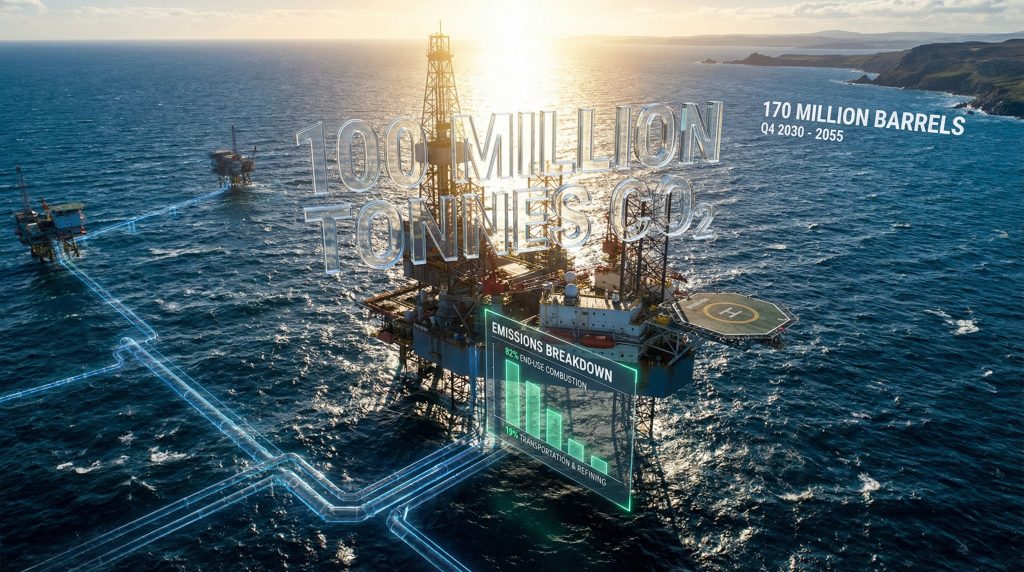
The Cambo field's environmental assessment reveals the distribution of emissions across different operational phases, providing insight into modern lifecycle accounting methodologies. Total projected Cambo GHG emissions of 100 million tonnes CO2 equivalent represent one of the most comprehensive disclosure exercises in UK offshore development history.
Cambo Field Emissions Distribution
| Emission Category | Volume (Million Tonnes CO2e) | Percentage of Total | Annual Average |
|---|---|---|---|
| End-use combustion | 82.0 | 82% | 3.3 |
| Transportation & refining | 18.9 | 19% | 0.8 |
| Upstream operations | 0.13 per year | <1% | 0.13 |
The assessment indicates that upstream operational emissions during full production would average approximately 130,300 tonnes annually, representing 1.1% of UK oil and gas sector upstream emissions based on current industry output levels. This relatively modest operational footprint contrasts sharply with the substantial downstream emissions from refined product combustion.
However, the broader implications of these emissions must be considered within the context of global oil price movements and energy market dynamics that influence the economic viability of such developments.
Climate Pathway Compatibility Assessment
Ithaca Energy's analysis acknowledges that project emissions align with climate pathways limiting warming to 2°C by 2100 while exceeding the 1.5°C threshold during the 21st century. This transparent assessment reveals the tension between existing energy infrastructure and ambitious climate targets established under the Paris Agreement.
According to Argus Media's analysis, "The Cambo field development represents a significant challenge for balancing energy security needs with climate commitments."
Climate Impact Considerations:
- Compatibility with 2°C warming scenarios versus 1.5°C aspirations
- Global context of "minor" climate impact within broader emission sources
- Long-term implications for UK net-zero commitments by 2050
- Post-2050 offset requirements for continued operations
- Integration with evolving carbon removal technologies
The assessment framework demonstrates industry recognition that traditional energy developments face increasing scrutiny regarding climate compatibility. Moreover, it reflects pragmatic approaches to energy transition that acknowledge transitional roles for domestic hydrocarbon production.
Strategic Resource Context and Market Significance
Scale and Infrastructure Integration
Cambo's resource base of 170 million barrels of oil equivalent positions it as the second-largest undeveloped North Sea discovery according to industry assessments. This substantial resource endowment creates strategic implications for UK energy security during the transition toward renewable energy systems.
Development Timeline and Milestones:
- Drilling commencement: Q3 2028
- First oil production: Q4 2030
- Field operational life: Through 2055
- Total production period: 25 years
- Single operator structure following Shell divestment completion
The project's viability depends significantly on connection to existing North Sea infrastructure, aligning with UK government policies that permit new wells connected to established systems while restricting entirely new infrastructure developments. This framework reflects attempts to balance energy security considerations with climate commitments.
Additionally, understanding these resource developments requires consideration of energy security insights that shape national energy policy frameworks.
Investment Decision Framework
The approaching license expiration in September 2027 creates a compressed decision timeline for final investment approval. Operators must evaluate substantial capital commitments against evolving regulatory landscapes and uncertain long-term demand projections for hydrocarbon products.
"The Cambo development exemplifies modern offshore project challenges, requiring operators to balance substantial capital requirements with evolving climate policies that may significantly affect project economics throughout 25-year operational lifespans."
Economic Considerations:
- Capital expenditure requirements for 2028 drilling commencement
- Infrastructure development and connection costs
- Regulatory compliance expenses throughout project lifecycle
- Carbon pricing and offset obligation uncertainties
- Market demand evolution during extended operational periods
Regional Development Comparisons and Industry Context
Benchmark Analysis with Peer Projects
Comparative assessment with other major North Sea developments provides context for understanding Cambo GHG emissions relative environmental impact. Equinor's Rosebank field, currently in development, demonstrates substantially higher lifetime emissions at 249 million tonnes CO2 equivalent, offering perspective on project-specific carbon intensities.
Major North Sea Project Comparison
| Project | Operator | Lifetime Emissions (Mt CO2e) | Resource Base | Emissions Intensity |
|---|---|---|---|---|
| Rosebank | Equinor | 249 | Under review | TBD |
| Cambo | Ithaca Energy | 100 | 170 million BOE | 588 kg CO2e/BOE |
The 2.49x difference in lifetime emissions between projects suggests significant variations in field characteristics, development approaches, or resource recovery profiles. These differences highlight how geological factors, transportation distances, and production methods influence overall carbon footprints for offshore developments.
Industry Standards for Environmental Accounting
The comprehensive emissions disclosure requirements now standard for UK offshore developments represent evolving industry practices toward full lifecycle transparency. Projects must now account for:
Enhanced Disclosure Requirements:
- Complete Scope 1, 2, and 3 emissions accounting
- Transportation and refining impact quantification
- End-use combustion emissions estimation
- Climate pathway compatibility assessment
- Post-2050 offset obligation acknowledgment
These enhanced standards reflect international trends toward comprehensive environmental impact assessment, though specific methodologies and assumptions may vary between projects and operators. In addition, these developments must consider the broader context of decarbonisation economic benefits that influence industry transformation.
Financial and Investment Implications Under Climate Policy
ESG Integration Effects on Project Economics
Enhanced climate disclosure requirements fundamentally alter how institutional investors evaluate large-scale energy projects. The comprehensive carbon accounting now required for offshore developments creates transparency that enables more informed ESG screening but also reveals climate incompatibilities that may affect financing availability.
Investment Decision Factors:
- Enhanced due diligence requirements for carbon-intensive projects
- Institutional investor ESG mandate compliance
- Climate risk assessment integration into project evaluation
- Long-term demand uncertainty for hydrocarbon products
- Regulatory policy evolution throughout project lifecycles
The explicit acknowledgment that project emissions exceed 1.5°C warming pathways while remaining compatible with 2°C scenarios creates complex evaluation frameworks for investors balancing climate commitments with energy security considerations.
Policy Uncertainty and Risk Management
Ithaca's commitment to meet future greenhouse gas removal requirements illustrates significant policy uncertainty regarding post-2050 regulatory frameworks. This acknowledgment reveals substantial risk factors related to:
- Evolution of carbon pricing mechanisms
- Availability and cost of carbon removal technologies
- International climate policy coordination
- UK-specific net-zero implementation pathways
- Technology development for large-scale carbon capture
Risk Mitigation Strategies:
- Flexible operational planning for policy adaptation
- Investment in carbon reduction technologies
- Strategic partnerships for offset provision
- Regular assessment of regulatory compliance requirements
- Integration with emerging carbon removal markets
Long-term Strategic Implications for UK Energy Policy
Transitional Energy Development Framework
The Cambo development represents a significant test case for UK energy policy balancing climate commitments with energy security considerations. Government recognition of transitional roles for oil and gas during decarbonisation creates policy frameworks that permit selective development while restricting broader exploration activities.
Policy Balance Considerations:
- Domestic energy security during renewable energy transition
- Economic benefits from existing resource development
- Climate impact mitigation through comprehensive assessment
- International competitiveness of UK energy supply
- Long-term alignment with net-zero commitments
This approach reflects pragmatic recognition that renewable energy infrastructure development requires time while domestic energy demand continues requiring reliable supply sources.
Precedent Setting for Future Developments
The comprehensive Cambo GHG emissions assessment establishes important precedents for future UK offshore developments. The detailed lifecycle accounting and climate pathway analysis create benchmarks that subsequent projects must meet or exceed.
Precedent Elements:
- Comprehensive Scope 3 emissions disclosure standards
- Climate scenario compatibility assessment requirements
- Post-2050 offset obligation acknowledgments
- Transparent carbon intensity reporting
- Integration with national climate policy frameworks
These standards suggest that future offshore developments will face increasingly rigorous environmental assessment requirements, potentially affecting project viability and investment decisions across the broader UK continental shelf.
The next major ASX story will hit our subscribers first
Industry Knowledge and Technical Considerations
Emissions Accounting Methodology
The 100 million tonne carbon footprint calculation employs sophisticated lifecycle assessment methodologies that capture emissions across multiple operational phases. End-use combustion accounts for 82% of total emissions, reflecting the carbon content of refined petroleum products when burned by consumers.
According to the official Environmental Statement, detailed methodologies ensure comprehensive assessment across all emission categories.
Technical Assessment Components:
- Scope 1 emissions: Direct operational emissions from extraction
- Scope 2 emissions: Indirect emissions from purchased energy
- Scope 3 emissions: Downstream combustion of refined products
- Transportation emissions: Pipeline and shipping carbon impacts
- Refining emissions: Processing and product preparation impacts
The emissions intensity of 588 kg CO2e per barrel of oil equivalent provides a metric for comparing carbon efficiency across different offshore developments, though geological and operational factors significantly influence these calculations.
Geological and Operational Factors
North Sea offshore developments face unique technical challenges that influence both operational emissions and overall project carbon intensity. Water depth, reservoir characteristics, and distance to processing infrastructure all affect environmental impact calculations.
Project-Specific Factors:
- Reservoir pressure and production decline curves
- Water cut evolution throughout field life
- Transportation distance to processing facilities
- Infrastructure sharing with existing developments
- Production optimisation for carbon efficiency
These technical considerations demonstrate why similar-scale projects may have substantially different carbon footprints, as seen in the comparison between Cambo and Rosebank developments.
Market Psychology and Investment Sentiment
The comprehensive climate disclosure requirements reflect broader shifts in market psychology regarding energy investments. Institutional investors increasingly require transparent carbon accounting to meet ESG mandates, creating new evaluation frameworks for traditional energy projects.
Investment Sentiment Factors:
- ESG mandate compliance requirements for institutional capital
- Climate risk assessment integration into project evaluation
- Long-term demand uncertainty affecting asset valuation
- Regulatory evolution creating policy risk premiums
- Technology development affecting competitive positioning
This evolution in investment criteria fundamentally alters how energy projects secure financing and maintain investor support throughout extended operational periods. Consequently, Cambo GHG emissions assessments become critical components of investment decision-making processes.
Disclaimer: This analysis incorporates publicly available information and industry assessments. Investment decisions should be based on comprehensive due diligence including detailed financial modelling, regulatory compliance verification, and independent technical assessment. Future regulatory changes, technology developments, or market conditions may significantly affect project outcomes and investment returns. Carbon accounting methodologies and climate impact assessments involve complex assumptions that may not reflect actual future emissions or climate effects.
Are You Seeking Early Opportunities in UK Offshore Energy Developments?
Discovery Alert's proprietary Discovery IQ model delivers instant alerts when significant ASX mineral discoveries are announced, helping investors identify actionable opportunities in the resources sector before broader markets react. Explore historic examples of major mineral discoveries that have generated substantial returns, and begin your 14-day free trial today to gain a market-leading advantage in resource investment opportunities.

