July 31, 2026
When Markets Ignore the Battlefield: The Logic Behind Falling Oil Prices During Active Conflict
Energy markets operate on a principle that consistently confounds casual observers: prices move on probability, not headlines. The existence of armed conflict, sanctions, or geopolitical tension does not automatically sustain elevated crude benchmarks. What matters to traders positioning in WTI and Brent futures is the expected probability that physical barrels will fail to reach their destination. When that probability falls, even briefly, prices follow, regardless of whether bombs are still falling.
This distinction sits at the heart of understanding why oil falls on greater flows despite the US-Iran war, and why the pattern is far less contradictory than it first appears. Furthermore, monitoring crude oil price trends throughout the conflict period reveals a market that is functioning rationally, not erratically.
When big ASX news breaks, our subscribers know first
The Data That Defied the Narrative
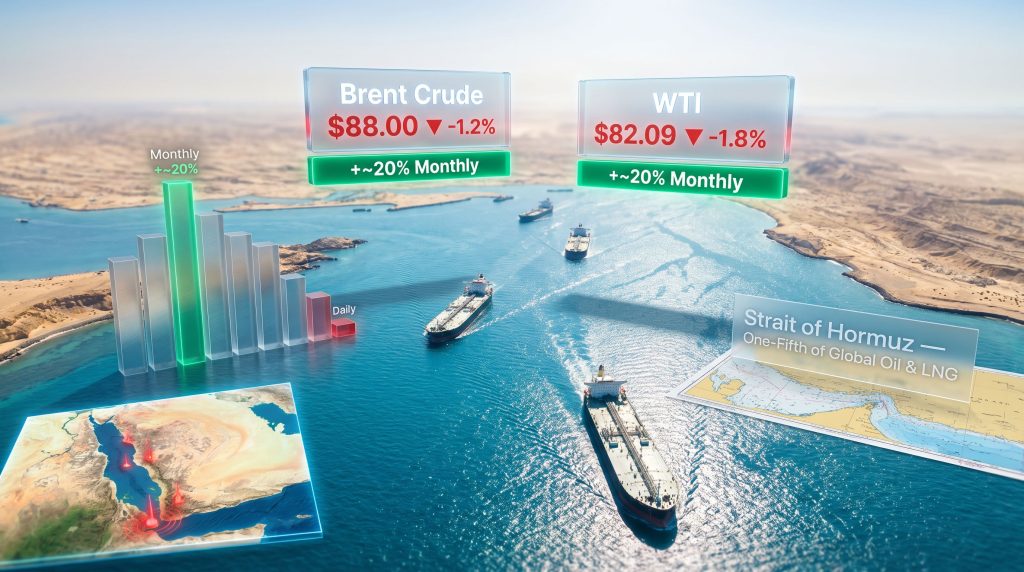
On July 31, 2026, crude benchmarks declined sharply in a single trading session despite the ongoing US-Iran conflict showing no formal resolution. Brent futures dropped $1.03, or 1.2%, settling at $88 per barrel, while US West Texas Intermediate fell $1.50, or 1.8%, to $82.09 per barrel. Both moves occurred against a backdrop where the same benchmarks had gained approximately 20% across the month, reflecting the war-risk premium that had been accumulating since hostilities began.
| Benchmark | Price (July 31, 2026) | Daily Change | Monthly Performance |
|---|---|---|---|
| Brent Crude | $88.00/barrel | -$1.03 (-1.2%) | +~20% |
| WTI Crude | $82.09/barrel | -$1.50 (-1.8%) | +~20% |
The divergence between the monthly gain and the daily loss is not contradictory. It is the market operating exactly as designed. The 20% monthly surge reflects the structural repricing of supply risk following the February 28, 2026 outbreak of the US-Israel conflict with Iran. The single-session decline reflects traders adjusting their disruption probability estimates downward in response to observable flow data emerging from critical maritime corridors.
The simultaneous occurrence of a roughly 20% monthly price surge and a single-session decline of up to 1.8% illustrates how short-term flow signals can temporarily override longer-term war-risk premiums embedded in crude futures markets.
How the Strait of Hormuz Functions as a Global Price Lever
To understand the price mechanics at play, it is essential to understand the physical geography of energy logistics. The Strait of Hormuz is a narrow maritime passage, approximately 33 kilometres wide at its narrowest navigable point, connecting the Persian Gulf to the Arabian Sea and the broader global ocean network.
Roughly one-fifth of all global crude oil and liquefied natural gas shipments transit this strait annually. This makes it, by any reasonable measure, the single most consequential energy chokepoint on the planet. Nations including Saudi Arabia, the UAE, Kuwait, Iraq, and Iran all depend on Hormuz access for meaningful portions of their export capacity.
When the US-Israel conflict with Iran commenced at the end of February 2026, the Strait of Hormuz effectively became the central variable in every crude pricing model used by institutional traders. Partial blockade conditions created upward pressure on freight rates and insurance premiums, introducing what analysts describe as a geopolitical risk premium into futures pricing — a surcharge above fundamental supply-demand levels that reflects conflict-driven disruption probability. Consequently, tracking current crude oil prices during this period has required close attention to maritime flow data as much as to battlefield developments.
What a Geopolitical Risk Premium Actually Means for Buyers
One of the less discussed dynamics in mainstream oil market commentary is the gap between benchmark price and delivered energy cost. Even when tankers continue moving through contested straits, the elevated security environment generates materially higher freight rates and marine war-risk insurance premiums.
Analysis from Phillip Nova noted that although tanker traffic persisted through both the Strait of Hormuz and the Red Sea, heightened security risks drove freight costs and insurance premiums substantially higher, effectively encoding a significant geopolitical surcharge into oil's true cost of delivery, even when published benchmark prices appeared relatively stable.
This distinction matters for industrial consumers, refiners, and downstream fuel markets, where the actual cost of energy inputs exceeds what spot price charts suggest.
The Red Sea Dimension: A Second Chokepoint Enters the Equation
Compounding the Hormuz risk, Yemen-based Houthi militants aligned with Iran declared a naval blockade targeting Saudi Arabia's Red Sea oil export corridor. The Red Sea route, which feeds through the Bab El-Mandeb Strait and the Gulf of Aden, serves as a critical alternative pathway for Saudi crude when Persian Gulf routes face disruption.
The implication of an effective Houthi blockade is not simply a regional logistics problem. If Saudi exports are forced off the Red Sea route, tankers must reroute around the Cape of Good Hope, adding weeks to voyage times and substantially increasing shipping costs, even without reducing the volume of barrels produced. This creates what energy analysts call a supply tightening effect without a production reduction, where the delivered supply available to consuming markets shrinks relative to demand even though production continues at normal rates.
Saudi Arabia's Coalition Response
In response to the Houthi blockade declaration, Saudi Arabia moved to build a multinational maritime defence coalition targeting the Bab El-Mandeb Strait, the Red Sea, and the Gulf of Aden. The Saudi defence ministry confirmed participation from 14 nations, spanning multiple geographic regions.
| Coalition Member Category | Nations Involved |
|---|---|
| African Members | Djibouti, Egypt, Sudan |
| South Asian Members | Pakistan |
| Middle Eastern/European Adjacent | Turkey |
| Total Coalition Participants | 14 Nations |
The formation of a coordinated multilateral maritime security presence introduces a partial stabilising mechanism into the Red Sea corridor. However, coalition deterrence is not equivalent to conflict resolution. The risk of interdiction remains elevated for as long as the underlying political dynamics between Iran-aligned forces and Gulf state energy infrastructure persist.
Three Scenarios: Where Oil Prices Go From Here
Understanding the mechanics of current pricing allows investors and analysts to construct structured scenarios for crude trajectory under continued conflict conditions. The critical variable in each scenario is not the existence of war, but the degree to which maritime flow volumes are disrupted. In addition, understanding the crude market drivers behind each scenario helps distinguish between temporary corrections and sustained trend shifts.
Scenario A: Sustained Flow Normalisation
- Tanker throughput through Hormuz and the Red Sea remains elevated
- Coalition maritime defence successfully deters Houthi interdiction efforts
- Diplomatic back-channels produce incremental de-escalation signals
- Price trajectory: Gradual war-risk premium compression; Brent drifts toward the $82 to $85 per barrel range
Scenario B: Chokepoint Disruption Escalation
- Houthi blockade successfully interdicts Saudi Red Sea crude exports
- Hormuz throughput declines materially due to intensified conflict
- Coalition response fails to restore shipping confidence or coverage
- Price trajectory: Rapid supply-shock repricing; Brent pushes toward $95 to $100 or higher depending on disruption scale and duration
Scenario C: Diplomatic Breakthrough with Partial Supply Expansion
- A US-Iran ceasefire framework or partial nuclear agreement advances
- Iranian crude re-enters global markets under relaxed sanctions enforcement
- War-risk premium compresses, but new supply volumes offset geopolitical tailwinds
- Price trajectory: Near-term volatility followed by a medium-term bearish bias as supply expands faster than demand growth absorbs it
Historically, oil markets have consistently demonstrated that the probability of supply interruption, rather than the raw existence of armed conflict, is the primary and sustained driver of elevated crude prices. Once that probability declines, prices correct regardless of whether fighting continues.
What History Shows About Conflict and Crude Pricing
The current US-Iran war dynamic is not without historical precedent. During the 1980s Iran-Iraq War, the so-called Tanker War period saw hundreds of oil tankers attacked in the Persian Gulf between 1984 and 1988. Despite the scale of attacks, global crude prices ultimately declined sharply across the late 1980s, driven by OPEC production disputes and demand softness overwhelming the conflict premium.
Similarly, during the 1990 Gulf War, crude prices spiked dramatically in the months immediately following Iraq's invasion of Kuwait in August 1990, but retraced sharply once coalition military success suggested rapid restoration of Kuwaiti production capacity. The market was not pricing the war. It was pricing the duration of expected supply loss.
The consistent structural rule across decades of geopolitical energy market episodes is that futures traders are implicitly running probabilistic models of supply availability, not moral or political assessments of conflict legitimacy or intensity. When observable data — specifically tanker tracking systems, satellite imagery of production facilities, and cargo movement records — suggests supply is flowing more freely than expected, prices adjust accordingly.
The next major ASX story will hit our subscribers first
Why Flow Data Dominates Over Conflict Headlines in Daily Price Discovery
Modern crude markets incorporate information extremely rapidly. Tanker tracking technology, available through commercial maritime intelligence platforms, provides near-real-time visibility of vessel movements through critical straits. When institutional traders observe increased Hormuz throughput on a given day, the speculative premium embedded in front-month futures contracts is recalibrated within hours, sometimes minutes.
This is precisely the mechanism behind the July 31 price declines. Reports of increased tanker flows through the Strait of Hormuz, noted by ING analyst Daniel Hynes as a key factor offsetting conflict-driven upward pressure, shifted the disruption probability calculus enough to trigger meaningful selling in both Brent and WTI contracts, even while the broader monthly trend remained firmly positive. Furthermore, this dynamic is why oil falls on greater flows despite the US-Iran war remaining unresolved.
Key mechanisms that have triggered oil price declines during the conflict period include:
- Temporary ceasefire frameworks reducing immediate supply disruption probability
- US military strike pauses interpreted by traders as signals against conflict expansion
- Resumed tanker movements through contested maritime corridors
- Multinational maritime security deployments reducing effective blockade risk at chokepoints
For instance, reports of a pause in US strikes on Iran were among the clearest examples of how diplomatic signals carry disproportionate short-term price influence, even in the absence of a formal ceasefire agreement. Understanding oil markets under geopolitical stress reveals that these patterns are consistent and largely predictable once the underlying logic is understood.
FAQ: Oil Falls Despite US-Iran War
Why did oil prices fall if the US and Iran are still at war?
Oil markets respond to expected supply availability, not conflict headlines. When tanker flows through the Strait of Hormuz increased and diplomatic signals suggested reduced escalation risk, traders reduced their supply disruption probability estimates, causing futures prices to decline even as the conflict itself continued.
What is the Strait of Hormuz and why does it matter for crude benchmarks?
The Strait of Hormuz is the narrow maritime passage connecting the Persian Gulf to global ocean shipping lanes. Approximately one-fifth of global oil and LNG shipments pass through it annually. Any material change in throughput, whether a reduction or restoration, has an outsized and near-immediate impact on global crude prices.
What is a geopolitical risk premium in oil pricing?
It is the additional cost layered into crude futures above fundamental supply-demand levels, reflecting the market-assessed probability of supply disruption due to conflict, sanctions, or infrastructure threats. This premium rises as disruption probability increases and compresses as risk signals ease, regardless of whether the underlying conflict has formally ended.
How does the Houthi naval blockade affect global oil supply?
The blockade targets Saudi Arabia's Red Sea export route. If effective, it forces Saudi crude onto significantly longer shipping routes around the Cape of Good Hope, increasing delivered costs and reducing the effective volume of oil available to consuming markets without reducing production volumes at source.
Could oil prices surge again if the conflict escalates?
Yes. A material reduction in Hormuz or Red Sea throughput would rapidly reintroduce the supply-shock premium into crude markets. Depending on the scale and duration of any disruption, Brent could reprice toward or above the $95 to $100 per barrel range under sustained chokepoint stress conditions. Oil falls on greater flows, but it rises equally fast when those flows are threatened.
Key Analytical Takeaways
- Flow data consistently overrides conflict headlines in daily crude price discovery mechanisms
- The Strait of Hormuz remains the single most price-sensitive physical variable in the current geopolitical energy environment
- Monthly performance of approximately 20% for both Brent and WTI reflects the structural war-risk premium; daily moves reflect real-time flow signal adjustments
- Dual chokepoint exposure across Hormuz and the Red Sea creates compounding logistical vulnerability for global energy supply chains
- Freight costs and insurance premiums represent a hidden geopolitical surcharge that benchmark prices alone do not fully capture
- Coalition maritime defence introduces partial stabilisation but cannot eliminate underlying disruption risk while the conflict persists
- Diplomatic signals carry disproportionate short-term price influence even in the absence of formal conflict resolution
This article is intended for informational purposes only and does not constitute financial or investment advice. Crude oil price forecasts and scenario projections involve inherent uncertainty and should not be relied upon as predictions of future market outcomes. Readers should conduct independent research and consult qualified financial professionals before making any investment decisions.
Want to Stay Ahead of the Next Major Resource Discovery?
While geopolitical tensions reshape energy markets and commodity prices swing on supply signals, Discovery Alert's proprietary Discovery IQ model cuts through the noise by delivering real-time alerts on significant ASX mineral discoveries — turning complex market data into actionable opportunities for traders and investors alike. Explore how historic mineral discoveries have generated substantial returns and begin your 14-day free trial today to position yourself ahead of the broader market.