July 31, 2026
The Anatomy of an Oil Price Shock: Why Chokepoints Define Global Energy Vulnerability
Global energy markets operate on a paradox: the most consequential pricing decisions are not made in boardrooms or policy chambers, but in narrow stretches of water where geography and geopolitics collide. The world's crude oil supply chain is remarkably concentrated for an asset class that underpins every sector of the modern economy. When that concentration is threatened, commodity markets respond not just to what has happened, but to what might happen next. Understanding this dynamic is essential for anyone tracking why oil prices rise on Strait of Hormuz supply risks with such speed and force.
When big ASX news breaks, our subscribers know first
What the Strait of Hormuz Actually Controls
The Strait of Hormuz is a narrow maritime passage connecting the Persian Gulf to the Gulf of Oman, flanked by Iran to the north and the UAE and Oman to the south. At its narrowest point, the navigable shipping channel is only a few kilometres wide. Yet through this corridor flows roughly 20% of global oil supply, including significant volumes of liquefied natural gas. Furthermore, understanding crude oil price trends helps contextualise just how sensitive benchmarks are to this single geographical bottleneck.
The numbers behind this concentration are striking:
| Market Metric | Recorded Data |
|---|---|
| Global oil share transiting the strait | ~20% |
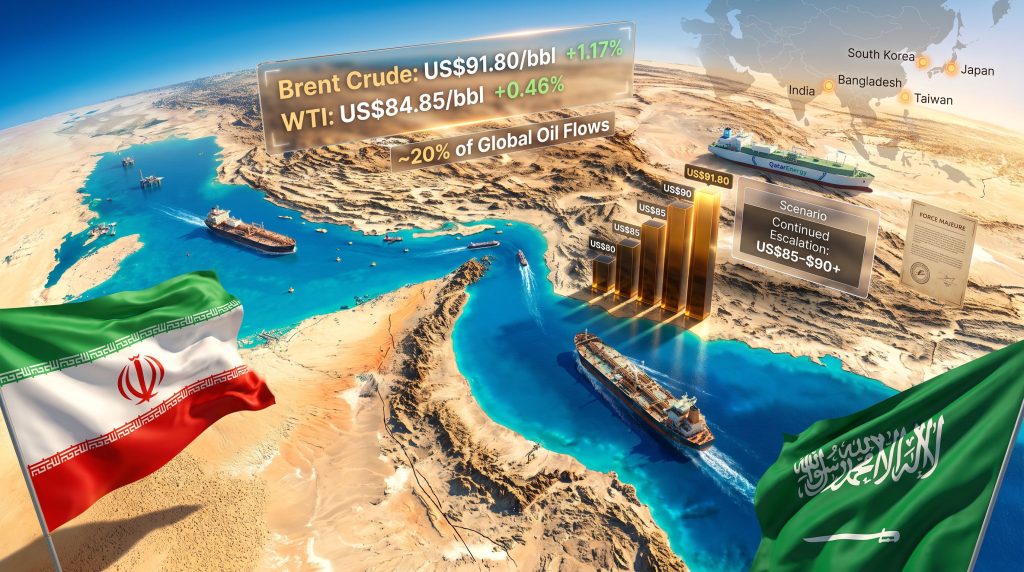
| Brent crude price (30 July 2026, 08:12 GMT) | US$91.80/barrel (+1.17%) |
| WTI crude price (same period) | US$84.85/barrel (+0.46%) |
| Peak single-session intraday gain | ~7-8% |
| Analyst projected range under ongoing escalation | US$85-US$90+/barrel |
| QatarEnergy US spot LNG cargoes secured (2026) | 33 (vs. 4 in prior year) |
A full closure of the Strait of Hormuz is not required to move global oil prices. The mere credible threat of disruption inflates war-risk insurance premiums, delays vessel scheduling, and introduces a geopolitical risk premium into forward contracts that can persist for weeks or months.
This is the mechanism that most casual observers miss. Crude markets reprice on probability-weighted supply expectations, not on actual shortfalls. The anticipation of disruption is itself a market-moving event, as UNCTAD's analysis of Hormuz trade implications has clearly documented.
How Military Escalation Transmits Into Commodity Prices
The sequence of events that drove Brent crude above US$91 per barrel in late July 2026 followed a recognisable escalation pattern, though several elements were historically significant.
The Escalation Sequence
-
An Iranian missile strike on a US military installation in Jordan prompted direct threats of retaliatory military force from Washington.
-
The United States and Saudi Arabia jointly conducted military operations targeting Iran-backed paramilitary groups in Iraq, a direct response to drone attacks on Saudi oil infrastructure.
-
This marked the first publicly acknowledged Saudi participation in such operations, representing a meaningful recalibration of Gulf alliance posture.
-
A brief pause in US military activity that had allowed markets to stabilise over the preceding weekend was terminated by this escalation sequence.
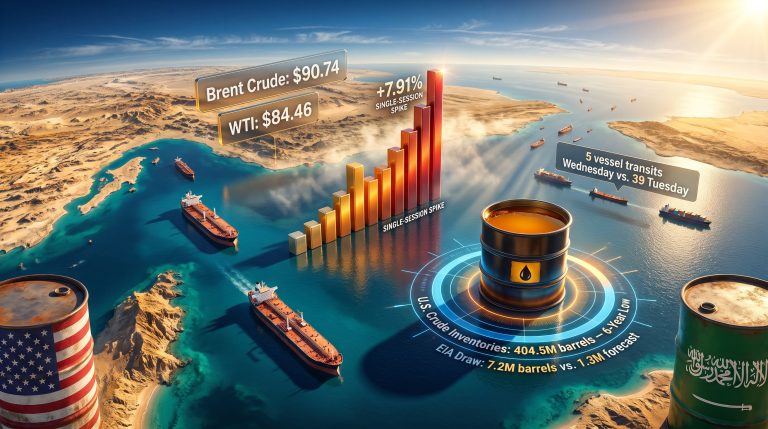
Markets initially priced in the worst-case scenario. Both Brent and WTI recorded intraday gains of approximately 7-8% at peak escalation. A subsequent partial recovery occurred as diplomatic signals emerged suggesting the possibility of a negotiated agreement to restore shipping access through the strait.
Why the Risk Premium Persisted After the Partial Reversal
Even after benchmark prices gave back a portion of their sharp gains, the residual elevation above pre-escalation levels reflected something important: traders were not simply reacting to a specific event but pricing in the ongoing possibility that the situation could deteriorate further. The geopolitical oil risks surrounding the region have long demonstrated that this distinction between event-driven spikes and sustained risk premiums is critical for understanding how geopolitical disruptions age in commodity markets.
Beyond Crude: The Multi-Commodity Disruption Map
One of the less-discussed dimensions of a Hormuz disruption is how broadly the impact fans out across commodity classes and industrial supply chains. The 2026 escalation illustrated this with unusual clarity.
LNG Markets and QatarEnergy's Emergency Response
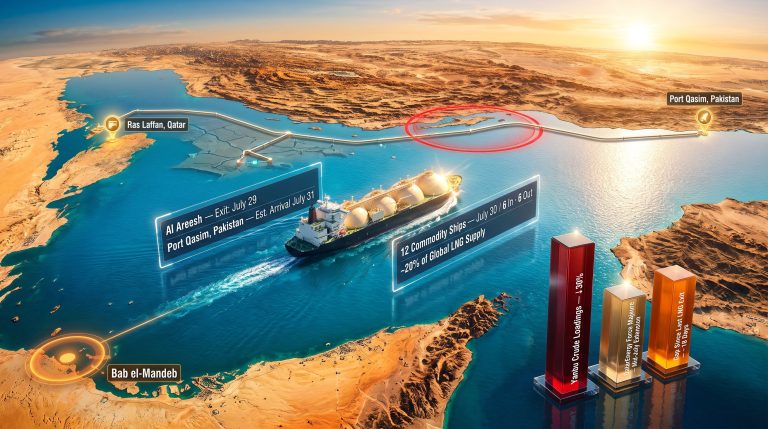
Qatar is the world's largest LNG exporter by historical output, and approximately 80% of its LNG volumes are directed to Asian markets. The closure of the Strait of Hormuz by Iran severed this export corridor entirely. QatarEnergy invoked force majeure, a contractual protection clause that releases a supplier from delivery obligations when extraordinary events outside their control make fulfilment physically impossible.
The scale of QatarEnergy's emergency procurement response was extraordinary. In addition, shifts in global LNG supply have further amplified the pressure on Asian energy importers scrambling to source replacement volumes:
- 33 spot LNG cargoes were sourced from the United States in 2026 alone
- This compares to just four US spot cargoes in the prior year
- Replacement volumes were directed to customers across South Korea, Taiwan, Bangladesh, India, and Japan
- The cost differential between long-term contracted supply and emergency spot procurement was substantial, transmitting cost pressure across Asian energy import markets
This episode revealed a structural vulnerability in Asia-Pacific LNG supply chains. Because Asian importers rely so heavily on Qatari supply through a single maritime corridor, any disruption to that route creates a disproportionate scramble for spot replacement volumes, which in turn drives up spot LNG prices across the region.
The Caspian Pipeline Consortium: A Separate Supply Shock
Compounding the Hormuz situation, a drone attack on a tanker in the Caspian region prompted the Caspian Pipeline Consortium to suspend oil loadings. This pipeline system carries Kazakhstani crude to the Black Sea for export. The suspension introduced a second, geographically distinct vector of supply disruption, reinforcing the anxiety already present in crude markets and demonstrating that the conflict's reach was not confined to the Gulf.
INEOS Project ONE: When Industrial Supply Chains Run Through a War Zone
The Strait of Hormuz disruption also delayed a major European industrial infrastructure project in a way that attracted relatively little mainstream coverage but illustrated the broader economic consequences of prolonged blockades:
- INEOS's Project ONE ethane cracker at the Port of Antwerp, valued at approximately €5 billion (US$5.7 billion), relies on two large construction modules manufactured in Abu Dhabi
- Both modules were trapped in the Strait of Hormuz for months due to conflict-related shipping restrictions
- The first module, weighing 6,920 tonnes and standing 55 metres tall, arrived via the Suez Canal following a temporary ceasefire in mid-June 2026
- The second module, weighing 7,200 tonnes, remained in transit at the time of reporting
This case study is instructive because it shows that the economic costs of Hormuz disruptions extend well beyond the energy sector into manufacturing, chemicals, and industrial capital expenditure timelines across Europe and beyond.
China's Structural Transformation as a Price Circuit Breaker
Perhaps the most consequential and underappreciated dynamic of the 2026 oil price shock was the degree to which China's evolving energy consumption structure prevented the worst-case scenarios from materialising.
Analysis from TS Lombard identified China's structural demand transformation as a primary reason why oil prices, despite sharp intraday spikes, never approached the US$200 per barrel levels that some market participants had modelled under a prolonged Hormuz closure. Consequently, China and oil prices have become an increasingly intertwined consideration for analysts assessing global supply and demand dynamics.
Why Chinese Crude Demand Fell Without Hurting the Economy
Chinese crude import volumes reached ten-year lows during the escalation period, yet this reduction occurred without measurable damage to domestic industrial output or economic activity. Several structural factors explain this apparent paradox:
| Structural Factor | Price-Dampening Mechanism |
|---|---|
| Widespread electrification of transport and manufacturing | Reduced marginal petroleum demand per unit of economic output |
| State strategic petroleum reserves | Provided a buffer against import shortfalls without spot purchasing |
| Commercial refined product inventories (~50% above pre-COVID levels) | Allowed industry to draw down existing stocks rather than buy at elevated spot prices |
| Demand destruction at the margin | Reduced overall crude import volume requirements |
The implication for global oil markets is significant: China's energy system has structurally reduced its sensitivity to short-term crude supply disruptions. This acts as a natural ceiling on price spikes that would previously have been far more severe.
The Forward Risk: What Happens When Chinese Demand Recovers
High-frequency trade flow data indicated at the time of reporting that Chinese crude import volumes were beginning to recover. Analysts noted that shifting geopolitical alignments and domestic infrastructure spending could push import volumes meaningfully higher in subsequent months. If that demand recovery coincides with a continuation or worsening of Hormuz supply disruptions, the price ceiling effect created by China's current demand suppression would erode, potentially amplifying upside price pressure considerably.
How Downstream Inflation Spreads From the Strait
Crude oil price shocks at the Hormuz level do not remain contained within energy markets. The transmission mechanism runs through multiple layers of the consumer economy:
- Retail fuel prices respond to crude benchmark movements typically within days to weeks, affecting household budgets across importing nations
- Airline fuel surcharges rise as jet fuel tracks refined product price increases, increasing travel costs
- Freight and logistics costs escalate as vessel operators price elevated war-risk insurance premiums into shipping rates for Gulf routing
- Petrochemical feedstock costs increase, affecting downstream prices for plastics, synthetic fibres, fertilisers, and industrial chemicals
- Asian LNG and natural gas prices spike when Qatari supply is interrupted and spot replacement cargoes are sourced at significant premiums to contracted volumes
The next major ASX story will hit our subscribers first
Scenario Analysis: Where Oil Prices Go From Here
Understanding the current risk environment requires mapping outcomes across plausible geopolitical scenarios rather than relying on a single price forecast. The OPEC market influence on supply decisions will also play a defining role in how these scenarios ultimately unfold. According to Reuters reporting on Middle East supply risks, market participants remain acutely aware that conditions can shift rapidly depending on diplomatic developments.
| Scenario | Brent Crude Outlook | Primary Driver |
|---|---|---|
| Negotiated Hormuz shipping agreement | Pullback toward US$80-US$85 | Reduced geopolitical risk premium |
| Continued low-level escalation | Sustained US$85-US$90+ | Persistent shipping uncertainty |
| Full or extended Hormuz closure | Potential spike well above US$90 | Interruption of ~20% of global oil flows |
| China demand recovery + supply disruption | Amplified upside pressure | Simultaneous demand and supply shock |
The scenario that warrants the most careful monitoring is the fourth: a situation where China's structural demand buffers are depleted or its import volumes recover just as Hormuz supply disruptions persist or intensify. This combination would remove the price-moderating effect that prevented the most extreme outcomes in the current cycle. It is precisely this risk that makes oil prices rise on Strait of Hormuz supply risks a critical watch item for investors and policymakers alike.
Frequently Asked Questions
What percentage of global oil supply passes through the Strait of Hormuz?
Approximately 20% of global oil flows transit the strait, making it the single most strategically significant energy chokepoint in the world. Disruption to shipping through the strait creates immediate upward pressure on global crude benchmarks regardless of a country's direct import exposure, because crude is priced globally.
Why did oil prices partially reverse after the initial spike?
Markets priced in the possibility of a negotiated resolution that could restore Hormuz shipping access, reducing the forward probability of a full blockade. The partial reversal reflects traders adjusting their probability-weighted view of supply outcomes rather than any actual change in physical supply conditions.
What is force majeure in LNG contracts?
Force majeure is a standard contractual clause that allows a supplier to suspend delivery obligations without financial penalty when extraordinary events outside their control make fulfilment physically impossible. QatarEnergy invoked this clause when Iran's actions rendered LNG shipments through the strait impossible to execute.
How does a Hormuz disruption affect countries that source oil elsewhere?
Through global commodity pricing mechanisms, a Hormuz disruption raises benchmark crude prices worldwide. Nations sourcing oil from non-Gulf producers still face higher prices because global crude markets reprice based on aggregate supply expectations and risk sentiment, not just on the bilateral trade flows of individual countries.
Key Takeaways
- The Strait of Hormuz handles approximately one-fifth of global oil flows, making it the world's most consequential energy chokepoint
- Brent crude reached US$91.80 per barrel on 30 July 2026, reflecting both residual risk premium and renewed escalation signals
- Peak intraday gains of 7-8% in both Brent and WTI occurred before a partial reversal as diplomatic signals emerged
- QatarEnergy's emergency procurement of 33 US spot LNG cargoes in 2026 versus just four the prior year illustrates the scale of supply chain restructuring underway
- China's structural demand transformation — including electrification, strategic stockpiles, and refined product inventories roughly 50% above pre-COVID levels — prevented worst-case price scenarios
- Analysts project Brent in the US$85-US$90+ range under continued low-level escalation, with meaningful upside risk if Chinese demand recovers while disruptions persist
- The Caspian Pipeline Consortium suspension added a secondary, geographically distinct supply disruption vector
- INEOS's delayed Project ONE modules, each weighing over 6,900 tonnes, demonstrated that Hormuz disruptions impose real costs on European industrial supply chains
This article is intended for informational purposes only and does not constitute financial or investment advice. Commodity price forecasts involve inherent uncertainty and actual market outcomes may differ materially from projections. Readers should conduct their own research before making investment decisions.
Readers seeking further context on global energy chokepoints and oil market developments across the Asia-Pacific region can explore ongoing coverage available through Petroleum Australia.
Want to Capitalise on the Next Major Commodity Discovery Before the Market Moves?
Whilst geopolitical shocks like Strait of Hormuz disruptions dominate energy headlines, significant mineral discoveries on the ASX can deliver equally transformative returns — and Discovery Alert's proprietary Discovery IQ model ensures subscribers receive real-time alerts the moment those discoveries are announced. Explore historic discovery returns on Discovery Alert's dedicated discoveries page and begin a 14-day free trial to position ahead of the broader market.