July 31, 2026
The Architecture of Vulnerability: How the World's Most Critical Energy Corridor Became a Permission-Based Waterway
For decades, maritime energy security analysts treated the Strait of Hormuz as a theoretical flashpoint, a corridor so vital that any serious disruption was considered almost self-deterring. That calculus has now collapsed. The passage of the Al Areesh, marking the latest QatarEnergy LNG tanker exits Strait of Hormuz event, on July 29, 2026, was not a sign of normalcy restored. It was a data point in a system that has fundamentally changed, one where transit through a previously open international waterway now requires explicit approval from a state actor with strategic interests in controlling energy flows.
Understanding what this shift means, for global LNG supply markets, for energy security planning, and for the buyers who depend on Middle Eastern supply, requires looking beyond the single vessel movement and examining the structural architecture that surrounds it.
When big ASX news breaks, our subscribers know first
LNG and the Chokepoint Problem: Why This Strait Is Different
Not all maritime chokepoints carry equal risk. The Strait of Hormuz sits in a category of its own because of the specific nature of what flows through it and the absence of credible alternatives. Before the conflict that began in February 2026 following U.S.-Israeli strikes on Iran, the waterway carried approximately one-fifth of the world's combined crude oil and LNG supply. That figure alone would make any disruption consequential. However, LNG faces a dimension of vulnerability that crude oil does not.
Crude oil, while concentrated in Middle Eastern production, can be partially rerouted through pipeline networks, stored in strategic reserves, or substituted from alternative suppliers with relatively short lead times. LNG operates under a different set of physical and commercial constraints:
- LNG must be liquefied at dedicated, capital-intensive terminals before loading, making supply origin highly fixed.
- Regasification infrastructure at receiving ports is purpose-built and cannot quickly adapt to alternative supply routes.
- Long-term LNG contracts are typically tied to specific delivery origins, creating legal and financial exposure when supply is disrupted.
- Unlike crude, LNG cannot be easily blended or substituted at the last stage of the supply chain.
This infrastructure dependency means that a sustained Hormuz disruption is not merely a shipping problem. It is a contractual crisis, a storage crisis, and a price discovery crisis simultaneously. Furthermore, the energy export challenges this creates extend well beyond the Middle East, affecting suppliers and buyers across the globe.
The Al Areesh Transit: Reading One Data Point Carefully
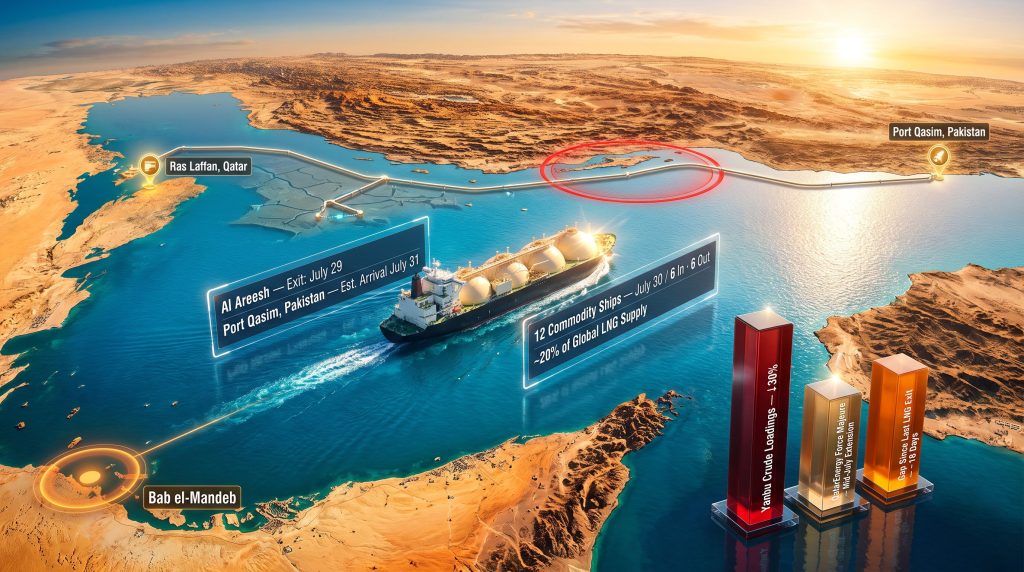
The Al Areesh loaded its cargo at Qatar's Ras Laffan terminal during a window of approximately July 4 to July 6, 2026. It did not exit the Strait of Hormuz until July 29. That gap of roughly three weeks is not logistically explained by voyage time. It reflects the operational reality of a waterway where transit decisions are now shaped by geopolitical permission structures rather than commercial scheduling.
According to tracking data from both Kpler and LSEG, the vessel was heading toward Port Qasim in Pakistan, with an estimated arrival of July 31. The choice of destination is itself analytically significant. Pakistan represents one of the most price-sensitive and supply-constrained LNG markets in Asia, a buyer with limited alternatives and acute domestic energy demand.
That this cargo went to Port Qasim rather than a European or Northeast Asian terminal suggests that, under constrained transit conditions, supply is being directed toward markets with the most acute vulnerability rather than the highest price.
| Data Point | Detail |
|---|---|
| Cargo loading window | Approximately July 4 to July 6, Ras Laffan, Qatar |
| Strait exit date | July 29, 2026 |
| Time since previous QatarEnergy LNG exit | Approximately 18 days (since Al Rekayyat strike, early July) |
| Previous LNG exit reference | Al Hamra, July 11, UAE Das Island cargo |
| Destination | Port Qasim, Pakistan (estimated arrival July 31) |
| Total commodity ships through Hormuz on July 30 | 12 (6 entering, 6 exiting) |
The preceding LNG exit from the strait was the Al Hamra on July 11, carrying cargo originating from the UAE's Das Island terminal. That vessel was not QatarEnergy-controlled, making the Al Areesh the first confirmed QatarEnergy-linked LNG transit since the Al Rekayyat was struck in early July — a gap of approximately 18 days with profound implications for contracted supply chains.
Iran's Permission Architecture: A Structural Shift in Waterway Governance
The most consequential element of the Al Areesh transit is not the vessel itself but the mechanism by which it was permitted to pass. Iran's Fars news agency confirmed that a Qatari LNG carrier traversed a route specifically designated by Iran, with Iranian permission explicitly granted. No further details were provided on vessel identity or the terms of approval.
This confirmation reframes the Strait of Hormuz from a multilateral international waterway operating under freedom of navigation principles into something closer to a controlled access corridor. The strategic and legal implications extend well beyond this individual transit:
- Freedom of navigation, a foundational principle of international maritime law under UNCLOS, is effectively suspended in practice when transit requires bilateral permission from a single state actor.
- The precedent of a permission-based transit creates leverage for Iran to selectively allow or deny passage based on political conditions, pricing disputes, or geopolitical developments entirely unrelated to LNG logistics.
- For LNG buyers operating under long-term contracts, the enforceability of delivery obligations becomes uncertain when the route itself is contingent on a third party's consent.
- Insurance underwriters and P&I clubs now face a fundamentally different risk calculus when pricing war risk premiums for Gulf transits.
Earlier in the conflict, Iran demonstrated its willingness to delay and selectively halt Qatari LNG tankers before permitting some transits, establishing a pattern of selective access management rather than blanket closure. This intermittent approach may be strategically deliberate, maintaining enough supply flow to avoid triggering maximum geopolitical pressure while preserving the leverage to restrict access at any moment.
The transformation of an international waterway into a permission-based corridor represents one of the most significant shifts in maritime energy governance since the 1973 oil embargo. The legal architecture of freedom of navigation was designed for a world where state actors competed for influence over shipping lanes rather than directly controlling them.
Consequently, the broader geopolitical risk landscape now facing commodity markets has intensified considerably, with energy buyers reassessing the reliability of supply chains they once considered stable.
The Transponder Problem: Structural Blind Spots in Shipping Data
Any analysis of Hormuz transit volumes must account for a fundamental limitation in the underlying data. Vessel tracking relies on Automatic Identification System (AIS) transponder signals. When operators deactivate transponders, which is increasingly common in high-risk corridors, those vessels disappear from visible tracking databases.
The practical consequence is systematic undercount. The 12 commodity ships recorded passing through the Strait of Hormuz on July 30 (six entering, six exiting, per Kpler data) represents only the visible traffic. The actual volume of vessels transiting the strait is likely higher, though by an amount that cannot be precisely quantified from open-source data alone.
This transponder gap creates compounding analytical problems:
- Supply disruption assessments based on visible vessel counts will overestimate the severity of the disruption relative to actual cargo movement.
- Price signals derived from reported transit volumes may not accurately reflect underlying supply availability, distorting both spot market pricing and hedging decisions.
- Sanctions monitoring becomes structurally compromised when the vessels most likely to be carrying sensitive cargoes are also the most likely to be running dark.
- Insurance and reinsurance markets struggle to price risk accurately when the exposure they are underwriting is partially invisible.
The ADNOC Gas-controlled vessel Mraweh illustrates this dynamic directly. Last detected outside the strait in ballast on July 24, the vessel reappeared inside the strait on July 29 according to Kpler and LSEG data, still in ballast. ADNOC's formal policy is to decline comment on vessel positions, movements, or routing. This opacity is operationally rational from a risk management perspective but further constrains the market's ability to assess true transit conditions.
Bab el-Mandeb: The Second Chokepoint Under Stress
While Hormuz commands the most attention, analysts tracking global LNG and crude oil flows must simultaneously assess a second major disruption node operating in parallel. The Bab el-Mandeb strait, which links the Red Sea to the Gulf of Aden, recorded 19 commodity ship transits on July 30 according to Kpler data (eight entering, eleven exiting), while LSEG tracking placed the figure at 26. This discrepancy of seven vessels, attributable at least in part to dark vessel activity, underscores the same visibility problem that affects Hormuz data.
How Significant Is the Houthi Blockade Threat?
The more immediate concern at Bab el-Mandeb is the Houthi blockade declaration targeting Saudi Arabia. Visible crude loadings from Yanbu, a major Red Sea export terminal, fell by at least 30% in the week following that declaration, according to data from Kpler and AXSMarine. However, Vortexa's analysis suggests total exports may have remained more broadly stable, with the visible decline partially offset by an increase in dark tanker activity.
Tracking data from Vortexa identified a measurable increase in crude and condensate tankers heading northward after loading in the Red Sea, a pattern consistent with vessels seeking to avoid the heightened security risk around Bab el-Mandeb by routing away from the Houthi threat zone before turning toward their final destinations.
The Yanbu disruption carries specific implications for Asian refinery feedstock planning. Cargoes originating at Yanbu accounted for approximately 15% of Asia's total seaborne crude and condensate imports in June 2026. A sustained reduction in Yanbu loadings, whether through visible disruption or the operational complications introduced by dark tanker logistics, would create meaningful feedstock gaps for Asian refiners already navigating elevated spot LNG prices. In addition, the crude oil market overview for the region reflects growing concern about the compounding effects of dual chokepoint stress.
The next major ASX story will hit our subscribers first
Qatar's Export Model: Single-Origin, Single-Route Exposure
The current crisis has exposed a structural fragility in Qatar's LNG export architecture that was understood in theory but is now being tested in practice. Every cubic metre of Qatari LNG produced at Ras Laffan must exit through the Strait of Hormuz. There is no pipeline alternative, no secondary maritime route, and no meaningful storage buffer that could sustain export continuity through a prolonged closure.
Qatar is one of the world's largest LNG exporters, and the Ras Laffan complex represents a concentration of liquefaction, storage, and loading infrastructure of extraordinary scale. That concentration is both a competitive advantage under normal conditions and a single point of failure under geopolitical stress.
QatarEnergy's extension of force majeure declarations in mid-July, which legally suspended delivery obligations without financial penalty, signals that the operator does not regard transit conditions as reliably stable. Furthermore, the global trade disruption now rippling through commodity markets adds another layer of commercial uncertainty for long-term contract holders.
The conflict has also introduced timing uncertainty into QatarEnergy's ambitious North Field expansion programme, designed to increase Qatar's LNG production capacity significantly over the coming years. Prolonged Hormuz disruption, or even persistent uncertainty about transit conditions, could affect buyer confidence in signing long-term offtake agreements tied to Qatari supply.
Scenario Pathways: What Happens Next
The QatarEnergy LNG tanker exits Strait of Hormuz event establishes a possibility but not a pattern. The weeks ahead will determine whether this represents an early signal of cautious resumption or an isolated event in a continuing disruption. Three broad scenarios frame the range of outcomes:
Scenario A: Partial Resumption (Base Case)
Intermittent QatarEnergy-controlled LNG transits continue under Iranian permission, with irregular cadence and selective approval. Spot LNG prices remain elevated but do not spike catastrophically. South Asian buyers absorb higher costs; European buyers supplement Qatari volumes with increased spot purchases from U.S. and Australian suppliers.
Scenario B: Sustained Blockade
No further QatarEnergy LNG exits occur for 30 or more days. European buyers accelerate spot purchasing from Atlantic Basin suppliers. Global LNG benchmark prices rise sharply. Storage levels in East Asia decline toward seasonal minimums, increasing price volatility heading into the Northern Hemisphere winter demand period.
Scenario C: Dual Chokepoint Closure
Both the Strait of Hormuz and Bab el-Mandeb become effectively impassable for loaded LNG and crude tankers. Global traded LNG volumes lose access to more than 20% of supply simultaneously. IEA member states trigger emergency strategic reserve drawdowns. Spot prices reach levels that force demand destruction in price-sensitive markets across South and Southeast Asia.
Indicators That Will Define the Outlook
For market participants, energy security planners, and policymakers tracking this situation, several specific indicators will determine which scenario pathway is unfolding:
- The frequency and regularity of subsequent QatarEnergy-controlled LNG transits following the Al Areesh departure
- Whether Iranian transit permissions are being granted consistently, selectively, or conditionally
- QatarEnergy's decision to extend, modify, or lift its force majeure declarations
- Spot LNG price movements in Asian JKM benchmarks and European TTF markets as proxy indicators of supply tightness perception
- The evolution of Houthi activity at Bab el-Mandeb and any corresponding changes in Yanbu loading volumes
- Developments in the broader Iran conflict, including any ceasefire signals or diplomatic de-escalation efforts
Frequently Asked Questions
What Makes the Strait of Hormuz So Critical for Global LNG Supply?
Before the current conflict, the strait carried approximately one-fifth of global crude oil and LNG combined. For LNG specifically, Qatar's Ras Laffan complex, one of the world's largest liquefaction hubs, has no alternative maritime export route. Every cargo must pass through Hormuz.
What Was Significant About the Al Areesh Transit on July 29, 2026?
It was the first confirmed QatarEnergy LNG tanker exits Strait of Hormuz event since the Al Rekayyat was struck in early July, representing a gap of approximately 18 days. Its passage under Iranian permission also confirmed that Iran has established an active approval mechanism for strait transits.
Why Is Iran's Role in Permitting Transit So Significant?
International maritime law under UNCLOS establishes freedom of navigation as a baseline right for vessels transiting international straits. Iran's confirmation that it granted permission for the Al Areesh transit suggests the strait now operates as a controlled access corridor rather than an open international waterway, with profound legal, commercial, and strategic implications.
What Is Force Majeure and Why Has QatarEnergy Invoked It?
Force majeure is a contractual provision that allows a party to suspend obligations without financial penalty when circumstances beyond their control make performance impossible or unreasonably dangerous. QatarEnergy's mid-July extension signals that the operator does not consider stable, unimpeded transit conditions to be reliably restored.
How Does the Yanbu Situation Affect Asian Energy Markets?
Yanbu cargoes supplied approximately 15% of Asia's seaborne crude and condensate imports in June 2026. The visible 30% decline in loadings following the Houthi blockade declaration, even if partially offset by dark tanker activity, introduces feedstock uncertainty for Asian refiners already managing elevated LNG costs.
What Does the Transponder Data Gap Mean for Market Analysis?
Vessel tracking systems only capture ships broadcasting AIS transponder signals. Vessels running dark, which is increasingly common in high-risk corridors, are invisible to standard tracking platforms. This means both the severity of disruptions and the degree of recovery are likely being partially misread by analysts relying solely on visible transit counts.
The QatarEnergy LNG tanker exits Strait of Hormuz event is most accurately understood as a signal that the system retains some residual function, not that it has returned to normal operating conditions. A single transit event, occurring under explicit third-party permission, through a waterway that once operated under freedom of navigation principles, is not a resolution. It is a data point in an ongoing strategic emergency that will define global LNG market dynamics for months to come.
Want to Stay Ahead of the Resource Opportunities Emerging From Global Energy Disruptions?
As geopolitical stress reshapes energy supply chains and redirects capital toward alternative resource strategies, Discovery Alert's proprietary Discovery IQ model delivers real-time alerts on significant ASX mineral discoveries — turning complex market shifts into actionable investment insights for both short-term traders and long-term investors. Explore how major mineral discoveries have historically generated extraordinary returns and begin your 14-day free trial today to position yourself ahead of the market.