July 24, 2026
The Hidden Architecture of Oil Price Volatility: Why Geopolitical Risk Premiums Are Never Permanent
Every experienced energy market participant understands an uncomfortable truth: crude oil prices are rarely a pure reflection of physical supply and demand. Embedded within every barrel price is an invisible surcharge, what traders call the geopolitical risk premium. This premium expands when conflict threatens to disrupt supply chains and contracts when diplomatic signals suggest stability may be returning. Understanding how this mechanism works is essential context for interpreting why oil falls after Iran-Israel halt attacks, and why the market's response is almost always more complicated than a simple cause-and-effect narrative suggests.
The risk premium is not a line item on any exchange. It lives in futures pricing, in the spread between Brent and WTI, and in the positioning of institutional traders who move billions of dollars based on a single statement from a military commander or a diplomatic briefing from Washington. When that premium partially unwinds, prices fall. However, the fall itself carries a warning: partial unwinding is not the same as resolution.
When big ASX news breaks, our subscribers know first
Understanding the Geopolitical Risk Premium in Crude Markets
How Conflict Cycles Shape Benchmark Pricing
Oil markets have long operated within a framework that treats Middle Eastern instability as a baseline risk rather than an exceptional event. What changes over time is the magnitude of that risk, measured in dollars per barrel added to prevailing prices during periods of acute tension. The geopolitical and logistical factors at play are rarely simple or one-dimensional.
When military action escalates in a region that either produces significant volumes of crude or controls critical maritime transit routes, traders bid prices higher to account for the possibility that supply will be curtailed. This is not irrational behaviour. It reflects a probabilistic assessment of scenarios where physical barrels fail to reach their intended destinations.
The inverse is equally true. When a ceasefire is announced, a truce is brokered, or direct military exchanges pause, the probability-weighted expectation of supply disruption falls. Traders unwind risk positions, and prices decline. The critical analytical question is always: how much of the premium should be removed, and how durable is the de-escalation?
When oil markets become dominated by geopolitical news flow rather than fundamental supply-demand signals, a single diplomatic statement can shift Brent crude by 1 to 5 percent within a single trading session. This is the defining characteristic of a headline-driven market.
The Middle East's Structural Role in Global Oil Supply
The Persian Gulf region's importance to global energy markets is not simply a matter of production volume. It is also a function of geography. Several critical chokepoints sit within or adjacent to zones of recurring conflict, meaning that even limited military activity carries disproportionate potential to disrupt global supply chains.
This structural vulnerability is why traders treat any Middle East conflict with elevated sensitivity, even when the immediate probability of a major supply disruption remains relatively low. The asymmetry of outcomes, where a worst-case scenario could trigger a price spike far exceeding what a best-case scenario would reduce prices, biases market positioning toward caution. Furthermore, understanding oil markets under trade war conditions adds another layer of complexity to these pricing dynamics.
What Triggered the June 2026 Price Reversal
The Sequence of Events That Moved Markets
The events that led to the June 9, 2026 oil price decline unfolded across a compressed timeframe, illustrating just how rapidly sentiment can reverse in a geopolitically sensitive market. As reported by CNBC, investor clarity remained elusive even as the situation appeared to stabilise.
In the session preceding the announcement, oil prices surged by as much as 5 percent as renewed Israeli strikes on Iran and continued attacks in Lebanon eroded trader confidence that the broader conflict was nearing resolution. The fear embedded in that rally reflected genuine concern that the situation was escalating beyond diplomatic containment.
That fear began to unwind following a combined sequence of events:
- US President Donald Trump publicly appealed for an immediate cessation of hostilities between the two nations.
- Iran's armed forces announced the end of military operations against Israel.
- Israel acknowledged the pause while explicitly reserving the right to respond if attacked again.
- Tehran simultaneously conditioned its ceasefire on Israel halting operations against Hezbollah in Lebanon, introducing an immediate complication that prevented markets from treating the pause as a genuine resolution.
The result was a partial, rather than complete, unwinding of the prior session's gains.
The Price Reversal in Numbers
| Benchmark | Pre-Halt Intraday Peak | Post-Halt Price (09:30 Saudi Time) | Change |
|---|---|---|---|
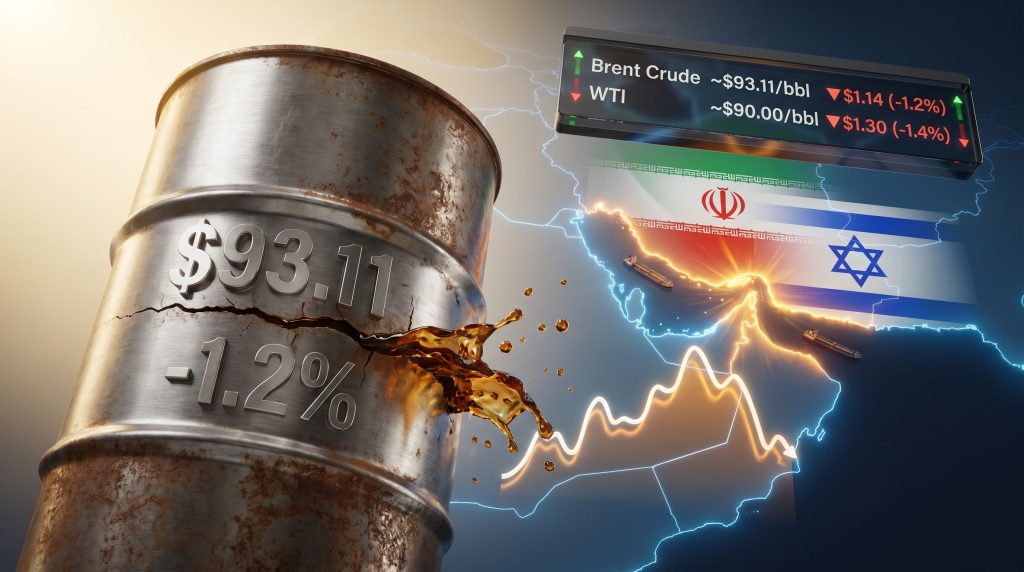
| Brent Crude | ~$94-$95+ | $93.11 per barrel | -$1.14 (-1.2%) |
| WTI Crude | ~$91+ | $90.00 per barrel | -$1.30 (-1.4%) |
| Session prior gains | Up to +5% | Largely reversed | Partial unwinding only |
The price action itself communicates something important: the market did not treat the ceasefire announcement as a resolution event. It treated it as a risk reduction event, warranting a partial drawdown of the premium but not its complete removal.
Why the Drop Was Partial, Not Total
Several factors prevented a more complete price reversal:
- Both Iran and Israel explicitly retained the right to resume hostilities under specific conditions.
- Lebanon remained an active theatre, with Israel's operations against Hezbollah functioning as a potential trigger for Iranian re-engagement.
- The Strait of Hormuz remained under blockade, meaning physical supply disruption was still ongoing regardless of the diplomatic pause in direct strikes.
- Market analysts noted that investor confidence in the durability of the truce was limited from the outset.
KCM Trade's chief market analyst Tim Waterer noted publicly that while some relief had entered the market from the pause in direct strikes, investors remained sceptical that the truce would hold. IG market analyst Tony Sycamore similarly observed that while the situation had been prevented from escalating further, the geopolitical backdrop remained tense and a lasting peace arrangement remained a distant prospect.
The Strait of Hormuz: The Supply Risk That Persists Through Every Ceasefire
Why Hormuz Outweighs the Ceasefire in Market Calculations
While diplomatic headlines focused on the halt to direct Iranian-Israeli strikes, the more structurally significant supply risk in the market is the Strait of Hormuz. Before the US and Israel launched airstrikes on Iran at the end of February 2026, approximately one-fifth of the world's oil supply transited through this critical maritime chokepoint.
The strait's closure, or even its partial disruption through blockade enforcement, creates a supply bottleneck that no diplomatic pause between two nations can resolve on its own. Hormuz is not simply a diplomatic bargaining chip; it is a physical infrastructure constraint that requires active resolution, not merely a ceasefire.
Washington has reportedly made the reopening of the Strait of Hormuz a primary demand in ongoing peace negotiations with Tehran, reflecting how central the chokepoint has become to both the military and economic dimensions of the conflict. In addition, OPEC's market influence adds a further dimension to how prolonged blockades reshape global supply expectations.
US Military Enforcement Actions: The Blockade Remains Active
A detail that received less attention than the ceasefire announcement but carries significant market implications: on June 8, 2026, US forces disabled an unladen oil tanker in the Gulf of Oman after it attempted to reach an Iranian port in breach of the active blockade. According to Energy Connects, this enforcement action underscores that even during periods of diplomatic de-escalation, the physical supply chain disruption is ongoing and actively policed.
For energy market participants, this is a critical distinction. A ceasefire between governments does not equate to resumed tanker traffic. The Hormuz blockade operates under a separate set of conditions that require their own resolution.
Three Scenarios and Their Oil Price Implications
| Scenario | Hormuz Status | Estimated Brent Price Direction |
|---|---|---|
| Full diplomatic resolution and peace framework | Reopened to normal tanker traffic | Significant downward pressure, potential sub-$85 environment |
| Extended fragile truce with partial compliance | Monitored or partial access | Moderate stabilisation in $88-$95 range |
| Renewed hostilities or diplomatic breakdown | Continued or tightened blockade | Potential spike toward or above $100 per barrel |
How This Conflict Compares to Historical Middle East Oil Shocks
A Market Memory Framework
Placing the current situation within a historical context helps calibrate expectations for how long elevated risk premiums tend to persist and what resolution mechanisms have proven effective in the past.
| Event | Duration of Market Impact | Peak Price Reaction | Resolution Mechanism |
|---|---|---|---|
| 1973 Arab Oil Embargo | Multi-year | Over 300% price increase | OPEC policy realignment |
| 1990 Gulf War | Several months | Approximately 100% spike | Military resolution |
| 2019 Abqaiq Attack | Days | ~15% intraday spike | Rapid supply restoration |
| 2026 Iran-Israel Conflict | Ongoing as of June 2026 | Up to 5% in a single session | Fragile diplomatic pause |
What distinguishes the current episode from prior shocks is the combination of direct nation-state conflict, active maritime blockade of a critical chokepoint, and ongoing proxy conflict in Lebanon. Prior disruptions tended to involve either production facility attacks or regional wars, but rarely all three simultaneously.
The Lebanon Variable: The Conflict Within the Conflict
One of the least appreciated complexities of the current situation is that Lebanon functions as a secondary conflict theatre that directly conditions Iran's ceasefire terms. Tehran has stated that it would resume strikes on Israel if Israeli operations against Hezbollah in Lebanon continued.
This means the ceasefire between Iran and Israel is not a self-contained bilateral arrangement. It is structurally dependent on a third-party variable, the status of Hezbollah's military engagement with Israel, which operates on its own escalation dynamics. This triangular dependency significantly reduces the reliability of any bilateral ceasefire announcement as a durable market signal.
Algorithmic Trading and the Amplification of Headline Risk
Why Modern Oil Markets Overreact to News Events
A less commonly understood driver of crude price volatility in geopolitically sensitive environments is the role of algorithmic and sentiment-based trading systems. These systems are designed to react to keyword detection, news flow sentiment scores, and social media volume metrics, meaning that a diplomatic announcement can trigger automated position changes within milliseconds of publication.
This creates a self-reinforcing dynamic. When a ceasefire is announced, algorithms reduce long positions simultaneously across multiple funds, amplifying the initial price decline beyond what a purely human-driven market would produce. The reverse occurs during escalation: automated systems pile into long positions as conflict keywords appear in news feeds, driving prices higher faster than fundamental analysis would justify.
For longer-term investors, this dynamic presents both a risk and an opportunity. The risk is mistaking algorithmically amplified price moves for genuine market consensus. The opportunity is recognising that extreme headline-driven moves in either direction tend to partially reverse as fundamental analysis reasserts itself. Consequently, reviewing oil volatility trends over recent years provides valuable context for navigating these conditions.
The next major ASX story will hit our subscribers first
Key Risk Factors That Could Reignite Volatility
What to Watch in the Coming Days and Weeks
Both Iran and Israel have explicitly retained the right to resume military operations under specific conditions. Any deterioration in Lebanon, a breakdown in US-brokered negotiations, or a tightening of the Hormuz blockade could rapidly reverse the current de-escalation and push crude prices back toward or beyond prior session highs.
The four primary risk factors market participants should monitor are:
- Resumption of direct Iranian-Israeli strikes, which would immediately rebuild the full risk premium stripped out by the ceasefire announcement.
- Hezbollah's operational posture in Lebanon, which functions as Iran's conditional trigger for re-engagement, making Lebanese battlefield developments directly relevant to crude pricing.
- US tanker interdiction activity in the Gulf of Oman, which signals the ongoing status of the Hormuz blockade regardless of diplomatic developments.
- Shifts in US diplomatic engagement, given that Washington's mediation role has been the primary stabilising force. Any signals of reduced US involvement or policy recalibration under domestic political pressures could remove the key moderating influence from the conflict dynamic.
Trump's reported communication to Israeli Prime Minister Benjamin Netanyahu, that Israel risked facing the conflict without US support if it re-engaged with Iran, represents a significant but fragile moderating signal. Its durability depends entirely on the consistency of US policy, which itself carries uncertainty.
What Energy Market Participants Should Monitor
Short-Term Indicators
- Daily diplomatic communications from Washington, Tehran, and Jerusalem for any signs of conditional clause activation.
- Tanker traffic data through the Strait of Hormuz and Gulf of Oman as a real-time indicator of physical supply chain status.
- OPEC+ production posture, as the cartel may adjust output targets in response to conflict-driven price movements that diverge from their preferred price band.
Medium-Term Structural Questions
- Whether a formal diplomatic framework can be established that explicitly addresses Hormuz reopening as a binding condition.
- The internal political durability of ceasefire commitments in both Tehran and Jerusalem, where domestic constituencies may pressure governments toward re-escalation.
- Lebanon's trajectory, including whether Hezbollah's rejection of ceasefire terms creates an inevitable trigger for Iranian re-engagement. The broader trade and geopolitical analysis of the region will likely shape how these medium-term questions resolve.
Long-Term Energy Security Implications
The conflict has already accelerated several structural discussions that were previously theoretical:
- Diversification of global oil supply routing away from Persian Gulf chokepoints.
- Strategic petroleum reserve drawdown discussions among IEA member nations facing elevated price environments.
- Renewed investment interest in non-Middle Eastern crude production capacity, particularly from producers in the Americas, West Africa, and the North Sea.
Frequently Asked Questions
Why did oil falls after Iran-Israel halt attacks occur so quickly?
Oil markets partially unwound a geopolitical risk premium that had been priced into benchmarks during the escalation phase. When both nations announced a pause in direct strikes following US diplomatic pressure, traders reduced their exposure to conflict-driven supply disruption scenarios, pushing Brent and WTI lower. The decline was partial because the ceasefire was conditional and the Hormuz blockade remained active.
How much did oil prices drop after the attack halt?
Brent crude fell $1.14 per barrel, or 1.2 percent, to approximately $93.11 at the time of reporting. WTI declined $1.30, or 1.4 percent, to near $90 per barrel. These moves erased most, but not all, of the prior session's gains.
What is the Strait of Hormuz and why does it matter?
The Strait of Hormuz is a narrow maritime passage connecting the Persian Gulf to the Gulf of Oman and broader global shipping lanes. Before the conflict escalated in late February 2026, approximately one-fifth of the world's oil supply passed through it daily. Any disruption to transit through Hormuz, whether through military action or active blockade, has an outsized effect on global crude availability and pricing.
Could oil prices spike again if the truce breaks down?
Yes. Market analysts have consistently noted that the ceasefire is fragile, conditional, and dependent on developments in Lebanon that neither Iran nor Israel directly controls. A breakdown in the diplomatic process or renewed direct strikes could rapidly restore and potentially exceed the risk premium that was partially removed on June 9, 2026.
Disclaimer: This article contains forward-looking analysis, scenario projections, and market commentary intended for informational purposes only. It does not constitute financial or investment advice. Oil market conditions, geopolitical developments, and diplomatic outcomes are subject to rapid change. Readers should conduct their own research and consult qualified financial professionals before making investment decisions.
Want to Stay Ahead of the Next Major Resource Discovery Triggered by Shifting Energy Markets?
Whilst geopolitical volatility reshapes global commodity markets, Discovery Alert's proprietary Discovery IQ model delivers real-time ASX mineral discovery alerts, transforming complex market signals into actionable investment opportunities for both short-term traders and long-term investors — begin your 14-day free trial today, or explore historic discoveries and their market returns to understand the transformative potential of being positioned ahead of the broader market.