August 21, 2026
What Makes Oil Infrastructure Vulnerable to Modern Drone Attacks?
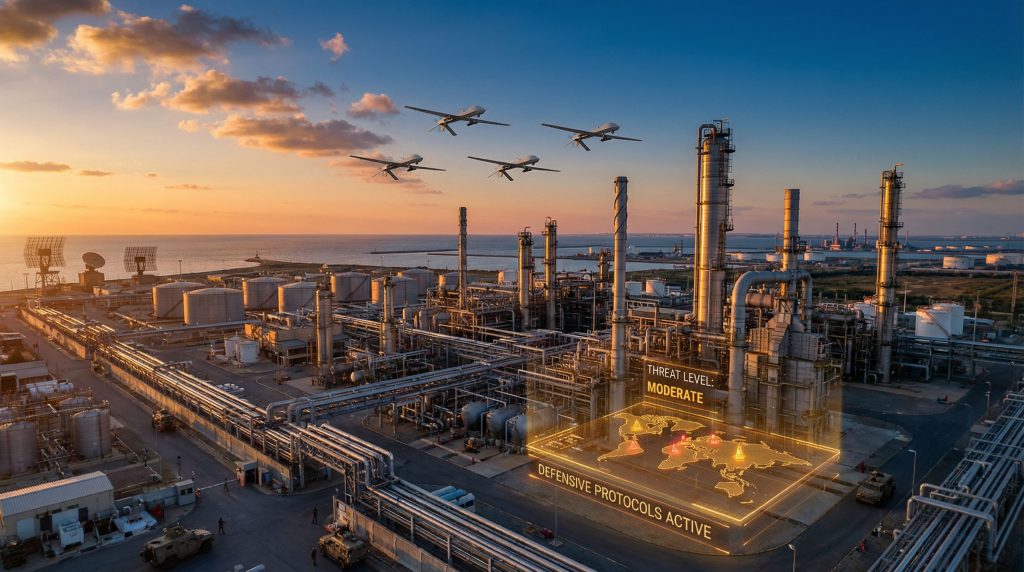
Critical energy infrastructure faces unprecedented security challenges from unmanned aerial systems that exploit fundamental design weaknesses built into decades-old facilities. Recent attacks targeting facilities in Saudi Arabia's Dhahran region demonstrate how drone strikes on oil facilities create systematic vulnerabilities that traditional security frameworks cannot adequately address.
Critical Infrastructure Design Flaws
Modern oil and gas facilities present extensive surface areas with minimal comprehensive air defense coverage, creating multiple attack vectors for coordinated drone swarms. Processing plants, storage tank farms, and export terminals were designed during an era when ground-based sabotage represented the primary security concern, leaving vast overhead exposure zones.
The centralised processing model that defines most major facilities creates single points of failure where relatively small explosive payloads can generate cascading operational shutdowns. A typical refinery complex concentrates multiple critical systems within confined geographic boundaries, amplifying the potential impact of precision strikes on key infrastructure nodes.
Legacy security architectures struggle with the fundamental challenge of detecting and intercepting small-profile, low-altitude unmanned systems that operate below traditional radar coverage thresholds. Current perimeter defence systems excel at preventing ground-based intrusions but lack the integrated air defence capabilities required for multi-vector aerial threats.
Geographic Concentration Risks
The clustering of energy infrastructure within specific geographic zones creates force multiplication opportunities for attackers while limiting defensive resource deployment options. This geographic concentration is particularly evident in the saudi oil exploration impact analysis, where the kingdom's Eastern Province exemplifies vulnerability with the majority of oil and gas installations concentrated in relatively confined areas around Dhahran and surrounding industrial complexes.
This geographic concentration enables attackers to achieve strategic impact through tactical operations, as drone systems can target multiple facilities within single operational ranges. The proximity of critical infrastructure components reduces the time and coordination requirements for synchronised attacks while stretching defensive capabilities across multiple simultaneous targets.
Persian Gulf energy installations face additional vulnerability from maritime-based launch platforms that can position drone systems within optimal strike ranges while avoiding terrestrial detection networks. Offshore platforms and coastal processing facilities lack the comprehensive air defence integration available to major terrestrial installations.
Detection and Response Limitations
Contemporary radar systems encounter significant technical challenges when tracking small unmanned aerial vehicles operating at low altitudes, particularly when attackers employ formation flying or electronic countermeasures. The radar cross-section profile of commercial and military-grade drones often falls below detection thresholds for systems designed to track conventional aircraft.
Response time gaps between initial detection and effective interception create operational windows that favour attackers, especially when dealing with swarm tactics or multi-vector approaches combining drones with traditional missile systems. The timeline from threat identification to kinetic response typically exceeds the engagement window for fast-moving, low-altitude targets.
The cost asymmetry inherent in drone warfare significantly favours offensive operations, with sophisticated attack platforms available at fractions of the expense required for comprehensive defensive systems. This economic imbalance enables sustained offensive campaigns that can overwhelm even well-funded defensive infrastructures through resource attrition.
When big ASX news breaks, our subscribers know first
How Do Drone Strikes Cascade Through Global Energy Markets?
Energy market disruptions from infrastructure attacks propagate through interconnected global systems in predictable patterns that amplify initial supply shocks through psychological and algorithmic trading responses. However, recent analysis of oil price rally analysis suggests that the mere threat of drone strikes on oil facilities can trigger preemptive market reactions before actual production impacts materialise.
Immediate Market Shock Mechanisms
Price volatility triggers activate within minutes of confirmed attacks on major energy infrastructure, as algorithmic trading systems respond to keyword recognition in news feeds and official statements. The satellite images revealing destruction at Iranian oil refineries demonstrate how even partially successful strikes generate immediate futures market spikes that exceed the actual production impact.
Trading algorithm responses to supply disruption signals create feedback loops that amplify initial price movements through rapid position adjustments across commodity markets. These automated systems lack the contextual analysis capability to differentiate between temporary operational disruptions and permanent capacity losses.
Futures market positioning during geopolitical crises reflects risk premium calculations that often exceed rational economic projections, creating speculative bubbles around supply security concerns. Market participants systematically overweight the probability of sustained production disruptions compared to historical recovery patterns.
Supply Chain Domino Effects
| Impact Timeline | Primary Effects | Secondary Effects |
|---|---|---|
| 0-24 hours | Production shutdowns, price spikes | Emergency reserve releases |
| 1-7 days | Shipping route diversions | Alternative supplier activation |
| 1-4 weeks | Refinery capacity adjustments | Consumer price increases |
| 1-6 months | Infrastructure hardening investments | Strategic reserve rebuilding |
Regional refineries adjust processing schedules based on supply disruption assessments, creating secondary bottlenecks in petroleum product markets even when crude oil supplies remain adequate. These operational modifications require weeks to implement and additional time to reverse once normal supply patterns resume.
Shipping companies implement route diversions and insurance surcharge adjustments that affect global logistics costs across multiple commodity categories. Marine insurance markets particularly react to threats against Gulf shipping lanes, as cargo vessels transiting these waters face elevated risk premiums.
Regional Contagion Patterns
Single-facility attacks spread market uncertainty across entire regional energy networks through supply interdependence mechanisms that connect seemingly separate infrastructure systems. Furthermore, understanding oil market movements reveals how targeting of Dhahran facilities affects not only Saudi production but also regional processing capacity serving multiple Gulf Cooperation Council nations.
Insurance premium adjustments cascade across entire sectors when major attacks demonstrate successful penetration of previously considered secure installations. Underwriters reassess risk models for similar facilities globally, affecting capital costs for energy infrastructure development projects worldwide.
Investment flow redirections toward perceived safer regions create capital availability imbalances that affect energy development timelines in both secure and threatened areas. Capital markets systematically undervalue projects in regions with demonstrated attack capabilities while potentially overvaluing alternatives in stable jurisdictions.
Which Energy Facilities Present the Highest Strategic Value Targets?
Strategic targeting analysis reveals that attackers prioritise infrastructure nodes where minimal investment yields maximum economic disruption, focusing on chokepoint facilities rather than absolute production volumes. This targeting logic explains the focus on concentrated installations like Saudi Arabia's Dhahran complex, which houses multiple critical processing and export functions.
Critical Node Analysis Framework
Strategic Targeting Logic: Attackers prioritise facilities where minimal investment yields maximum economic disruption, focusing on chokepoints rather than absolute production volumes.
Export terminals that serve multiple destination markets simultaneously present higher strategic value than production facilities with limited export capacity. Facilities combining crude oil processing, refined product storage, and marine loading capabilities offer target efficiency by concentrating multiple supply chain functions within single operational areas.
Pipeline junction points and major pumping stations represent force multiplier targets where successful attacks can disrupt flows across entire network segments. These installations often lack the comprehensive security measures deployed at major processing facilities while maintaining critical operational importance.
Liquefied natural gas export terminals present particularly attractive targets due to their complex operational requirements and limited global replacement capacity. The specialised infrastructure and extended construction timelines for LNG facilities make successful attacks more strategically significant than comparable crude oil installations.
Vulnerability Hierarchy Assessment
Storage tank farms present large-profile targets with significant visual impact potential, making them attractive for psychological warfare objectives while maintaining operational significance. The concentrated energy content in storage facilities can generate spectacular secondary explosions that amplify media coverage and market psychology effects.
Offshore platform accessibility challenges generally provide superior security compared to terrestrial installations, but successful attacks against offshore infrastructure demonstrate advanced operational capabilities that enhance attacker credibility. The isolation of offshore facilities can also complicate response and recovery operations.
Dual-use facilities handling both domestic consumption and export volumes offer strategic targeting opportunities that simultaneously affect local economic conditions and international supply chains. These installations present higher complexity for defensive planning due to their multiple operational functions and stakeholder groups.
Economic Impact Multipliers
Facilities serving as regional hubs for multiple smaller producers create economic impact multipliers where single attacks affect numerous supply chains simultaneously. The concentration of processing capacity at major installations like Dhahran means successful strikes can disrupt production from multiple upstream sources.
Strategic petroleum reserve storage facilities represent national security targets that carry political significance beyond their immediate economic impact. Attacks on reserve stockpiles demonstrate capability to threaten government contingency planning while affecting long-term supply security calculations.
Infrastructure supporting both civilian and military fuel requirements presents dual-use targeting opportunities that complicate defensive prioritisation and response protocols. Military fuel depot attacks carry escalatory implications that differ significantly from purely commercial infrastructure targeting.
What Defence Strategies Can Protect Energy Infrastructure?
Comprehensive energy infrastructure protection requires layered defence architectures that integrate multiple detection and response capabilities across ground, air, and cyber domains. Recent conflict patterns demonstrate the necessity for automated response systems capable of engaging multiple simultaneous targets without relying on human decision-making delays.
Layered Air Defence Architecture
Integrated radar networks combining traditional surveillance systems with specialised small-drone detection capabilities provide comprehensive airspace monitoring around critical facilities. These systems require overlapping coverage zones to eliminate blind spots while maintaining continuous tracking capability for low-altitude, slow-moving targets.
Electronic warfare systems capable of disrupting drone control signals and navigation systems offer non-kinetic defence options that can disable attack platforms without creating debris hazards near sensitive infrastructure. Counter-drone electronic systems must operate across multiple frequency bands to address diverse control mechanisms.
Automated response protocols enable rapid engagement sequences that eliminate human decision-making delays during swarm attack scenarios. The integration of artificial intelligence in target identification and engagement prioritisation becomes essential when dealing with coordinated attacks involving multiple simultaneous threats.
Mobile defence units provide rapid deployment capability for emerging threats while offering redundancy when fixed defensive systems require maintenance or suffer battle damage. These units can reposition based on threat intelligence while maintaining protective coverage during facility upgrades.
Hardening and Redundancy Measures
Physical Infrastructure Modifications:
- Underground storage systems reduce target visibility while providing enhanced protection against aerial attacks
- Distributed processing capabilities eliminate single points of failure through geographic separation of critical functions
- Rapid repair systems enable faster operational recovery through pre-positioned equipment and trained response teams
- Modular replacement components allow damaged systems to be quickly restored using standardised backup units
Distributed processing approaches reduce dependency on centralised facilities by spreading production capacity across multiple smaller installations. This geographic distribution complicates attack planning while reducing the potential impact of successful strikes against individual facilities.
Underground infrastructure development, while expensive, provides superior protection against aerial attacks and reduces the visual signature of critical processing equipment. Subsurface installation also complicates intelligence gathering for potential attackers while providing natural blast protection.
Intelligence and Early Warning Systems
Satellite surveillance networks capable of monitoring potential launch sites and staging areas provide advance warning of attack preparation activities. These systems require continuous monitoring capability and sophisticated analysis protocols to identify relevant preparation indicators from normal activity patterns.
Cybersecurity measures protecting drone control systems and facility operational networks prevent attackers from compromising defensive systems or operational equipment. The integration of cyber and physical security becomes essential as facility operations increasingly rely on networked control systems.
Intelligence sharing protocols between government agencies and private facility operators ensure rapid dissemination of threat information while protecting sensitive operational details. These frameworks must balance security requirements with the operational needs of facility management teams.
How Are Insurance Markets Responding to Drone Strike Risks?
Insurance markets face fundamental challenges in pricing and coverage decisions for energy infrastructure exposed to evolving drone threat vectors. Traditional war risk and terrorism coverage frameworks require substantial modification to address the unique characteristics of unmanned aerial system attacks against critical infrastructure.
Premium Restructuring Across Energy Sectors
War risk versus terrorism coverage distinctions become increasingly complex when state and non-state actors employ similar attack methods and technologies. Insurance underwriters must develop new classification frameworks that account for the blurred lines between conventional military operations and asymmetric warfare tactics.
Geographic risk rating systems require comprehensive updates to reflect demonstrated attack capabilities rather than traditional conflict zone assessments. Recent Iran attacks on Gulf oil facilities have forced fundamental reassessment of risk models across global energy markets, particularly affecting previously considered secure regions.
Technology-specific exclusions addressing drone and missile attacks may become standard policy features, requiring specialised coverage supplements for comprehensive protection. Insurers increasingly demand detailed security assessments before providing coverage for facilities in regions with demonstrated attack capabilities.
Risk Transfer Mechanisms
Government backstop programmes for critical infrastructure may expand to address drone strike risks that exceed private market capacity. These programmes must balance moral hazard concerns with the necessity of maintaining private investment in essential energy infrastructure.
Mutual insurance pools among energy companies provide alternative risk sharing arrangements for threats that affect entire industry sectors. These collaborative approaches enable smaller operators to access coverage that might be unavailable through traditional commercial markets.
Parametric insurance products offer rapid claim settlement mechanisms based on objective attack indicators rather than detailed damage assessments. These products become particularly valuable for business interruption coverage when facility damage assessments require extended investigation periods.
What Long-Term Strategic Implications Emerge from These Attacks?
The integration of drone warfare into energy infrastructure targeting represents a fundamental shift in strategic vulnerability assessment that extends beyond immediate security concerns. The targeting of political succession infrastructure alongside military and energy facilities indicates comprehensive strategic planning that aims to create both operational and governance disruption.
Energy Security Doctrine Evolution
Traditional military threat assessment frameworks require substantial modification to address asymmetric warfare capabilities that blur distinctions between state and non-state actors. The demonstration of sustained multi-theatre conflict expansion, as evidenced by concurrent operations in multiple regions, challenges existing defence resource allocation models.
National defence planning increasingly must integrate energy infrastructure protection as a core military mission rather than a civilian security responsibility. In addition, analysis of oil price crash factors shows that unsuccessful diplomatic isolation strategies, with negotiation frameworks proving ineffective during active conflict phases, demonstrate the necessity for defensive rather than diplomatic solutions.
International cooperation frameworks for critical infrastructure protection become essential when attack capabilities transcend national boundaries and threaten regional energy security. Technology sharing agreements for defensive systems require new frameworks that balance national security concerns with collective defence needs.
Investment Pattern Shifts
Capital Allocation Changes:
- Security technology spending increases as mandatory percentage of total capital expenditures for new facilities
- Investment preferences shift toward distributed energy systems that reduce single-point-of-failure vulnerabilities
- Geographic diversification requirements influence facility location decisions based on security rather than purely economic factors
- Defensive technology development receives accelerated funding compared to traditional infrastructure expansion
Energy partnership restructuring based on security considerations rather than purely economic factors affects long-term supply relationships and development project planning. Companies must evaluate potential partners and investment locations through comprehensive threat assessment rather than traditional financial metrics alone.
Geographic diversification of processing capabilities becomes a strategic necessity rather than an operational preference, affecting facility planning and investment timelines. The concentration risks demonstrated in recent attacks force fundamental reconsideration of centralised processing models that dominated industry development for decades.
Geopolitical Realignment Scenarios
Energy alliance structures require modification to address shared security threats that affect multiple regional partners simultaneously. Traditional bilateral energy relationships must evolve toward multilateral security cooperation frameworks that provide collective defensive capabilities.
Technology export controls on drone systems and related technologies become essential tools for limiting attack capability proliferation. These regulatory frameworks must balance legitimate commercial applications with security concerns about military dual-use potential.
Sanctions regimes targeting drone technology development and transfer capabilities represent new categories of economic pressure that specifically address asymmetric warfare capabilities. These measures require international coordination to achieve effectiveness while avoiding unintended consequences for legitimate technology development.
The next major ASX story will hit our subscribers first
How Can Energy Companies Build Resilience Against Future Attacks?
Comprehensive resilience planning requires energy companies to integrate military-style threat assessment and response capabilities into traditionally civilian operational frameworks. The demonstrated effectiveness of multi-vector attack approaches necessitates defensive systems capable of addressing simultaneous threats across multiple domains.
Operational Continuity Planning
Scenario-based response protocols must address different attack scales from isolated facility strikes to coordinated regional campaigns. These frameworks require detailed contingency planning for various damage scenarios while maintaining flexibility for threats that exceed historical precedents.
Cross-training programmes enable rapid facility restoration by developing multi-skilled workforce capabilities that reduce dependency on specialised personnel who may be unavailable during crisis periods. These programmes must balance operational efficiency with emergency response requirements.
Alternative routing and processing arrangements provide operational flexibility when primary facilities suffer attack damage or require enhanced security measures. Companies must develop relationships with potential partners before crisis situations arise to ensure rapid activation when needed.
Technology Integration Strategies
Artificial intelligence-powered threat detection systems provide automated analysis capabilities that can identify attack indicators faster than human operators while maintaining continuous monitoring capacity. These systems must integrate multiple data sources including satellite imagery, communications intelligence, and facility sensor networks.
Blockchain-based supply chain verification ensures operational continuity and authenticity verification when traditional communication and verification systems may be compromised during conflict periods. These systems provide tamper-resistant documentation for critical supply chain transactions.
Autonomous security systems reduce human response delays while providing consistent defensive capabilities that do not degrade due to personnel fatigue or stress factors. Integration of these systems requires careful consideration of engagement protocols and oversight mechanisms.
Stakeholder Coordination Frameworks
Information sharing protocols with government agencies must balance operational security requirements with the necessity for real-time threat intelligence dissemination. These frameworks require secure communication systems and standardised reporting protocols.
Industry-wide threat intelligence networks enable collective security approaches that benefit all participants while distributing analysis costs across multiple organisations. Participation in these networks becomes essential for maintaining situational awareness in evolving threat environments.
Joint investment in defensive technologies provides cost-sharing opportunities for expensive defensive systems while ensuring standardisation and interoperability between different company facilities. These collaborative approaches enable smaller operators to access advanced defensive capabilities.
What Does This Mean for Global Energy Transition Timelines?
Security considerations for renewable energy infrastructure introduce new variables into energy transition planning that may affect deployment timelines and technology choices. However, understanding geopolitical oil supply dynamics reveals that wind and solar installations present different vulnerability profiles compared to traditional energy facilities, requiring specialised security assessment frameworks.
Security Considerations in Renewable Infrastructure
Wind farm installations present distributed target sets that complicate attack planning while providing numerous individual targets that are difficult to defend comprehensively. The geographic spread of renewable installations requires different security approaches compared to centralised fossil fuel facilities.
Smart grid technologies introduce cybersecurity vulnerabilities that complement physical infrastructure risks, creating multi-domain threat scenarios that require integrated defensive approaches. The increasing digital integration of renewable energy systems expands potential attack vectors beyond traditional physical infrastructure targeting.
Grid resilience requirements for distributed energy systems must account for the potential loss of multiple generation sources simultaneously during coordinated attack scenarios. These requirements may affect renewable energy integration rates and backup system requirements.
Strategic Reserve Policy Adaptations
Optimal strategic reserve sizes require recalculation considering new threat vectors that can simultaneously affect multiple supply sources and infrastructure systems. Traditional reserve calculations based on market disruptions may prove inadequate for scenarios involving sustained infrastructure attacks.
Geographic distribution of emergency stockpiles becomes essential when centralised storage facilities present attractive strategic targets for attackers seeking maximum economic disruption with minimal operational investment.
Release mechanisms during infrastructure attacks must account for potential compromise of traditional distribution systems while ensuring reserve availability reaches affected markets efficiently.
Key Insight: The evolution of drone warfare against energy infrastructure represents a fundamental shift in how nations must approach energy security, requiring integration of military defence concepts into civilian energy planning.
Frequently Asked Questions About Energy Infrastructure Security
How quickly can oil facilities resume operations after drone attacks?
Recovery timelines depend heavily on the specific infrastructure targeted and the extent of damage, with processing facilities typically requiring weeks to months for full operational restoration. The concentration of multiple critical systems in facilities like Dhahran means that even limited damage can create cascading operational disruptions affecting entire production chains.
Emergency repair capabilities and pre-positioned equipment significantly influence recovery speeds, with facilities investing in rapid response systems achieving faster restoration times. However, the recurring nature of demonstrated attacks may prevent immediate restoration assumptions, as facilities may face additional strikes during repair operations.
What role do international laws play in protecting energy infrastructure?
Current international legal frameworks provide limited protection against energy infrastructure attacks, particularly when diplomatic engagement proves ineffective during active conflict periods. The March 2026 situation demonstrates how traditional negotiation frameworks can become inoperative when attacking parties reject diplomatic solutions.
Geneva Convention provisions regarding civilian infrastructure protection face enforcement challenges when applied to energy facilities that serve both civilian and military purposes. International humanitarian law frameworks require updating to address modern asymmetric warfare tactics against dual-use infrastructure.
How do drone attacks compare to traditional sabotage methods?
Drone-based attacks offer significant advantages over ground-based sabotage in terms of operational security, attack coordination, and target accessibility. The combination of drones and missiles demonstrated in recent attacks provides multiple approach vectors that complicate defensive planning compared to traditional infiltration-based sabotage.
Cost-effectiveness strongly favours drone operations over traditional sabotage methods, with advanced attack platforms available at fractions of the expense required for comprehensive ground-based operations. This economic advantage enables sustained offensive campaigns that can overwhelm defensive resources through operational attrition.
What technologies show the most promise for infrastructure defence?
Integrated air defence systems combining radar detection, electronic warfare capabilities, and kinetic interception methods appear most effective against demonstrated attack methods. The sustained nature of recent conflict operations suggests that defensive systems must maintain operational effectiveness across extended engagement periods.
Artificial intelligence integration for threat identification and response coordination offers significant promise for addressing the human decision-making delays that favour fast-moving attack systems. However, successful implementation requires substantial investment and testing under realistic threat conditions.
Disclaimer: This analysis is based on publicly available information and general security principles. Specific facility vulnerabilities, defensive capabilities, and operational details may vary significantly from general assessments. Investment and security decisions should incorporate professional threat assessments and current intelligence evaluations appropriate to specific circumstances.
This article contains speculative analysis regarding future security developments and market impacts. While based on observable patterns and established security principles, predictions regarding technological development, policy implementation, and market responses involve inherent uncertainty and should be considered alongside other analytical perspectives.
Concerned About Geopolitical Risks in Your Energy Investments?
Discovery Alert's proprietary Discovery IQ model provides instant notifications on significant mineral discoveries across the ASX, helping investors navigate volatile markets with actionable intelligence on emerging opportunities. As energy security concerns reshape global investment patterns, subscribers gain real-time insights into commodity markets and mining discoveries that could benefit from the ongoing energy transition and infrastructure hardening investments. Begin your 14-day free trial today to stay ahead of market-moving developments in the resources sector.