May 11, 2026
Understanding Global Oil Market Dynamics Through Strategic Production Coordination
Energy markets operate through complex interconnected mechanisms that extend far beyond simple supply and demand equations. The petroleum industry's foundational structure relies on sophisticated coordination strategies among major producing nations, creating a framework where strategic production adjustments serve as primary tools for market stabilization and revenue optimization. Recent reductions in daily oil output by key Middle Eastern producers exemplify how coordinated supply management influences global energy pricing structures.
The Economic Foundation of Oil Production Management
Production coordination mechanisms within the global oil market represent centuries of evolved economic principles applied to finite resource management. These systems emerged from the necessity to balance immediate revenue requirements against long-term resource preservation, creating sophisticated frameworks that influence global energy pricing and availability.
Oil-producing nations utilise production flexibility as their primary economic lever, with the capacity to adjust output levels serving multiple strategic objectives simultaneously. This approach allows governments to respond to changing market conditions while maintaining fiscal stability and managing depletion rates of their petroleum reserves. Furthermore, these oil price movements demonstrate the interconnected nature of global energy markets.
Market Dynamics Behind Supply Coordination Strategies
The petroleum market operates through price discovery mechanisms that respond rapidly to supply-side adjustments. When major producing nations implement coordinated reductions in daily oil output, these changes cascade through global energy markets, influencing everything from transportation costs to industrial input prices across economic sectors worldwide.
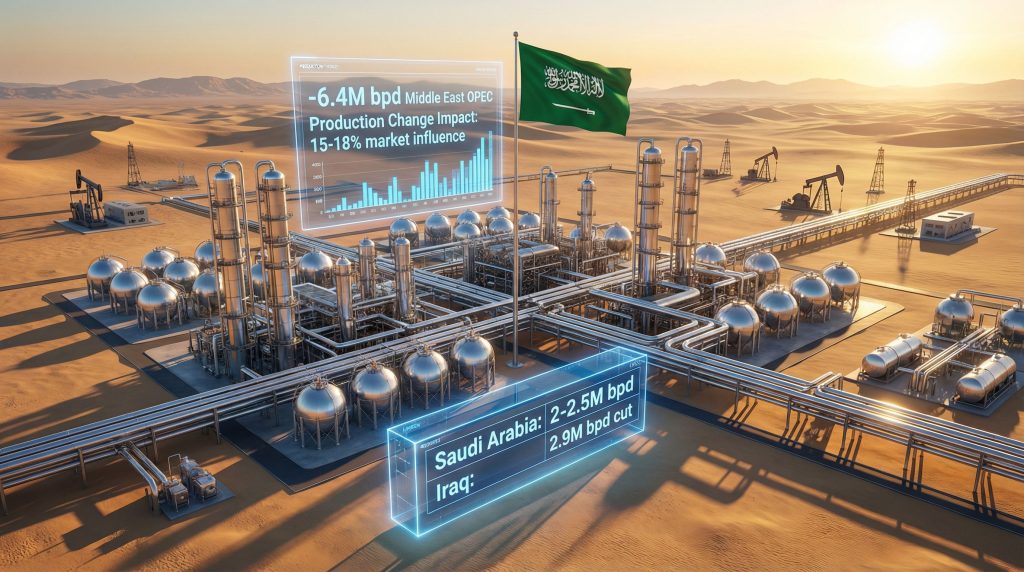
Recent production adjustments demonstrate these principles in action. Saudi Arabia has implemented substantial reductions ranging between 2.0 to 2.5 million barrels per day, while the UAE has reduced production by approximately 500,000 to 800,000 barrels daily. Kuwait has lowered its production by 500,000 barrels per day, with Iraq implementing the most substantial cuts reaching around 2.9 million barrels per day.
Regional Oil Production Adjustment Impact Analysis
| Region | Production Change (bpd) | Market Share Impact | Economic Significance |
|---|---|---|---|
| Saudi Arabia | -2.0M to -2.5M | Largest absolute reduction | Primary swing producer capacity |
| Iraq | -2.9M | Substantial compliance | Revenue prioritisation strategy |
| UAE | -500K to -800K | Moderate adjustment | Balanced production approach |
| Kuwait | -500K | OPEC+ alignment | Strategic coordination |
When big ASX news breaks, our subscribers know first
How Do Oil Production Cuts Impact Global Energy Markets?
Price Discovery Mechanisms in Crude Oil Markets
Oil markets utilise sophisticated pricing mechanisms that incorporate both current supply levels and future expectations. When major producers announce reductions in daily oil output, these signals travel through commodity trading systems, influencing spot prices, futures contracts, and long-term supply agreements simultaneously.
The petroleum pricing structure operates on multiple time horizons, with immediate spot market reactions often followed by longer-term adjustments in investment patterns and infrastructure development. These cascading effects extend beyond energy markets, influencing currency valuations, inflation expectations, and economic growth projections globally. Additionally, tariff impact easing has contributed to recent market stability.
Supply-Demand Balance and Market Psychology
Market psychology plays a crucial role in how production adjustments translate into price movements. The announcement of coordinated reductions creates supply tightness expectations that often generate price responses before physical shortages materialise in the market.
Professional traders and institutional investors analyse production cut announcements through multiple analytical frameworks:
- Immediate supply gap calculations based on current global consumption rates
- Seasonal demand pattern analysis incorporating weather-dependent consumption variations
- Strategic reserve utilisation potential from consuming nations
- Alternative supply source activation possibilities from non-participating producers
Regional Economic Implications of Production Adjustments
The economic impact of production coordination varies significantly across different geographical regions and economic sectors. Energy-importing nations experience increased input costs that flow through their entire economic systems, while energy-exporting regions benefit from improved revenue per barrel but face reduced volume-based income.
Manufacturing sectors dependent on petroleum-based inputs adjust their production schedules and pricing strategies in response to energy cost fluctuations. Transportation industries, including shipping, aviation, and logistics, incorporate these cost changes into their operational models and customer pricing structures. Moreover, recent oil price stagnation has created additional uncertainty for these sectors.
What Drives Coordinated Production Strategies Among Oil Producers?
OPEC+ Framework and Decision-Making Processes
The Organization of the Petroleum Exporting Countries and its allies (OPEC+) operates as the primary coordination mechanism for global oil production management. This framework allows member nations to collectively influence market conditions while maintaining individual sovereignty over their natural resources.
Decision-making within this structure involves complex negotiations that balance each member nation's economic requirements with collective market objectives. Countries consider their fiscal breakeven prices, infrastructure capacity, reserve depletion timelines, and domestic economic diversification goals when participating in coordinated production adjustments.
Economic Incentives Behind Supply Management
Revenue optimisation serves as the primary driver behind coordinated production strategies. Oil-producing nations recognise that uncoordinated production increases can lead to oversupply conditions that depress global prices, ultimately reducing total revenue despite higher production volumes.
Strategic production management enables oil-producing nations to maximise revenue streams while maintaining long-term resource sustainability and market stability, creating optimal conditions for economic planning and infrastructure investment.
The mathematical relationship between production volume and price per barrel creates scenarios where reduced output can generate higher total revenue. This economic principle drives much of the coordination observed in global oil markets, particularly during periods of uncertain demand or geopolitical instability. Consequently, analysis of oil price crash analysis becomes crucial for understanding these dynamics.
Geopolitical Considerations in Energy Policy
Energy security represents a critical component of national security for both producing and consuming nations. Oil-producing countries utilise their production capacity as diplomatic leverage, while importing nations seek to diversify supply sources and reduce dependency on any single region.
The strategic nature of petroleum resources creates complex international relationships where economic cooperation intersects with geopolitical considerations. Production coordination decisions often reflect broader diplomatic objectives beyond immediate economic optimisation. Furthermore, US economy and tariffs dynamics significantly influence global energy trade patterns.
Regional Analysis: Middle Eastern Production Coordination Strategies
Saudi Arabia's Market Leadership Role
Saudi Arabia maintains its position as the world's primary swing producer through its substantial spare production capacity and willingness to make significant output adjustments. The kingdom's recent reductions in daily oil output of 2.0 to 2.5 million barrels per day demonstrates the scale of production flexibility available to major producers.
Key aspects of Saudi Arabia's production strategy include:
- Spare capacity maintenance of approximately 2-3 million barrels per day above current production levels
- Infrastructure investment to support production flexibility and rapid output adjustments
- Revenue optimisation balancing current income requirements with long-term economic diversification objectives
- Market stabilisation through coordinated action with other major producers
The kingdom's production decisions integrate with broader economic transformation initiatives, including industrial diversification programmes and renewable energy development projects. This comprehensive approach ensures that petroleum revenue optimisation supports long-term economic sustainability.
UAE's Balanced Production Approach
The United Arab Emirates has implemented production reductions ranging from 500,000 to 800,000 barrels per day, reflecting a measured approach to market coordination. This strategy demonstrates the country's commitment to collective market management while maintaining operational flexibility for its expanding energy infrastructure.
UAE's production coordination strategy emphasises:
- Downstream integration connecting production adjustments with refining capacity optimisation
- Hub development positioning the country as a regional energy trading centre
- Investment balance maintaining production capability while expanding renewable energy infrastructure
- Economic diversification supporting broader transformation beyond petroleum dependency
Kuwait and Iraq: Emerging Production Dynamics
Kuwait's reduction of 500,000 barrels per day aligns with OPEC+ coordination frameworks while supporting the country's long-term resource management objectives. This measured approach reflects Kuwait's strategy of maintaining production discipline while investing in infrastructure modernisation.
Iraq's substantial production cut of approximately 2.9 million barrels per day represents one of the largest absolute reductions among participating nations. This significant adjustment demonstrates Iraq's commitment to market coordination despite the country's substantial infrastructure investment requirements and economic development needs.
Factors influencing Iraq's production strategy include:
- Infrastructure modernisation requirements for long-term production optimisation
- Revenue prioritisation balancing current income needs with market coordination benefits
- Capacity expansion planning for future production increases when market conditions support growth
- Regional integration participating in broader Middle Eastern energy coordination strategies
How Do Weather-Related Disruptions Affect Global Oil Supply?
North American Winter Impact Assessment
Seasonal weather patterns create predictable supply disruptions that complement strategic production adjustments by major oil-producing nations. Winter conditions in North America typically reduce production efficiency due to equipment winterisation requirements, transportation challenges, and increased energy consumption for field operations.
These natural production variations interact with coordinated cuts from OPEC+ members, creating compound effects on global supply availability. Market analysts incorporate both planned production adjustments and weather-related capacity reductions when forecasting supply-demand balance conditions. According to Bloomberg's analysis, Middle Eastern production adjustments have intensified amid regional tensions affecting shipping routes.
Infrastructure Resilience and Production Recovery
Modern oil production infrastructure incorporates weather resilience features designed to minimise climate-related disruptions. However, extreme weather events can still create temporary supply shortages that amplify the market impact of strategic production coordination.
Recovery timelines from weather-related disruptions vary based on:
- Severity and duration of weather events affecting production regions
- Infrastructure hardening investments in weather-resistant equipment and procedures
- Transportation network resilience for moving petroleum products to market
- Strategic reserve utilisation to offset temporary supply gaps
Seasonal Demand Patterns and Supply Adjustments
Energy consumption patterns vary seasonally, with winter months typically showing increased demand for heating fuels and summer periods requiring higher gasoline production for transportation. Production coordination strategies often account for these predictable demand cycles when timing output adjustments.
Sophisticated market analysis incorporates seasonal demand forecasting with production adjustment timing to optimise price stability throughout the year. This coordination helps prevent excessive price volatility during peak consumption periods.
What Are the Long-Term Economic Implications of Current Production Trends?
Market Rebalancing and Investment Implications
Current production coordination strategies create market conditions that influence long-term investment patterns across the global energy sector. Sustained higher prices resulting from supply management encourage investment in alternative energy sources while supporting continued petroleum infrastructure development.
The economic implications extend beyond immediate price effects:
- Capital allocation patterns shifting between energy sectors based on price stability expectations
- Technology investment acceleration in both traditional and renewable energy infrastructure
- Geopolitical relationships evolving based on energy trade dependencies and supply security concerns
- Economic diversification opportunities for oil-producing nations to develop non-petroleum industries
Investment Capital Allocation in Energy Infrastructure
Production coordination creates price stability that supports long-term infrastructure investment planning. Companies can justify major capital expenditures when revenue projections incorporate coordinated supply management rather than volatile market conditions.
Current market conditions influenced by production adjustments affect:
- Upstream exploration investment decisions based on long-term price expectations
- Refining capacity expansion planning incorporating supply availability forecasts
- Transportation infrastructure development linking production regions with consuming markets
- Storage facility construction for managing supply timing and market optimisation
Economic Diversification Strategies for Oil-Dependent Economies
Oil-producing nations utilise revenue from coordinated production strategies to fund economic diversification initiatives. Higher per-barrel revenues create fiscal space for investing in education, technology, renewable energy, and manufacturing sectors.
Investment Strategy Framework for Energy Portfolios
Consider institutional investors evaluating energy sector exposure during periods of coordinated production management. The strategic nature of current supply reductions creates several investment considerations:
- Upstream energy companies benefit from improved pricing environments and production optimisation
- Integrated oil companies can optimise refining margins through supply chain coordination
- Energy infrastructure investments gain value from increased utilisation and stable cash flows
- Alternative energy projects become more competitive as traditional energy prices stabilise at higher levels
The next major ASX story will hit our subscribers first
Market Response Mechanisms: How Energy Markets Adapt to Supply Changes
Price Elasticity and Consumer Behaviour Patterns
Energy markets demonstrate varying degrees of price responsiveness across different consumer segments and time horizons. Short-term demand often shows limited elasticity, as consumers require time to adjust consumption patterns or invest in alternative energy sources.
Consumer adaptation mechanisms include:
- Immediate conservation measures reducing non-essential energy consumption
- Technology adoption accelerating investment in energy-efficient equipment and vehicles
- Behavioural changes modifying transportation and heating patterns to reduce energy costs
- Alternative energy consideration for residential and commercial applications
Strategic Petroleum Reserve Utilisation
Consuming nations maintain strategic petroleum reserves specifically to offset supply disruptions and moderate price volatility. The decision to utilise these reserves depends on multiple factors including disruption severity, duration expectations, and reserve level maintenance requirements.
Strategic reserve management involves complex decision-making:
- Release timing optimisation to maximise market impact and price moderation
- Replacement strategies for maintaining reserve levels after utilisation
- International coordination with other consuming nations for collective reserve actions
- Market communication regarding reserve utilisation policies and availability
Alternative Energy Acceleration Factors
Production coordination in traditional energy markets creates economic incentives for alternative energy development and adoption. Higher petroleum prices improve the competitive position of renewable energy sources and accelerate investment in clean energy infrastructure.
Market dynamics supporting alternative energy growth include:
- Price competitiveness improvement for renewable energy sources relative to petroleum-based alternatives
- Investment attraction to clean energy projects offering stable long-term returns
- Policy support strengthening as governments seek energy security and environmental objectives
- Technology advancement acceleration driven by increased research and development funding
Investment Perspective: Energy Sector Portfolio Implications
Upstream vs. Downstream Investment Opportunities
The current environment of coordinated production management creates distinct investment opportunities across different segments of the energy value chain. Upstream production companies benefit from improved pricing while downstream operations face varying margin impacts depending on their operational structure.
Strategic Investment Considerations:
- Upstream exploration companies with low-cost production capacity gain significant value from sustained higher prices
- Integrated energy companies can optimise across their value chains to benefit from production coordination
- Downstream refining operations experience varying impacts based on their crude oil sourcing strategies
- Energy services companies supporting production optimisation and infrastructure development
Recent market conditions provide context for energy sector investment analysis. Saudi Aramco reported a 12% decline in net profit for 2025 while maintaining capital investment guidance up to $55 billion for 2026, indicating continued commitment to infrastructure development despite short-term earnings fluctuations.
ESG Considerations in Energy Investment Strategies
Environmental, social, and governance (ESG) factors increasingly influence energy sector investment decisions. Production coordination strategies that optimise resource utilisation and reduce waste align with environmental sustainability objectives while supporting economic development in producing regions.
ESG integration in energy investment includes:
- Environmental impact assessment of production efficiency improvements and waste reduction
- Social responsibility evaluation of community development and economic benefits in producing regions
- Governance standards analysis of transparent decision-making processes and regulatory compliance
- Transition planning assessment of companies' strategies for adapting to evolving energy markets
Renewable Energy Transition Timeline Impact
Coordinated production management in traditional energy markets affects the timeline and economics of renewable energy transition. Stable petroleum pricing creates predictable conditions that support both continued traditional energy investment and competitive renewable energy development.
Transition timeline factors include:
- Technology cost curves for renewable energy becoming increasingly competitive with traditional sources
- Infrastructure investment requirements for supporting renewable energy integration
- Policy frameworks supporting transition while maintaining energy security during the changeover period
- Economic planning horizons for energy companies investing in both traditional and renewable capacity
Future Outlook: Sustainable Production Management in Global Energy Transition
Technology Integration in Production Optimisation
Advanced technology applications enable more precise production management and coordination among oil-producing nations. Digital monitoring systems, artificial intelligence analytics, and real-time market data integration support sophisticated production optimisation strategies.
Technological advancement areas include:
- Production monitoring systems providing real-time output data and optimisation recommendations
- Market analysis tools incorporating global supply-demand data for coordination decision-making
- Infrastructure efficiency improvements reducing production costs and environmental impact
- Communication systems enabling rapid coordination among participating nations and companies
Climate Policy Influence on Production Decisions
International climate policy frameworks increasingly influence oil production strategies and coordination mechanisms. Producing nations integrate carbon emissions considerations, renewable energy development goals, and international environmental commitments into their production planning. Reports from Reuters indicate that Middle Eastern countries continue implementing substantial output reductions as part of coordinated market management strategies.
Climate policy integration affects:
- Production efficiency standards incorporating environmental impact minimisation
- Revenue allocation toward renewable energy development and carbon offset programmes
- International cooperation on climate objectives while maintaining energy security
- Technology investment in cleaner production methods and carbon capture systems
Energy Security vs. Environmental Objectives Balance
The challenge of balancing immediate energy security requirements with long-term environmental sustainability creates complex decision-making frameworks for both producing and consuming nations. Production coordination strategies increasingly incorporate environmental considerations alongside economic optimisation.
Balancing mechanisms include:
- Gradual transition planning supporting renewable energy development while maintaining supply security
- Investment diversification spreading resources between traditional and renewable energy infrastructure
- Policy coordination aligning energy security and environmental objectives through comprehensive frameworks
- Technology development supporting cleaner traditional energy production during the transition period
Why do oil-producing countries coordinate production cuts?
Countries coordinate production adjustments to optimise collective revenue, maintain price stability, and manage long-term reserve depletion while responding to global economic conditions and demand patterns.
How do production cuts affect global economic growth?
Strategic production adjustments can support energy price stability, which influences inflation rates, transportation costs, and industrial input prices across all economic sectors globally.
What factors determine the size of production adjustments?
Production adjustment decisions consider current market inventory levels, demand forecasts, spare production capacity, economic diversification goals, and geopolitical stability requirements.
Disclaimer: This analysis is provided for educational purposes and should not be considered as investment advice. Energy markets involve significant risks, and investment decisions should be based on individual circumstances and professional financial guidance. Production figures and market conditions are subject to change based on evolving global economic and geopolitical factors.
Further exploration of global energy market dynamics and production coordination strategies can be found through various educational resources on energy economics and international energy policy frameworks available from academic and research institutions worldwide.
Want to stay ahead of energy market opportunities?
Discovery Alert's proprietary Discovery IQ model delivers real-time alerts on significant ASX mineral discoveries, including energy and critical minerals sectors, instantly empowering subscribers to identify actionable opportunities ahead of the broader market. Begin your 14-day free trial today and secure your market-leading advantage in the evolving energy transition landscape.