
July 18, 2026
**Understanding the Structural Forces Behind Oil Market Volatility**
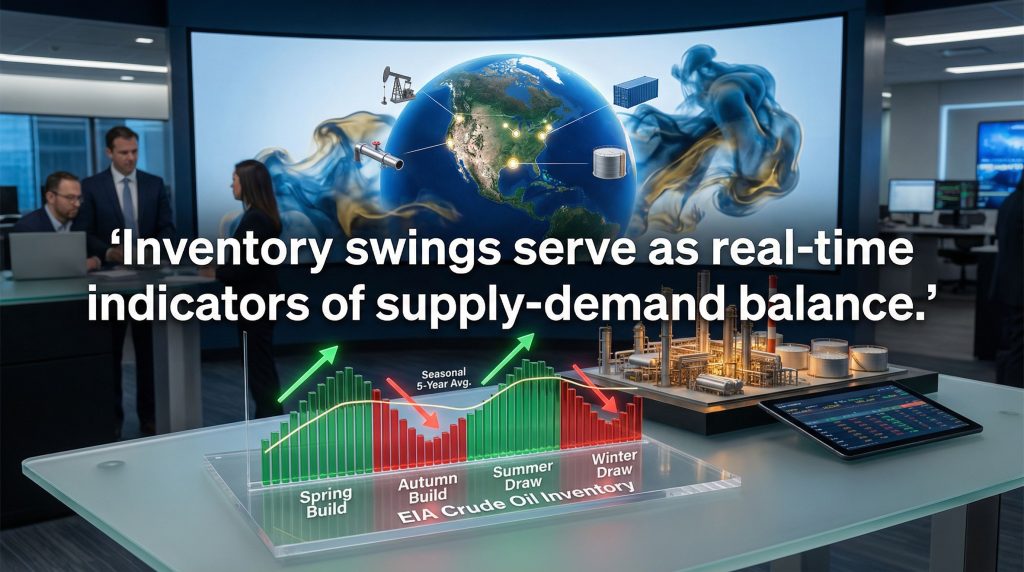
Modern energy markets operate in a complex web where supply and demand intertwine. In this environment, the EIA crude oil inventory swing serves as a vital indicator of market sentiment. Furthermore, recent events have spurred an oil price rally across global commodity markets.
Seasonal patterns and economic indicators add further complexity. Consequently, strategic decisions depend heavily on inventory fluctuations and evolving trade relationships, including influences from trade war oil movements.
When big ASX news breaks, our subscribers know first
**The Mechanics of Supply Chain Disruption and Recovery**
Weather-related production interruptions can suddenly reshape market dynamics. Recent freeze-offs led to a dramatic climb in inventories, with commercial crude stockpiles reaching 435.8 million barrels in February 2026. This event contributed to a 16 million barrel increase over one week, underscoring volatile week-to-week changes.
Analysts note that such swings sometimes follow cycles of stagnant oil prices as recovery lags interplay with production halts. Moreover, some regions have experienced an oil production decline, prompting closer scrutiny of output figures.
Furthermore, detailed summaries of these shifts can be found through specialized agencies. In addition, resources like oil market data offer further clarity on these rapid changes.
**Market Psychology and Behavioural Response Patterns**
Financial markets often react sharply to weekly inventory changes. Algorithmic trading systems and speculative positioning may amplify even modest shifts, contributing to significant price volatility. As a result, traders must distinguish between transient anomalies and underlying market trends.
Following the February 25, 2026 release, crude oil prices responded immediately. WTI crude traded at $65.84 per barrel while Brent crude reached $71.09 per barrel. These rapid adjustments underscore market sensitivity and the importance of timely data interpretation.
Furthermore, behavioural finance considerations—such as risk management and herd mentality—play a crucial role. In addition, outcomes of key meetings, reflected by discussions on the opec meeting impact, further influence trading decisions.
**Regional Infrastructure and Economic Distribution Patterns**
Geographic storage and regional demand characteristics significantly shape market responses. Various regions exhibit unique functions, ranging from refining hubs to agricultural centres that drive seasonal consumption. Infrastructure in these sectors is vital to ensuring smooth oil flow and competitive pricing.
The table below highlights differences across key regions:
| Region | Strategic Function | Economic Significance |
|---|---|---|
| Gulf Coast | Refining concentration hub | Export capacity limitations |
| Midwest | Agricultural demand centre | Seasonal consumption variations |
| West Coast | Import dependency zone | Premium pricing dynamics |
| East Coast | Population density focus | Infrastructure modernisation needs |
Infrastructure investment remains a top priority. Key areas include pipeline expansion, storage facility development, and port modernisation. In addition, these projects help reduce bottlenecks and improve overall supply chain efficiency.
**Demand-Side Economic Health Indicators**
Four-week rolling averages for petroleum products reveal robust economic momentum. Recent figures show 21.4 million barrels per day in total products supplied, marking a 5.4% year-over-year increase. Despite short-term inventory volatility, these figures indicate solid underlying demand.
These averages cover diverse sectors such as transportation and industrial use. For instance, the breakdown is as follows:
- Gasoline Demand: Four-week average of 8.5 million barrels per day.
- Distillate Consumption: Averaging 4.4 million barrels daily, with 4% growth.
- Production Metrics: Gasoline production at 9.2 million barrels daily; middle distillates at 4.8 million barrels daily.
Market intelligence suggests that the stability of these averages confirms that the EIA crude oil inventory swing signals timing adjustments rather than deep-seated economic shifts.
**International Trade Balance and Strategic Considerations**
Domestic inventory levels directly shape a nation’s trade balance. Export terminal utilisation, import dependencies, and strategic alliances all influence energy security. In addition, these factors highlight the interdependence between supply management and international trade policies.
Current inventory levels, reported at 3% below seasonal averages, suggest an underlying tightness. Consequently, decisions regarding export capacity and import requirements may be adjusted during peak periods, such as the spring refinery maintenance season.
The next major ASX story will hit our subscribers first
**Investment Market Responses and Capital Allocation Strategies**
Investors rely on real-time data to guide capital allocation decisions. These trends impact upstream exploration investments, downstream capacity planning, and midstream infrastructure projects. In this context, the recent EIA crude oil inventory swing has provided essential insights into market stability.
Key elements in the investment decision framework include:
- Upstream Analysis: Adjusting exploration budgets in response to supply shifts.
- Downstream Planning: Realigning refining capacity with emerging demand signals.
- Midstream Development: Enhancing pipeline and storage optimisation.
- Renewable Transition: Balancing investments in traditional and alternative energy sources.
In addition, external insights, such as those from a comprehensive global oil outlook, deepen understanding of long-term trends and risks.
**Seasonal Pattern Analysis and Economic Forecasting Models**
Seasonal inventory cycles provide a framework for distinguishing cyclical adjustments from structural changes. Current inventory levels—3% below five-year averages—offer critical context for economic forecasting during traditional build periods.
Seasonal analysis examines several key components:
- Winter Heating Patterns: Inventory draws reflect demand for residential and commercial heating.
- Spring Maintenance Season: Refineries undergo maintenance, influencing stock levels.
- Summer Driving Preparation: Stock builds in anticipation of increased gasoline demand.
- Hurricane Season Planning: Strategic reserves are adjusted for potential disruptions.
These components work together to inform policymakers and investors alike about the timing and scale of market movements.
**Policy Framework and Strategic Government Response**
Government agencies closely monitor inventory trends to shape strategic responses. Timely adjustments to strategic petroleum reserves, export licences, and emergency protocols are vital during periods of volatility. In addition, regulators work to maintain a balance between domestic supply and international obligations.
Policy responses are often implemented during periods of sudden shifts. For instance, meetings and discussions may prompt a reconsideration of export policies. Such measures help stabilise markets and reinforce investor confidence.
**Future Market Evolution and Risk Assessment Scenarios**
Long-term transitions to lower-carbon alternatives may reshape traditional inventory patterns. As market participants assess risks and opportunities, evolving geopolitical and climatic factors become increasingly important. In addition, these shifts are expected to redefine industry standards over the coming years.
Analysts forecast that this EIA crude oil inventory swing will act as a pivotal indicator of emerging risks. Moreover, the forecast assists in differentiating between temporary supply disruptions and lasting shifts.
Scenario planning now incorporates several considerations:
- Transportation Evolution: The rise of electric vehicles alters gasoline demand.
- Grid Integration: Increasing reliance on renewable energy influences backup fuel strategies.
- Geopolitical Realignment: Shifts in international alliances can affect oil distribution.
- Climate Policy Implementation: New regulations may modify consumption patterns.
Furthermore, recent studies emphasise that dynamic forecasting models are essential. Consequently, investors are urged to remain agile and well informed.
Understanding these complex dynamics is vital for policymakers, investors, and industry stakeholders. By analysing key indicators and trends, market actors can refine strategies and respond effectively. In conclusion, regular monitoring of inventory patterns remains essential for navigating a volatile global energy market.
Ready to Capitalise on Energy Market Volatility?
Discovery Alert's proprietary Discovery IQ model delivers real-time alerts on significant mineral discoveries across the ASX, helping investors identify actionable opportunities in volatile commodity markets. Start your 14-day free trial today and gain immediate access to morning AI trade alerts that turn complex market data into clear investment insights.