June 6, 2026
Global energy markets operate within complex frameworks where geopolitical tensions create cascading economic effects across interconnected systems. When regional conflicts emerge in oil-producing regions, particularly those controlling strategic transportation chokepoints, the ripple effects extend far beyond immediate supply disruptions. Understanding these market dynamics requires examining multiple layers of economic influence, from immediate price discovery mechanisms to long-term structural adjustments that reshape global energy allocation patterns.
What Economic Forces Drive Oil Price Volatility During Middle Eastern Conflicts?
Understanding the Petroleum Risk Premium Framework
Market psychology during geopolitical crises operates on risk premium calculations that often exceed actual supply disruption impacts. The impact of Iran war on oil prices demonstrates this phenomenon clearly, with Brent crude surging to $82.37 per barrel on March 2, 2026, representing a 13% intraday spike before moderating to 7.4% gains at settlement. This price behaviour illustrates how fear-driven buying creates temporary premium layers that gradually unwind as market participants assess real versus perceived threats.
Historical correlation patterns reveal that energy markets embed uncertainty coefficients into pricing structures ahead of actual supply shortfalls. The March 2026 crisis showed this dynamic when traders had already factored risk premiums into valuations before conflicts escalated, explaining why prices retreated from peak levels as fundamental analysis replaced emotional positioning.
Furthermore, speculative trading amplification occurs through algorithmic systems that respond to news flow and volatility spikes with predetermined liquidation patterns. During the Iranian crisis, the 5-percentage-point correction between peak and settlement prices reflected systematic unwinding as market fundamentals became clearer, demonstrating how modern trading infrastructure both accelerates and moderates crisis-driven price movements.
Supply Chain Vulnerability Assessment
Critical infrastructure exposure analysis focuses on chokepoint dependencies that create systemic risks within global energy transportation networks. The Strait of Hormuz exemplifies this vulnerability, with approximately 20% of global oil demand transiting this waterway daily, creating single-point-of-failure risks for energy security across major consuming regions.
Moreover, regional production capacity distribution effects become apparent when conflicts disrupt established export patterns. Iran's position within global supply dynamics, while representing roughly 3.2% of daily production, carries disproportionate market influence due to its strategic location and the concentration of regional exports through vulnerable maritime corridors.
Transportation corridor dependency mapping reveals how shipping route alternatives carry significant cost premiums compared to standard routing. The March 2026 crisis demonstrated this when over 200 vessels anchored outside the Strait rather than attempting transit, creating de facto supply disruptions despite the waterway remaining physically navigable.
When big ASX news breaks, our subscribers know first
Why Is the Strait of Hormuz Central to Global Energy Economics?
Strategic Chokepoint Analysis
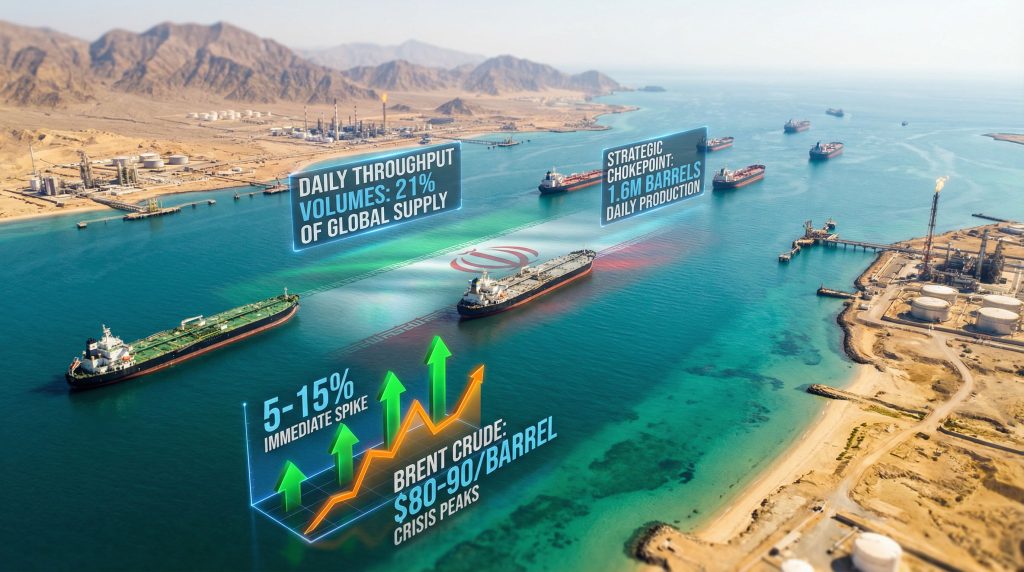
Daily throughput volumes through the Strait of Hormuz represent approximately 20% of global oil demand, making this waterway one of the most economically significant geographic features in global energy markets. Ships carrying crude oil from Saudi Arabia, UAE, Iraq, Iran, and Kuwait must transit this narrow passage to reach major Asian markets, including China and India, which collectively represent the largest growth centres for energy consumption.
The economic impact of shipping route disruptions extends beyond immediate supply concerns to encompass broader market confidence factors. When the March 2026 crisis forced shipping companies to adopt "anchor and wait" strategies rather than attempting transit, the resulting backlog of vessels created supply chain bottlenecks that rippled through downstream industries dependent on petroleum products and petrochemical feedstocks.
In addition, alternative transportation cost differentials make the Strait economically irreplaceable for regional producers. Pipeline alternatives lack sufficient capacity to handle the volume currently moving through maritime routes, while alternative shipping paths around Africa or through other regional waterways carry prohibitive time and fuel cost premiums that would fundamentally alter the economics of Middle Eastern energy exports.
Maritime Insurance and Shipping Cost Dynamics
War risk premium calculations during regional conflicts create immediate cost escalations for maritime transportation that get embedded into commodity pricing structures. Insurance markets respond to geopolitical uncertainty by adjusting coverage terms and premium structures, often making certain shipping routes temporarily uneconomical regardless of underlying commodity demand.
Fleet availability and routing decisions reflect real-time risk assessment by shipping companies balancing potential voyage profits against vessel security concerns. The decision by major tanker operators to anchor outside the Strait rather than attempt transit during active hostilities demonstrates how operational risk management can create supply disruptions independent of actual infrastructure damage.
Consequently, time charter rate fluctuations during crisis periods create additional cost layers that affect final delivered energy prices. When standard shipping schedules become unreliable due to security concerns, the resulting schedule disruptions force buyers to secure alternative transportation at premium rates, costs that ultimately flow through to consumer energy pricing.
How Do Oil Markets React to Iranian Production Disruptions?
Iran's Position in Global Supply Dynamics
| Metric | Volume | Global Share | Primary Destinations |
|---|---|---|---|
| Daily Production | 1.6M barrels | 3.2% | China (60%), India (25%) |
| Proven Reserves | 208B barrels | 12.4% | Asia-Pacific region |
| Export Revenue | $35B annually | 80% of govt income | Refineries in East Asia |
Iran's production capacity represents a relatively modest share of global output, but its strategic importance extends beyond volume considerations. The concentration of Iranian exports to specific Asian markets, particularly China and India, means that supply disruptions create localised shortages that force importing nations to secure alternative supplies at premium pricing, amplifying regional price volatility. For deeper insights into how oil prices respond to geopolitical tensions, understanding oil price rally insights can provide valuable context.
The revenue dependency relationship between Iranian government finances and energy exports creates additional market dynamics during conflicts. With petroleum exports representing approximately 80% of government income, sustained production disruptions carry fiscal implications that can influence conflict duration and resolution strategies, factors that energy markets attempt to price into forward contracts.
Substitution Economics and Market Rebalancing
Saudi Arabia's spare capacity utilisation potential represents the primary mechanism for global oil market rebalancing during supply disruptions. Analysis from energy market specialists indicates that every OPEC+ producer operates essentially at capacity except Saudi Arabia, making the kingdom the critical swing producer capable of offsetting Iranian production losses during extended conflicts.
OPEC market influence demonstrates immediate coordination capability during the March 2026 crisis, with the organisation agreeing to a 206,000 barrels per day output increase for April. However, this modest increase highlights the limited availability of spare capacity across the producer group, suggesting that sustained Iranian disruptions could create supply deficits that require demand destruction through higher prices.
Strategic petroleum reserve deployment scenarios provide temporary buffering capacity for major consuming nations during supply emergencies. The International Energy Agency confirmed coordination readiness with major Middle Eastern producers, indicating pre-positioned policy response mechanisms designed to moderate price spikes through coordinated stockpile releases.
What Are the Immediate Market Mechanics During Crisis Events?
Price Discovery Patterns in Volatile Conditions
Oil prices typically surge 5-15% immediately following Middle Eastern conflict escalation, driven by supply disruption fears rather than actual shortages. Brent crude historically peaks at $80-90/barrel during regional crises before stabilising as markets assess real versus perceived threats. This pattern reflects the systematic relationship between geopolitical uncertainty and energy market risk premium adjustments.
The March 2026 Iranian crisis exemplified these price discovery mechanics, with Brent crude reaching $82.37/barrel during peak fear trading before retreating to $78.28/barrel at settlement. Similarly, WTI crude climbed to $75.33/barrel before moderating to $71.76/barrel, demonstrating how initial panic buying gives way to fundamental analysis as market participants evaluate actual versus perceived supply threats.
Market psychology assessment during crisis events reveals the distinction between geopolitical shocks and systemic crises. Analysis from energy market specialists suggests that markets differentiate between temporary supply disruptions and broader credit system threats, with the former creating commodity-specific volatility while the latter triggers broader market liquidation patterns.
Trading Volume and Volatility Amplification
Algorithmic trading response patterns during geopolitical crises create amplification effects that exceed traditional supply-demand calculations. Modern energy markets incorporate high-frequency trading systems that respond to news flow and volatility spikes with predetermined position adjustments, creating rapid price movements that can overshoot fundamental valuations in either direction.
The 5-percentage-point daily reversal between peak and settlement prices during the March 2026 crisis demonstrates how modern market microstructure affects price discovery during volatile conditions. This intraday correction pattern suggests that while initial algorithmic responses create dramatic price spikes, subsequent fundamental analysis and profit-taking moderate extreme moves within single trading sessions.
Furthermore, options market positioning and gamma effects during crisis events require examination of derivative market structures that can amplify underlying commodity volatility. Energy options markets often experience significant implied volatility expansion during geopolitical events, creating feedback loops that influence spot market pricing through hedging activities and risk management adjustments.
How Do Different Conflict Scenarios Affect Long-Term Pricing?
Duration-Based Impact Modeling
| Conflict Duration | Price Impact Range | Key Variables | Market Recovery Time |
|---|---|---|---|
| 1-7 days | 5-15% spike | Insurance halts, shipping delays | 2-4 weeks |
| 1-3 months | 20-40% sustained | Infrastructure damage, sanctions | 6-12 months |
| 6+ months | 50-80% structural | Regime change, supply reallocation | 18-36 months |
Duration-based impact modelling reveals how market pricing mechanisms adapt to conflict timeline expectations. Short-term disruptions typically generate temporary risk premiums that unwind quickly once normal operations resume, while extended conflicts force structural adjustments in global supply allocation patterns that create longer-lasting price effects.
Infrastructure vulnerability assessment becomes critical for understanding potential conflict duration impacts. Physical damage to production facilities, export terminals, or transportation infrastructure creates supply disruptions that extend beyond immediate hostilities, requiring months or years for full capacity restoration depending on damage severity and available reconstruction resources.
Additionally, regime change scenarios introduce additional complexity layers into energy market forecasting, as new governments may implement different production policies, export strategies, or international relationship patterns that permanently alter regional energy market dynamics beyond immediate conflict resolution.
Historical Precedent Analysis
The Iran-Iraq War (1980-1988) provides the most relevant historical precedent for sustained regional conflict impacts on global energy markets. During this eight-year conflict, oil prices experienced multiple surge-and-retreat cycles as markets repeatedly adjusted expectations about conflict duration and regional production capacity destruction.
Gulf War economic impacts (1990-1991) demonstrated how rapid military resolution could limit long-term energy market disruption despite initial dramatic price spikes. The brief duration of active combat operations allowed damaged infrastructure to be repaired relatively quickly, enabling price normalisation within months rather than years.
Arab Oil Embargo lessons (1973-1974) illustrate how coordinated supply restrictions can create structural price adjustments that persist beyond the immediate political crisis. The quadrupling of oil prices during this period established new baseline pricing expectations that influenced global energy markets for decades, showing how geopolitical events can create permanent market structure changes.
What Secondary Economic Effects Ripple Through Global Markets?
Inflation Transmission Mechanisms
Energy cost pass-through to consumer prices operates through multiple channels that amplify initial commodity price increases throughout the broader economy. Transportation costs, heating expenses, and petroleum-based product pricing all adjust rapidly to crude oil price movements, creating inflationary pressures that extend beyond direct energy consumption.
Manufacturing input cost adjustments occur as industries dependent on petroleum-derived chemicals, plastics, and synthetic materials experience margin compression during energy price spikes. These costs eventually flow through to consumer goods pricing, creating delayed inflationary effects that persist after initial energy price volatility subsides.
However, the economic multiplier effects from energy price increases typically exceed the direct percentage impact on consumer price indices due to the pervasive role of energy inputs throughout economic production chains. A 20% increase in crude oil prices often translates to 2-3% broader inflationary pressure as energy costs compound through multiple economic sectors. Understanding trade war oil movements can provide additional insight into these complex economic relationships.
Currency and Equity Market Correlations
Petrodollar recycling patterns during price spikes create currency market flows that can strengthen or weaken major trading currencies depending on net energy trade balances. Energy-exporting nations experience currency appreciation pressure during price increases, while importing nations face depreciation pressures that can amplify imported inflation effects.
Energy sector equity performance divergence during geopolitical crises typically sees upstream exploration and production companies outperform while downstream refining and distribution companies face margin pressure. Aramco shares rose 3.37% during the March 2026 crisis, demonstrating how market participants differentiate between different segments of the energy value chain during supply disruptions.
In addition, emerging market currency vulnerability assessment becomes critical during energy price volatility, as many developing economies maintain high energy import dependencies that create balance-of-payments pressures during sustained price increases. These pressures can trigger capital flight and currency devaluation cycles that amplify regional economic instability.
The next major ASX story will hit our subscribers first
How Do OPEC+ Dynamics Influence Crisis Response?
Production Coordination During Supply Shocks
OPEC+ spare capacity allocation decisions during regional conflicts balance revenue optimisation against market stability considerations. The organisation's ability to coordinate rapid production increases depends heavily on Saudi Arabia's willingness and capability to activate spare capacity, as most other member nations operate at or near maximum sustainable production levels.
The OPEC production increase of 206,000 barrels per day agreed during the March 2026 crisis demonstrates both the organisation's coordination capability and its capacity constraints. This modest increase represents the immediately available spare capacity within the OPEC+ system, highlighting how limited flexibility exists for offsetting major producer disruptions without longer-term capacity development.
Revenue optimisation versus market stability creates ongoing tension within OPEC+ decision-making during crisis events. While higher prices benefit member nation revenues in the short term, excessive price levels can trigger demand destruction and accelerate alternative energy adoption that reduces long-term market share for petroleum exporters.
Strategic Reserve Utilisation Frameworks
International Energy Agency coordinated release mechanisms provide established protocols for managing supply emergencies through strategic petroleum stockpile deployment. The IEA confirmed readiness for coordination with major Middle Eastern producers during the March 2026 crisis, indicating pre-positioned policy response capabilities designed to moderate extreme price volatility.
Global inventory sufficiency currently stands at 7.827 million barrels, providing approximately 74 days of demand coverage according to recent analysis. This inventory level represents near-historical median coverage, suggesting adequate but not excessive buffer capacity for managing temporary supply disruptions without triggering strategic reserve releases.
Furthermore, national stockpile deployment criteria vary among major consuming nations, with some countries maintaining higher strategic reserves relative to consumption patterns than others. These deployment decisions create coordination challenges during international crisis response, as different nations may prioritise domestic supply security over global market stability.
What Are the Investment Implications for Energy Markets?
Sector Rotation and Capital Allocation Shifts
Energy equity valuation adjustments during geopolitical crises typically favour companies with diverse geographic exposure and established alternative supply relationships over those with concentrated regional dependencies. Investors systematically repriced energy sector holdings during the March 2026 crisis based on operational exposure to Middle Eastern supply chain risks.
Renewable energy investment acceleration often receives policy support during energy security crises as governments seek to reduce dependence on volatile petroleum markets. While immediate supply disruptions require conventional energy solutions, sustained geopolitical uncertainty can accelerate long-term transition planning and renewable capacity development.
Consequently, infrastructure security premium calculations become embedded into energy project valuations as investors assess political risk factors alongside traditional economic returns. Projects in stable jurisdictions command valuation premiums over comparable developments in regions with higher geopolitical uncertainty, regardless of underlying resource quality or development costs.
Commodity Trading Strategy Adaptations
Contango versus backwardation positioning during supply crises reflects market expectations about conflict duration and resolution likelihood. The energy futures curve structure provides insights into whether traders expect temporary disruptions (supporting backwardation) or sustained supply constraints (supporting contango) that influence optimal hedging strategies.
Cross-commodity spread relationships during energy crises often create trading opportunities as different petroleum products, natural gas, and coal experience varying supply-demand dynamics. Traders systematically analyse these spread relationships to identify arbitrage opportunities that emerge during market dislocations.
Moreover, hedging cost optimisation during volatility requires sophisticated risk management approaches as option premiums expand significantly during geopolitical uncertainty. Energy consumers and producers must balance hedging costs against potential price movement exposure, often requiring dynamic adjustment of hedge ratios based on evolving market conditions.
How Do Gasoline Prices Respond to Crude Oil Disruptions?
Refining Margin Dynamics
Crack spread expansion during supply constraints creates divergent price movements between crude oil and refined products that affect downstream industry profitability. US gasoline futures surged 9.1% to $2.496 per gallon during the March 2026 crisis, representing the highest levels since July 2024, demonstrating how refining margins expand during supply uncertainty.
Regional gasoline market segmentation effects create varying consumer price impacts depending on refinery configurations, distribution networks, and local market competition patterns. Areas dependent on complex refineries optimised for specific crude oil types experience greater price volatility during supply disruptions that affect their preferred feedstock sources.
Additionally, seasonal demand overlay considerations influence how crude oil price increases translate to gasoline price changes, with summer driving seasons typically amplifying price transmission effects while winter periods may show more muted consumer price responses depending on regional heating oil versus gasoline demand patterns.
Consumer Economic Impact Assessment
Household budget allocation shifts during energy price spikes create broader economic effects as consumers reduce discretionary spending to accommodate higher transportation and heating costs. Economic research indicates that sustained gasoline price increases above $3.00 per gallon typically trigger measurable reductions in consumer spending on non-essential goods and services, as reported by the Atlantic Council's analysis on oil market impacts.
Economic growth drag coefficients from energy price increases operate through multiple channels including reduced consumer spending, higher transportation costs for goods distribution, and increased production costs for energy-intensive industries. Historical analysis suggests that sustained 20% energy price increases typically reduce GDP growth by approximately 0.3-0.5 percentage points annually.
Political implications of fuel price increases create policy response pressures that can influence government intervention decisions during energy crises. Rising gasoline prices ahead of election cycles often trigger political pressure for strategic reserve releases, fuel tax suspensions, or other intervention measures designed to moderate consumer price impacts.
What Long-Term Structural Changes Could Emerge?
Energy Security Policy Responses
Strategic reserve expansion initiatives often receive increased policy attention and funding allocation following supply disruption events that highlight vulnerability to import dependence. Nations with limited domestic energy production typically reassess stockpile adequacy and consider expanding storage capacity to provide greater buffer against future supply emergencies.
Alternative supply route development becomes a strategic priority for major energy importers seeking to diversify transportation pathways and reduce dependence on single chokepoint routes. Pipeline development, liquefied natural gas terminal construction, and rail transportation capacity expansion represent common policy responses to supply route vulnerability.
In addition, domestic production incentive programmes receive enhanced political support during energy security crises as governments balance environmental concerns against supply security imperatives. Tax incentives, regulatory streamlining, and direct investment support for domestic energy development often emerge from crisis-driven policy reviews.
Transition Acceleration Scenarios
Renewable energy adoption timeline compression can result from sustained periods of fossil fuel price volatility that improve the relative economics of alternative energy investments. High petroleum prices make renewable alternatives more economically competitive while reducing payback periods for clean energy infrastructure investments.
Electric vehicle market penetration effects accelerate during periods of sustained high gasoline prices as consumers seek alternatives to petroleum-dependent transportation. Fleet operators and individual consumers often accelerate electrification timelines when petroleum price volatility creates uncertainty about future operating costs.
Furthermore, energy independence policy implementations receive increased political support during supply security crises, leading to accelerated domestic renewable energy development, energy efficiency programmes, and alternative fuel mandates designed to reduce import dependency and enhance supply security resilience.
Frequently Asked Questions About Iran War Oil Price Impacts
How quickly do oil prices react to Middle Eastern conflicts?
Oil markets typically respond within hours of conflict escalation, with futures contracts showing immediate price adjustments as trading begins in Asian markets. The March 2026 Iranian crisis demonstrated this rapid response, with Brent crude surging 13% during early Asian trading before moderating as fundamental analysis replaced initial fear-driven buying.
What percentage of global oil supply could be at risk?
Approximately 20% of global oil demand transits the Strait of Hormuz daily, making this the most vulnerable single chokepoint in global energy transportation. Additional risk exists from Iranian production capacity and potential secondary effects on neighbouring producer nations, creating total at-risk supply of approximately 25-30% of global petroleum trade.
How long do geopolitical oil price spikes typically last?
Historical analysis indicates that geopolitical price spikes typically moderate within 2-4 weeks unless actual supply infrastructure suffers damage. Temporary diplomatic crises often create 1-2 week price premiums, while sustained conflicts involving infrastructure damage can maintain elevated prices for 6-18 months depending on repair timelines and alternative supply activation.
Which countries are most vulnerable to supply disruptions?
Asian economies with high energy import dependence, particularly China and India, face the greatest vulnerability to Middle Eastern supply disruptions. South Korea and Japan also maintain significant exposure, while European nations have more diverse supply sources that provide greater resilience against single-region disruptions.
What role do strategic reserves play in price stabilisation?
Strategic petroleum reserves provide temporary supply buffers that can moderate price spikes during supply emergencies. Current global inventories of 7.827 million barrels provide approximately 74 days of demand coverage, offering sufficient buffer capacity to manage temporary disruptions while alternative supplies activate or diplomatic solutions emerge.
Navigating Energy Market Uncertainty
Key Monitoring Indicators for Investors
Strait of Hormuz shipping traffic data provides real-time assessment of supply chain functionality and risk escalation. Daily vessel counts, transit times, and insurance premium adjustments offer leading indicators of supply disruption severity and market sentiment regarding conflict duration expectations.
Insurance market pricing signals often precede commodity price movements as maritime insurance providers adjust war risk premiums based on security assessments and operational risk evaluations. These adjustments can signal escalating tensions before they fully manifest in commodity pricing.
OPEC+ production adjustment announcements provide critical insights into spare capacity utilisation and producer coordination capabilities. The organisation's ability to coordinate rapid production increases serves as a key stabilising mechanism during regional supply disruptions.
Risk Management Strategies
Portfolio diversification considerations should include geographic exposure analysis for energy investments, with particular attention to operational dependencies on vulnerable transportation routes or politically unstable regions. Investors may benefit from maintaining exposure to energy companies with diverse operational footprints and alternative supply relationships. However, understanding oil price stagnation analysis can help identify periods when diversification may be particularly crucial.
Hedging instrument utilisation becomes critical for energy-intensive businesses during periods of elevated geopolitical uncertainty. Options contracts, futures positioning, and commodity-linked financial instruments provide risk management tools for managing price volatility exposure, though hedging costs typically increase during crisis periods.
Long-term energy transition positioning recognises that geopolitical supply disruptions often accelerate alternative energy adoption timelines. Investors may consider balancing traditional energy investments with renewable energy infrastructure and electrification technology investments that benefit from petroleum market volatility and energy security policy responses.
Finally, the impact of Iran war on oil prices demonstrates the interconnected nature of geopolitical events and global energy markets, requiring sophisticated analysis and risk management approaches. As Columbia University's energy policy research suggests, understanding these dynamics becomes increasingly important for both investors and policymakers navigating an uncertain energy landscape.
Disclaimer: This analysis is based on publicly available information and market data as of the referenced dates. Energy markets remain highly volatile and subject to rapid changes based on geopolitical developments, policy decisions, and economic factors. Investors should conduct independent research and consult qualified financial advisors before making investment decisions based on this information. Past performance does not guarantee future results, and all investments carry inherent risks including potential loss of principal.
Looking to Capitalise on Energy Market Volatility?
Discovery Alert's proprietary Discovery IQ model delivers real-time alerts on significant ASX mineral discoveries, including energy and resource opportunities that often surge during geopolitical uncertainty. Stay ahead of market movements with instant notifications that turn complex mineral data into actionable insights, ensuring you don't miss the next breakthrough discovery while energy markets remain volatile. Begin your 14-day free trial at Discovery Alert today and position yourself to benefit from both energy sector opportunities and broader resource market developments.