July 28, 2026
Oil prices falling due to global surplus has become the defining characteristic of energy markets throughout 2025, as crude oil experienced its steepest annual decline since the pandemic-induced collapse of 2020. The confluence of structural oversupply conditions, weakening demand growth trajectories, and shifting geopolitical dynamics created a perfect storm that fundamentally reshaped pricing mechanisms across international petroleum markets. Understanding these interconnected forces requires examining both the immediate catalysts and underlying structural changes that continue to influence market behavior.
The magnitude of supply-demand imbalances reached levels not witnessed since the early stages of the COVID-19 pandemic, when global mobility restrictions temporarily eliminated approximately 20 million barrels per day of petroleum demand. However, unlike the temporary demand destruction of 2020, the 2025 market conditions reflect structural production increases occurring alongside persistently weak consumption growth patterns across major economies.
The Mechanics Behind Crude Oil's Sharp Decline
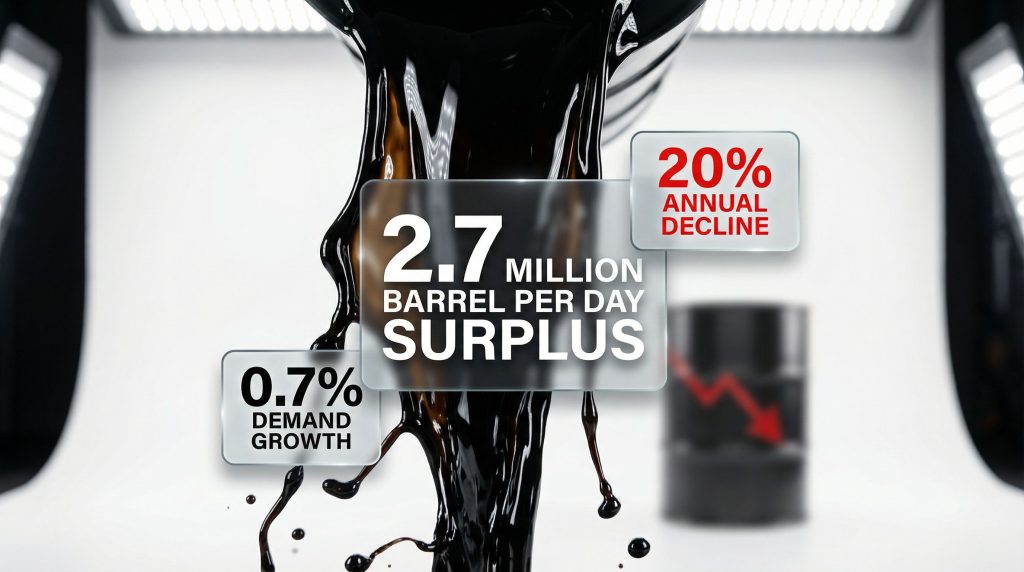
The global petroleum market entered 2025 with underlying supply-demand fundamentals already showing signs of deterioration, but the severity of the price collapse caught many analysts by surprise. West Texas Intermediate crude futures settled at $57.42 per barrel on December 31, 2025, completing a 20% annual decline that represented the steepest yearly loss since crude prices fell 34% during the pandemic year of 2020.
This dramatic price movement reflected the intersection of multiple supply-side pressures with notably weak demand expansion. According to latest oil market analysis, the International Energy Agency and U.S. Energy Information Administration both documented a global crude surplus exceeding 2.7 million barrels per day throughout 2025, representing approximately 2.6% of total global petroleum consumption. This imbalance created sustained downward pressure on pricing mechanisms across all major crude benchmarks.
Supply Surge Outpaces Historical Growth Patterns
The production expansion driving market oversupply originated from multiple geographic regions simultaneously, creating a supply shock that overwhelmed the market's ability to absorb incremental volumes through normal demand growth. Non-OPEC+ production increased by 3.0 million barrels per day in 2025, representing growth rates 67% above the 2015-2019 historical average of 1.8 million barrels per day annually.
United States shale operators achieved record production levels despite the sustained price decline, demonstrating the sector's enhanced operational efficiency and reduced breakeven costs compared to previous cycles. Furthermore, technological improvements in drilling and completion techniques, combined with the elimination of high-cost operators during earlier downturns, established a new production floor at lower price thresholds than historically maintained.
Brazil and Guyana emerged as particularly significant contributors to the global supply increase, with their combined output rising by 1.5 million barrels per day. Brazil's pre-salt deepwater developments continued ramping production from massive capital investments initiated years earlier, while Guyana's offshore Stabroek field complex added substantial new capacity through multiple floating production storage and offloading vessels.
Demand Growth Stagnation Amplifies Oversupply Impact
Global petroleum demand growth decelerated to just 0.7% year-over-year in 2025, falling substantially below the 2015-2019 historical average growth rate of 1.2% annually. This weakened consumption trajectory reflected multiple economic factors, including slower economic expansion in major consuming regions and continued efficiency improvements in transportation and industrial sectors.
China's economic rebalancing toward services and away from heavy industry reduced the country's petroleum intensity, while developed economies continued experiencing demand plateau effects as transportation electrification gradually gained market share. Consequently, the combination of supply acceleration and demand deceleration created a fundamental mismatch that traditional price mechanisms struggled to resolve through normal market adjustments.
Post-pandemic consumption patterns stabilised at approximately 103.8 million barrels daily, but the growth trajectory remained insufficient to absorb the substantial production increases occurring across multiple regions simultaneously. This supply-demand gap represented the largest sustained imbalance since the early 2020 pandemic period.
When big ASX news breaks, our subscribers know first
Regional Production Dynamics Reshaping Global Markets
The geographic distribution of production increases fundamentally altered global supply chain dynamics and pricing relationships during 2025. Unlike previous supply cycles dominated by single-region expansions, the oil prices falling due to global surplus reflected simultaneous production growth across the Americas, with significant implications for traditional market management approaches.
North American Shale Resilience Defies Price Signals
United States unconventional oil production demonstrated remarkable resilience throughout the price decline, maintaining output levels that would have been economically unsustainable during previous cycles. The Permian Basin, Eagle Ford, and Bakken formations continued operating at high capacity utilisation rates despite WTI crude trading substantially below historical breakeven estimates.
This production persistence reflected structural changes in the U.S. shale industry, including:
• Enhanced drilling efficiency reducing per-well completion costs by 15-25% compared to 2019 levels
• Improved reservoir characterisation enabling higher recovery rates from existing acreage
• Financial discipline among operators focusing on cash flow generation rather than growth-at-any-cost strategies
• Currency advantages for U.S. producers as the dollar strengthened against other major currencies
Canadian oil sands operations similarly maintained production levels despite lower pricing, partly due to the long-cycle nature of these investments and the operational imperative to continue production once massive capital expenditures had been committed. Additionally, depreciation of the Canadian dollar relative to the U.S. dollar partially offset the impact of lower crude prices for Canadian operators.
South American Production Surge Creates New Supply Centres
Brazil's offshore pre-salt developments reached a critical inflection point during 2025, with multiple deepwater projects achieving planned production capacity simultaneously. The Campos and Santos basins produced at record levels as Petrobras and international operators completed field development programmes initiated during the previous higher-price environment.
These Brazilian developments benefit from several competitive advantages:
- Low operating costs once production infrastructure is established
- High-quality crude grades commanding premium pricing over benchmark crudes
- Proximity to major refining centres in the Americas and Europe reducing transportation costs
- Stable fiscal terms providing long-term investment certainty
Guyana's emergence as a major oil producer represented perhaps the most dramatic single-country production increase globally. The Stabroek block, operated by ExxonMobil in partnership with Hess and CNOOC, achieved production rates exceeding initial development projections as multiple floating production units came online throughout 2025.
OPEC+ Strategic Pivot Abandons Price Defence
The Organization of the Petroleum Exporting Countries and its allies implemented a 2.9 million barrel per day quota increase during 2025, representing a fundamental departure from the group's traditional role as swing producer managing global supply to maintain price stability. This policy shift reflected growing internal pressure among member countries to reclaim market share lost during previous quota restriction periods.
For instance, this strategic change positioned OPEC+ for long-term market share competition rather than short-term price optimisation, reflecting economic calculations by major producers that sustaining market share justified accepting lower per-barrel revenues. The OPEC meeting insights revealed that countries like Saudi Arabia and the UAE were particularly influential in driving this strategic pivot.
The timing of OPEC+ production increases coincided with accelerating non-OPEC+ output growth, creating a compound supply shock that overwhelmed the market's absorptive capacity. This coordination failure between OPEC+ policy decisions and broader supply trends illustrated the challenges facing traditional market management approaches in an increasingly diverse global production landscape.
Storage Dynamics and Geographic Arbitrage Patterns
The global response to oversupply conditions manifested differently across regional storage systems, creating geographic arbitrage opportunities that partially insulated certain pricing hubs from the full impact of surplus volumes. Understanding these storage patterns provides insight into how physical markets adjusted to accommodate excess production when demand proved insufficient to absorb incremental supply.
China's Strategic Accumulation Strategy
Chinese entities, including both government strategic petroleum reserves and commercial storage operators, absorbed substantial portions of the global crude surplus throughout 2025. This accumulation strategy reflected multiple motivations, including opportunistic purchasing at lower price levels and strategic considerations regarding long-term energy security.
The geographic concentration of surplus inventory in Chinese storage facilities created an important disconnect between physical supply-demand balances and pricing dynamics at Western trading hubs. While global production exceeded consumption by 2.7 million barrels per day, much of this surplus accumulated thousands of miles from the delivery points for major crude oil futures contracts.
Chinese strategic petroleum reserve expansion continued throughout 2025, taking advantage of lower prices to build inventory at costs substantially below previous acquisition levels. However, commercial storage operators similarly increased utilisation rates as contango market structures made inventory accumulation economically attractive for traders with access to storage capacity.
Western Storage Facilities Show Contradictory Trends
Contrary to typical oversupply patterns, Western storage facilities maintained relatively low inventory levels throughout 2025 despite global surplus conditions. Cushing, Oklahoma, the delivery point for West Texas Intermediate futures contracts, recorded its lowest annual average storage levels since 2008, creating an apparent paradox where pricing reflected oversupply while physical storage remained constrained.
This inventory distribution pattern reflected several factors:
• Geographic arbitrage as surplus volumes flowed to Asia rather than North American storage
• Infrastructure constraints limiting the ability to transport surplus production to major storage hubs
• Economic incentives favouring direct sales to Asian buyers over inventory accumulation in Western facilities
• Refined product storage absorbing crude volumes through downstream processing rather than crude storage directly
The U.S. Energy Information Administration reported that refined product inventories experienced strong builds that outpaced crude oil draws, indicating that downstream processing capacity was accommodating crude volumes while demand weakness manifested in product storage accumulation rather than crude inventory directly.
Contango Market Structure Enables Storage Arbitrage
The crude oil futures curve entered sustained contango throughout most of 2025, creating economic incentives for storage operators and traders to accumulate inventory when storage capacity was available. Contango structures, where longer-dated futures prices exceed near-term prices, compensate storage operators for the costs and risks associated with holding inventory over time.
Market participants with access to storage infrastructure could profit from purchasing crude at spot prices and simultaneously selling futures contracts for delivery at later dates, capturing the time spread while providing liquidity to producers seeking immediate sale outlets. This mechanism helped accommodate surplus production while distributing the economic impact across multiple market participants and timeframes.
Economic Policy Responses to Lower Energy Costs
The substantial decline in crude oil prices created significant macroeconomic effects across both energy-consuming and energy-producing nations, influencing central bank policy decisions, fiscal planning, and investment allocation patterns. Understanding these broader economic implications helps explain why the oil price crash analysis sustained momentum throughout 2025 despite occasional supply disruption risks.
Central Bank Policy Coordination and Inflation Targeting
The Federal Reserve implemented three interest rate reductions during 2025, with policymaker meeting minutes indicating that most officials viewed additional rate cuts as appropriate given reduced inflationary pressures from lower energy costs. The relationship between energy prices and broader inflation trends provided central banks with increased flexibility to maintain accommodative monetary policies despite other economic pressures.
Lower transportation fuel costs created immediate deflationary effects across multiple economic sectors, reducing input costs for freight transportation, commercial logistics, and consumer mobility. These cost reductions translated into measurable impacts on consumer price indices across major economies, providing justification for continued monetary accommodation despite concerns about asset price inflation in other sectors.
International central bank coordination reflected shared recognition that lower energy costs created a favourable disinflationary environment supporting continued economic expansion. European, Asian, and North American monetary authorities all adjusted policy frameworks to account for reduced energy-related inflation pressures throughout 2025.
Consumer Spending Power Redistribution Effects
Reduced expenditures on transportation fuel and heating costs effectively increased discretionary income for consumers across energy-importing economies. Economic analysis suggested that each $10 reduction in crude oil prices corresponded to approximately $14 billion in annual consumer savings within the United States alone, with proportional effects across other major consuming nations.
This wealth transfer from energy producers to energy consumers created complex macroeconomic adjustments, supporting consumption growth in some sectors while reducing investment and employment in energy-related industries. Furthermore, the net economic impact varied significantly across regions depending on their relative positions as energy producers or consumers.
Service sector expansion accelerated in major consuming economies as households redirected spending from energy costs toward discretionary consumption categories. Restaurant, retail, and entertainment industries reported improved demand conditions attributable partly to reduced transportation costs and increased disposable income from lower fuel expenditures.
Fiscal Stress on Resource-Dependent Economies
Energy-exporting nations faced substantial fiscal pressures as government revenues declined alongside crude oil prices. Countries with high fiscal breakeven prices for their crude oil exports experienced widening budget deficits requiring either expenditure reductions or increased non-oil revenue generation.
The Middle East, Africa, and Latin American economies particularly dependent on petroleum export revenues implemented various adjustment strategies:
• Sovereign wealth fund withdrawals to finance current expenditures during the price downturn
• Currency devaluations to maintain competitiveness in non-oil sectors while reducing import purchasing power
• Fiscal consolidation programmes reducing government expenditures and subsidy programmes
• Economic diversification initiatives accelerating development of non-oil revenue sources
These fiscal adjustments created secondary economic effects influencing global trade patterns, commodity demand, and financial market stability. Countries experiencing severe fiscal stress reduced imports and development expenditures, contributing to weaker global economic growth conditions.
Geopolitical Risk Assessment and Market Pricing
Despite the fundamental oversupply conditions driving oil prices falling due to global surplus throughout 2025, various geopolitical developments created periodic upward pressure on pricing. Understanding how markets evaluated and priced these risk factors provides insight into the balance between physical supply-demand fundamentals and security-related risk premiums.
Russia-Ukraine Conflict Evolution and Energy Market Implications
The ongoing Russia-Ukraine conflict continued influencing global energy markets throughout 2025, though its impact evolved as diplomatic efforts toward conflict resolution gained momentum. The Trump administration's involvement in peace negotiations created uncertainty about future sanctions regimes and their effects on Russian petroleum exports.
Current sanctions frameworks restrict Russian crude oil sales while allowing continued exports at discounted prices through various enforcement mechanisms. Market participants closely monitored diplomatic developments for signals about potential sanctions modifications that could alter global supply availability and pricing dynamics, as discussed in our trade war market impact analysis.
The potential for sanctions relief represented both upside and downside risks for crude oil pricing. Removal of restrictions could increase available supply, adding to existing oversupply pressures. Conversely, escalation of enforcement or expansion of sanctions could reduce Russian export volumes, providing price support despite broader surplus conditions.
Russian crude accumulating at sea due to transportation and payment restrictions created a substantial floating inventory that could be rapidly released to markets under changed political conditions. This floating storage represented a significant supply overhang that markets continued evaluating throughout the year.
Venezuelan Production Constraints and U.S. Enforcement Actions
United States enforcement actions against Venezuelan petroleum exports intensified during 2025, with authorities seizing tankers carrying Venezuelan crude and imposing additional restrictions on entities facilitating these transactions. These enforcement measures contributed to reduced Venezuelan production capacity and export availability.
Venezuelan output declined as transportation constraints and payment difficulties limited the country's ability to maintain production operations and infrastructure investments. The South American nation reduced production in recent periods as enforcement actions disrupted established export channels and customer relationships.
However, the impact on global supply balances remained limited due to Venezuela's reduced production capacity compared to historical levels. While enforcement actions created marginal supply reductions, they proved insufficient to offset the larger oversupply conditions driven by production increases in other regions.
Iranian Nuclear Programme Developments and Military Response Risks
Iranian nuclear programme developments created periodic risk premium fluctuations in crude oil pricing throughout 2025. The Trump administration's threats regarding military responses to nuclear programme reconstruction contributed to market volatility despite underlying oversupply conditions.
Historical precedent from earlier Iranian military actions demonstrated the potential for significant short-term price spikes during acute crisis periods. Brent crude futures exceeded $80 per barrel following previous Iranian strikes but declined rapidly once conflicts de-escalated and markets refocused on fundamental supply-demand balances.
The persistent oversupply conditions limited the sustainability of geopolitical risk premiums, as markets recognised that temporary supply disruptions would likely be offset by spare production capacity and inventory releases from strategic reserves. This dynamic reduced the magnitude and duration of risk-related price increases compared to previous geopolitical crisis periods.
Industry Forecasts and 2026 Market Projections
Energy industry analysts and government agencies developed increasingly bearish outlooks for 2026 crude oil markets as the fundamental drivers of oversupply appeared likely to persist or intensify. Understanding these professional forecasts provides insight into expected market evolution and the factors most likely to influence pricing in the coming year, building on our comprehensive crude oil volatility guide.
International Energy Agency Supply-Demand Modelling
The International Energy Agency projected that global crude oil surplus conditions would deteriorate further in 2026, with excess supply potentially reaching 4.0 million barrels per day. This projection reflected continued non-OPEC+ production growth outpacing demand increases across major consuming regions.
IEA modelling assumed several key variables for 2026 market conditions:
- Non-OPEC+ production growth of approximately 2.1 million barrels per day, moderating from 2025 levels but remaining substantial
- Global demand expansion of 0.9% year-over-year, representing modest improvement over 2025's 0.7% growth
- OPEC+ production maintenance at current elevated levels rather than additional increases
- Inventory adjustments partially offsetting surplus through strategic and commercial storage accumulation
The agency's base case scenario assumed continued economic growth in major consuming economies while acknowledging downside risks from potential recession conditions or accelerated transportation electrification that could further reduce petroleum demand growth.
Regional Production Growth Assumptions and Reliability
Analyst projections for 2026 production levels incorporated detailed assessments of development projects already under construction and likely to achieve first production during the year. This approach provided greater confidence in near-term supply forecasts compared to longer-term projections dependent on investment decisions not yet finalised.
United States production growth expectations for 2026 ranged from 300,000 to 600,000 barrels per day, representing moderation from 2025 levels but continued expansion from the world's largest petroleum producing region. Permian Basin development remained the primary driver, with associated natural gas production creating additional market pressures in gas-related liquid fuels.
South American contributions from Brazil and Guyana were expected to provide another 400,000 to 600,000 barrels per day of incremental production as offshore developments achieved planned capacity targets. These projects benefit from multi-year development timelines that make production increases highly predictable once infrastructure investments have been committed.
African production growth from countries including Nigeria, Ghana, and Senegal could contribute additional supply, though political and infrastructure challenges created greater uncertainty around these projections compared to Americas-based developments.
Price Range Expectations and Volatility Analysis
Professional market analysis projected that crude oil prices would remain range-bound between $50 and $70 per barrel throughout 2026, with the trading range reflecting the balance between fundamental oversupply pressures and potential supply disruption risks from geopolitical developments. This outlook aligns with our analysis of OPEC market influence on pricing dynamics.
The Energy Information Administration's preliminary analysis suggested average 2026 Brent crude prices near $55 per barrel, representing continued pressure from oversupply conditions. This forecast assumed normal weather patterns, moderate global economic growth, and no major supply disruptions from geopolitical events.
Probability distributions for extreme price scenarios indicated:
• 15% probability of sustained periods below $45 per barrel if demand growth disappoints or supply increases exceed expectations
• 25% probability of prices above $75 per barrel due to geopolitical supply disruptions or unexpected demand strength
• 60% probability of trading within the $50-70 range under baseline economic and geopolitical assumptions
These probability assessments reflected the unusual combination of strong fundamental oversupply conditions with persistent geopolitical risks that could create temporary price spikes despite underlying bearish trends.
The next major ASX story will hit our subscribers first
Investment Strategy Evolution in Lower Price Environment
The sustained decline in crude oil prices throughout 2025 forced significant adjustments in investment strategies across energy sector participants, commodity traders, and institutional investors with energy exposure. Understanding these strategic adaptations provides insight into market structure changes and their implications for future price discovery mechanisms.
Energy Sector Equity Valuation Adjustments
Publicly traded energy companies experienced substantial equity valuation compression as investors adjusted expectations for future cash flow generation and dividend sustainability under lower commodity price assumptions. Traditional valuation metrics required recalibration to reflect the new pricing environment and its implications for capital allocation decisions.
Price-to-earnings ratios across the energy sector contracted as investors demanded higher equity risk premiums to compensate for increased commodity price volatility and uncertainty about long-term profitability. Companies with strong balance sheets and low-cost production assets outperformed peers with higher leverage or marginal production economics.
Dividend sustainability analysis became a critical investment consideration as income-focused investors evaluated whether energy companies could maintain distribution policies under sustained lower pricing. Companies with flexible dividend policies and strong free cash flow generation capabilities attracted premium valuations relative to peers with fixed distribution commitments.
Merger and acquisition activity increased as larger operators sought to acquire distressed assets at attractive valuations, while smaller companies evaluated strategic alternatives to improve their competitive positioning or access capital for development projects.
Commodity Trading and Risk Management Strategies
Professional commodity traders and hedge funds adapted strategies to capitalise on the evolving market structure and volatility patterns associated with persistent oversupply conditions. These adaptations included both directional position-taking and relative value strategies designed to profit from market inefficiencies.
Contango structures in crude oil futures curves created opportunities for storage arbitrage strategies where traders with access to tank capacity could profit from the time spread between spot and forward prices. This strategy required substantial capital and storage infrastructure but offered relatively low-risk returns in sustained contango environments.
Geographic arbitrage trading became increasingly important as price differentials between regional crude oil benchmarks widened due to transportation constraints and inventory distribution patterns. Traders with access to shipping and logistics capabilities could profit from price discrepancies between producing regions and consuming markets.
Options volatility strategies adapted to the changing risk profile of crude oil markets, where fundamental oversupply conditions reduced the probability of sustained upward price movements while geopolitical risks continued creating periodic spike potential. This environment favoured strategies that profited from time decay while maintaining protection against extreme price movements.
Currency Correlation Effects on International Trade
The decline in crude oil prices occurred alongside significant currency movements that influenced international petroleum trade patterns and investment flows. Understanding these currency relationships helped market participants develop hedging strategies and identify arbitrage opportunities across different geographic markets.
U.S. dollar strength relative to other major currencies amplified the impact of lower crude oil prices for producers in countries with local currency cost structures. This currency effect improved the competitive position of U.S. shale producers while creating additional pressure on international operators with dollar-denominated sales and local currency costs.
Emerging market currency devaluations in oil-exporting nations created complex feedback effects, where currency weakness improved the local economics of petroleum production while reducing the ability of these countries to import equipment and services necessary for maintaining production capacity.
International trading companies and integrated oil companies with global operations implemented sophisticated currency hedging strategies to manage the interaction between commodity price exposure and foreign exchange risk across multiple operating jurisdictions.
Long-term Structural Implications for Global Energy Markets
The events of 2025 represent more than a cyclical downturn in commodity pricing, potentially signalling fundamental structural changes in global energy market organisation and the role of traditional market management mechanisms. Understanding these longer-term implications helps investors and policymakers prepare for a potentially different energy market landscape in the coming decade.
Accelerated Energy Transition Investment Dynamics
Lower crude oil prices created a complex set of incentives for energy transition investments, simultaneously reducing the immediate economic competitiveness of renewable energy alternatives while potentially accelerating longer-term transition planning due to increased uncertainty about fossil fuel price stability.
Renewable energy competitiveness faced headwinds in the near term as lower oil prices reduced the economic advantage of solar, wind, and other alternative energy sources. However, institutional investors and government policy makers increasingly viewed fossil fuel price volatility as a strategic risk justifying continued renewable energy investment despite temporary competitive disadvantages.
Electric vehicle adoption curves showed complex responses to lower petroleum prices, with some consumers delaying purchase decisions while others accelerated adoption due to concerns about future fuel price uncertainty. Commercial fleet operators particularly emphasised total cost of ownership analysis incorporating both current and projected fuel costs over vehicle lifespans.
Infrastructure investment reallocation began shifting away from traditional petroleum industry projects toward renewable energy and electric transportation infrastructure, as investors sought to position portfolios for long-term energy transition trends rather than cyclical commodity price movements.
OPEC+ Market Management Framework Evolution
The decision by OPEC+ to abandon traditional price defence strategies in favour of market share competition potentially signals a permanent shift in global energy market organisation. This strategic evolution reflects recognition that traditional swing producer models may no longer be economically sustainable in an increasingly diverse global production landscape.
Alternative revenue diversification strategies for OPEC+ member states gained urgency as petroleum export revenues declined. Countries like Saudi Arabia, UAE, and Kuwait accelerated economic diversification programmes designed to reduce fiscal dependence on oil revenues while maintaining their positions in global energy markets.
Quota system modifications appeared increasingly likely as OPEC+ members evaluated whether traditional production sharing agreements remained appropriate for market conditions characterised by sustained non-OPEC+ supply growth and changing global demand patterns.
The potential for permanent market structure changes remained a critical uncertainty for long-term energy market participants, as the abandonment of price management could lead to increased volatility and different investment risk profiles across the global petroleum industry.
Disclaimer: This analysis is based on publicly available information and market observations. Oil price forecasts, geopolitical risk assessments, and investment strategy discussions are speculative and subject to significant uncertainty. Readers should conduct independent research and consult financial advisors before making investment decisions. Past performance does not guarantee future results, and commodity investments involve substantial risk of loss.
| Metric | 2025 Actual | 2026 Projection | Historical Comparison |
|---|---|---|---|
| Global Surplus (million bpd) | 2.7 | 4.0 | 2020: 2.4 million bpd |
| WTI Price Decline | -20% | Additional -15% est. | 2020: -34% |
| Demand Growth Rate | 0.7% | 0.9% est. | 2015-19 avg: 1.2% |
| Non-OPEC+ Production Growth | 3.0 million bpd | 2.1 million bpd est. | 2019: 1.8 million bpd |
The convergence of oversupply conditions, shifting geopolitical dynamics, and evolving energy transition pressures created a unique set of market conditions during 2025 that may persist well into 2026. Market participants across all sectors continue adapting strategies to navigate this complex environment while positioning for potential structural changes in global energy market organisation.
Ready to Capitalise on Energy Market Volatility?
Whilst oil markets experience unprecedented volatility, Discovery Alert's proprietary Discovery IQ model delivers real-time alerts on significant ASX mineral discoveries, helping investors identify actionable opportunities ahead of the broader market. Explore how historic discoveries have generated substantial returns and begin your 30-day free trial today to position yourself advantageously in today's dynamic commodity landscape.