August 3, 2026
The Hidden Supply Chain That Links Crude Oil to Every Tonne of Aluminium
Few commodity relationships are as structurally important yet as routinely overlooked as the connection between oil prices and aluminium production costs. While energy analysts track oil's influence on petrochemicals, aviation fuel, and plastics, the metallurgical pathway through which a barrel of crude oil shapes the cost of producing primary aluminium receives far less attention. Understanding this relationship requires tracing a precise industrial supply chain, one that runs from the heavy ends of oil refining through to the electrolytic cells of aluminium smelters on multiple continents. For commodity investors, procurement specialists, and metals analysts, this transmission mechanism is not a marginal footnote — it is a structurally embedded cost driver.
When big ASX news breaks, our subscribers know first
The Full Cost Architecture of Primary Aluminium Production
Primary aluminium is produced through the Hall-Héroult electrolytic process, which reduces alumina into metal using enormous quantities of direct current electricity. This electricity-intensive nature means power costs dominate the production cost structure, but they do not tell the complete story.
| Cost Component | Estimated Share of Total Production Cost |
|---|---|
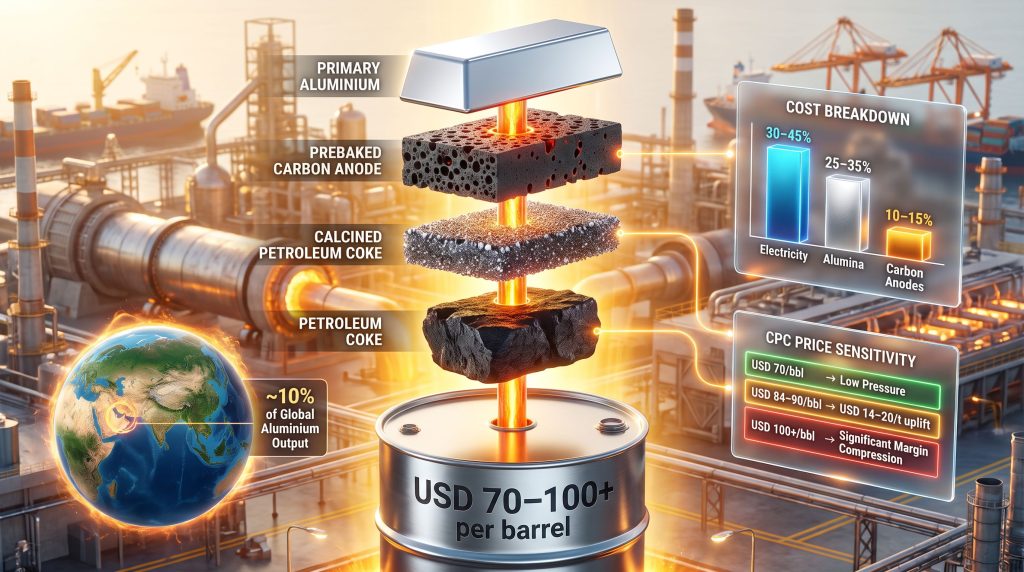
| Electricity | 30–45% |
| Alumina | 25–35% |
| Carbon anodes (including CPC) | 10–15% |
| Labour, maintenance, and other | 10–20% |
While electricity commands the largest share of total costs, carbon anodes represent a discrete and highly oil-sensitive cost line. The anode cost component is frequently underweighted in mainstream commodity analysis, yet its behaviour during oil price spikes can meaningfully compress smelter margins across the industry.
Beyond this, oil influences aluminium economics through at least three separate channels:
- Petroleum coke pricing, which feeds directly into anode manufacturing costs
- Maritime freight and war-risk insurance costs, which affect the CIF price of aluminium exports
- Broader energy complex benchmarking, which indirectly affects fossil-fuel-linked power grids that many smelters depend upon
The Regional Cost Divide That Oil Price Movements Expose
Not all smelters are equally exposed to oil-driven cost inflation. Hydropower-dependent operations in Norway, Canada, and parts of China's Yunnan province are structurally insulated from oil-linked energy price escalation. In contrast, coal and gas-linked smelters across India, parts of China's northern provinces, and the Middle East face compounding exposure when energy benchmarks rise simultaneously.
This regional asymmetry creates divergent cost floors across global producers and generates relative value opportunities for investors who understand the underlying exposure structure. Furthermore, global metals production trends suggest that this regional divide is likely to widen as energy transition policies reshape the competitive landscape.
From Crude Oil Barrel to Smelter: The Step-by-Step Production Pathway
The transmission mechanism linking crude oil to aluminium production costs follows a precise industrial sequence. Each step adds specificity to how oil price movements eventually reach a smelter's cost ledger.
- Heavy crude oil enters a refinery and undergoes the delayed coking process, a thermal cracking operation that processes the heaviest residual fraction of crude
- Green petroleum coke (also called raw pet coke) is produced as a solid carbonaceous byproduct of this process
- Green pet coke is fed into a calcination kiln operating at temperatures of approximately 1,200°C to 1,300°C, driving off volatile hydrocarbons and water
- The resulting calcined petroleum coke (CPC) is a dense, electrically conductive carbon material with low ash and sulphur content (in premium grades)
- CPC is blended with coal tar pitch, a binder derived from coal tar distillation, to form a paste that is moulded and baked into prebaked carbon anodes
- These anodes are consumed inside the electrolytic reduction cells where they act as the positive electrode, being oxidised as alumina is reduced into metallic aluminium
A critical detail that is not widely appreciated is that petroleum coke is a byproduct rather than a primary refinery product. This means its supply is structurally tied to refinery throughput decisions. Pet coke availability can tighten even when crude oil prices fall, if refiners cut throughput rates in response to weak fuel demand or maintenance cycles.
Crude Oil Type and Pet Coke Yield: Why Heavy Crude Matters
| Crude Oil Type | Pet Coke Yield (% of mass) |
|---|---|
| Medium crude | Approximately 8% |
| Heavy crude (Venezuelan, oil sands) | 15–20% or more |
| Barrels of crude required per tonne of pet coke | Approximately 5 barrels |
Specialist Insight: Low-sulphur petroleum coke grades are specifically required for high-quality anode production in primary aluminium smelting. Supply tightness in this premium grade is a distinct risk factor from headline crude oil price movements. A refinery processing higher-sulphur crude may produce abundant pet coke by volume but deliver a product that is unsuitable for anode manufacturing without additional treatment. This grade-quality dimension is routinely missed in broad commodity analysis.
Quantifying the Cost Sensitivity: From CPC Price to Aluminium Production Cost
The financial transmission from crude oil price movements to aluminium production costs can be modelled with reasonable precision using established input ratios. According to factors affecting aluminium pricing, energy and feedstock costs consistently rank as the primary drivers of smelter economics across global markets.
Key input ratios for cost modelling:
- CPC accounts for 60–75% of total carbon anode composition by weight
- Each tonne of carbon anode requires approximately 0.7 tonnes of CPC
- Each tonne of primary aluminium consumes 400–450 kg of prebaked carbon anodes
Worked cost sensitivity example:
If CPC prices increase by USD 50 per tonne, an anode plant consuming 0.7 tonnes of CPC per tonne of finished anode faces a cost increase of USD 35 per tonne of anode. Applying this across an anode consumption rate of 420 kg per tonne of primary aluminium produced generates an additional cost of approximately USD 14.70 per tonne of aluminium.
Current Anode Cost Contribution: A Snapshot
| Metric | Value |
|---|---|
| Prebaked carbon anode price range | USD 700–900 per tonne |
| Anode consumption per tonne of aluminium | 400–450 kg |
| Anode cost contribution per tonne of aluminium | USD 294–378 |
| Anode share of total production cost | 10–15% |
Crude Oil Price Scenarios and Flow-Through Effects
| Crude Oil Price (per barrel) | Approx. Pet Coke Cost (5 barrels) | Anode Cost Pressure | Aluminium Cost Impact |
|---|---|---|---|
| USD 70 | Approximately USD 350/t | Low | Minimal |
| USD 84–90 | Approximately USD 420–450/t | Moderate to High | USD 14–20/t uplift |
| USD 100+ | USD 500+/t | High | Significant margin compression |
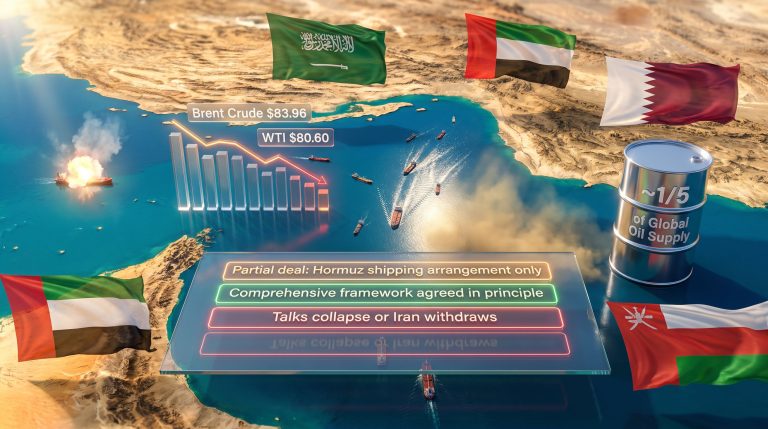
Monitoring crude oil price trends is therefore essential for any analyst building an accurate aluminium cost model. With crude oil prices in late July 2026 trading in the USD 84–90 per barrel range following renewed Middle East military escalation, the petroleum coke cost channel was actively transmitting upward pressure into anode manufacturing globally.
The Middle East as a Dual Pressure Point for Global Aluminium Markets
The Middle East occupies a structurally unique position in the global aluminium supply chain because it functions simultaneously as a major crude oil exporter and as a significant primary aluminium producer, accounting for approximately 10% of global primary aluminium output. This dual role means that geopolitical escalation in the region creates compounding and correlated risk across both the cost side and the supply side of global aluminium markets.
The renewed military escalation that began in early July 2026 pushed oil prices sharply higher, with crude rising approximately 7% in a single session on July 29, 2026. Analysis from DBS Bank's energy research division indicated Brent crude prices could approach USD 100 per barrel in the near term as geopolitical conditions remained volatile.
The Strait of Hormuz: A Chokepoint with Cascading Consequences
Critical Risk Factor: Disruption to the Strait of Hormuz creates two distinct but simultaneous waves of cost inflation for aluminium markets. The first wave flows through petroleum coke pricing as crude oil supply tightens. The second wave materialises through elevated freight rates, war-risk insurance premiums, and transshipment costs, which inflate the CIF price of aluminium reaching importing regions. Most cost models account for only one of these channels at a time.
Reuters reporting in late July 2026 noted that only a small number of commercial vessels were transiting the Strait of Hormuz, with traffic shifting toward alternative routes including the Bab el-Mandeb strait. Furthermore, the aluminium tariffs impact analysis indicates that compounding trade policy pressures alongside supply route disruptions can amplify cost transmission significantly beyond what either factor would produce in isolation.
Shipping cost escalation factors during Strait of Hormuz disruption:
- War-risk marine insurance premiums escalated from approximately 0.25% of vessel value pre-conflict to as high as 3% during peak disruption periods
- Tanker freight rates surged as vessel availability tightened and risk pricing rose sharply
- Rerouting through alternative passages adds transit delays that compound inventory management challenges for importers
- These elevated shipping costs directly increase the CIF-priced landed cost of aluminium for Asian and European buyers
China's Petroleum Coke and Anode Markets: Cost Pressure at Scale
China's position as the world's largest primary aluminium producer means that domestic pet coke and anode price movements have outsized consequences for global aluminium cost benchmarks. As a major importer of Middle Eastern crude oil, China industrial demand dynamics directly shape how cost pressures from the Gulf region propagate through to global aluminium pricing.
The cost pressure has been visible in China's spot pet coke markets. As of July 30, 2026, regional price indices reflected meaningful grade-based price differentiation:
| Region and Grade | Spot Price (RMB per tonne) |
|---|---|
| North-East China No. 1 | RMB 4,415.73 |
| Shandong No. 2 | RMB 4,276.73 |
| Shandong No. 3 | RMB 3,738.11 |
| Shandong No. 4 | RMB 2,093.05 |
The price spread between the highest and lowest grades exceeds RMB 2,300 per tonne, underscoring how significantly sulphur content and carbon purity affect market pricing. Premium low-sulphur grades suitable for anode-grade CPC production command substantially higher prices than lower-quality industrial grades, and their availability can tighten independently of broader pet coke market conditions.
Prebaked Anode Pricing in China: July 2026 Benchmark
Data from Mysteel confirmed that the July 2026 prebaked anode procurement benchmark at a major Shandong-based aluminium smelter reached RMB 5,683 per tonne on a cash basis and RMB 5,707 per tonne on an acceptance basis, representing a month-on-month increase of RMB 30 per tonne.
Applying the current anode benchmark to standard consumption ratios:
RMB 5,683/t anode × 0.42 t anode per tonne of aluminium = approximately RMB 2,387 per tonne of aluminium in anode costs alone
This figure represents a meaningful input cost that Chinese smelters must cover before accounting for electricity, alumina, labour, and overhead — illustrating precisely why oil prices and aluminium production costs are so closely intertwined at industrial scale.
The next major ASX story will hit our subscribers first
When Cost Inflation Does Not Translate Directly to Higher Prices
The relationship between rising oil prices and aluminium production costs, while mechanistically clear, does not always translate linearly into higher LME aluminium prices. Several structural factors can interrupt or delay this transmission.
Factors that can decouple cost inflation from aluminium price response:
- Demand destruction accompanying energy price shocks, such as recession scenarios, can prevent smelters from passing costs downstream
- Smelters operating under long-term fixed-price anode supply agreements experience delayed cost exposure relative to spot-priced competitors
- Producers with vertically integrated CPC supply or captive refinery access are structurally insulated from spot market volatility
- Inventory drawdowns by major consumers can suppress LME prices even as input costs rise
Paradoxically, sustained cost pressure at the upper end of the global cost curve can trigger capacity curtailments at marginal producers. These production cuts tighten physical aluminium supply, which can ultimately support prices even as the cost environment that caused the curtailments remains challenging. The leading aluminium mining companies with vertically integrated supply chains are consequently better positioned to weather these periods of elevated input costs.
Market Normalisation Timeline and IEA Demand Outlook
Phil Flynn, Senior Analyst at Price Futures Group, assessed for Reuters that full normalisation of oil flows from the Gulf following a durable ceasefire would likely require four to six months, with complete market equilibrium potentially not achievable until early 2027. The International Energy Agency projected global oil demand would contract by approximately 1 million barrels per day in the near term before recovering by 2 million barrels per day in 2027 — a trajectory with direct implications for pet coke availability and anode cost dynamics during that window.
The Full Transmission Chain: A Summary Framework
| Stage | Input | Output | Key Variable |
|---|---|---|---|
| 1. Refinery | Crude oil | Green petroleum coke | Oil price and refinery throughput |
| 2. Calcination | Green pet coke | Calcined petroleum coke | Calcination energy costs and grade quality |
| 3. Anode plant | CPC and coal tar pitch | Prebaked carbon anodes | CPC price and pitch availability |
| 4. Smelter | Anodes, alumina, electricity | Primary aluminium | Anode cost and power price |
| 5. Export | Primary aluminium | CIF-priced metal | Freight, insurance, and routing |
Strategic Implications for Different Market Participants
For aluminium producers:
- Track crude oil benchmarks as a leading indicator for anode cost pressure, with a typical lag of several weeks through the supply chain
- Evaluate long-term CPC supply agreements as a cost hedge during periods of oil price volatility
- Assess shipping route diversification strategies for Gulf-exposed export operations, particularly given Strait of Hormuz risk scenarios
- Monitor low-sulphur pet coke availability independently from headline crude oil prices, as grade-specific tightness can occur without broader market moves
For investors and commodity analysts:
- Oil price spikes provide a structural cost floor signal for aluminium pricing across the market
- Regional differentiation in cost exposure — particularly between hydropower-dependent and fossil-fuel-linked smelters — creates relative value opportunities across producer geographies
- Geopolitical risk in oil-producing regions generates correlated risk across energy and metals markets simultaneously, a dynamic that traditional siloed sector analysis routinely underestimates
- The byproduct nature of pet coke means supply constraints can develop during periods of refinery underutilisation, even when crude oil prices are falling, creating a potential cost trap for anode manufacturers
For procurement and supply chain teams:
- Low-sulphur pet coke supply risk must be managed as a distinct category from general petroleum coke procurement
- War-risk insurance premium escalation can materially affect landed aluminium costs in importing regions and should be stress-tested in supply chain cost models
- Dual-route sourcing strategies for CPC, combining domestic and imported supply, reduce concentration risk during periods of geopolitical disruption affecting maritime corridors
The analysis of aluminium in energy crossfire confirms that the confluence of oil price volatility and supply route disruptions represents one of the most significant structural risks facing aluminium markets in 2025 and 2026. Consequently, understanding oil prices and aluminium production costs as an integrated system — rather than as separate market variables — is essential for any participant operating across the aluminium value chain.
Disclaimer: This article is intended for informational and educational purposes only and does not constitute financial or investment advice. Commodity price forecasts, cost sensitivity models, and geopolitical scenario assessments referenced in this article involve inherent uncertainty. Readers should conduct independent research and consult qualified advisors before making investment or procurement decisions. Past cost relationships between crude oil and aluminium production inputs may not predict future outcomes.
Want to Stay Ahead of the Next Major Mineral Discovery Driving Metals Markets?
While understanding the structural cost relationships between oil and aluminium is essential for informed investing, identifying the next high-impact ASX mineral discovery before the broader market can be equally transformative. Discovery Alert's proprietary Discovery IQ model delivers real-time alerts on significant ASX mineral discoveries, instantly converting complex mineral data into actionable insights for both short-term traders and long-term investors — begin your 14-day free trial today, or explore Discovery Alert's discoveries page to see how historic mineral discoveries have generated substantial market returns.