
August 6, 2026
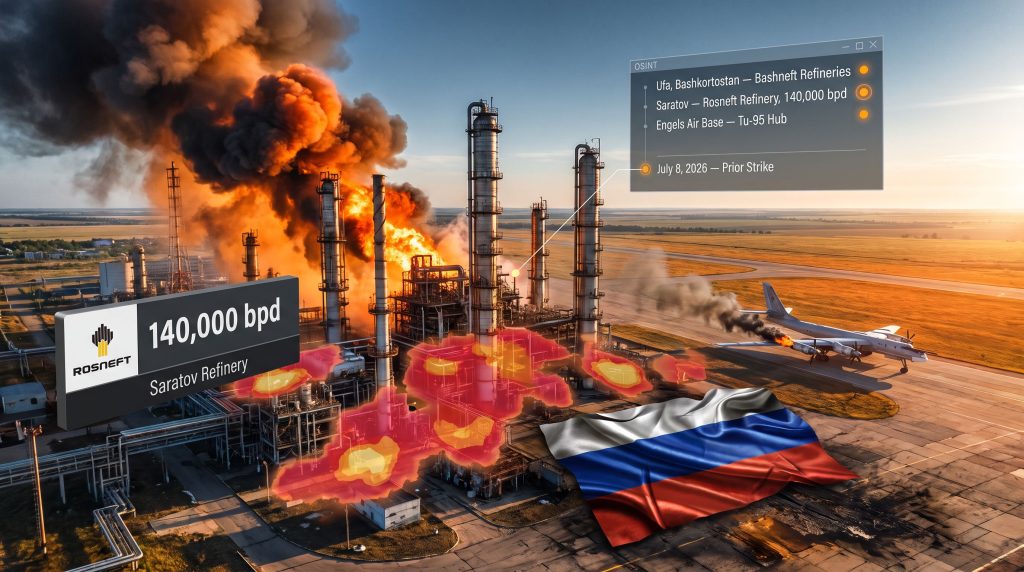
Why Petroleum Infrastructure Has Become the Decisive Battleground of Modern Warfare
The weaponisation of energy infrastructure is not a new concept in warfare, but the precision, frequency, and strategic coherence with which Ukraine has pursued Russia's refining network marks a genuinely new chapter in conflict doctrine. Across history, industrial capacity has been targeted during wartime, but the combination of long-range drone technology, open-source satellite intelligence, and deliberate economic timing has elevated infrastructure warfare into something far more sophisticated than aerial bombardment campaigns of the past.
Understanding why Ukraine strikes Rosneft Saratov refinery and Engels air base simultaneously, and why these events matter beyond their immediate military context, requires looking at the deeper structural logic connecting fuel production, military logistics, and strategic aviation into a single interconnected target system. Furthermore, the trade war economic impact on global energy systems adds an additional layer of complexity to how these strikes resonate beyond the battlefield.
When big ASX news breaks, our subscribers know first
The Architecture of Russia's Refining Vulnerability
Russia's domestic petroleum refining sector carries a set of structural vulnerabilities that make it disproportionately susceptible to sustained strike campaigns. Unlike pipeline networks, which can be partially rerouted or bypassed, the core processing units within a refinery, including atmospheric distillation towers, catalytic crackers, and hydrocracking columns, are among the most complex and difficult industrial assets to repair rapidly.
Replacement components for these systems are frequently manufactured in Western countries, the very same nations that have imposed sweeping export controls on Russia since 2022. This creates a repair bottleneck that extends recovery timelines well beyond what a peacetime industrial accident would require. A refinery struck during active conflict, in a sanctions environment, faces a compounding set of obstacles that can stretch outages from weeks into months.
The Rosneft Saratov refinery illustrates this dynamic precisely. With a crude processing capacity of approximately 140,000 barrels per day, the facility is a meaningful contributor to regional fuel supply across central Russia. Following a confirmed Ukrainian strike on July 8, 2026, the refinery had only recently returned to operational status before being struck again in the overnight attack of August 3, 2026. The recurrence of damage at the same facility within roughly four weeks reveals how compressed the recovery window has become, and how quickly Ukraine can re-exploit a restored target.
Structural Note: The reliance of Russian refineries on imported instrumentation, control systems, and specialist catalysts, now effectively unavailable due to sanctions regimes, means that structural damage translates into far longer operational outages than historical precedent would suggest.
Saratov and Engels: A Dual-Target Strategy With Compounding Effects
The overnight operation of August 3, 2026 was notable not just for the individual significance of each target, but for the deliberate pairing of an energy asset with a military aviation hub in a single coordinated strike package.
The Rosneft Saratov refinery was confirmed as struck by Ukraine's General Staff, with the attack triggering a major fire at the facility. Independent corroboration came from NASA's Fire Information for Resource Management System (FIRMS), which detected fresh heat anomalies at the Saratov site consistent with active combustion. Rosneft issued no immediate comment, continuing its established pattern of non-disclosure during active strike events. Russian regional authorities confirmed that civilian infrastructure in both Saratov and Engels was damaged, with two fatalities reported.
Engels air base represents an entirely different category of strategic value. The facility serves as a primary operating hub for Russia's Tu-95 "Bear" strategic bombers, turboprop-powered long-range aircraft that have been used extensively throughout the conflict to launch Kh-101 and Kh-55 cruise missiles against Ukrainian power grids, civilian infrastructure, and military positions. Damaging Engels does not merely affect aircraft — it disrupts the entire support ecosystem surrounding strategic aviation operations, including fuel storage, munitions handling infrastructure, maintenance facilities, crew support systems, and command coordination networks.
Geographically, Engels sits approximately 850 kilometres from the Ukrainian border, a distance that had historically placed it within what Russian planners likely considered a safe operational interior. Repeated successful strikes on the base since 2022 have systematically dismantled that assumption.
Key Strategic Insight: Targeting a fuel production facility and a strategic bomber base within the same operational window creates a compounding pressure dynamic. Russia must simultaneously manage domestic fuel supply disruptions and accelerated air base hardening requirements, each drawing on the same pool of constrained industrial and financial resources.
A Documented Campaign: The August 2026 Strike Sequence
The Saratov and Engels strikes did not occur in isolation. They were the culminating events in a concentrated, multi-day offensive against Russian petroleum infrastructure that unfolded across a tight operational window.
| Date | Target Location | Asset Type | Confirmed Outcome |
|---|---|---|---|
| Friday, ~Aug 1 | Undisclosed major facility | Petroleum refining | Strike confirmed |
| Saturday, ~Aug 2 | Ufa, Bashkortostan | Bashneft refineries (x3) | Strike confirmed |
| Sunday, Aug 3 | Ufa, Bashkortostan | Industrial site | Fire confirmed (Gov. Khabirov) |
| Sunday night, Aug 3 | Saratov | Rosneft refinery (140,000 bpd) | Fire confirmed (NASA FIRMS) |
| Sunday night, Aug 3 | Engels, Saratov region | Tu-95 strategic bomber hub | Strike claimed by Ukraine |
The Ufa strikes deserve particular attention. Bashkortostan houses three Bashneft refineries, making it one of Russia's most concentrated regional refining clusters. Bashneft, a subsidiary of Rosneft, processes substantial volumes of crude from the Ural region. Governor Radiy Khabirov confirmed the fire at a Ufa industrial site on Sunday, though without providing specifics about the facility or extent of damage, again consistent with Russian authorities' approach of acknowledging physical consequences while minimising operational disclosures.
The timing of this campaign carried deliberate economic intent. Russia had recently begun relaxing domestic restrictions on gasoline and diesel sales across several regions, measures that had been imposed in response to earlier supply shortfalls created by prior refinery attacks. The renewed strike wave arrived at precisely the moment Russian fuel markets were attempting to stabilise, threatening to reverse that progress and potentially force the reimposition of sales controls. This mirrors broader oil price shock dynamics that energy executives have been closely monitoring throughout 2025 and into 2026.
The Tu-95 Problem: Why Engels Keeps Getting Hit
To fully appreciate the Engels air base targeting, it is worth understanding the specific role the Tu-95 plays in Russia's war strategy and why eliminating or degrading its operational capacity matters so much to Ukrainian planners.
The Tu-95 is not a modern stealth platform. First introduced in the 1950s, it is one of the oldest combat aircraft still in active service anywhere in the world. Its continued operational relevance rests entirely on its ability to serve as a stand-off cruise missile launch platform, releasing weapons at distances that, until recently, kept the aircraft itself well beyond Ukrainian air defence range. Russia has used mass Tu-95 launches to overwhelm Ukrainian air defence systems through sheer volume, making the bomber a central instrument of civilian infrastructure destruction.
Russia operates a very limited number of strategic bomber bases capable of supporting Tu-95 operations, which makes each one carry disproportionate weight in the overall strike architecture. Engels is among the most important. By repeatedly striking Engels, Ukraine is not just seeking to destroy individual aircraft but to impose cumulative costs on the entire Long-Range Aviation (LRA) support ecosystem, forcing Russia to:
- Invest heavily in base hardening and dispersal operations
- Relocate aircraft to less-prepared alternate facilities
- Divert air defence assets to protect interior air bases
- Spend finite maintenance and engineering resources on repair rather than readiness
Each of these responses draws capacity away from offensive operations, creating a strategic drag that compounds over time.
Ukraine's Deep-Strike Capability: How the Technology Has Evolved
Ukraine's capacity to conduct simultaneous, multi-target strikes hundreds of kilometres inside Russian territory represents one of the most consequential capability developments of the conflict. The operational toolkit has expanded considerably since 2022 and now includes domestically developed long-range drones such as variants within the UJ-22 and Beaver series, repurposed Soviet-era cruise missiles, and Western-supplied precision systems operating within the constraints of use agreed with partner nations.
What makes the current strike campaign particularly sophisticated is not just range but operational coordination. Hitting Saratov and Engels in the same overnight window, following a multi-day sequence targeting Ufa, demonstrates the ability to plan, resource, and execute concurrent strike packages against geographically dispersed targets while maintaining operational security. This is qualitatively different from earlier phases of the conflict when strikes were more episodic and individually significant rather than sequenced for cumulative strategic effect.
Ukraine's use of NASA FIRMS thermal anomaly data as a public verification mechanism is also worth examining from an information warfare perspective. By referencing independent satellite data to confirm physical damage, Ukrainian military communicators build credibility with international audiences without relying solely on claims that adversaries can dismiss. Ukraine's confirmed strike on the Rosneft facility, as reported by the Financial Post, provided external corroboration that exists entirely outside the control of either party to the conflict.
The next major ASX story will hit our subscribers first
Energy Market Implications: What Repeated Refinery Strikes Mean for Supply
The cumulative impact of Ukraine's refinery campaign extends well beyond military logistics into Russia's broader economic stability and, indirectly, into global energy markets. However, understanding these implications requires examining both domestic and international dimensions separately.
How Do the Strikes Affect Russia's Domestic Fuel Supply?
Domestic supply effects:
- Repeated disruption of refining capacity reduces output of gasoline, diesel, jet fuel, and heating oil
- Military logistics, which are heavily diesel-dependent, face compounding supply pressure
- Russia's pattern of imposing regional fuel sale restrictions demonstrates that prior strikes have already pushed domestic supply to operational margins
- The re-interruption of recently stabilised markets threatens broader consumer and industrial disruption
What Is Rosneft's Systemic Exposure?
Rosneft controls the largest share of Russia's domestic refining capacity, meaning that concentrated strikes against its facilities create systemic rather than localised risk. The Saratov facility's 140,000 bpd throughput, combined with damage to Bashneft assets in Ufa (Bashneft being a Rosneft subsidiary), suggests that a significant portion of Russia's centrally controlled refining network is experiencing simultaneous pressure.
How Do These Strikes Ripple Into Global Markets?
Russia's energy exports are predominantly crude rather than refined products, which limits the direct transmission of refining disruptions into global product markets. However, sustained damage to domestic refining capacity alters Russia's internal crude allocation and may affect export volumes as domestic consumption requirements compete with export commitments.
Consequently, geopolitical risk premiums in oil markets remain sensitive to escalation signals. The trade war oil impact already weighing on global benchmarks means that a sustained, publicly documented campaign against major Russian energy infrastructure introduces additional upward pricing pressure. In addition, safe-haven flows into gold and other assets tend to intensify when conflict-driven energy risk spikes, reflecting how interconnected these dynamics have become.
Frequently Asked Questions
What is the Rosneft Saratov refinery and why does Ukraine target it?
The Saratov refinery is a major petroleum processing facility operated by Rosneft, Russia's largest state-controlled oil company, with crude throughput capacity of approximately 140,000 barrels per day. Its value as a target lies in its dual role supplying both civilian fuel markets and military logistics networks. Ukraine strikes Rosneft Saratov refinery and Engels air base in coordinated operations because each target compounds pressure on the other, with the July 8, 2026 and August 3, 2026 strikes demonstrating both the strategic priority placed on the target and the compressed repair timelines Russia faces in a sanctions environment.
What aircraft operate from Engels air base?
Engels is the primary operating hub for Russia's Tu-95 "Bear" strategic bombers, long-range turboprop aircraft used to launch cruise missiles against Ukrainian targets. The base supports elements of Russia's broader Long-Range Aviation fleet and provides the maintenance, fuel, munitions, and command infrastructure required for sustained strategic bombing operations.
How does Ukraine confirm strike results?
Ukraine combines official military statements with independent verification from open-source satellite data. In the Saratov case, fresh heat anomalies detected by NASA's Fire Information for Resource Management System (FIRMS) provided external corroboration of active fires at the refinery, independent of either side's claims.
Has Russia confirmed the August 3 damage?
Russian regional authorities acknowledged damage to civilian infrastructure in Saratov and Engels and confirmed two fatalities. Rosneft issued no immediate statement. This pattern of partial official acknowledgement combined with corporate silence is consistent with Russia's approach to previous strike events at sensitive energy and military infrastructure.
What is the broader economic impact of the refinery campaign?
The cumulative effect of repeated strikes across multiple facilities threatens to reverse Russia's recent progress in stabilising domestic fuel markets. Russia had begun easing regional restrictions on gasoline and diesel sales when the August strike wave resumed, risking the reimposition of supply controls and broader disruption to civilian and military consumption chains.
The Compounding Logic: What the Trajectory Signals
What emerges from the pattern of Ukraine strikes on Rosneft Saratov refinery and Engels air base is a strategic framework that treats infrastructure warfare not as a supplement to battlefield operations but as an independent line of effort with its own theory of victory. Furthermore, the broader geopolitical mining landscape reflects how resource infrastructure globally has become increasingly vulnerable to conflict-driven disruption.
By targeting fuel production capacity and strategic aviation infrastructure simultaneously, and by timing strikes to coincide with periods of Russian economic recovery rather than pure military opportunity, Ukraine is applying a form of pressure that operates across multiple Russian vulnerabilities at once. The military faces degraded logistics. The domestic economy faces renewed fuel supply pressure. The strategic aviation fleet faces compounding maintenance and dispersal demands.
Each successful deep-strike operation also carries a psychological dimension that extends beyond physical damage. The repeated penetration of Russian airspace over interior targets at distances previously considered secure forces a recalibration of Russian planning assumptions and consumes defensive resources that would otherwise support offensive capacity.
Disclaimer: This article contains analysis of ongoing military operations and energy infrastructure impacts. Assessments of military effectiveness, economic consequences, and geopolitical trajectories involve inherent uncertainty. Readers should treat forward-looking interpretations as analytical perspectives rather than definitive conclusions. Energy market projections are subject to change based on evolving conflict dynamics and policy responses.
Want to Track How Geopolitical Conflicts Are Reshaping Commodity Markets in Real Time?
Discovery Alert's proprietary Discovery IQ model monitors significant ASX mineral discoveries as they emerge, instantly converting complex resource data into actionable investment insights — because when energy infrastructure warfare reshapes global commodity pricing, being first to identify the resulting opportunities can be decisive. Explore historic discovery returns to understand the scale of what early positioning can achieve, and begin your 14-day free trial today to stay ahead of the market.