August 3, 2026
The Strait That Shakes Markets: Why Hormuz Diplomacy Carries Such Enormous Weight
Global energy markets have always been hostage to geography. A handful of narrow maritime corridors, each measured in nautical miles rather than kilometres, carry the economic lifeblood of entire continents. No chokepoint illustrates this vulnerability more starkly than the Strait of Hormuz, a passage so strategically loaded that a single presidential statement aboard Air Force One was enough to move crude oil prices by nearly five percent in a single session.
The announcement that Trump Iran talks to resume Monday would restart formal negotiations with Tehran after a planned military operation was called off did not emerge from a signed treaty or a joint communique. It came from a brief exchange with reporters at altitude, without confirmed venues, without named participants, and without Iranian confirmation. Yet markets responded immediately and decisively. That asymmetry between the thinness of the information and the scale of the market reaction reveals something fundamental about how geopolitical risk is priced in energy commodities.
When big ASX news breaks, our subscribers know first
How Oil Markets Price War Premiums and Why They Unwind So Fast
To understand Monday's crude price move, it helps to understand what traders call a war premium. When military conflict threatens a major supply corridor, the crude oil market dynamics see futures markets incorporate a probability-weighted estimate of potential disruption into spot prices. This premium accumulates quickly because the consequences of a supply shock are immediate and severe, while the benefits of peace are diffuse and delayed.
The war premium does not require an actual disruption to materialise. The possibility of disruption, multiplied by the severity of its consequences, is sufficient to inflate prices. This is why crude benchmarks had already moved well above fundamental supply-demand clearing levels before any barrel of oil was actually prevented from leaving the Gulf.
The unwinding of that premium follows a different logic. A single credible signal that military action is off the table, even temporarily, is enough to trigger rapid selling of the risk position. The result is the kind of sharp, single-session decline seen on Monday:
| Benchmark | Price Movement | Approximate Settlement |
|---|---|---|
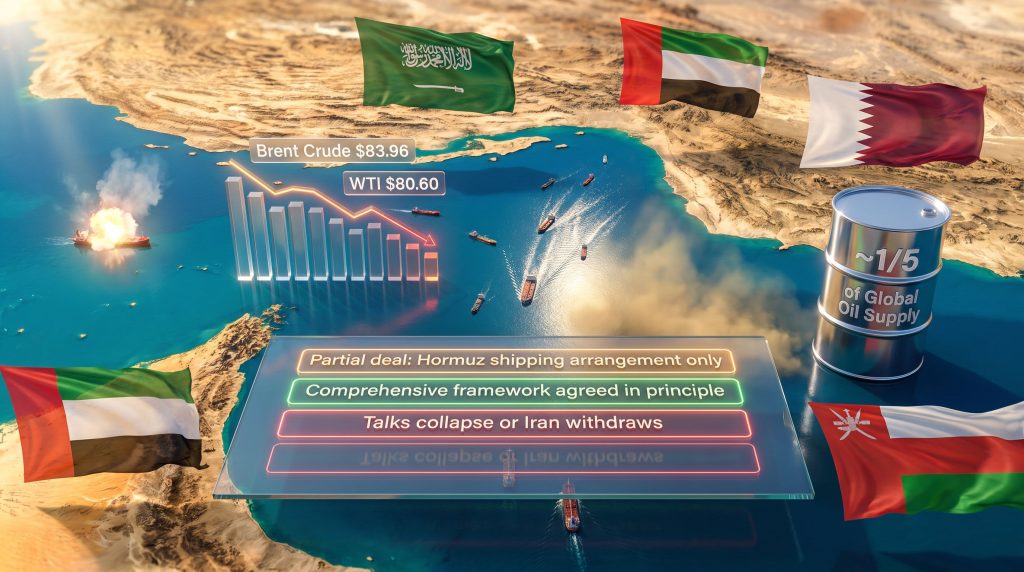
| Brent Crude | -4.6% | ~$83.96 per barrel |
| WTI (U.S. Crude) | -4.7% | ~$80.60 per barrel |
What is notable here is the speed of repricing relative to the quality of the underlying information. No deal had been reached. Iran had not confirmed participation. The venue for the talks was disputed across multiple reporting outlets, with early reports citing Islamabad and later reports pointing to Doha. Yet markets moved as though a meaningful shift in conflict probability had occurred, because for pricing purposes, it had.
The asymmetry is structural: fear of supply disruption inflates oil prices faster and further than diplomatic progress deflates them. This means the war premium unwind on Monday likely overstates the probability of a durable resolution.
The Four-Pillar Framework Under Negotiation
Setting aside the question of whether talks actually commenced as announced, the proposed framework being mediated through regional channels represents a layered structure rather than a single bilateral deal. According to reporting by the Associated Press citing a regional official involved in mediation, the broad architecture includes four interconnected components:
- Formal U.S.-Iran negotiations resuming, with venue and participation details unconfirmed at time of reporting.
- Reopening of the Strait of Hormuz to commercial shipping traffic, restoring a corridor that previously handled roughly one-fifth of global oil supply.
- A regional ceasefire framework, specifically including a halt to attacks by Iranian-backed militia networks in Iraq that have been targeting Arab Gulf states and Jordan.
- Termination of the U.S. naval blockade on Iran, with restored access for Iranian crude exports to reach international markets.
Each pillar carries its own implementation complexity, and critically, they are not equally tractable. The Hormuz shipping arrangement is the most operationally concrete. The militia ceasefire is arguably the most structurally difficult.
The Venue Ambiguity and What It Signals
The conflicting reports over where talks would be held are not merely a logistical footnote. The choice of host country carries significant diplomatic weight. Furthermore, the geopolitical trade tensions surrounding this process add further complexity to which regional power ultimately hosts the negotiations:
| Reported Venue | Diplomatic Signal |
|---|---|
| Islamabad, Pakistan | Engagement through a non-Gulf, non-Western intermediary with historical Iran ties |
| Doha, Qatar | Gulf-led mediation with U.S. military presence in-country; Qatar has hosted prior Iran-linked diplomacy |
Pakistan's role would suggest a track operating outside the Gulf Cooperation Council framework, potentially reflecting Iranian preference for a less U.S.-aligned host. Qatar's involvement would signal deeper Gulf state coordination with Washington. The distinction matters because it indicates which regional power holds the greatest leverage over the process.
Iran's non-confirmation of participation adds a further layer of ambiguity. In diplomatic practice, a state may decline to publicly confirm engagement to preserve negotiating flexibility, to signal dissatisfaction with preconditions, or because internal factions are genuinely divided on whether to participate. All three possibilities apply to Tehran's current posture.
Is Iran Genuinely at the Table?
Iranian officials have denied Trump's claims that peace talks were set to resume following weekend strikes, creating a significant credibility gap in the diplomatic narrative. However, Trump has stated publicly that Iran wants to resume negotiations, characterising the operation as "ahead of schedule." The disconnect between these two positions is itself a significant signal about the fragility of the current moment.
Oman's Unique Role: The Hormuz Track That Is Separate From Everything Else
One of the least reported but most consequential elements of the current diplomatic architecture is the parallel Iran-Oman negotiation over Hormuz shipping management. This track is structurally distinct from both the U.S.-Iran talks and the broader denuclearisation question.
Iranian officials confirmed that discussions with Muscat over future shipping arrangements through the strait were in their final stages. Iran's foreign ministry spokesperson Esmaeil Baghaei indicated the proposed route would differ from those used prior to the conflict, and explicitly clarified that this new arrangement is separate from the question of whether the strait formally reopens or remains closed.
This disaggregation is strategically significant for several reasons:
- It allows Iran to make incremental concessions on maritime commerce without appearing to capitulate on the broader conflict.
- It gives Oman, which occupies the southern shore of the strait and has historically served as a neutral back-channel between Washington and Tehran, a concrete deliverable that enhances its regional diplomatic standing.
- It creates a mechanism for partial economic normalisation, specifically for shipping insurance and tanker routing, even before a comprehensive agreement is reached.
Oman's neutrality is not incidental. Muscat has maintained diplomatic relations with Tehran through successive rounds of U.S.-Iran tensions, making it the preferred conduit for messages that neither side can deliver publicly. This role predates the current conflict by decades.
Why the Militia Dimension Is the Hardest Problem in the Room
The proposed regional ceasefire framework includes a requirement that Iranian-backed militia networks in Iraq cease attacks on Arab Gulf states and Jordan. This is, on paper, a reasonable condition for Gulf states that have been on the receiving end of those attacks. In practice, it is one of the most structurally complex commitments any party could attempt to enforce.
Militia networks affiliated with Iran do not operate under unified command-and-control structures. Their relationship with Tehran ranges from close operational coordination to ideological alignment with significant tactical autonomy. Historical patterns from Yemen and Lebanon demonstrate that militia ceasefire compliance is rarely immediate, rarely complete, and rarely verifiable in real time.
This creates a fundamental verification problem: even if Iran sincerely commits to halting militia activity, the ability of the Islamic Revolutionary Guard Corps to enforce that commitment across decentralised networks operating in multiple countries is genuinely constrained. Consequently, markets and policymakers should treat militia ceasefire provisions with considerable scepticism as a durability indicator.
The Security Situation on the Water: What the UKMTO Incident Reveals
Even as diplomatic signals were pushing oil prices lower on Monday, physical risk in the strait corridor remained unresolved. The United Kingdom Maritime Trade Operations agency reported receiving notification of an incident approximately 20 nautical miles northeast of Khasab, Oman, positioned at the entrance to the Strait of Hormuz. A tanker master reported an explosion in close proximity to the vessel at approximately 20:37 UTC on Sunday. The vessel and crew were confirmed safe, and an investigation was launched. UKMTO advised all transiting vessels to exercise heightened caution.
Shipping operators should note: Active diplomatic negotiations do not translate to immediate improvements in on-the-water safety. The Hormuz corridor remains a high-risk transit environment regardless of the diplomatic temperature in capitals.
The UKMTO incident arrived alongside reports that Kuwait's military had intercepted Iranian drones targeting critical infrastructure in the country's north on Saturday, within 24 hours of Trump's diplomatic reversal. The juxtaposition of escalating kinetic activity with advancing diplomacy is not unusual in conflict dynamics. However, it underscores that the gap between political agreements and operational reality on the ground and at sea can be substantial.
The next major ASX story will hit our subscribers first
Three Scenarios and Their Market Implications
Given the significant uncertainty around both the talks and their potential outcomes, investors and energy traders need to think in scenario terms rather than point forecasts. The oil market risks embedded in each scenario vary considerably in their severity and duration:
| Scenario | Assessment | Market Impact |
|---|---|---|
| Partial deal: Hormuz shipping arrangement only | Moderate probability | Moderate crude decline; shipping insurance premium relief; LNG routing improvement |
| Comprehensive framework agreed in principle | Lower probability near-term | Significant oil price correction; regional equity rally; Iranian supply re-entry risk |
| Talks collapse or Iran withdraws | Moderate probability | Sharp oil price reversal; risk-off across commodities; tanker insurance spike |
The third scenario deserves particular attention. A collapse in talks would likely trigger a rapid re-accumulation of the war premium that Monday's announcement partially unwound. Traders who sold crude exposure into Monday's diplomatic optimism would face rapid reversal risk, and the asymmetric nature of the war premium means the upside move on a collapse could be sharper than the downside move on the breakthrough.
Brookings Institution analyst Michael O'Hanlon has assessed the Iran conflict as likely to endure through at least the fall of 2026, a timeline that frames the current diplomatic moment as an early-stage negotiation rather than a near-term resolution. That framing matters enormously for medium-term oil price forecasting.
The Iranian Supply Wildcard: What Sanctions Relief Would Mean for Oil Prices
If the U.S. naval blockade is lifted as part of any deal, the return of Iranian crude to global markets introduces a meaningful supply variable that operates in the opposite direction from the war premium unwind. These two forces would be pulling oil prices in the same direction simultaneously, creating significant downside pressure on crude benchmarks.
Prior to the current conflict, Iran's oil export capacity was substantial, though precise figures depend on which baseline year is used and how sanctions compliance is measured. The timeline required to restore full export capacity following a blockade lifting is not instantaneous. Infrastructure, shipping arrangements, buyer relationships, and insurance coverage all require time to reconstitute.
The interaction between Iranian supply restoration and OPEC market influence over production management decisions will be the central variable shaping oil price trajectories over the following quarters. OPEC+ members have their own production targets and fiscal break-even requirements, and the reintroduction of Iranian barrels into a market they do not control creates coordination challenges that the cartel has historically struggled to resolve cleanly.
Beyond Crude: The Broader Commodity and Shipping Market Impact
The conflict's effects extend well beyond crude oil benchmarks. Several adjacent markets have been materially affected and would experience repricing in a durable de-escalation:
- LNG routing: The LNG supply outlook for tankers transiting from Gulf producers to Asian importers has been complicated by elevated risk premiums and rerouting costs.
- Tanker insurance: War risk insurance premiums for vessels transiting the Hormuz corridor have surged, with some underwriters excluding the strait entirely from standard coverage.
- Petrochemical supply chains: Gulf-origin feedstocks for regional petrochemical facilities have been disrupted, with downstream effects on plastics and chemical production.
- Strategic reserves: Major Asian importing nations have been drawing down strategic petroleum reserves at accelerated rates and pursuing alternative sourcing from Atlantic Basin producers, West Africa, and U.S. shale suppliers.
A durable diplomatic resolution would trigger repricing across all of these markets, not just crude oil spot prices. Investors focused solely on the Brent and WTI benchmarks may be underestimating the breadth of the commodity complex exposure to Hormuz developments.
What to Monitor as the Diplomatic Process Unfolds
For investors and energy market participants tracking the Trump Iran talks to resume Monday developments, the following indicators carry the highest signal value:
- Iranian official confirmation of participation in formal talks remains the single most critical variable. Without it, the diplomatic framework is effectively unilateral.
- Venue confirmation will indicate which regional power holds the most influence over the mediation track and how seriously Iran is engaging.
- UKMTO incident frequency in the Hormuz corridor will reflect whether on-the-water conditions are improving in parallel with political progress.
- Militia activity levels in Iraq and across the Gulf will serve as a leading indicator of whether Tehran is willing and able to enforce a regional ceasefire commitment.
- Iranian crude export data over the coming weeks will provide the most concrete signal of whether blockade enforcement is easing ahead of any formal deal.
- Oil price behaviour in the week following the announcement will reveal whether Monday's move represented genuine repricing or a temporary sentiment-driven correction that markets will partially reverse.
Disclaimer: This article contains analysis of ongoing geopolitical developments and commodity market dynamics. It does not constitute financial or investment advice. Oil price forecasts, scenario probabilities, and diplomatic outcome assessments involve significant uncertainty and are subject to rapid change as the situation evolves. Readers should conduct their own research and consult qualified financial advisors before making investment decisions.
Want to Stay Ahead of the Next Major Market-Moving Discovery?
While geopolitical tensions reshape global commodity markets, Discovery Alert's proprietary Discovery IQ model scans ASX announcements in real time, instantly identifying significant mineral discoveries and turning complex data into actionable opportunities — explore Discovery Alert's discoveries page to see how historic finds have generated substantial returns, and begin your 14-day free trial to position yourself ahead of the broader market.