June 11, 2026
The Mechanics Behind Oil Price Swings During Diplomatic Breakthroughs
Few phenomena in commodity markets are as counterintuitive to casual observers as the sight of oil prices falling precisely when a region responsible for a substantial portion of global supply edges toward peace. Yet this is exactly what professional traders and institutional investors expect. The mechanics of geopolitical risk pricing in crude oil markets mean that fear itself carries a monetary value, one that evaporates the moment diplomatic signals shift the probability calculus away from worst-case outcomes.
Understanding this dynamic is not merely academic. For investors, analysts, and energy-market participants, it explains why oil falls as Lebanon and Israel agree on a ceasefire, even when not a single physical barrel of supply has changed hands or routing. Furthermore, oil price movements in these circumstances often tell a more complex story than the headlines suggest.
When big ASX news breaks, our subscribers know first
How Fear Gets Priced Into Crude Oil Benchmarks
The concept of a geopolitical risk premium in oil markets refers to the additional dollar value that market participants assign to crude above what supply and demand fundamentals alone would justify. This premium is not static. It inflates when credible threats to supply emerge and deflates when those threats recede, sometimes within hours.
The premium functions as a real-time probabilistic insurance cost embedded in the spot and futures price of crude. Traders are not betting on whether a pipeline has already been bombed. They are pricing in the likelihood that it might be, and that likelihood shifts continuously as diplomatic or military events unfold.
Several factors determine the size of the geopolitical risk premium at any given moment:
- The geographic proximity of conflict to critical oil infrastructure or shipping lanes
- The involvement of major producing nations or their proxies in the conflict
- The credibility of stated escalation threats from state actors
- The perceived durability of any ceasefire or diplomatic agreement
- The current level of global spare capacity that could absorb a supply disruption
When multiple high-risk variables converge simultaneously, as they did in late May and early June 2026 with Iranian military activity, US strikes near the Strait of Hormuz, and fighting in Lebanon, the premium can compound rapidly. Its unwinding is equally swift when conditions reverse. In addition, the trade war impact on oil has added another layer of complexity to how risk premiums are calculated in today's market.
The Strait of Hormuz: The Geography That Moves Markets
No geographic feature on Earth carries more weight in global oil pricing than a narrow, 33-kilometre-wide passage at the mouth of the Persian Gulf. Approximately 20% of the world's entire oil supply transits the Strait of Hormuz daily, making it the most consequential chokepoint in global energy logistics. According to the US Energy Information Administration, volumes passing through the strait regularly exceed 20 million barrels per day, encompassing crude oil, condensates, and petroleum products destined for Asia, Europe, and beyond.
What makes this chokepoint uniquely powerful as a price variable is its geographic constraints. Unlike most shipping lanes, the Strait of Hormuz cannot be bypassed at scale. Saudi Arabia's East-West pipeline and the Abu Dhabi Crude Oil Pipeline provide limited alternative routing capacity, but neither can absorb the full volume that would be displaced by a sustained Hormuz closure. This structural bottleneck means that even a partial or perceived threat to the strait is sufficient to generate significant price movements.
Critical Market Context: Oil markets respond to changes in the probability of supply disruption, not just confirmed disruptions. A 10% reduction in the perceived likelihood of Hormuz closure can produce a price decline entirely disproportionate to any actual barrel change, because traders are repricing the tail risk embedded in their positions.
What Actually Happened to Oil Prices on June 4, 2026
The announcement by Israel and Lebanon late on Wednesday, June 3, 2026, that both parties had agreed to implement a ceasefire triggered an immediate repricing of geopolitical risk across crude benchmarks. By 07:58 a.m. Saudi time on Thursday, June 4:
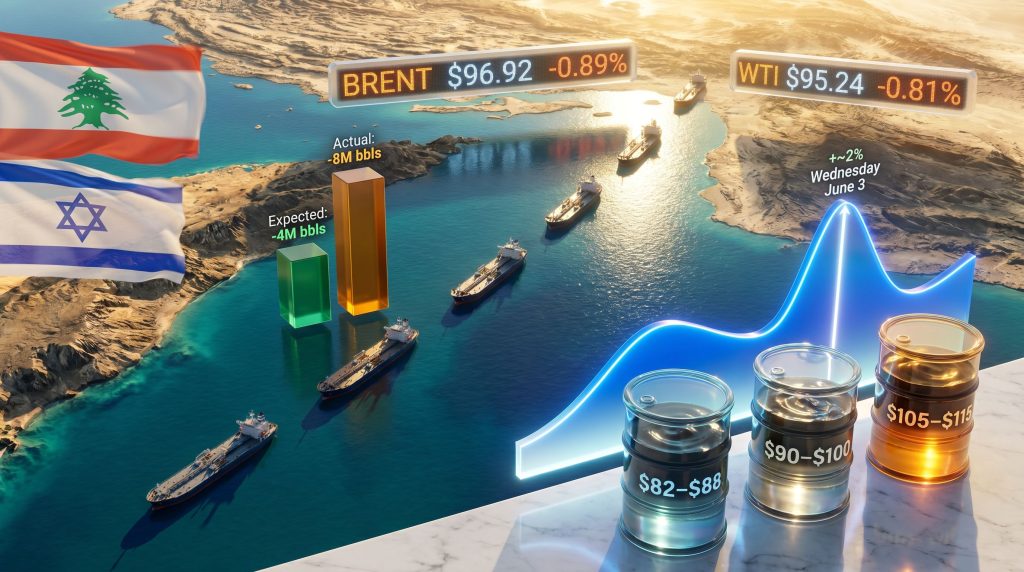
- Brent crude futures had declined $0.87 per barrel, or 0.89%, settling at $96.92 per barrel
- WTI crude had dropped $0.78 per barrel, or 0.81%, to $95.24 per barrel
- Broader session estimates across the trading day indicated benchmark declines of 3% to 4% as diplomatic optimism accumulated
These moves represented a partial unwinding of the gains recorded in the prior session. Both Brent and WTI had climbed approximately 2% on Wednesday, June 3, driven by a sharp escalation in regional hostilities. Iranian military strikes on Kuwait and US military operations near the Strait of Hormuz had pushed risk premium valuations sharply higher before the ceasefire announcement reversed the trajectory.
| Benchmark | Wednesday Session | Thursday Session | Net Directional Move |
|---|---|---|---|
| Brent Crude | +~2.0% | -0.89% to $96.92/bbl | Partial reversal |
| WTI Crude | +~2.0% | -0.81% to $95.24/bbl | Partial reversal |
This pattern, rapid escalation-driven rally followed by an equally rapid diplomacy-driven correction, is not new. It is a recurring structural feature of oil markets during periods of active Middle Eastern conflict, and it illustrates a critical point: the oil price is simultaneously a commodity price and a geopolitical sentiment index. Consequently, a thorough geopolitical oil price analysis is essential for understanding the forces at work beneath these headline moves.
The Lebanon Ceasefire as a Gateway to Broader US-Iran Diplomacy
The significance of the Israel-Lebanon ceasefire extends well beyond the bilateral conflict itself. Tehran had previously signalled that its willingness to engage substantively in negotiations with Washington was partly contingent on a halt to fighting between Israel and Lebanon. The ceasefire therefore functioned, in market terms, not merely as a localised de-escalation, but as a potential precondition being satisfied for a broader diplomatic process.
Iranian Foreign Minister Abbas Araqchi confirmed publicly that communication channels between Tehran and Washington remained open. He acknowledged, however, that no meaningful progress had been achieved in negotiations, and that both parties were still reviewing draft texts that had been exchanged. This nuanced position, open but stalled, is precisely the kind of ambiguous diplomatic signal that prevents markets from fully deflating the risk premium even as they begin to reprice it downward.
US President Donald Trump, speaking on Wednesday, suggested that progress in Iran negotiations could emerge as early as the coming weekend, a forward-looking signal that amplified the bearish price response in crude markets.
Adding a further dimension, the Republican-led House of Representatives passed a resolution to limit presidential authority to continue military operations against Iran. For the resolution to acquire legal force, it would need Senate passage and two-thirds supermajority votes in both chambers to override an anticipated presidential veto, making its immediate operational impact limited. Nevertheless, it introduced a congressional pressure dynamic that markets read as incrementally supportive of a negotiated rather than military resolution.
US Inventory Data: The Bullish Counterweight
While the diplomatic headlines dominated short-term price direction, the physical fundamentals of the crude market were simultaneously sending a very different signal. The US Energy Information Administration reported that domestic crude stockpiles declined by 8 million barrels during the week ending May 29, 2026, bringing total US inventories to 433.7 million barrels.
The scale of that drawdown significantly exceeded analyst expectations. A Reuters poll of analysts had anticipated a draw of approximately 4 million barrels, meaning actual depletion came in at double the forecasted rate.
| Inventory Metric | Market Expectation | Actual Result | Variance |
|---|---|---|---|
| Weekly US Crude Draw | -4.0 million barrels | -8.0 million barrels | 2x forecast |
| Total US Inventories | ~437.7 million barrels | 433.7 million barrels | Below consensus |
This data matters because inventory levels serve as the market's physical buffer against supply shocks. When stocks are ample, traders can tolerate supply disruptions with more equanimity, knowing that existing inventories can bridge a gap. When stocks are depleting faster than expected, the market's tolerance for supply disruption shrinks, and the price floor moves higher accordingly.
The inventory draw therefore acted as a countervailing bullish signal beneath the diplomatic-driven price decline, compressing the magnitude of the ceasefire-related selloff and maintaining a structural price floor.
The IEA Warning and the Slow Recovery Problem
On Tuesday, June 3, the International Energy Agency issued a warning that global oil inventories could reach critically low thresholds ahead of peak summer demand if current drawdown rates were maintained. This warning carried additional weight given that it was issued even against the backdrop of Chinese crude import volumes falling by approximately 6 million barrels per day in May 2026 compared to March 2026 levels. Despite that significant demand reduction from the world's largest crude importer, global inventory depletion continued at a pace that concerned the agency's analysts.
ING Research articulated a perspective shared by a number of market analysts regarding what the firm described as the slow recovery problem. The core argument is that even if the Strait of Hormuz were to reopen promptly following a diplomatic resolution, the physical supply chain response would not be instantaneous. Tanker routing adjustments, port scheduling, refinery intake normalisation, and logistics coordination each require time to reorganise after a major disruption.
The recovery of actual barrel flows into consuming markets would therefore be gradual, likely taking weeks to months, not days. ING Research concluded that inventories were likely to continue tightening into the third quarter of 2026, maintaining upside price risk even as diplomatic progress reduced headline geopolitical risk. This view underlines why oil falls as Lebanon and Israel agree on a ceasefire, yet the structural tightness building in the physical market remains largely intact.
The next major ASX story will hit our subscribers first
Scenario Analysis: Three Price Pathways Into Q3 2026
With diplomatic and physical market forces pulling in opposite directions, oil price trajectory through the third quarter of 2026 depends heavily on which variable dominates. Three broad scenarios capture the range of plausible outcomes:
| Scenario | Brent Price Range | Key Driver | Inventory Trajectory |
|---|---|---|---|
| Full Diplomatic Resolution | $82 to $88/bbl | US-Iran deal signed, Hormuz fully reopened | Gradual rebuilding begins |
| Partial Diplomacy, Ongoing Uncertainty | $90 to $100/bbl | Talks ongoing, Hormuz partially constrained | Continued draws, elevated floor |
| Diplomatic Breakdown, Renewed Escalation | $105 to $115/bbl | Ceasefire collapses, Iran-US tensions re-escalate | Rapid depletion, price spike |
Scenario 1: Full Resolution requires not just a Lebanon ceasefire but a substantive US-Iran agreement that resolves sanctions and security disputes sufficiently to allow Hormuz traffic to normalise. Even in this optimistic scenario, inventory recovery would be slow, and Brent would likely find a floor in the mid-to-high $80s rather than collapsing to pre-crisis levels.
Scenario 2: Partial Diplomacy reflects the most probable near-term outcome given current negotiating positions. A Lebanon ceasefire holds but US-Iran talks proceed slowly without a binding agreement. Oil prices remain elevated but volatile, with the inventory floor supporting prices above $90 despite reduced geopolitical risk premium. Furthermore, OPEC's market influence remains a critical factor in determining whether any production adjustments accompany the diplomatic progress.
Scenario 3: Escalation Renewal represents the tail risk that traders have not fully priced out. A ceasefire breakdown combined with Iranian moves against Hormuz transit infrastructure could push Brent into the $105 to $115 range, with inventory buffers eroding rapidly and OPEC's market influence becoming the primary stabilising variable.
Investor Caution: These scenarios are analytical frameworks based on available information as of early June 2026 and represent speculative projections rather than confirmed forecasts. Oil markets are subject to rapid and unpredictable geopolitical shifts. This analysis does not constitute financial advice.
Historical Patterns: What Past Ceasefires Tell Us About Price Durability
Oil market history provides a consistent pattern around ceasefire announcements in the Middle East. The initial price drop that follows a diplomatic breakthrough typically overreacts to the near-term probability improvement, pricing in a more durable peace than the fragile early stages of a ceasefire actually represent. Markets then partially retrace as traders reassess the durability and scope of the agreement.
The key variables that determine whether a ceasefire-driven price decline is sustained or reversed include:
- Ceasefire durability: Early violations, territorial disputes, or domestic political pressure on either party can rapidly reverse market sentiment within days of the initial announcement
- Iran's substantive posture: Tehran's actual negotiating flexibility on nuclear and sanctions issues, rather than its rhetorical positioning, determines the real probability of Hormuz risk resolution
- Inventory trajectory: If global stockpiles continue drawing down at current rates, the supply-side floor beneath prices remains elevated regardless of diplomatic progress
- OPEC+ production policy: Any coalition response to price movements, whether an accelerated production increase or a production cut to defend revenue, introduces a variable that operates independently of geopolitical risk dynamics. Reviewing OPEC demand forecasts provides further context on how these decisions are being shaped for the months ahead
- Chinese demand trajectory: A recovery in Chinese crude import volumes from their May 2026 lows would add demand-side upward pressure that diplomatic progress alone could not offset
The interplay of these variables means that a single ceasefire announcement, however significant diplomatically, rarely produces a clean, sustained directional move in oil prices over a multi-week horizon.
Frequently Asked Questions
Why did oil prices fall when a ceasefire was announced?
The ceasefire between Israel and Lebanon reduced the market's perceived probability of a wider regional conflict that could disrupt Hormuz shipping. Since crude prices embed a geopolitical risk premium during periods of active conflict, the deflation of that premium causes prices to fall even without any actual change in physical supply volumes.
How much did oil prices drop after the ceasefire news?
Brent crude fell approximately $0.87 per barrel (0.89%) to $96.92, while WTI declined $0.78 (0.81%) to $95.24 in early Thursday trading on June 4, 2026. Broader session estimates indicated declines of 3% to 4% across benchmarks as diplomatic optimism accumulated throughout the day. As reported by CNBC, the market's response was swift and broad-based across both major benchmarks.
Could oil prices rise again despite the ceasefire?
Yes. US crude inventories drew down at twice the expected rate in the week ending May 29, 2026, and the IEA warned that global stocks could reach critically low levels ahead of peak summer demand. Even if Hormuz were to reopen, the physical supply recovery would be gradual, maintaining upside price risk through Q3 2026. The situation where oil falls as Lebanon and Israel agree on a ceasefire does not automatically translate into a sustained bear market for crude.
What is the Strait of Hormuz and why does it matter for oil?
The Strait of Hormuz is the world's most critical oil shipping chokepoint, through which approximately one-fifth of global oil supply passes daily. Its geographic constraints mean it cannot be bypassed at meaningful scale, making it the single most consequential variable in Middle East oil risk pricing.
What is a geopolitical risk premium?
It is the additional price embedded in crude oil above what supply and demand fundamentals alone would justify, reflecting the market's probabilistic assessment of conflict-driven supply disruption. It inflates during escalation and deflates during diplomatic progress, often irrespective of actual barrel flows.
Readers seeking further context on Middle East energy geopolitics and regional commodity market developments can explore ongoing analysis and reporting via Arab News Energy Coverage.
Want To Stay Ahead Of The Next Major Commodity Discovery?
While geopolitical risk premiums dominate oil market headlines, significant mineral discoveries on the ASX can generate equally compelling investment opportunities — and Discovery Alert's proprietary Discovery IQ model delivers real-time alerts the moment they emerge, turning complex data across 30-plus commodities into clear, actionable insights. Explore historic discoveries and their market returns, then begin a 14-day free trial to ensure you're positioned ahead of the broader market when the next major find is announced.