August 9, 2026
When Geography Becomes Destiny: The Strait That Holds Global Energy Hostage
Every few decades, a single stretch of water reasserts its stranglehold over the global economy. The Strait of Hormuz, barely 33 kilometres wide at its narrowest navigable point, has long been described in energy textbooks as the world's most consequential maritime chokepoint. In June 2026, that description shifted from theoretical to viscerally real. Understanding why oil prices after Israeli strikes on Lebanon surged more than $3 in a single session requires stepping back from the headlines and examining the structural mechanics that transform military events into commodity price shocks.
The relationship between armed conflict in the broader Middle East and crude oil pricing is not simply a matter of sentiment. It is rooted in physical geography, infrastructure concentration, and the mathematical reality that roughly one-fifth of all globally traded oil moves through a corridor Iran can effectively threaten or block. When that threat becomes action, no policy statement, diplomatic communique, or OPEC+ resolution can substitute for actual barrels flowing to actual refineries.
When big ASX news breaks, our subscribers know first
The Sequence of Events That Broke the Market's Calm
The session that captured global attention on June 8, 2026, did not emerge from a single event. It was the product of a compounding sequence, each development eroding the fragile de-escalation optimism that had briefly pushed prices lower on the preceding Friday.
Israel launched renewed military strikes on Lebanon on June 7, reversing a ceasefire arrangement that had been brokered in Washington just days earlier, on June 3. That ceasefire itself was the second such agreement to be reached; an earlier cessation of hostilities in April had similarly failed to hold, with violence continuing despite the formal announcement.
Then, early on June 8, sounds of explosions were reported across multiple Iranian cities, including Tehran, Tabriz, and Isfahan. Iran had already fired a salvo of missiles at Israeli targets in retaliation for the Lebanon strikes. What markets were processing was not a discrete event but a feedback loop: strikes generating counter-strikes, ceasefire announcements collapsing within days, and diplomatic assurances carrying diminishing credibility with each failed agreement.
"The repeated failure of ceasefire frameworks to hold has fundamentally shifted how energy markets interpret diplomatic signals. Each collapse adds a layer of structural risk premium that becomes progressively harder to unwind."
The Price Movement in Detail
By 06:33 a.m. Saudi time on June 8, crude benchmarks had staged a decisive recovery from Friday's losses. The numbers told a clear story.
| Benchmark | Price Level | Change | Percentage Move |
|---|---|---|---|
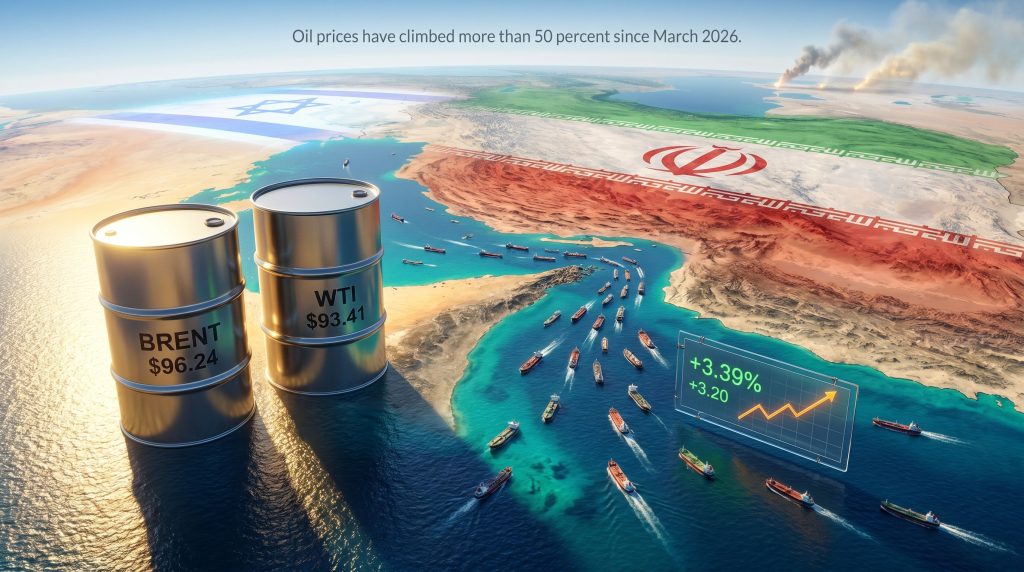
| Brent Crude Futures | $96.24 per barrel | +$3.20 | +3.39% |
| WTI (US Crude) Futures | $93.41 per barrel | +$2.87 | +3.17% |
| Brent Intraday High | ~$97.15 per barrel | Extended gains | Post-open spike |
| WTI Intraday High | ~$94.61 per barrel | Extended gains | Post-open spike |
These gains completely erased the losses recorded on Friday, when prices had briefly declined on hopes that the US-Iran conflict was moving toward a negotiated resolution. That two-day round-trip illustrates a market dynamic that energy traders have increasingly come to terms with: de-escalation rallies in crude are borrowed time, and the underlying bid reasserts itself whenever military reality contradicts diplomatic narrative.
The broader context is equally striking. For a fuller crude price overview, oil prices have climbed by more than 50 percent since March 2026, when the conflict between the United States and Iran began escalating in earnest. That sustained move represents one of the most significant geopolitically driven oil shocks in recent memory, with implications that extend well beyond energy markets into global inflation dynamics and central bank policy calculations.
Why the Strait of Hormuz Is the Single Most Important Variable
The Physics of a Chokepoint
The Strait of Hormuz functions as a maritime funnel through which crude oil from Saudi Arabia, Iraq, Kuwait, the UAE, and Iran itself must pass before reaching global consumers. There is no viable large-scale alternative routing that does not involve enormous additional cost and time. The two primary escape valves, Saudi Arabia's East-West pipeline to Yanbu and the Abu Dhabi Crude Oil Pipeline, have combined export capacity that falls well short of replacing full Hormuz throughput.
When Iran restricts or blocks shipping through this corridor, the physical consequences are immediate:
- Tankers must reroute around the Cape of Good Hope, adding approximately two to three weeks to delivery times and materially increasing freight costs
- Asian importing nations, particularly China, Japan, South Korea, and India, face acute supply competition because their refinery configurations are specifically optimised for Persian Gulf crude grades
- Medium and heavy sour crude, the grade profile that dominates Persian Gulf exports, becomes scarcer globally, creating distortions across the refinery feedstock spectrum
- Spot market premiums spike as buyers compete for alternative supplies from West Africa, the North Sea, and the Americas
Since the conflict intensified, Iran has been blocking the majority of shipping through the strait. The United States has simultaneously imposed a blockade on Iranian ports. The combined effect of these dual-sided restrictions has removed a significant volume of crude from accessible global supply, creating the structural foundation for the current price environment.
A Metric Worth Internalising
To put the scale in perspective: approximately 17 to 21 million barrels per day transited the Strait of Hormuz in normal operating conditions prior to the conflict. For reference, total global oil demand runs at roughly 100 to 103 million barrels per day. The closure or severe restriction of Hormuz does not represent a marginal supply tightness. It represents the removal of a supply volume larger than the entire output of any single OPEC member, effectively overnight.
OPEC+ Announces Another Output Increase. Markets Shrug.
On the Sunday immediately preceding the June 8 price spike, OPEC+ formally agreed to its fourth consecutive monthly production increase. Under normal market conditions, four consecutive output hikes would represent a meaningful bearish signal for crude prices. In the current environment, however, the decision landed with virtually no market impact.
The reason is structural rather than procedural. Geopolitical analysis from Rystad Energy assessed that the physical impact of the OPEC+ output decision would be close to zero, given that the majority of member nations are unable to deliver additional barrels. This further underscores the limits of OPEC's market influence when physical access to shipping lanes is compromised. The gap between announced policy and physical delivery capacity is essentially total.
| Factor | OPEC+ Position | Operational Reality |
|---|---|---|
| Output targets | Increased for fourth month | Most members cannot meet prior targets |
| Hormuz access | Assumed open shipping lanes | Iran blocking majority of transit |
| Russian production | Assumed stable capacity | Degraded by infrastructure strikes |
| Net supply effect on market | Intended to be meaningful | Assessed as negligible to zero |
This disconnect illustrates a broader dynamic that sophisticated energy market participants have been grappling with throughout this conflict: paper barrels and physical barrels are not the same thing, and in a supply crisis driven by physical access restrictions, announced production policy carries almost no weight.
The Diplomatic Overlay: Trump, Netanyahu, and the Ceasefire Credibility Problem
US President Donald Trump has publicly maintained that a deal to end the broader war remains achievable, telling the Financial Times that he controls the trajectory of negotiations and that Israeli military activity will not derail a potential agreement. Trump also reportedly urged Israeli Prime Minister Benjamin Netanyahu to hold back from further strikes, indicating active White House management of the conflict's escalation dynamics.
Iran, for its part, has conditioned any peace agreement with Washington on a simultaneous ceasefire between Israel and Lebanon. That linkage creates a structural negotiating complexity: progress on the US-Iran track is functionally dependent on a Lebanon ceasefire that has now collapsed twice. Furthermore, the intersection of crude oil and geopolitics means that every diplomatic setback is immediately reflected in commodity pricing.
The Lebanon conflict timeline is instructive for understanding how fragile the diplomatic architecture actually is:
| Date | Development |
|---|---|
| March 2026 | Israel invades Lebanon following Hezbollah rocket and drone attacks across the border |
| April 2026 | First cessation of hostilities agreement reached; violence continues regardless |
| June 3, 2026 | Second ceasefire announced following Washington-brokered negotiations |
| June 7, 2026 | Israel launches renewed strikes on Lebanon, breaking the fresh ceasefire |
| June 8, 2026 | Explosions reported in Tehran, Tabriz, and Isfahan; Iran fires missiles at Israeli targets |
The pattern of ceasefire announcement followed by rapid collapse has had a measurable effect on how energy markets weight diplomatic signals. Traders and risk desks have progressively reduced the discount they apply to geopolitical risk premiums on the basis of diplomatic progress, because that progress has repeatedly and rapidly reversed.
The next major ASX story will hit our subscribers first
Regional Exposure: Who Bears the Heaviest Economic Burden
Asia-Pacific Nations Face the Sharpest Supply Risk
The economies most directly exposed to a sustained Hormuz disruption are those in Northeast and South Asia. China, Japan, South Korea, and India collectively represent the dominant importing bloc for Persian Gulf crude. Their exposure is compounded by a structural factor that is less widely understood: refinery configuration lock-in.
Asian refineries have been built and optimised over decades specifically to process medium and heavy sour crude, the grade profile that characterises Saudi, Iraqi, Kuwaiti, and UAE production. Switching to light sweet crude from the Americas or North Sea requires either significant capital investment in refinery modifications or the acceptance of substantial margin compression. This means that even when alternative supply sources exist in volume terms, the practical substitution flexibility is far more limited than headline import statistics suggest.
Europe Faces Inflationary Feedthrough
European refiners face tighter feedstock availability and higher input costs, which feed through into transport fuel prices, heating energy, and industrial inputs. The inflationary channel from energy to broader consumer prices is well-documented. Sustained crude prices above $90 per barrel present a material complication for central banks already managing complex inflation dynamics.
The United States: Simultaneously Actor and Market Participant
The United States occupies an unusual dual position. Washington's blockade of Iranian ports makes the US an active participant in the supply restriction that is driving prices higher, while simultaneously exposing the US domestic economy to elevated energy costs. Domestic shale production provides a meaningful buffer, and WTI pricing at a modest discount to Brent reflects some of that insulation. However, the $93.41 per barrel WTI print on June 8 makes clear that the buffer is partial rather than complete.
Scenario Framework: Three Price Pathways From Here
Investors and risk managers assessing crude exposure in the current environment are typically working across three broad scenarios:
Scenario 1: Diplomatic Breakthrough (Bearish for Oil)
A credible, verified ceasefire between Israel and Lebanon, combined with a framework agreement between the US and Iran that reopens Hormuz shipping lanes, would remove the structural risk premium from crude pricing. Analysts estimate Brent could retrace toward the $80 to $85 per barrel range in a genuine de-escalation scenario. OPEC+ output decisions would then carry meaningful supply weight once physical delivery constraints are lifted.
Scenario 2: Conflict Stalemate Continues (Base Case)
No further major escalation, but no resolution either. The current supply constraint persists, diplomatic signals continue to be treated sceptically by markets, and Brent holds in the $90 to $97 per barrel range with periodic volatility spikes triggered by individual military events. Global inflation remains elevated, and energy becomes an ongoing headwind for consumer spending and corporate margins.
Scenario 3: Full Regional Escalation (Highly Bullish for Oil)
Conflict spreads to additional Persian Gulf states, or direct attacks on major oil production and export infrastructure occur. Brent could test $110 to $120 per barrel or higher in a severe disruption scenario. Global recession risk increases materially as energy costs become a dominant macroeconomic constraint, central banks face a stagflationary policy dilemma, and demand destruction eventually becomes the market-clearing mechanism.
Disclaimer: Scenario projections are analytical frameworks, not financial forecasts. Actual outcomes will depend on geopolitical developments that are inherently unpredictable. This article does not constitute investment advice.
The Deeper Market Psychology Behind the Price Spike
One dimension of the current oil price environment that receives insufficient analytical attention is the shift in market psychology from event-driven volatility to structural risk premium pricing. These are meaningfully different market states with different implications for how prices behave.
In an event-driven volatility regime, prices spike on specific developments and retrace as the immediate shock fades. Traders buy the dip and sell the spike. In a structural risk premium regime, the elevated price level becomes the baseline, and the market's default assumption shifts from eventual normalisation to sustained disruption. Position management changes fundamentally.
The potential for oil market disruption to compound with broader trade tensions adds a further layer of complexity, as investors simultaneously seek safe-haven market shifts in assets such as gold. The 50%+ price rise since March 2026 is itself evidence of this psychological transition. Markets that are merely reacting to events do not sustain half-a-year-long directional moves of this magnitude.
Frequently Asked Questions
Why did oil prices after Israeli strikes on Lebanon jump more than $3?
The strikes on Lebanon, combined with reports of explosions across multiple Iranian cities, signalled to energy markets that the conflict was deepening rather than resolving. This raised fears of prolonged disruption to oil flows through the Strait of Hormuz. Brent crude rose sharply, gaining $3.20, or 3.39%, to $96.24 per barrel, while WTI gained $2.87, or 3.17%, to $93.41 per barrel, fully reversing Friday's losses.
What makes the Strait of Hormuz so critical to global oil pricing?
The Strait of Hormuz is the transit corridor for approximately one-fifth of all globally traded oil. There is no adequate large-scale alternative routing. When access is restricted or blocked, the physical supply reaching global refineries decreases materially, creating direct upward pressure on benchmark crude prices regardless of what producing nations announce in terms of output targets.
Why did the OPEC+ production increase have no market impact?
OPEC+ approved its fourth consecutive monthly output increase, but energy analysts assessed the real-world supply impact as negligible. Most member nations cannot physically deliver additional barrels due to the Hormuz closure, and Russia's production capacity has been degraded by infrastructure attacks. There is, consequently, a fundamental disconnect between announced output policy and actual deliverable supply.
How much have oil prices risen since the conflict started?
Crude prices have risen by more than 50 percent since March 2026, when the broader US-Iran conflict began escalating. The June 8 session extended that trend after a brief and quickly reversed de-escalation dip on the preceding Friday.
Could prices fall sharply if a peace deal is reached?
Yes, a credible and verified diplomatic resolution that reopens Hormuz to normal shipping would likely remove a substantial portion of the current risk premium from crude pricing. Analyst scenario modelling suggests Brent could retrace to the $80 to $85 per barrel range in a genuine resolution scenario, though the repeated failure of previous ceasefire agreements has substantially reduced the market's willingness to price in diplomatic progress before it is verified.
Want to Stay Ahead of the Next Major Commodity Discovery Driven by Geopolitical Shifts?
When energy markets move this sharply, the ripple effects extend well beyond crude oil — and Discovery Alert's proprietary Discovery IQ model scans the ASX daily to deliver real-time alerts on significant mineral discoveries, including those in energy and resource commodities poised to benefit from supply disruptions. Explore historic discoveries and their returns to understand the scale of opportunity, then begin your 14-day free trial at Discovery Alert to ensure you're positioned before the broader market catches on.