June 5, 2026
The Hidden Mechanics Behind Oil Price Drops During Geopolitical De-escalation
Energy markets operate on a logic that often defies intuition. When headlines signal progress toward peace in one of the world's most strategically sensitive regions, many observers expect stability or even relief. Yet seasoned traders and energy analysts understand the counterintuitive reality: diplomatic breakthroughs frequently send crude oil prices sharply lower, sometimes within hours of positive news flow.
This dynamic sits at the heart of how modern commodity markets actually function, and understanding it reveals far more about energy pricing than most casual observers ever encounter.
The recent episode involving US-Iran negotiations serves as a textbook example. As oil prices drop on US-Iran talks progress became the defining market narrative of May 27, 2026, both major crude benchmarks experienced meaningful declines that erased the previous session's gains entirely. To understand why, it is necessary to start not with the news itself, but with the architecture of risk embedded in every barrel of crude traded on global futures exchanges.
When big ASX news breaks, our subscribers know first
What the Geopolitical Risk Premium Actually Represents
The concept of a geopolitical risk premium is frequently referenced but rarely explained with precision. At its core, it represents the additional price that futures market participants are willing to pay today to hedge against the possibility that supply will be disrupted tomorrow. It is not a reflection of current physical shortfalls. No barrels need to disappear from the market for the premium to form. The mere credible possibility of future disruption is sufficient.
This distinction matters enormously. When military conflict threatens a major producing region or transit corridor, traders on futures exchanges begin pricing in probability-weighted scenarios. A 20% chance of a significant supply disruption might add $5 to $8 per barrel to the prevailing price. A 40% chance could add $15 or more, depending on the severity of the disruption being modelled.
Furthermore, the trade war impact on oil adds another layer of complexity to these probability calculations, making accurate risk assessment even more challenging for market participants.
"The risk premium is a forward-looking insurance mechanism. When perceived risk diminishes, the premium deflates and prices fall, even if the physical supply picture has not changed at all."
This asymmetry creates an environment where diplomatic progress is, paradoxically, a bearish signal for crude oil prices. Every step toward resolution reduces the probability weighting assigned to the worst-case supply scenarios, and that reduced probability directly deflates the premium embedded in the price.
How Algorithmic Trading Amplifies the Effect
Modern energy markets are dominated by algorithmic and quantitative trading systems that monitor news flows in real time and execute within milliseconds. When diplomatic signals emerge, these systems begin unwinding long positions accumulated during the escalation phase, often before human analysts have fully processed the implications. This creates a compounding effect where:
- Initial positive diplomatic signals trigger algorithmic selling
- That selling depresses prices, which triggers further stop-loss orders
- Human traders observe the price action and add selling pressure
- The total move substantially exceeds what fundamental supply analysis would justify
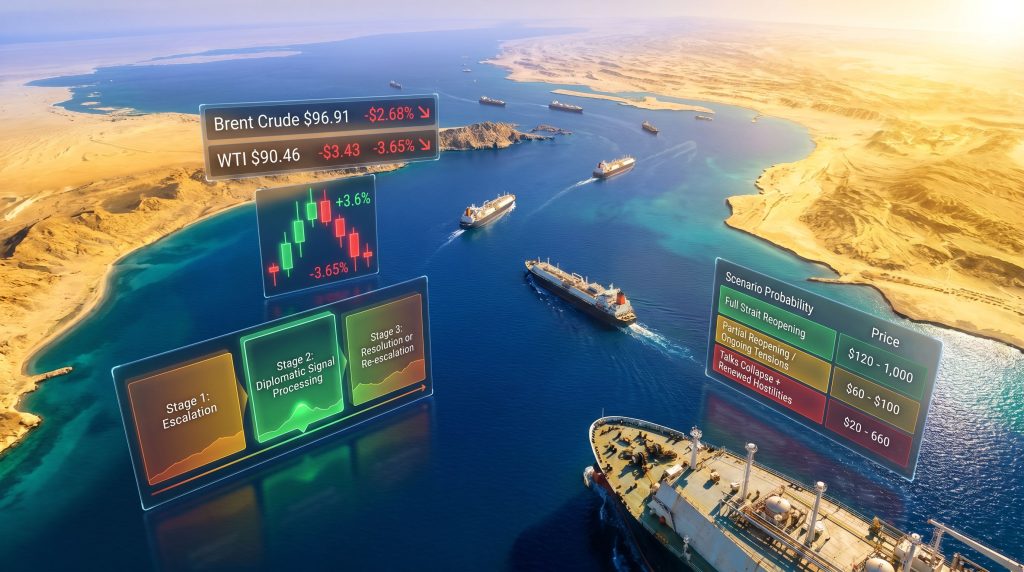
The result is the kind of sharp, rapid price decline that characterised the May 27 session, where Brent crude futures fell $2.67, or 2.68%, to $96.91 per barrel, and WTI crude shed $3.43, or 3.65%, to $90.46 per barrel, according to Reuters reporting via Arab News.
Brent and WTI: Reading the 24-Hour Volatility Cycle
The price movements on May 27 become even more significant when viewed in the context of what happened in the preceding session. On Tuesday, July Brent futures surged 3.6% following reports of new US military strikes targeting Iranian missile infrastructure and vessels allegedly involved in mine-laying operations near the Strait of Hormuz. That gain was built almost entirely on escalating geopolitical risk.
Within 24 hours, those gains were not just reversed but exceeded in relative terms for WTI. The following table captures the scale of the price movement:
| Benchmark | Price Level | Change (USD) | Percentage Decline |
|---|---|---|---|
| Brent Crude Futures | $96.91/barrel | -$2.67 | -2.68% |
| WTI (West Texas Intermediate) | $90.46/barrel | -$3.43 | -3.65% |
The proportionally steeper WTI decline compared to Brent reflects a structural feature of these markets. US-traded contracts tend to respond more sharply to supply-side expectation shifts because WTI pricing is more sensitive to domestic inventory signals and short-term supply availability assumptions. Brent, as a global benchmark, incorporates a broader set of variables including shipping, geopolitical spread, and European demand dynamics.
What this 24-hour cycle illustrates is that during active geopolitical conflicts, news flow rather than physical supply fundamentals drives price discovery. Traders are not responding to actual barrels entering or leaving the market. They are responding to revised probability estimates for future scenarios. Oil price movements during trade wars follow a similar pattern, reinforcing just how powerfully sentiment shapes crude benchmarks.
The Strait of Hormuz: Why One Waterway Can Move Global Energy Markets
No understanding of this market episode is complete without examining the specific geography involved. The Strait of Hormuz is a narrow channel connecting the Persian Gulf to the Gulf of Oman, and through it flows a volume of crude oil and liquefied natural gas that makes it arguably the single most consequential maritime chokepoint in the global energy system.
Several structural features explain why its status commands such disproportionate market attention:
- Volume concentration: Approximately 20% of the world's total oil supply and around 20% of global LNG trade transits this corridor, according to data from the US Energy Information Administration. Any disruption immediately affects supply chains spanning Asia, Europe, and beyond.
- Limited substitution capacity: Alternative routing options exist in theory, including overland pipelines through Saudi Arabia and the UAE, but these carry far less volume than the Strait itself and cannot absorb full Strait traffic at short notice.
- Psychological leverage: Market participants understand that the Strait cannot be easily hedged against at scale. The tail risk of complete blockage is therefore priced with a fear premium that exceeds what actuarial probability alone would suggest.
- Dual commodity exposure: Unlike some chokepoints that primarily affect crude oil, the Strait's centrality to LNG trade means disruptions simultaneously affect natural gas pricing in Asia and Europe, amplifying the downstream economic effects.
LNG Tanker Movements as a Real-Time Market Signal
One of the more technically sophisticated aspects of this market episode was how analysts and traders interpreted LNG tanker transit data as a leading indicator. When reports emerged that LNG carriers had begun passing through the Strait in the days preceding the May 27 session, this was treated as meaningful new information for several reasons.
First, commercial LNG tanker operators make decisions based on hard security assessments, not diplomatic statements. Their willingness to commit multi-hundred-million-dollar vessels to a contested transit corridor signals that their risk models indicate acceptable operational conditions. Second, the resumption of tanker transits provides a measurable, verifiable data point in an environment otherwise dominated by unverifiable diplomatic claims.
Third, it creates a self-reinforcing dynamic: as more tankers transit successfully, the operational safety case for the waterway strengthens, attracting further transits and further deflating the risk premium.
PVM analyst Tamas Varga identified exactly this mechanism as the primary driver of renewed downward price pressure on May 27, noting that both measurable diplomatic progress and an increasing number of vessels transiting the critical chokepoint explained the resumption of selling pressure in crude markets.
Competing Signals: Why the Market Didn't Collapse Further
Despite the meaningful declines recorded on May 27, prices did not fall to levels that would reflect a full unwinding of the geopolitical premium. Several countervailing forces maintained a floor under crude benchmarks, illustrating that the market was pricing in a nuanced, probability-weighted scenario rather than a clean resolution.
Bearish signals driving prices lower:
- Confirmed LNG tanker transits through the Strait suggesting improved operational conditions
- Reports of substantive framework discussions between Washington and Tehran
- An April ceasefire providing an established baseline for continued negotiations
Bullish risk factors preventing a steeper decline:
- Recent US military strikes on Iranian missile sites and vessels remained an unresolved source of diplomatic friction
- Iran formally accused the US of violating ceasefire terms by striking targets near the Strait, introducing legal and political complications
- Escalating Israeli military activity in Lebanon added a parallel regional destabilisation risk that traders could not ignore
Commerzbank analysts captured this dual-signal environment with precision on May 27, acknowledging that recent US strikes had introduced some dampening effect on hopes for a rapid framework agreement, while simultaneously noting that overall market confidence in an eventual resolution remained relatively intact. This combination of cautious optimism and persistent uncertainty is characteristic of markets operating in the transition zone between geopolitical escalation and resolution.
A Three-Stage Framework for Understanding Oil Price Behaviour During Conflicts
The mechanics of this episode can be understood more clearly through a structured framework that maps how crude oil prices typically evolve through geopolitical crises:
Stage 1: Escalation Premium Buildup
Military action, territorial disputes, or infrastructure threats emerge. Traders add a risk premium to futures contracts. Prices rise even without confirmed supply disruption. This is the phase that characterised the Tuesday session, when Brent surged 3.6% on strike reports.
Stage 2: Diplomatic Signal Processing
Ceasefire talks, back-channel negotiations, or tanker resumptions begin filtering into market awareness. Risk premium deflates. Prices fall as supply expectations improve. This is precisely the phase that drove the May 27 declines, and it is where oil prices drop on US-Iran talks progress becomes the operative market dynamic.
Stage 3: Resolution or Re-escalation
If a deal is formalised, the premium fully deflates and prices normalise toward fundamental supply-demand valuations. If talks collapse, the premium re-inflates rapidly, often surpassing prior highs because credibility damage makes future diplomatic signals less believable.
Based on the available market data and analyst positioning from May 27, the US-Iran situation was clearly in transition between Stage 1 and Stage 2, with traders pricing in a partial but incomplete deflation of the escalation premium. The continued military activity and ceasefire disputes prevented a full Stage 2 resolution, which explains why prices fell meaningfully but did not approach the fundamental valuation floor. Understanding crude oil price volatility is therefore essential for navigating these transitional market phases effectively.
The next major ASX story will hit our subscribers first
Scenario Analysis: Where Do Prices Go From Here?
Note: The following scenarios involve forward-looking analysis and speculative projections. They do not constitute financial advice and actual outcomes may differ materially from any projections presented.
| Scenario | Key Signal | Expected Price Range |
|---|---|---|
| Full Strait reopening with formal deal | Sustained LNG and crude tanker transits confirmed | Brent potentially moves toward $85-$90 range as full premium unwinds |
| Partial reopening with ongoing low-level tensions | Current trajectory continues | Prices remain volatile in the $90-$100 range with high intraday swings |
| Talks collapse with renewed hostilities | Resumed military escalation signals | Risk premium re-inflates sharply, potentially driving Brent above $100 |
The downstream implications extend well beyond the futures market. Asian economies including Japan, South Korea, India, and China carry the most direct exposure to Strait disruptions given their substantial dependence on Middle Eastern crude and LNG imports. European energy markets remain sensitive for different structural reasons, particularly given the ongoing effort to diversify away from Russian supply that has elevated the strategic importance of Middle Eastern alternatives since 2022.
Global refining margins tend to compress during high-volatility periods as operators struggle to lock in feedstock costs at predictable price levels. In addition, global crude oil shipments remain a key variable, as any sustained disruption to tanker flows compounds the downstream pressure on refinery operations worldwide.
What This Episode Reveals About Modern Energy Market Structure
The US-Iran oil price dynamic of late May 2026 is not an anomaly. It reflects several deep structural features of how contemporary energy markets function that carry lasting relevance for investors, energy policymakers, and supply chain managers. Consequently, OPEC's influence on global markets operates alongside these geopolitical forces, creating a layered pricing environment that demands careful analysis.
Oil prices drop on US-Iran talks progress in ways that consistently mirror the broader mechanics described here, and the episode's insights apply across future conflict scenarios:
- Geopolitical risk premiums are the dominant short-term price driver during active conflicts, routinely overriding fundamental supply-demand signals
- Markets price in probabilities, not certainties, which means partial diplomatic progress produces partial price adjustments in a continuous and often non-linear way
- The speed of algorithmic response means price moves now happen faster than the diplomatic events that trigger them can be fully assessed
- LNG tanker movements and other observable physical signals carry exceptional informational value precisely because they represent real-world operational decisions rather than political statements
- The Strait of Hormuz retains its status as the single most consequential geographic variable in global energy pricing, and its operational status functions as a real-time barometer for supply risk across multiple commodity classes simultaneously
For investors and traders operating in energy markets, this framework provides a more systematic basis for interpreting geopolitical news flow than the conventional headline-driven approach. The key question in any conflict episode is not simply whether the news is good or bad, but where the market currently sits within the escalation-resolution cycle, and how much premium has already been priced in relative to the probability-weighted expected outcome.
Want to Stay Ahead of the Next Major Commodity Market Shift?
Discovery Alert's proprietary Discovery IQ model scans ASX announcements in real time, delivering instant alerts on significant mineral discoveries across more than 30 commodities — transforming complex market data into clear, actionable opportunities for traders and investors alike. Explore historic discoveries and their market returns, then begin your 14-day free trial at Discovery Alert to position yourself ahead of the market.