July 21, 2026
The Asymmetric Logic of Oil Markets: Why Peace Signals Hit Prices Harder Than War
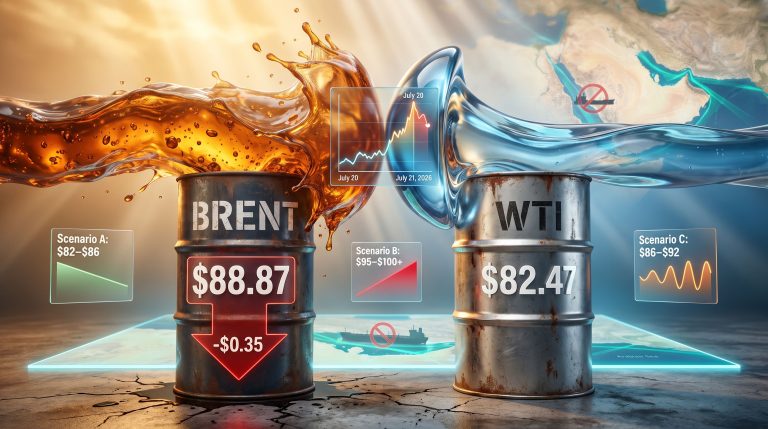
Energy markets operate on a logic that often confuses casual observers. Prices spike violently on fear and unwind slowly on relief — except when diplomatic signals are unusually clear, at which point the unwind can be just as sudden as the original surge. This asymmetry sits at the heart of understanding why oil prices pull back as Iran signals US talks resumed in mid-July 2026, even as the underlying physical environment remained genuinely disrupted.
The episode also reveals something deeper about how modern crude markets function: they are not purely driven by supply and demand fundamentals. Embedded within every barrel price is an invisible component, a risk premium that reflects trader compensation for the possibility of unexpected disruption. When that possibility appears to diminish, the premium deflates — sometimes faster than the underlying risk actually changes.
When big ASX news breaks, our subscribers know first
The Geopolitical Risk Premium: What It Is and Why It Matters
Pricing the Unknown Into Every Barrel
The geopolitical risk premium in oil is the portion of the benchmark crude price that cannot be explained by physical supply-demand balances alone. During periods of active conflict or credible supply disruption threats, traders embed a worst-case buffer into their positions. This buffer compensates for scenarios that may never materialise but carry severe consequences if they do.
What makes this mechanism particularly powerful is its directional asymmetry. Fear-driven price spikes tend to be sharp and rapid, as market participants rush to hedge exposure simultaneously. Diplomatic unwinds, by contrast, are typically more gradual — unless a signal is unusually credible and well-sourced, at which point the deflation of the premium can mirror the original spike in both speed and magnitude. For a broader understanding of these dynamics, the crude oil volatility guide provides essential context on how benchmark prices behave under stress.
"The low-probability but high-impact nature of a full Hormuz closure is precisely why energy markets retain a structural risk premium even during active de-escalation phases. The premium does not disappear; it simply reprices."
Why Iran Holds Structural Influence Over Crude Benchmarks
Iran ranks among the world's top-ten crude producers and sits at the geographic centre of the most consequential maritime chokepoint in global energy logistics. The Strait of Hormuz, the narrow passage between Iran and Oman, carries approximately 20% of the world's daily petroleum liquids through a corridor that, at its narrowest point, is only about 33 kilometres wide.
Every significant shift in US-Iran relations since the original Joint Comprehensive Plan of Action negotiations in 2015 has produced measurable crude price volatility. This is not coincidence — it is structural. Iran's capacity to threaten, restrict, or effectively close Hormuz to commercial traffic represents a credible supply disruption scenario that markets must price regardless of the current diplomatic temperature.
What Happened on 20 July 2026: The Signals That Moved Markets
Iran's Foreign Ministry Statement and Its Market Impact
The price reversal on 20 July 2026 was triggered by a statement from Iran's Foreign Ministry indicating that the country remained open to continuing negotiations with the United States on the basis of national interest. According to reporting from the Wall Street Journal, Oman confirmed that a third round of US-Iran talks was scheduled to resume in Geneva. Iranian officials described a readiness to discuss and negotiate outstanding proposals, language that energy traders interpreted as a meaningful step back from the brink.
The speed of the market response reflected the degree to which the prior week's rally had been built almost entirely on escalation risk rather than on any confirmed change to physical supply volumes. Consequently, oil prices pull back as Iran signals US talks progressed, demonstrating just how sentiment-driven these markets can be.
The Price Movements in Detail
| Benchmark | Intraday High | Post-Signal Level | Session Move |
|---|---|---|---|
| Brent Crude | US$91.42/bbl (highest since 11 June) | US$87.96/bbl | -US$0.14 (-0.16%) |
| WTI Crude | Highest since 12 June | US$81.99/bbl | -US$0.50 (-0.61%) |
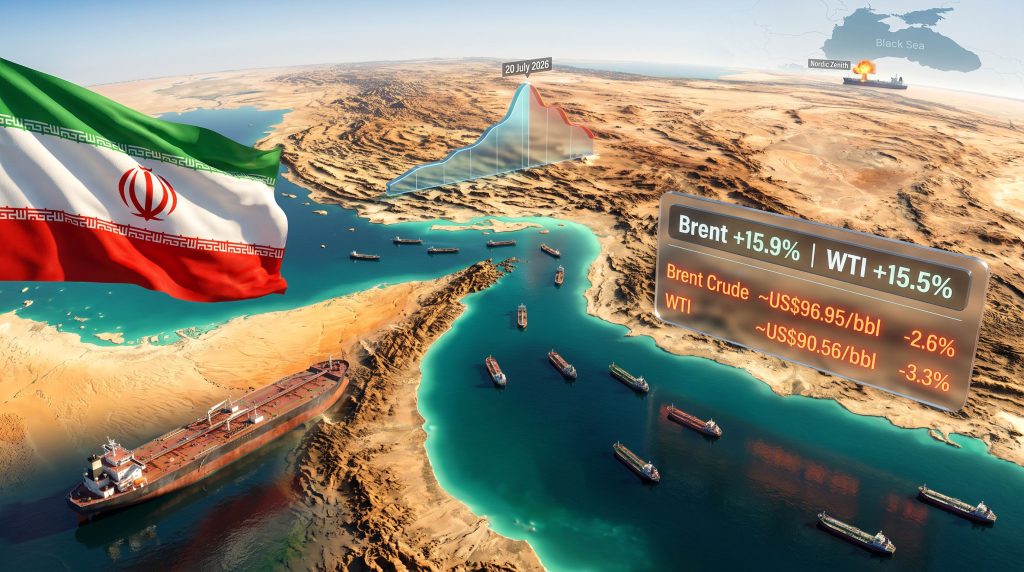
| Brent (weekly context) | Prior week surge | ~US$96.95/bbl | -2.6% broader session |
| WTI (weekly context) | Prior week surge | ~US$90.56/bbl | -3.3% broader session |
The prior week had delivered the largest weekly gains for both benchmarks since early 2026, with Brent surging 15.9% and WTI climbing 15.5%. That scale of weekly move in crude benchmarks is extraordinary by historical standards and reflects just how aggressively the market had priced in conflict escalation.
What Built the Rally in the First Place
The preceding week's surge was not built on speculation alone. A series of concrete escalation events created a genuine supply disruption narrative:
- The US conducted its ninth consecutive night of military strikes against Iran over the weekend
- Regional allies Kuwait and Bahrain reported further Iranian retaliatory attacks
- Iran's Islamic Revolutionary Guard Corps claimed two oil tankers had been immobilised after attempting to navigate a southern route through the Strait of Hormuz
- The UK Maritime Trade Operations centre reported a vessel on fire northwest of Kumzar in Oman
- Strait transit volumes fell from eight vessels per day to just four, according to LSEG data, representing a 50% decline in daily throughput
That final data point deserves particular attention. Daily transit volumes through Hormuz are one of the most closely monitored leading indicators in global energy markets. A halving of throughput, even temporarily, is sufficient to sustain elevated benchmarks for weeks given the just-in-time nature of modern petroleum supply chains.
The Strait of Hormuz Under Active Pressure
Naval Blockade and Counter-Measures
The escalation extended beyond air strikes. The United States announced enforcement of a naval blockade on Iranian ports, applying direct maritime pressure on Iran's export capacity. Iran responded by declaring it would act against vessels it considered to be in violation of its navigation rules within the strait. This mutual posturing transformed a regional military conflict into a direct threat to the physical flow of petroleum to global markets.
Since the Friday prior to the 20 July session, at least three oil product tankers and one large crude carrier had entered the strait to load oil, suggesting that commercial operators had not entirely abandoned Hormuz transits but were clearly recalibrating risk exposure. Furthermore, these geopolitical market risks extend well beyond the energy sector, affecting metals, mining, and broader commodity markets simultaneously.
Why Even Partial Disruption Has Outsized Consequences
A commonly underappreciated dynamic in Hormuz risk analysis is that a total closure is not required to generate significant price pressure. Even a 30-40% reduction in daily transits is sufficient to create meaningful supply tightness in downstream refining markets across Asia and Europe within weeks. Insurance costs for tanker operators spike rapidly under conflict conditions, which effectively prices smaller or less capitalised shipping companies out of the route altogether, amplifying the physical reduction in throughput.
The Black Sea Dimension: A Second Supply Corridor Under Threat
The Nordic Zenith Attack and CPC Pipeline Exposure
Compounding the Hormuz disruption, the Caspian Pipeline Consortium reported on the preceding Friday that an oil tanker near Russia's Black Sea coast had been struck and damaged by two drones. The vessel, the Nordic Zenith, was chartered by ExxonMobil at the time of the attack. No party claimed responsibility.
| CPC Pipeline Metric | Data Point |
|---|---|
| Share of Kazakhstan's oil exports carried | ~80% |
| Export terminal location | Novorossiysk, Black Sea |
| Conflict exposure | Repeated drone strikes since 2022 |
| Strategic role | Major non-OPEC supply corridor to Europe and Asia |
The CPC pipeline system connecting Kazakhstan's prolific oilfields to the Black Sea export terminal at Novorossiysk represents one of the most strategically significant non-OPEC supply arteries in existence. Repeated disruptions to this corridor have already raised the risk profile of Central Asian oil supply, and simultaneous pressure on both Hormuz and Black Sea routing creates what analysts describe as a compound supply risk scenario.
Structural Vulnerabilities Amplifying Price Sensitivity
Depleted Inventories and Reduced Refining Capacity
TS Lombard's analysis identified a critical structural dimension that mainstream reporting has largely underweighted. The current episode of geopolitical disruption is occurring against a backdrop of depleted global petroleum inventories and reduced worldwide refining capacity. Ukrainian strikes on Russian refinery infrastructure have removed approximately 10% of global refining capacity, according to TS Lombard's assessment, compressing the system's ability to absorb crude supply shocks.
Refining margins, the spread between crude input costs and the market price of refined products like petrol and diesel, have remained above pre-conflict levels. This is a meaningful signal. Elevated refining margins indicate that downstream demand for refined products is strong relative to the capacity available to process crude into usable fuels, a dynamic that amplifies the consumer-level impact of any upstream supply disruption.
China's Role as the Market's Hidden Stabiliser
One of the least-discussed mechanisms moderating crude price escalation during this cycle is China's strategic flexibility as both a major importer and a significant exporter of refined petroleum products. Understanding China demand dynamics is essential here, as China's capacity to defer the timing of oil import purchases while simultaneously exporting refined products to global markets provides a demand-side buffer that prevents supply shocks from translating into runaway benchmark price increases.
This dynamic acts as a form of market ballast. If Chinese import schedules accelerate during a period of Hormuz disruption, the resulting demand surge would amplify price pressure significantly. Conversely, by deferring purchases and drawing on domestic refined product inventories, China effectively moderates the speed at which a supply shock transmits into global prices. Understanding this mechanism is essential for anyone modelling crude price behaviour during Middle East escalation cycles.
"Should China's strategic flexibility diminish, whether through domestic demand acceleration, inventory exhaustion, or a policy shift away from refined product exports, the stabilising effect would evaporate rapidly, exposing global benchmarks to significantly greater upside volatility."
The next major ASX story will hit our subscribers first
Diplomatic Scenario Analysis: Three Pathways for Oil Prices
Scenario 1: Geneva Talks Produce a Framework (Base Case)
If a third round of US-Iran negotiations in Geneva delivers a framework understanding or interim agreement, the conditions for a sustained unwinding of the risk premium fall into place:
- Strait of Hormuz transit volumes recover toward normalised levels of 8-12 vessels per day
- Insurance costs for tanker operators decline, restoring commercial viability of the route
- Brent crude retreats toward the US$82-85/bbl range as the conflict premium fully deflates
- Downward pressure on benchmarks is sustained in the near term absent other supply shocks
Scenario 2: Talks Stall Without Escalation (Neutral Case)
Negotiations produce no breakthrough but neither side escalates the military dimension materially:
- Crude prices stabilise in the US$87-92/bbl range, reflecting residual but non-accelerating uncertainty
- Market attention rotates back toward OPEC market influence and Chinese demand trajectory data
- The risk premium persists at a reduced but non-trivial level
Scenario 3: Diplomatic Breakdown and Renewed Escalation (Tail Risk)
Talks collapse and military activity in and around the Strait of Hormuz intensifies:
- Transit volumes fall further; tanker insurance costs spike to prohibitive levels for smaller operators
- Brent crude tests the US$100+ per barrel threshold given the combination of depleted inventories and constrained refining capacity
- Inflation pass-through to petrol and diesel prices accelerates in import-dependent economies
- Australia, as a significant net importer of refined petroleum products, would see bowser prices rise materially within two to four weeks of sustained benchmark elevation
This scenario would be further exacerbated by ongoing trade war oil impact dynamics, which have already introduced additional layers of uncertainty into global energy pricing structures.
What This Means for Australian Energy Markets
Direct Exposure Through Import Dependence
Australia's domestic fuel pricing is structurally linked to Brent crude movements through import pricing mechanisms. A sustained Brent rally toward the US$95-100/bbl range would translate into meaningful increases at petrol stations across the country within weeks, given the typical lag between international benchmark movements and domestic retail price adjustments.
Beyond retail fuel costs, Australia's LNG export revenues carry indirect exposure to crude benchmark movements through oil-indexed contract pricing structures that remain common in long-term LNG supply agreements across the Asia-Pacific region.
LNG Transit Risk Through Hormuz
LNG carriers transiting the Strait of Hormuz face identical navigational risk to crude tankers during periods of heightened military activity. Reports of stalled LNG transits through Hormuz in mid-July 2026 have direct implications for Middle Eastern LNG competitors and for global LNG spot pricing dynamics that affect Australian producers.
Queensland's recent A$19 million investment in gas and fuel security infrastructure reflects growing policy awareness within Australia of the systemic vulnerability created by concentrated import dependence on Middle Eastern supply routes. Indeed, oil prices whipsaw events of this nature serve as a reminder of just how rapidly benchmark movements can translate into domestic economic consequences.
FAQ: Oil Prices, Iran Talks, and the Strait of Hormuz
Why do Iran-US negotiations cause oil prices to fall?
When diplomatic engagement reduces the perceived probability of military escalation, traders unwind the geopolitical risk premium built into crude prices. Lower conflict risk means lower expected supply disruption probability, reducing the justification for elevated benchmarks above fundamental supply-demand levels.
What is the Strait of Hormuz and why does it matter for oil prices?
The Strait of Hormuz is a narrow maritime passage between Iran and Oman through which approximately 20% of the world's daily petroleum liquids flow. Any credible threat to navigation through this chokepoint creates immediate upward pressure on global crude benchmarks, regardless of whether physical disruption actually materialises.
How much did oil prices fall after Iran signalled talks?
Brent crude declined approximately 2.6% to around US$96.95 per barrel in the broader session, while WTI fell roughly 3.3% to approximately US$90.56 per barrel following Iran's diplomatic signals. Intraday, Brent had reached as high as US$91.42 before the reversal took hold. This confirms that oil prices pull back as Iran signals US talks in a pattern that has become increasingly predictable to seasoned energy traders.
What is a geopolitical risk premium in oil markets?
It is the additional price embedded in crude oil benchmarks above what supply-demand fundamentals alone would justify, reflecting trader compensation for the risk of unexpected supply disruption due to conflict, sanctions, or political instability. Global Banking & Finance has documented how these premiums behave across multiple conflict cycles.
How does the CPC pipeline relate to global oil supply?
The Caspian Pipeline Consortium pipeline carries approximately 80% of Kazakhstan's oil exports to the Black Sea for global distribution. Disruptions to this corridor represent a secondary supply risk that compounds Middle East tensions and creates a compound disruption scenario for energy markets.
What role does China play in stabilising oil prices during geopolitical crises?
China's capacity to adjust the timing of its oil import purchases while continuing to export refined petroleum products acts as a demand-side buffer, moderating the price impact of supply shocks that would otherwise drive crude benchmarks significantly higher in the near term.
For ongoing coverage of global energy markets, Middle East geopolitics, and their implications for Australian oil and gas stakeholders, visit Petroleum Australia.
Disclaimer: This article contains forward-looking analysis and scenario projections based on publicly available information. These scenarios involve inherent uncertainty and should not be construed as financial advice. Readers should conduct their own due diligence before making investment or commercial decisions based on energy market conditions.
Want to Capitalise on the Next Major Commodity Discovery Before the Market Moves?
While geopolitical tensions continue to whipsaw energy benchmarks, savvy investors know that real asymmetric returns often emerge from significant mineral discoveries — and Discovery Alert's proprietary Discovery IQ model delivers real-time ASX discovery alerts, turning complex data across 30+ commodities into actionable insights the moment they break. Start your 14-day free trial with Discovery Alert today, or explore the historic returns major discoveries have generated to understand just how transformative early positioning can be.