July 18, 2026
The Strait of Hormuz and the Structural Fragility of Global Oil Markets
There is a peculiar paradox at the heart of modern energy markets: despite decades of diversification efforts, technological advancement, and geopolitical risk management frameworks, roughly one-fifth of all seaborne crude oil on Earth still moves through a waterway less than 33 kilometres wide at its narrowest navigable point. The Strait of Hormuz is not merely a geographic feature. It is the single greatest concentration of structural vulnerability in the entire global energy system, and every escalation involving Iran forces markets to confront that vulnerability with fresh urgency.
Understanding why oil prices and Iran-U.S. tensions move in such tight correlation requires looking past the headlines and into the mechanics of how energy markets price risk at the intersection of geography, geopolitics, and supply chain logistics. Furthermore, crude oil trade geopolitics play a crucial role in shaping both short-term volatility and longer-term structural pricing behaviour.
When big ASX news breaks, our subscribers know first
Why the Strait of Hormuz Creates Asymmetric Price Risk
Most supply disruptions in commodity markets are gradual. A production outage at an oilfield unfolds over days. A refinery shutdown propagates through inventories over weeks. Market participants have time to assess, hedge, and adjust. Chokepoint disruptions, however, operate on an entirely different timeline.
When the Strait of Hormuz becomes a zone of active conflict or credible threat, oil prices reprice within hours rather than days. This speed asymmetry is critical to understanding why geopolitical risk at Hormuz commands such a disproportionate market premium relative to the actual barrels at risk in any given incident.
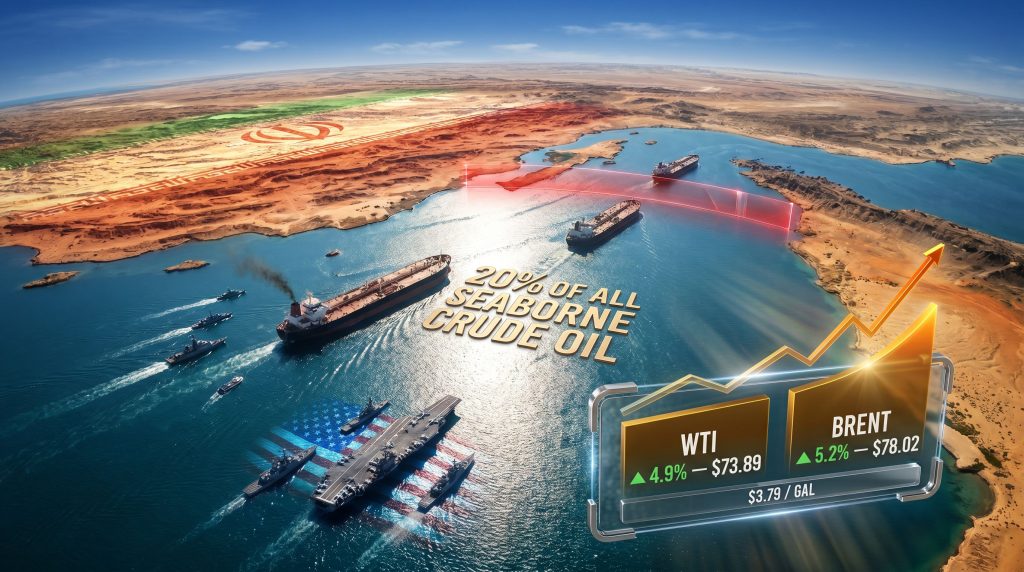
The waterway facilitates the transit of approximately 20% of all seaborne crude oil globally, including the majority of export volumes from Saudi Arabia, the UAE, Kuwait, Iraq, and Iran itself. The concentration of export dependency through a single corridor creates what risk analysts describe as a non-linear pricing environment: small probability events with catastrophic consequences carry pricing weight far beyond their statistical likelihood.
What Mechanisms Amplify the Initial Price Shock?
Several compounding mechanisms amplify the initial price shock:
- Insurance premium escalation: War-risk surcharges on tanker insurance spike rapidly when vessels transit active conflict zones, adding direct cost to every barrel that reaches market even without physical supply loss.
- Freight market tightening: Tankers rerouted around the Cape of Good Hope add approximately 10 to 14 days of transit time per voyage, reducing effective global supply even when production volumes remain unchanged.
- Speculative positioning: Commodity traders and hedge funds accelerate their long positioning in crude futures during Hormuz tension events, pushing prices beyond what physical supply-demand fundamentals alone would justify.
- Sentiment contagion: Correlated repricing spreads rapidly from crude benchmarks into LNG, refined products, and petrochemical feedstocks, broadening the inflationary transmission mechanism.
As Saxo analysts noted in response to the July 2026 escalation, markets are being forced to price the risk that renewed attacks on shipping or a broader deterioration in U.S.-Iran relations could slow the normalisation of energy flows through the strait. Even limited disruption carries the potential for outsized impact on prompt crude pricing, freight costs, and broader market sentiment. In addition, oil market disruptions of this nature tend to create cascading effects well beyond the immediate region.
A Timeline of Escalation: July 2026
The most recent surge in oil prices and Iran-U.S. tensions developed rapidly across a 48-hour window in early July 2026, with each development compounding the market's risk assessment.
What Triggered the July 2026 Escalation?
On Tuesday, July 7, 2026, Iranian forces attacked three commercial vessels transiting the Strait of Hormuz. The U.S. Central Command characterised the attacks as unwarranted, dangerous, and a direct violation of the existing ceasefire framework between the two nations.
By Wednesday, July 8, 2026, the situation had escalated significantly. The U.S. military launched fresh retaliatory strikes against Iranian targets. President Trump publicly declared the ceasefire over and signalled he was no longer pursuing a negotiated settlement with Tehran. Simultaneously, the U.S. Treasury Department revoked a sanctions waiver that had permitted Iran to continue oil export operations during the ceasefire period, introducing a supply-side dimension to what had begun as a shipping disruption story. According to NBC News, the collapse of Iran talks sent immediate shockwaves through energy markets globally.
The market response was immediate and substantial:
| Benchmark | Movement (Jul 8) | Price Level |
|---|---|---|
| WTI Crude (August futures) | +4.9% | $73.89/barrel |
| Brent Crude (September futures) | +5.2% | $78.02/barrel |
| Intraday peak move | +6%+ | Multiple sessions |
| WTI (Jul 9 continuation) | +1.06% | $74.29/barrel |
| Brent (Jul 9 continuation) | +1.03% | $78.82/barrel |
The two-day cumulative price movement represented one of the most pronounced geopolitically-driven oil price accelerations in recent months. Downstream, average U.S. retail gasoline prices climbed to approximately $3.79 per gallon, demonstrating the speed at which wholesale crude volatility transmits to consumer-facing energy costs.
The Sanctions Waiver Revocation: A Supply Shock Within a Shipping Shock
A dimension of the July 2026 escalation that received less immediate attention than the shipping attacks was the U.S. Treasury's decision to revoke Iran's oil export sanctions waiver. This policy action introduced a second, structurally distinct source of upward price pressure.
During the ceasefire period, Iran had been exporting an estimated 1.5 to 1.8 million barrels per day under the relaxed sanctions environment. The reimposition of export restrictions does not eliminate Iranian production immediately, but it progressively reduces the volume of Iranian crude accessible to international buyers, particularly refiners in Asia who had been significant purchasers of discounted Iranian barrels.
This matters for several interconnected reasons:
- The reduction in available Iranian supply tightens the global supply-demand balance independent of any physical Hormuz disruption.
- Refiners who had been reliant on lower-cost Iranian crude must now source replacement barrels at prevailing market prices, adding demand pressure across other production regions.
- The compounding effect of simultaneous shipping disruption and sanctions reimposition creates a scenario where both the physical and financial oil markets face tightening from multiple directions at once.
Three Scenarios: Where Do Oil Prices Go From Here?
Mapping the forward price trajectory requires a scenario-based framework rather than a point forecast, given the inherent unpredictability of geopolitical escalation dynamics. The following scenarios are analytical frameworks for understanding the range of potential outcomes and do not constitute financial or investment advice.
Scenario 1: Contained Escalation (Base Case)
Strikes remain limited in scope. Commercial shipping resumes with elevated but manageable insurance premiums. The sanctions waiver revocation restricts Iranian volumes but does not trigger a broader supply crisis. Brent crude stabilises within the $78 to $85 per barrel range. Consequently, OPEC's global influence acts as an implicit ceiling on price upside through its spare capacity deployment.
Scenario 2: Prolonged Shipping Interdiction (Elevated Risk)
Iran escalates its interdiction of commercial vessels transiting the strait. Partial effective closure forces sustained rerouting. Brent tests the $90 to $95 per barrel range. Freight markets tighten further, LNG and refined product markets reprice simultaneously, and the Federal Reserve faces renewed inflationary pressure that pushes rate cut timelines further out. Bond markets continue repricing yield expectations upward, creating a dual headwind for equity valuations.
Scenario 3: Full Escalation or Hormuz Closure (Tail Risk)
A complete or near-complete blockade of the Strait of Hormuz forces the diversion or halt of roughly 20% of global seaborne crude. Brent retests or exceeds $100 per barrel, the level reached during the height of the Iran-U.S. conflict in spring 2026. The International Energy Agency would likely coordinate emergency strategic reserve releases among member nations. Global recession risk becomes a material consideration as energy inflation feeds into broader consumer price indices.
Markets are currently pricing something between Scenario 1 and Scenario 2. The approximately $20 to $25 per barrel gap between current Brent levels and the spring 2026 wartime peak above $100 per barrel represents the market's embedded probability that full Hormuz closure remains avoidable. This embedded optimism is not irrational, but it is fragile.
OPEC+ Spare Capacity: The Market's Shock Absorber
One factor that distinguishes the current episode from truly catastrophic historical oil shocks is the existence of meaningful OPEC+ spare production capacity. Saudi Arabia and the UAE collectively hold the majority of OPEC+'s estimated 3 to 4 million barrels per day of idle capacity, representing a substantial buffer against supply disruption. Monitoring current crude prices remains essential for understanding how effectively this buffer is being deployed.
However, the deployment of this capacity is neither automatic nor guaranteed. Several complicating factors apply:
- Political dynamics within OPEC+ do not always align with market-stabilising objectives, particularly when some members benefit from higher prices.
- The physical logistics of ramping production and delivering barrels through potentially disrupted shipping lanes creates a lag between a political decision to produce and actual market availability.
- Saudi spare capacity itself largely sits in the Persian Gulf region, meaning any severe Hormuz disruption could effectively strand additional supply even if the production decision were made.
A rapid and coordinated OPEC+ supply response could cap the upside in Brent pricing. An absent or delayed response would validate the higher-price scenarios and compound the inflationary transmission into broader economies.
The next major ASX story will hit our subscribers first
Macro Consequences: Inflation, Rate Policy, and Emerging Market Stress
Oil price shocks in the $80 per barrel and above range historically feed into core inflation readings through transportation costs, manufacturing input costs, and agricultural production expenses. The Federal Reserve's rate trajectory becomes progressively constrained when energy-driven inflation re-accelerates, reducing the probability of near-term rate cuts and increasing the risk of policy miscalculation.
For oil-importing emerging market economies, the consequences are particularly acute. Rising import bills denominated in U.S. dollars combine with potential currency depreciation as the dollar strengthens on safe-haven flows, creating a dual fiscal squeeze. Countries with limited foreign exchange reserves and high oil import dependency face the most significant stress in a sustained price shock scenario. As the BBC reports, this dynamic is frequently underappreciated in market commentary that focuses exclusively on the crude price headline number without examining the downstream transmission into sovereign fiscal positions.
The broader lesson of the July 2026 escalation is not simply that oil prices rose sharply. It is that the Strait of Hormuz remains a structural vulnerability that no amount of policy engineering, demand diversification, or renewable energy deployment has yet meaningfully reduced. Furthermore, geopolitical trade tensions continue to compound the challenge facing policymakers seeking stability in global energy supply chains. As long as approximately one-fifth of global seaborne crude transits a single politically contested waterway, oil prices and Iran-U.S. tensions will remain among the most consequential paired variables in global financial markets.
This article is intended for informational purposes only and does not constitute financial, investment, or trading advice. Geopolitical outcomes and commodity price trajectories are inherently uncertain, and actual market developments may differ materially from any scenarios described herein.
Want to Stay Ahead of Market-Moving Resource Discoveries on the ASX?
While geopolitical shocks like Hormuz escalations dominate oil market headlines, significant mineral discoveries on the ASX can offer compelling opportunities entirely independent of macro volatility — and Discovery Alert's proprietary Discovery IQ model instantly identifies these high-potential announcements the moment they hit the exchange, turning complex data across 30+ commodities into clear, actionable insights. Explore historic discovery returns on Discovery Alert's dedicated discoveries page to understand the scale of opportunity, then begin a 14-day free trial to position yourself ahead of the broader market.