May 21, 2026
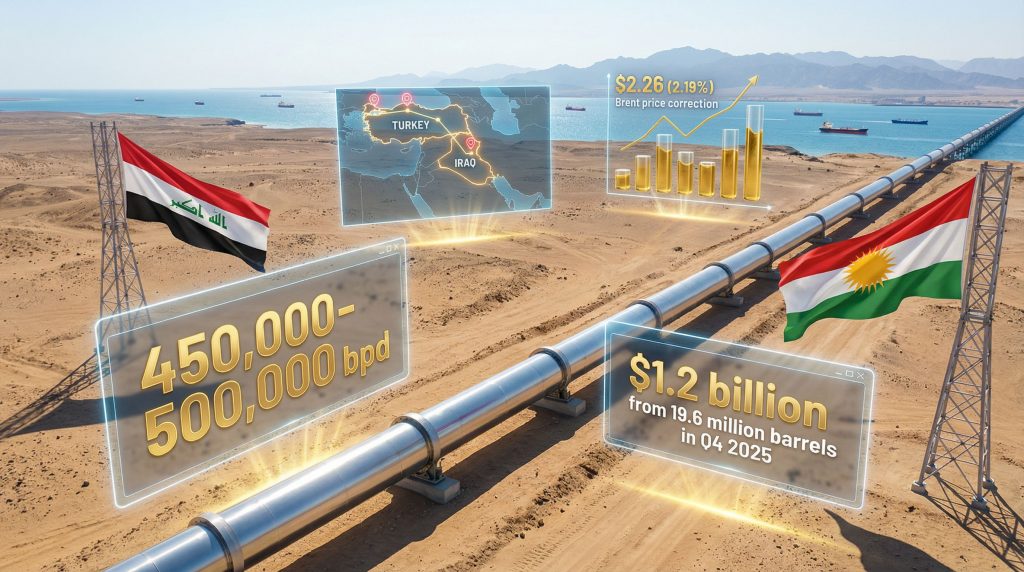
Oil prices have experienced significant volatility following recent developments in Iraq's export infrastructure, with markets responding dramatically to news of restored pipeline flows through Turkey. The oil prices and Iraqi Kurdish export deal situation exemplifies how regional supply agreements can generate outsized market reactions, demonstrating the psychological impact of supply restoration on global energy markets.
How Export Corridors Amplify Global Market Sensitivity
Regional export agreements represent critical nodes in the global energy distribution network, where relatively small supply additions can generate outsized market reactions. The psychological impact of supply restoration often exceeds the mathematical significance of volume increases, demonstrating how trader sentiment and risk perception drive price discovery mechanisms.
Furthermore, the OPEC market influence continues to shape these dynamics, as even modest supply changes from non-OPEC sources can trigger significant price movements.
Strategic Infrastructure Dependencies and Capacity Constraints
The Iraq-Turkey pipeline system exemplifies how infrastructure bottlenecks create both opportunities and vulnerabilities in global energy supply chains. This northern export route provides an alternative to maritime shipping through conflict-prone regions, yet its limited capacity constrains its ability to offset major supply disruptions elsewhere.
When Iraqi authorities announced the resumption of oil flows through Turkey's Ceyhan port on March 18, 2026, markets responded with a $2.26 decline in Brent crude prices, representing a 2.19% correction from elevated levels. This price movement occurred despite the relatively modest scale of supply restoration, with Iraqi officials targeting at least 100,000 barrels per day through the Mediterranean terminal.
The magnitude of this market response reveals several key dynamics:
- Psychological relief effect: Markets had incorporated worst-case scenarios, making any positive supply news disproportionately impactful
- Infrastructure scarcity premium: Alternative export routes command premium valuations during primary corridor disruptions
- Geopolitical risk recalibration: Supply diversification reduces concentration risk, even at modest volumes
- Technical trading responses: Algorithmic systems amplify initial price movements based on supply headline analysis
Revenue Distribution Models and Economic Multiplier Effects
The complexity of revenue-sharing arrangements between federal and regional authorities creates additional layers of investment risk and operational uncertainty. These agreements must balance multiple stakeholders while maintaining operational efficiency and investment attractiveness.
Revenue allocation frameworks typically involve:
| Stakeholder | Revenue Component | Risk Factors |
|---|---|---|
| Federal Government | Majority allocation for national budget | Political stability, fiscal policy changes |
| Regional Authorities | Development fund allocation | Autonomy agreements, local governance |
| International Operators | Cost recovery plus profit sharing | Contract sanctity, regulatory changes |
| Transportation Entities | Per-barrel transit fees | Infrastructure maintenance, capacity constraints |
The $16 per barrel transportation cost referenced in industry discussions reflects the premium associated with alternative export routes compared to traditional maritime shipping. This cost differential becomes economically viable only when primary export channels face significant disruption risks.
Export Capacity Optimisation and Investment Requirements
Current export operations through northern Iraq represent only a fraction of potential capacity, highlighting both immediate opportunities and longer-term infrastructure investment needs. The gap between current flows and maximum capacity reflects various constraints:
- Technical limitations in pipeline pressure and pumping station capacity
- Security considerations affecting operational continuity
- Commercial arrangements governing throughput allocation
- Maintenance scheduling requirements for ageing infrastructure
Industry analysts suggest that expanding export capacity to 300,000-450,000 barrels per day would require substantial capital investment in compression facilities, storage infrastructure, and enhanced security systems. Such investments become economically justified only under scenarios of sustained high oil prices and reduced access to alternative export routes.
Market Psychology During Supply Disruption Cycles
Energy markets exhibit distinct behavioural patterns during supply crisis periods, where fear-driven buying creates price floors that persist even after supply conditions begin improving. This psychological anchoring effect reflects the asymmetric nature of supply disruption risks versus restoration timelines.
In addition, recent oil price rally analysis has shown how geopolitical developments continue to drive trader sentiment and risk perception.
Price Floor Formation and Psychological Thresholds
The sustained trading of Brent crude above $100 per barrel for four consecutive sessions in March 2026 demonstrates how psychological price levels become self-reinforcing during crisis periods. Market participants develop cognitive anchors around triple-digit pricing that resist downward pressure despite improving supply fundamentals.
Key psychological factors supporting elevated pricing include:
- Loss aversion bias: Traders overweight potential supply losses versus supply gains
- Recency bias: Recent disruption events receive disproportionate probability weighting
- Anchoring effects: $100+ pricing becomes normalised reference point
- Herding behaviour: Collective positioning reinforces price momentum
When Iraqi production plunged 70% to just 1.3 million barrels per day due to regional conflict spillover effects, markets incorporated worst-case scenarios into pricing models. The scale of this production decline from baseline levels demonstrates how regional conflicts create supply destruction that extends far beyond direct conflict zones.
Volatility Patterns and Correction Mechanisms
The sequence of oil prices rising more than 3% on Tuesday followed by a 2.19% correction on Wednesday illustrates classic volatility clustering during uncertain periods. This price action reflects the rapid incorporation of new information and subsequent technical correction once initial overreaction becomes apparent.
Professional market analysis suggests these patterns result from:
Risk-on/risk-off sentiment cycles that amplify underlying supply-demand imbalances during geopolitical uncertainty
The differential between Brent crude at $101.16 and West Texas Intermediate at $93.22 on March 18, 2026, reflects regional supply dynamics and transportation cost premiums embedded in international pricing structures. This $7.94 spread indicates how geographic supply constraints create persistent price differentials even within globally integrated markets.
Inventory Dynamics and Storage Economics
Crude oil inventory movements provide critical insights into underlying supply-demand balances beyond headline price movements. US crude stocks rose by 6.56 million barrels in the week ended March 13, significantly exceeding the 380,000 barrel increase expected by Reuters consensus forecasts.
This inventory surprise suggests several possibilities:
- Demand destruction from high prices reducing consumption
- Strategic stockpiling by refiners anticipating further supply disruptions
- Import acceleration before potential shipping route closures
- Refinery maintenance reducing crude processing rates
The magnitude of inventory builds during crisis pricing periods often signals that current price levels have begun impacting demand patterns, potentially setting the stage for future corrections once supply concerns moderate.
Infrastructure Vulnerability Analysis and Alternative Route Economics
Modern energy supply chains depend heavily on critical infrastructure chokepoints where geographic constraints create systemic vulnerabilities. The Strait of Hormuz carries approximately 20% of global oil transit, making it perhaps the world's most strategically significant maritime passage for energy security.
Chokepoint Dependencies and Cascading Effects
The effective closure of Strait of Hormuz shipping lanes during the Iran conflict created immediate supply destruction throughout the Middle Eastern export system. Iranian anti-ship missiles posed risks to international shipping, forcing vessels to avoid the narrow waterway and disrupting established supply chains.
Geographic vulnerability assessment reveals several critical factors:
| Chokepoint | Daily Transit Volume | Alternative Route | Additional Cost |
|---|---|---|---|
| Strait of Hormuz | ~20 million barrels | Overland pipelines | $15-25 per barrel |
| Suez Canal | ~12 million barrels | Cape of Good Hope | $8-12 per barrel |
| Bab el-Mandeb | ~8 million barrels | Cape routing | $6-10 per barrel |
The concentration of supply routes through narrow maritime passages creates single points of failure that can rapidly propagate throughout global markets. Alternative overland routes, while providing diversification benefits, typically operate at significantly higher per-barrel costs and limited capacity.
However, the US oil production decline has added another layer of complexity to global supply dynamics, highlighting the importance of alternative export routes.
Pipeline System Resilience and Capacity Expansion
Northern Iraqi export infrastructure represents a critical alternative to maritime shipping, yet current capacity utilisation suggests substantial underinvestment in alternative route development. The technical capability to pump at least 100,000 barrels per day through Ceyhan represents only a fraction of potential system capacity.
Pipeline infrastructure optimisation requires addressing several technical constraints:
- Pressure management systems to maintain flow rates across long distances
- Pumping station redundancy to ensure operational continuity
- Storage capacity at terminal facilities for operational flexibility
- Security infrastructure protecting pipeline integrity across multiple jurisdictions
Investment in pipeline capacity expansion becomes economically attractive when the probability-weighted cost of supply disruption exceeds the annualised infrastructure investment required. Current pricing patterns suggest this threshold has been reached for several alternative route projects.
Economic Analysis of Route Diversification
The economics of supply route diversification involve complex trade-offs between infrastructure investment costs, operational expenses, and risk mitigation benefits. Transportation costs of $16 per barrel for alternative routes may appear expensive compared to maritime shipping, yet this premium reflects both infrastructure scarcity and risk insurance value.
Key economic considerations include:
- Capital cost recovery periods for major infrastructure investments
- Operating cost structures including maintenance, security, and regulatory compliance
- Utilisation rate optimisation to maximise return on infrastructure assets
- Risk premium valuation for supply security and route diversification
During periods of elevated geopolitical risk, the economic value of alternative export routes increases substantially, potentially justifying infrastructure investments that appear uneconomical under normal market conditions.
Long-Term Implications for Energy Market Structure
Recent supply disruptions highlight fundamental questions about energy market resilience and the adequacy of current infrastructure investment patterns. The concentration of global oil production and export capacity in geopolitically volatile regions creates persistent systemic risks that may require structural changes to supply chain architecture.
Moreover, oil price trade implications demonstrate how international trade policies continue to influence market structure evolution.
Strategic Reserve Management and Market Stabilisation
Government strategic petroleum reserves traditionally serve as emergency supply buffers during short-term disruptions, yet prolonged regional conflicts test the adequacy of existing reserve policies. The duration and severity of current supply constraints may exceed the design parameters of traditional strategic reserve systems.
Effective reserve management strategies require:
- Coordinated release policies among consuming nations to maximise market impact
- Reserve size optimisation balancing storage costs against disruption protection
- Geographic distribution of reserve facilities to ensure access during crisis periods
- Quality specification management ensuring stored crude matches refinery requirements
The interaction between strategic reserves and commercial inventory cycles creates complex market dynamics during crisis periods, where reserve releases may be offset by commercial stockpiling behaviour.
Investment Patterns and Capital Allocation Efficiency
Sustained high oil prices create investment incentives for both increased production capacity and supply chain diversification projects. However, the cyclical nature of energy markets means that investments justified at crisis prices may appear excessive once normal conditions return.
This creates several investment challenges:
- Capital cycle timing: Major infrastructure projects require multi-year development periods
- Regulatory uncertainty: Changing environmental and safety requirements affect project economics
- Technology evolution: Advanced extraction and transportation methods may obsolete current infrastructure
- Market structure changes: Renewable energy adoption affects long-term demand projections
The optimal balance between supply security and economic efficiency remains an ongoing challenge for both private investors and policymakers responsible for energy security.
Consequently, oil prices ease analysis provides insights into how markets respond to policy shifts and their long-term implications.
Market Integration and Price Discovery Evolution
Global oil markets continue evolving toward greater integration, yet regional supply disruptions reveal persistent segmentation in pricing and access. The development of more resilient supply chains may require accepting higher structural costs in exchange for reduced vulnerability to individual chokepoint failures.
Future market structure considerations include:
- Regional pricing benchmark evolution to reflect local supply-demand conditions
- Financial instrument development for hedging geographic and political risks
- Information system enhancement for real-time supply chain monitoring
- International cooperation frameworks for coordinated crisis response
The experience of recent supply disruptions provides valuable data for improving both market mechanisms and crisis response capabilities, potentially leading to more resilient energy market structures over time.
Risk Assessment and Strategic Planning Frameworks
Energy market participants require sophisticated risk management frameworks capable of addressing both traditional commercial risks and emerging geopolitical uncertainties. The interconnected nature of modern supply chains means that regional disruptions can create global consequences within days or weeks.
Scenario Planning and Probability Assessment
Effective risk management requires developing multiple scenario frameworks that account for various disruption types, durations, and geographic scopes. Recent events demonstrate how regional conflicts can escalate beyond initial expectations, creating supply impacts that persist longer than initially anticipated.
Critical scenario variables include:
- Disruption duration: Short-term technical problems versus extended geopolitical conflicts
- Geographic scope: Single facility outages versus regional supply destruction
- Cascade effects: How initial disruptions propagate through interconnected systems
- Recovery timelines: Infrastructure repair periods and diplomatic resolution processes
For instance, according to Reuters, crude oil markets continue to monitor geopolitical developments closely. Additionally, Oil Price reported that the oil prices and Iraqi Kurdish export deal represents a crucial development for regional supply security.
Market participants must balance scenario planning sophistication with practical implementation constraints, ensuring that risk management systems remain functional during actual crisis periods when normal market conditions may not apply.
Disclaimer: The analysis presented in this article involves forward-looking scenarios and market predictions that are inherently uncertain. Oil prices and supply chain dynamics are subject to numerous unpredictable factors including geopolitical events, technological changes, and macroeconomic conditions. Past performance and historical patterns do not guarantee future results.
The ongoing evolution of global energy markets continues revealing new vulnerabilities and opportunities, requiring constant adaptation of both commercial strategies and policy frameworks to maintain adequate energy security while supporting economic efficiency and environmental objectives.
Ready to Capitalise on Energy Market Volatility?
Discovery Alert's proprietary Discovery IQ model delivers real-time alerts on significant ASX mineral discoveries, including energy-related opportunities that can generate substantial returns during market volatility periods. Stay ahead of energy sector developments and discover why major mineral discoveries have historically delivered exceptional investment outcomes, then begin your 14-day free trial today to secure your market-leading advantage.