June 16, 2026
Global energy markets face unprecedented volatility as maritime infrastructure becomes a central target in modern geopolitical conflicts. Oil prices jump following drone strike at black sea terminal, highlighting how the intersection of technological warfare capabilities and critical export terminals creates cascading effects that extend far beyond regional boundaries, fundamentally altering how traders assess supply chain security and price energy commodities.
This transformation reflects broader shifts in warfare tactics, where precision strikes on economic infrastructure generate disproportionate market responses compared to traditional military engagements. Understanding these mechanisms requires examining how concentrated export systems, algorithmic trading responses, and insurance markets interact during crisis periods, particularly considering the OPEC production impact on global supply dynamics.
Energy Infrastructure as Strategic Vulnerability Points
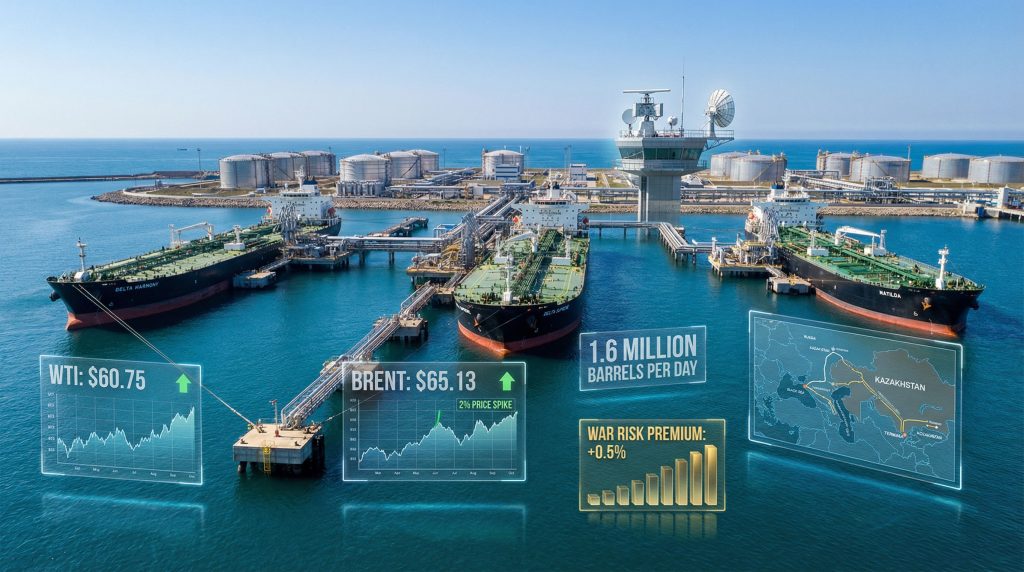
The Black Sea region demonstrates how geographic concentration of export capacity creates systemic risks for global oil markets. Kazakhstan's energy export architecture exemplifies this vulnerability, with approximately 80% of the country's crude oil exports flowing through a single terminal system at Novorossiysk. This infrastructure handles roughly 1.6 million barrels per day, representing approximately 2% of global oil supply.
When three Greek-operated tankers approached the Caspian Pipeline Consortium terminal for loading operations, their targeting by drone strikes revealed how maritime chokepoints become force multipliers for geopolitical disruption. According to reports from industry sources, the vessels affected included the Delta Harmony, Delta Supreme, and Matilda, demonstrating how attackers can simultaneously impact multiple supply chain components through coordinated strikes.
Critical Infrastructure Concentration Risks:
• Single-point mooring systems that handle multiple vessel loading operations simultaneously
• Floating storage units that create concentrated target areas for precision weapons
• Loading terminal facilities with limited operational redundancy
• Maritime approach routes that funnel tanker traffic into predictable patterns
The technical specifications of these facilities reveal inherent vulnerabilities. Modern oil terminals employ sophisticated loading systems designed for efficiency rather than distributed security. When disrupted, these systems cannot easily redirect operations to alternative facilities, creating immediate bottlenecks that ripple through global supply chains.
Alternative Export Route Limitations
Kazakhstan's export diversification options highlight the structural constraints facing oil-producing nations with concentrated infrastructure. The country's alternative routing capacity includes the Atyrau-Samara Pipeline offering 200,000 barrels per day through Russian territory, the Kazakhstan-China Pipeline providing 400,000 barrels per day eastward, and rail transport systems with emergency capacity of approximately 150,000 barrels per day.
These alternatives collectively represent only 47% of the primary CPC terminal's capacity, creating mathematical impossibilities for full production rerouting during disruptions. The geographic and political constraints of these routes further limit their utility during crisis periods, particularly when involving transit through potentially hostile territory or requiring complex international coordination.
When big ASX news breaks, our subscribers know first
Market Response Mechanisms and Trading Psychology
Oil markets demonstrated unprecedented reactivity during recent geopolitical tensions, with ICE Brent crude reaching $65.78 per barrel and WTI climbing to $61.32 following infrastructure attacks. These price movements occurred despite the absence of actual supply losses, indicating that market psychology increasingly prioritises potential disruption over current production levels, reflecting the complex oil price rally dynamics that characterise modern energy markets.
The January 2026 options trading activity revealed the extent of trader anxiety regarding infrastructure security. A record 556,000 Brent crude call option contracts traded on a single day, representing the busiest options session in market history. This volume surge reflected market participants rushing to hedge against sudden price spikes as geopolitical tensions escalated.
Options Market Indicators:
| Metric | January 2026 Data | Market Significance |
|---|---|---|
| Brent Call Options Volume | 556,000 contracts | Busiest single day on record |
| Options Skew Direction | Favours calls over puts | High-impact stress signal |
| Net Long Positioning | 122,965 lots | Quadrupled in three weeks |
| Price Response Speed | 2% within hours | Algorithmic trading acceleration |
The shift in ICE Brent's second-month options skew toward calls rather than puts signals professional traders anticipating higher probability tail-risk scenarios. This technical indicator transformation demonstrates how market professionals reframe risk assessment when infrastructure targeting becomes systematic rather than isolated.
Algorithmic Trading and Supply Disruption Signals
Modern commodity markets incorporate multiple automated response systems that process geopolitical events in real-time. These systems analyse satellite imagery for infrastructure damage assessment, track vessel movements through Automatic Identification Systems, process news sentiment for escalation probability calculations, and monitor options market volatility as forward-looking risk indicators.
The compression of decision-making timelines amplifies market volatility as algorithms execute positions within microseconds of detecting disruption signals. Terminal operations disruptions typically trigger price responses within 1-4 hours, while insurance premium adjustments activate over 24-48 hour periods, creating layered market response cascades.
Market Response Timeline Framework:
Immediate Phase (0-4 hours): Algorithmic trading systems detect infrastructure attacks and execute protective positions
Short-term Phase (24-48 hours): Insurance markets adjust war risk premiums and shipping costs
Medium-term Phase (3-7 days): Alternative routing arrangements increase transportation expenses
Strategic Phase (1-2 weeks): Government intervention through strategic reserve releases considered
Kazakhstan's Production Decline and Market Blind Spots
Kazakhstan experienced a dramatic 35% production decline in January 2026, representing one of the most severe operational disruptions among current geopolitical flashpoints. Despite this material impact on global supply, the situation remains what industry analysts describe as the least discussed subject among current market disruptions, suggesting cognitive limitations in processing multiple simultaneous crises.
This attention deficit reflects broader market psychology challenges where traders experience information overload during periods of overlapping geopolitical tensions. Furthermore, the simultaneous management of Iranian protests, Venezuela sanctions uncertainty, and Black Sea maritime attacks creates cognitive bottlenecks that prevent adequate risk repricing across all affected regions, particularly affecting trade war oil movements and pricing mechanisms.
How Does OPEC Production Decline Impact Global Markets?
OPEC's unexpected month-over-month production decline of 100,000 barrels per day, contrasting with planned increases of 85,000 barrels per day, demonstrates how infrastructure attacks compound existing operational challenges. This 185,000 barrel per day negative variance from projections reflects supply decisions influenced by sanctions, geopolitical factors, and direct infrastructure targeting rather than pure market-driven production adjustments.
The cumulative effect creates supply tightening beyond individual disruption events, as multiple producing regions simultaneously face operational constraints. This pattern suggests markets may be underestimating aggregate supply risks when focusing on individual crisis scenarios rather than systematic evaluation of compound disruptions.
Maritime Insurance and Shipping Cost Evolution
Lloyd's of London maritime insurance syndicates typically adjust war risk premiums by 0.1-0.5% of cargo value for vessels transiting affected areas following infrastructure attacks. With Brent crude pricing at approximately $65.78 per barrel, a 2 million barrel tanker cargo facing 0.3% insurance premium increases would incur approximately $39,400 in additional costs, translating to roughly $0.02 per barrel in direct cost pass-through.
These insurance cost adjustments operate on faster timelines than strategic policy responses but slower than algorithmic trading reactions, creating multi-layered market response mechanisms. The 24-48 hour activation period for war risk surcharges allows markets to process immediate price impacts before incorporating longer-term cost structures.
Dynamic Shipping Response Protocols:
• Immediate vessel diversions from threatened terminal facilities
• Alternative loading schedule coordination with backup infrastructure
• Enhanced security escort arrangements for high-value petroleum cargoes
• Real-time threat assessment integration with maritime navigation systems
Tanker operators implement these protocols when infrastructure faces attack risks, creating scheduling inefficiencies and operational cost increases beyond pure insurance premium adjustments. The cumulative effect of these measures contributes to persistent cost premiums even after immediate threats subside.
War Risk Assessment and Pricing Mechanisms
Maritime insurance markets assess threat levels using satellite tracking of hostile activities, historical incident pattern analysis, vessel type vulnerability profiles, and routing proximity calculations to active conflict zones. Premium adjustments reflect updated threat probability assessments incorporating real-time intelligence and predictive modelling.
The evolution from fixed infrastructure targeting to mobile maritime asset attacks requires insurers to recalibrate risk models continuously. This adaptation process creates pricing volatility as underwriters adjust to changing threat patterns and operational environments, particularly relevant to understanding tariffs and market volatility interactions.
Technological Solutions and Infrastructure Resilience
Next-generation terminal security systems integrate multiple defensive layers designed to address evolving threat environments. Radar-based drone detection networks provide 10-kilometre range early warning capabilities, while automated defensive countermeasures include electronic warfare systems capable of disrupting hostile drone operations.
These technological solutions represent adaptation to systematic infrastructure targeting rather than isolated security incidents. The integration of redundant loading system designs seeks to minimise single-point failure risks by distributing operational capability across multiple smaller facilities rather than concentrated mega-terminals.
Advanced Infrastructure Protection Systems:
• Multi-spectrum radar networks with autonomous threat classification
• Electronic warfare countermeasures for drone neutralisation
• Distributed loading architectures reducing target concentration
• Real-time damage assessment protocols enabling rapid operational recovery
The shift toward distributed infrastructure design reflects recognition that traditional security measures prove inadequate against precision weapons systems. Future oil export terminal developments emphasise geographic distribution and operational redundancy as primary defence mechanisms.
Strategic Reserve Policy Integration
Strategic petroleum reserve systems serve as primary policy tools for managing supply disruption impacts during infrastructure attacks. The U.S. Strategic Petroleum Reserve's 375 million barrel capacity provides approximately 20 days of import replacement capability, while coordinated International Energy Agency member nation releases can inject up to 120 million barrels into markets within 30-day periods.
These reserve release mechanisms operate on longer timelines than market trading responses, creating temporal gaps where price volatility can persist before policy intervention takes effect. In addition, the coordination requirements among multiple national reserve systems add complexity to response timing during crisis periods.
Government intervention through reserve releases represents the final layer of market stabilisation mechanisms, operating after trading algorithm responses, insurance adjustments, and alternative routing arrangements have been implemented. This sequential response structure creates multiple intervention points but also extends the duration of market disruption effects.
Regulatory Framework Gaps and International Law
International maritime law provides limited protection for energy infrastructure in contested waters, with the 1988 SUA Convention criminalising attacks on maritime vessels but offering inadequate enforcement mechanisms for preventing infrastructure targeting in active conflict zones. This regulatory gap creates legal uncertainties that complicate insurance coverage and operational security planning.
The evolution of warfare to include economic infrastructure targeting challenges existing international legal frameworks designed for traditional military engagements. Energy facilities and maritime transport systems operate in legal grey areas where protective conventions lack enforcement capability during active conflicts, particularly relevant when considering the US–China trade war impact on global infrastructure security.
Regulatory Adaptation Requirements:
• Enhanced international coordination for infrastructure protection
• Updated maritime law enforcement mechanisms in contested waters
• Standardised insurance coverage frameworks for geopolitical risks
• Coordinated strategic reserve release protocols among allied nations
The next major ASX story will hit our subscribers first
Market Structure Evolution and Permanent Risk Premiums
Repeated attacks on critical energy infrastructure drive structural changes in global oil markets, including geographic diversification of export terminal investments, enhanced storage capacity development at alternative loading points, flexible pipeline network construction enabling rapid route switching, and advanced derivative instruments designed for infrastructure risk hedging.
The emergence of infrastructure risk premiums as permanent market features reflects trader recognition that energy facilities have become legitimate military targets in modern conflicts. This shift from temporary geopolitical risk pricing to structural market adjustments indicates fundamental changes in how energy markets operate during extended conflict periods, as evidenced by recent market developments.
Structural Market Adaptations:
• Investment diversification away from concentrated export terminals
• Development of flexible routing infrastructure enabling rapid reconfiguration
• Creation of specialised financial instruments for infrastructure attack hedging
• Integration of real-time threat assessment into commodity pricing models
The transition toward distributed infrastructure investment patterns represents market adaptation to persistent targeting threats. Traditional efficiency-focused facility design gives way to resilience-oriented approaches that prioritise operational continuity over cost optimisation.
Long-term Investment Implications
Energy infrastructure investment priorities increasingly emphasise security and redundancy considerations alongside traditional economic efficiency metrics. The recognition that concentrated facilities create strategic vulnerabilities drives capital allocation toward distributed systems with enhanced defensive capabilities.
This investment pattern shift affects global energy system architecture, potentially increasing overall infrastructure costs while improving operational resilience during conflict periods. However, the trade-offs between efficiency and security create new evaluation frameworks for energy project development and financing decisions.
Oil prices jump following drone strike at black sea terminal events demonstrate how modern conflicts fundamentally alter traditional market assumptions about supply security. Consequently, the integration of infrastructure vulnerability assessments into commodity pricing models represents a permanent evolution in how energy markets function during extended geopolitical tensions.
The cumulative impact of these developments suggests that oil prices jump following drone strike at black sea terminal scenarios will continue influencing market structure as traders adapt to systematic infrastructure targeting as a feature of modern warfare. Furthermore, oil prices jump following drone strike at black sea terminal incidents highlight the need for enhanced international coordination in protecting critical energy infrastructure from precision weapons systems.
Disclaimer: This analysis is based on publicly available information and market data as of January 2026. Oil prices are subject to rapid change due to geopolitical developments, supply disruptions, and market sentiment. Investors should conduct independent research and consider multiple risk factors before making investment decisions. Infrastructure attacks and geopolitical tensions involve unpredictable elements that may not follow historical patterns or analytical projections.
Looking for Investment Opportunities in Energy Market Volatility?
Discovery Alert's proprietary Discovery IQ model delivers real-time alerts on significant ASX mineral discoveries, instantly empowering subscribers to identify actionable opportunities during periods of market volatility and geopolitical uncertainty. Begin your 30-day free trial today and position yourself ahead of the market with advanced AI technology that turns complex mineral data into clear investment insights.