July 13, 2026
Global energy markets operate within a complex web of supply-demand fundamentals, geopolitical risk calculations, and structural market forces that extend far beyond immediate headline events. Understanding these underlying mechanisms provides crucial insight into how petroleum pricing responds to international tensions, military deployments, and diplomatic developments across key producing regions. Furthermore, when oil prices rebound after Trump Iran threat, it demonstrates the intricate relationship between political positioning and market psychology.
Understanding Risk Premium Mechanisms in Energy Markets
Energy markets incorporate uncertainty through sophisticated risk premium calculations that reflect potential supply disruptions across major producing regions. These premiums function as market-embedded insurance policies, adjusting in real-time as traders assess the probability and magnitude of supply chain interruptions.
Current market conditions demonstrate how these mechanisms operate in practice. Brent crude futures for March reached $64.41 per barrel, representing a 0.55% increase, while WTI crude climbed to $59.69 per barrel with a 0.56% gain as of late January 2026. These price movements followed renewed tensions in the Middle East, yet the relatively modest adjustments suggest traders view immediate large-scale disruptions as limited despite escalating rhetoric.
The psychology behind risk premium calculations involves multiple layers of analysis. Market participants evaluate not just the immediate probability of supply disruption, but also the potential duration, scope, and availability of alternative sources. When geopolitical tensions escalate, options market activity intensifies as traders seek asymmetric exposure to potential price spikes while maintaining flexibility to adjust positions based on developing events.
Technical mechanisms driving these calculations include:
- Futures curve analysis: Contango or backwardation patterns reflect near-term versus long-term supply expectations
- Volatility surface modeling: Implied volatility across different strike prices and expiration dates
- Cross-commodity correlations: Natural gas, refined products, and alternative energy relationships
- Currency hedging considerations: Dollar strength impacts pricing for international buyers
Professional energy traders utilise sophisticated algorithms that continuously update probability distributions based on news flow, military deployments, diplomatic communications, and historical precedents. These systems can process thousands of data points simultaneously, creating dynamic pricing models that adjust within milliseconds of new information availability.
When big ASX news breaks, our subscribers know first
The Psychology of Energy Market Reactions
Market participants employ complex behavioural patterns when responding to geopolitical developments, often creating disconnects between surface-level price stability and underlying positioning changes. This psychological dimension explains why oil prices rebound after Trump Iran threat despite apparent diplomatic uncertainty remaining elevated.
Options markets provide particularly revealing insights into trader psychology. Recent analysis of one-month call option activity shows significant increases in premium levels since early January, indicating traders are positioning for potential upside scenarios whilst spot prices remain relatively stable. This divergence suggests sophisticated market participants are hedging against tail-risk events rather than expressing conviction about immediate price direction.
The timing of market reactions reveals important psychological factors. Both contracts declined approximately 2% on Thursday before reversing higher following renewed military deployment announcements. This pattern indicates initial scepticism about follow-through on geopolitical threats, followed by recalibration when credibility signals increase through concrete military positioning.
Several behavioural mechanisms drive these reaction patterns:
- Anchoring bias: Traders reference recent price levels when assessing new information
- Herding behaviour: Momentum following initial directional moves by large participants
- Asymmetric loss aversion: Greater sensitivity to potential supply disruption than oversupply scenarios
- Recency weighting: Recent geopolitical events receive disproportionate attention in risk calculations
Professional market makers and institutional traders often operate with different time horizons and risk tolerances than retail participants, creating layered market dynamics. Large commercial hedgers (oil producers and refiners) typically maintain longer-term positioning based on operational requirements, whilst speculative funds focus on shorter-term directional opportunities.
Iran's Strategic Position in Global Energy Networks
Iran maintains outsized influence on global petroleum markets through multiple interconnected channels that extend beyond simple production volume considerations. As the fourth-largest producer within OPEC, Iran's daily capacity of approximately 3.3 million barrels represents a significant portion of global supply, but its strategic importance stems from broader network effects across energy infrastructure systems. Consequently, the OPEC production impact extends beyond individual country contributions to encompass regional stability considerations.
The concentration of Iranian exports creates bilateral dependency relationships that complicate supply disruption scenarios. China serves as Iran's primary export destination, representing the world's second-largest oil consuming nation with daily imports exceeding 10 million barrels. This relationship creates mutual vulnerability – Iranian revenue depends heavily on Chinese demand, whilst China requires consistent supply flows to maintain economic stability.
Iran's export infrastructure demonstrates both capabilities and vulnerabilities:
| Infrastructure Component | Capacity | Strategic Vulnerability |
|---|---|---|
| Kharg Island Terminal | 1.5 MBPD | Maritime chokepoint exposure |
| Onshore Production Facilities | 3.3 MBPD | Concentrated geographic region |
| Pipeline Networks | 2.8 MBPD | Limited alternative routing |
| Tanker Loading Infrastructure | Variable | Secondary sanctions impact |
The technical specifications of Iranian crude create additional complexity for global supply chain management. Iranian oil grades typically feature medium API gravity (31-35 degrees) with moderate sulphur content, making them suitable for specific refinery configurations but requiring adjustment periods if alternative sources must be substituted rapidly.
Geographically, Iran's production facilities concentrate in the southwestern region near the Persian Gulf, creating potential single-point-of-failure scenarios if military action targets critical infrastructure nodes. However, the distributed nature of onshore fields provides some resilience against partial disruption attempts.
Regional Supply Chain Dependencies and Rebalancing Mechanisms
Middle Eastern petroleum production networks demonstrate high interconnectivity through shared maritime routes, processing facilities, and transportation infrastructure. This integration creates both efficiency benefits under normal operations and cascading vulnerability patterns during disruption scenarios. Furthermore, the global oil market influence shapes how regional disruptions propagate throughout international pricing structures.
The broader regional production complex includes several major contributors with varying spare capacity availability:
- Saudi Arabia: Estimated 1.5-2.0 MBPD spare capacity available for rapid deployment
- UAE: Approximately 200-300 thousand barrels daily expansion potential
- Iraq: Infrastructure-constrained despite reservoir capacity
- Kuwait: Limited near-term expansion capability due to aging facilities
Supply chain rebalancing following Iranian disruption would require coordinated responses across multiple dimensions. Saudi Arabia's spare capacity utilisation represents the most immediate backstop, though full activation requires 30-90 days depending on field specifications and transportation logistics.
Pipeline infrastructure interdependencies create additional complexity layers. Regional networks include cross-border connections, strategic storage facilities, and alternative routing capabilities that provide some flexibility during crisis scenarios. However, maximum throughput constraints limit rapid substitution possibilities regardless of upstream production availability.
Non-regional supply sources would play crucial roles in comprehensive rebalancing scenarios. However, the recent US oil production decline complicates traditional backstop capacity assumptions. Meanwhile, Brazilian pre-salt developments and Canadian oil sands production could provide additional volumes, but transportation logistics and refinery compatibility require careful coordination.
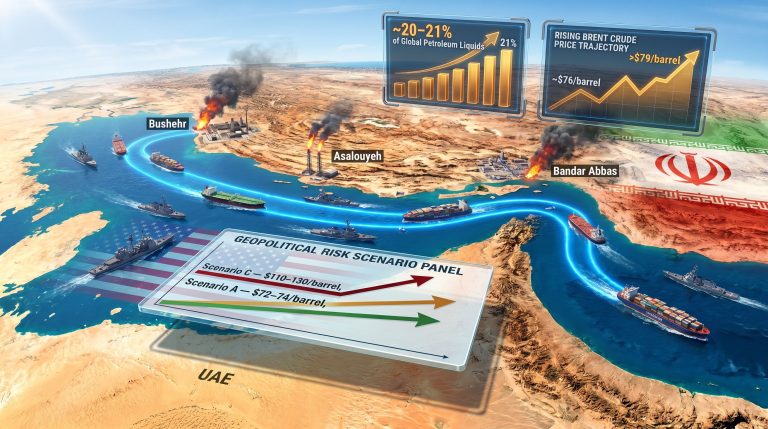
The Strait of Hormuz transit bottleneck represents the single most critical vulnerability point for regional supply chains. Approximately 21 million barrels daily pass through this narrow waterway, representing roughly 20% of global petroleum consumption. Alternative routing through the Suez Canal and Red Sea involves longer transit times and higher transportation costs, potentially adding $2-4 per barrel to delivered pricing.
Military Deployments and Market Signalling Effects
Naval asset positioning creates measurable market impacts through multiple signalling channels that extend beyond immediate military capabilities. Recent announcements regarding warships including aircraft carriers and guided missile destroyers arriving in the Middle East demonstrate how physical deployments translate into pricing adjustments across energy futures markets. Additionally, Trump's Iran rhetoric impacts oil prices as market participants carefully analyse diplomatic positioning for credibility signals.
The credibility enhancement mechanism operates through public commitment dynamics. When political leaders announce military deployments in public forums – such as President Trump's statement aboard Air Force One regarding an "armada" heading toward Iran – market participants interpret these declarations as increasing the probability of follow-through on previous threats.
Different military asset categories generate varying market response patterns:
High-Impact Deployments:
- Aircraft carrier battle groups (immediate options volatility)
- Guided missile destroyers (rapid futures adjustment)
- Strategic bomber positioning (significant call option premium increases)
Medium-Impact Deployments:
- Support vessels and logistics ships (gradual positioning changes)
- Maritime patrol aircraft (sustained elevated volatility)
- Regional base reinforcements (longer-term risk premium incorporation)
The timeline dynamics of deployment announcements create specific trading opportunities and risk management challenges. Oil prices rebounded Friday following Thursday's decline, demonstrating how rapidly markets adjust to credibility signals. Professional traders monitor military asset movements through multiple intelligence sources, often positioning ahead of public announcements.
Geographic positioning matters significantly for market impact assessment. Assets deployed to the Persian Gulf region generate higher immediate response than those stationed at more distant bases. Proximity to critical chokepoints such as the Strait of Hormuz creates exponentially greater market sensitivity than deployments to peripheral locations.
How Does Diplomatic Rhetoric Translate to Price Movements?
Market participants decode diplomatic communications through multiple analytical lenses, seeking to distinguish between routine posturing and credible threats. Oil prices tick up as Trump signals Iran pressure demonstrates how specific language choices and timing affect trader psychology and positioning decisions.
The temporal sequence of announcements creates additional layers of market interpretation. Initial rhetoric may generate limited response until supported by concrete actions such as military deployments or sanctions implementation. However, repeated statements can create accumulated credibility effects that build risk premiums over time.
Economic Scenarios and Long-term Pricing Projections
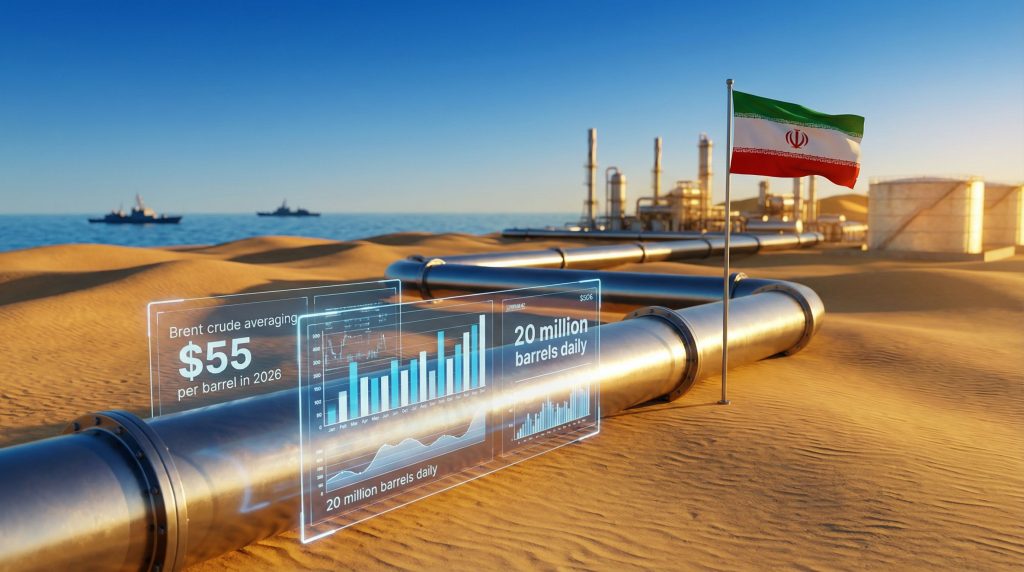
Energy market forecasting requires sophisticated scenario modelling that incorporates multiple probability-weighted outcomes across different disruption severities and durations. Current analysis suggests baseline Brent crude averaging $55 per barrel in 2026 under normal operational conditions, though geopolitical developments could drive significant deviations from this central estimate.
Moderate Disruption Scenario assumes partial Iranian production curtailment:
- 50% export reduction beginning Q2 2026
- Brent crude averaging $71 per barrel through mid-year
- Strategic petroleum reserve releases from consuming nations
- Accelerated Saudi spare capacity utilisation
Severe Disruption Scenario models complete Iranian supply removal:
- Full 3.3 MBPD production halt by Q3 2026
- Brent crude potentially reaching $91 per barrel in Q4
- Emergency IEA coordination mechanisms activated
- Demand destruction at price levels exceeding $85 per barrel
Market structure considerations significantly impact price discovery mechanisms during stress scenarios. Futures curve positioning currently shows modest backwardation, indicating near-term supply concerns remain limited. However, options market skew patterns reveal asymmetric risk positioning with elevated call premiums relative to historical norms.
Additionally, policy considerations such as the Alaska drilling policy shift could influence long-term supply availability and pricing dynamics across different scenario outcomes.
Disclaimer: These projections involve significant uncertainty and should not be used as the sole basis for investment decisions. Geopolitical developments, economic conditions, and market structure changes can substantially alter actual outcomes from modelled scenarios.
Inventory management plays crucial roles in scenario outcomes. Current OECD commercial petroleum stocks remain within normal ranges, providing some buffer against immediate supply disruption. However, strategic reserve utilisation requires political coordination that may lag market timing requirements during rapid-onset crisis scenarios.
The next major ASX story will hit our subscribers first
Investment Strategies and Market Positioning
Professional portfolio managers employ diverse approaches for navigating energy market volatility during geopolitical uncertainty periods. Direct energy exposure strategies include futures positioning, energy sector equity allocation, and commodity-linked investment vehicles that provide varying risk-return profiles. Moreover, comprehensive oil price rally analysis helps inform positioning decisions across different market scenarios.
Options-based strategies offer asymmetric risk management capabilities:
- Call spreads: Limited downside with capped upside potential
- Collar structures: Downside protection whilst maintaining participation in moderate price appreciation
- Straddle positioning: Volatility capture regardless of directional outcome
- Cross-commodity pairs: Natural gas, refined products, and alternative energy correlations
Sector rotation opportunities emerge during energy market stress periods. Traditional energy companies with strong balance sheets and hedging programmes may outperform during sustained elevated pricing environments. Alternative energy infrastructure investments could benefit from accelerated adoption timelines if conventional supply reliability concerns increase.
Currency considerations significantly impact international energy investment returns. U.S. dollar strength typically correlates inversely with commodity pricing, creating natural hedging mechanisms for dollar-based investors whilst presenting challenges for emerging market participants.
Long-term strategic positioning requires careful balance between immediate volatility capture and structural energy transition trends. Master Limited Partnerships (MLPs) and energy infrastructure assets may provide steady cash flow generation regardless of short-term price fluctuations.
Risk Management and Portfolio Protection
Institutional risk management frameworks incorporate multiple layers of protection against energy market volatility and geopolitical event risk. Correlation analysis reveals that traditional diversification benefits may deteriorate during stress periods when energy price shocks propagate across broader asset classes.
Hedging mechanisms available to different participant categories:
- Commercial hedgers: Forward sales contracts, futures positioning, and operational flexibility
- Financial institutions: Credit derivatives, energy-linked securities, and cross-asset hedging
- Sovereign wealth funds: Strategic petroleum reserves, energy sector investments, and currency hedging
- Retail investors: Energy ETFs, commodity mutual funds, and diversified allocation strategies
Stress testing methodologies should incorporate scenarios beyond historical precedent given evolving geopolitical dynamics and technological capabilities. Monte Carlo simulations using multiple probability distributions can provide insights into tail-risk exposure across different portfolio structures.
Liquidity considerations become paramount during volatile periods when bid-ask spreads widen and market depth decreases. Position sizing based on expected volatility rather than normal market conditions helps prevent forced selling during unfavourable market timing.
The interaction between monetary policy and energy prices creates additional complexity for risk management frameworks. Central bank responses to energy-driven inflation pressures can amplify or dampen commodity price movements through interest rate adjustments and quantitative easing programmes.
Current market conditions suggest maintaining flexibility across multiple scenarios whilst avoiding excessive concentration in single-outcome bets. The combination of geopolitical uncertainty, evolving energy transition dynamics, and traditional supply-demand fundamentals creates a complex environment requiring sophisticated analytical approaches and disciplined risk management practices.
Professional market participants continue monitoring diplomatic developments, military positioning updates, and fundamental supply-demand indicators for signals about future price direction. The balance between geopolitical risk premiums and underlying market fundamentals will likely determine whether current price levels represent temporary adjustments or the beginning of sustained higher volatility periods. Furthermore, when oil prices rebound after Trump Iran threat, it reflects the complex interplay between political signalling and market psychology that continues to shape energy pricing dynamics.
Looking to Capitalise on Energy Market Volatility?
Discovery Alert's proprietary Discovery IQ model delivers real-time alerts on significant ASX mineral discoveries, instantly empowering subscribers to identify actionable opportunities ahead of the broader market. Begin your 30-day free trial today and secure your market-leading advantage in the commodities sector.